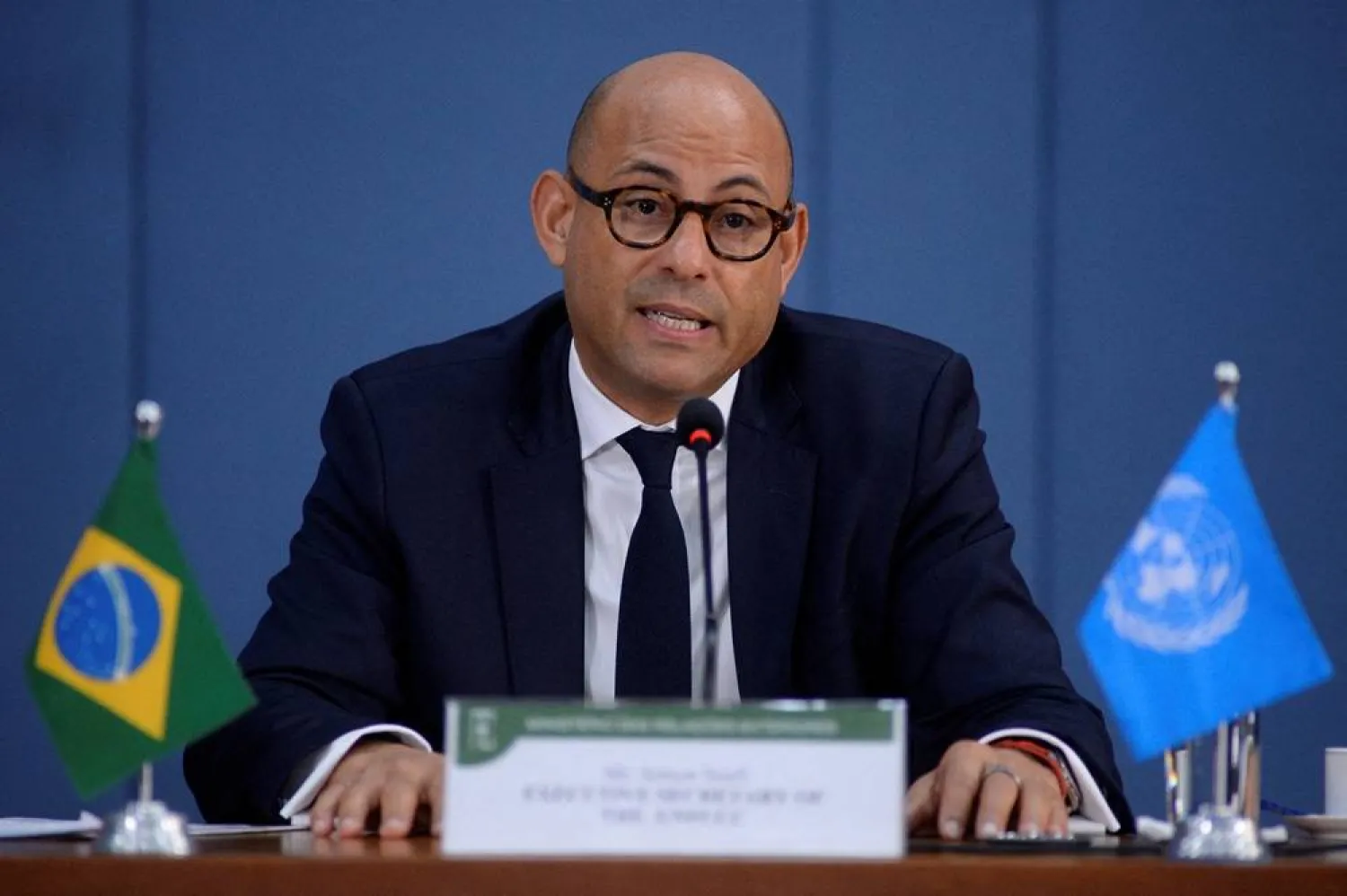
Countries Agree 10% Increase for UN Climate Budget

Simon Stiell, Secretary of UN Climate Change (UNFCCC), speaks during an event with the newly announced COP30 President Ambassador Andre Correa do Lago, in Brasilia, Brazil February 6, 2025. (Reuters)
TT

Countries Agree 10% Increase for UN Climate Budget

Simon Stiell, Secretary of UN Climate Change (UNFCCC), speaks during an event with the newly announced COP30 President Ambassador Andre Correa do Lago, in Brasilia, Brazil February 6, 2025. (Reuters)

Countries agreed on Thursday to increase the UN climate body's budget by 10% for the next two years, a move the body welcomed as a commitment by governments to work together to address on climate change, with China's contribution rising.

The deal, agreed by nearly 200 countries - from Japan to Saudi Arabia, to small island nations like Fiji - at UN climate negotiations in Bonn, comes despite major funding cuts at other UN agencies, triggered in part by the US slashing its contributions, and political pushback on ambitious climate policies in European countries.

Countries agreed to a core budget of 81.5 million euros for the United Nations Framework Convention on Climate Change (UNFCCC) over 2026-2027, up 10% from 2024-2025. The core budget is funded by government contributions.

The deal includes an increase in China's contribution, reflecting the country's economic growth. China, the world's second-biggest economy, would cover 20% of the new budget, up from 15% previously.

Only the United States, the world's biggest economy, was allocated a bigger share, of 22%. However, President Donald Trump quit the UN Paris climate agreement and halted international climate funding. Bloomberg Philanthropies has pledged to cover the US contribution to the UNFCCC budget.

The US did not attend the UN climate talks this week in Bonn, Germany where the budget was approved.

UN climate chief Simon Stiell welcomed the increase as "a clear signal that governments continue to see UN-convened climate cooperation as essential, even in difficult times."

The UNFCCC runs annual climate negotiations among countries and helps implement deals that are made, including the 2015 Paris Agreement, which commits nearly all nations to limit global warming.

The body has faced a severe budget shortfall in recent years, as major donors including China and the US had not paid on time, prompting the body to cut costs including by cancelling some events.

The UNFCC's running costs and headcount - its core budget funded 181 staff in 2025 - are smaller than some other UN bodies facing sharp funding cuts, such as the UN trade and development agency's roughly 400 staff.

Meanwhile, the UN Secretariat, the global body's executive arm, is preparing to slash its $3.7 billion budget by 20%, according to an internal memo.


Russia Plans a Nuclear Power Plant on the Moon within a Decade

November's full moon, also known as Beaver Moon, rises over Fort-de-France in the French overseas island of Martinique, on November 5, 2025. (AFP)
TT

Russia Plans a Nuclear Power Plant on the Moon within a Decade

November's full moon, also known as Beaver Moon, rises over Fort-de-France in the French overseas island of Martinique, on November 5, 2025. (AFP)

Russia plans to put ​a nuclear power plant on the moon in the next decade to supply its lunar space program and a joint Russian-Chinese research station as major powers rush to explore the earth's only natural satellite.

Ever since Soviet cosmonaut Yuri Gagarin became the first human to go into space in 1961, Russia has prided itself as ‌a leading power in ‌space exploration, but in recent ‌decades ⁠it ​has fallen ‌behind the United States and increasingly China.

Russia's ambitions suffered a massive blow in August 2023 when its unmanned Luna-25 mission smashed into the surface of the moon while attempting to land, and Elon Musk has revolutionized the launch of space vehicles - once a Russian specialty.

Russia's state space corporation, Roscosmos, ⁠said in a statement that it planned to build a lunar power ‌plant by 2036 and signed a contract ‍with the Lavochkin Association ‍aerospace company to do it.

Roscosmos said the purpose of ‍the plant was to power Russia's lunar program, including rovers, an observatory and the infrastructure of the joint Russian-Chinese International Lunar Research Station.

"The project is an important step towards the creation of ​a permanently functioning scientific lunar station and the transition from one-time missions to a long-term lunar exploration program," ⁠Roscosmos said.

Roscosmos did not say explicitly that the plant would be nuclear but it said the participants included Russian state nuclear corporation Rosatom and the Kurchatov Institute, Russia's leading nuclear research institute.

The head of Roscosmos, Dmitry Bakanov, said in June that one of the corporation's aims was to put a nuclear power plant on the moon and to explore Venus, known as earth's "sister" planet.

The moon, which is 384,400 km (238,855 miles) from our planet, moderates the earth's wobble ‌on its axis, which ensures a more stable climate. It also causes tides in the world's oceans.


Seasonal Rains Transform Saudi Arabia’s Rawdat Muhanna into Natural Lake

People visit Rawdat Muhanna after recent rainfall. (SPA)
TT

Seasonal Rains Transform Saudi Arabia’s Rawdat Muhanna into Natural Lake

People visit Rawdat Muhanna after recent rainfall. (SPA)

Rawdat Muhanna, or Muhanna's Garden, located near the town of Al-Nabqiyah in the eastern part of Saudi Arabia’s Qassim region, has witnessed a notable influx of visitors and picnickers in recent days following rainfall that filled the Rawdat with water, transforming it into a vast natural lake.

The rare and striking scene has drawn residents and visitors from within and outside the region, reported the Saudi Press Agency on Tuesday.

Stretching over more than 10 kilometers, Rawdat Muhanna has become a breathtaking natural landscape amid the sands of Al-Thuwairat. The contrast between the blue waters and the red desert sand has created a picturesque panorama, making the site a favored destination for nature enthusiasts and photographers.

Rawdat Muhanna is one of the region’s prominent seasonal parks, as several valleys flow into it, most notably Wadi Al-Mustawi. These valleys contribute to the accumulation of large volumes of water, which in some seasons can remain for nearly a year, boosting the site’s ecological value and making it one of the most beautiful natural areas in the Qassim desert.

Visitors said Rawdat Muhanna has become an ideal destination for outdoor recreation and relaxation.


Saudi Arabia’s AlUla’s Sharaan, Wadi Nakhlah Reserves Officially Designated Dark Sky Places

AlUla’s exceptionally clear night skies allow many stars to be observed with the naked eye, as well as through advanced astronomical tools. (SPA)
TT

Saudi Arabia’s AlUla’s Sharaan, Wadi Nakhlah Reserves Officially Designated Dark Sky Places

AlUla’s exceptionally clear night skies allow many stars to be observed with the naked eye, as well as through advanced astronomical tools. (SPA)

Saudi Arabia’s Royal Commission for AlUla (RCU) announced that the Sharaan and Wadi Nakhlah reserves received official accreditation from the DarkSky International, registering them as internationally recognized Dark Sky Places and joining more than 250 locations worldwide that are protected from light pollution, reported the Saudi Press Agency on Wednesday.

The accreditation builds on AlUla's 2024 achievement, when AlUla Manara and AlGharameel Nature Reserve became the first sites in the Kingdom and the Gulf region to receive Dark Sky Park designations. The latest recognition further strengthens AlUla’s position as a leading global destination for night sky protection and astronomical tourism.

The Sharaan and Wadi Nakhlah reserves span a combined area of 6,146 square kilometers, reflecting the expanded scope of environmental protection efforts aimed at preserving AlUla's pristine night skies and reducing light pollution across a vast geographical area.

Preserving dark skies aligns with the Royal Commission for AlUla's objectives to safeguard and celebrate the region's rich cultural and natural heritage, provide a sustainable environment that supports wildlife conservation, and boosting stargazing experiences.

AlUla’s exceptionally clear night skies allow many stars to be observed with the naked eye, as well as through advanced astronomical tools.

The DarkSky International works to reduce light pollution in both urban and rural areas and to raise global awareness of the importance of protecting the night sky.

AlUla’s accreditation reflects the RCU’s commitment to developing astronomical tourism, supporting space science, and encouraging scientific discovery and research.

The RCU previously announced the launch of the AlUla Manara Observatory, a specialized destination for scientific research, innovation, and sustainable economic opportunities.

The observatory is expected to become a prominent scientific landmark in the Kingdom, attracting visitors from around the world and offering an exceptional stargazing experience. It will feature interactive displays highlighting ancient and modern scientific discoveries, within an environment that integrates science, nature, and sustainability.

The RCU underlined its commitment to protecting the natural environment, preserving the night sky, and promoting sustainable tourism, further positioning AlUla as a leading global destination for astronomy, scientific research, and advanced environmental experiences, in line with AlUla Vision and the Kingdom’s Vision 2030.