Scientists in South Africa Are Making Rhino Horns Radioactive to Fight Poaching https://english.aawsat.com/varieties/5170677-scientists-south-africa-are-making-rhino-horns-radioactive-fight-poaching%C2%A0
Scientists in South Africa Are Making Rhino Horns Radioactive to Fight Poaching
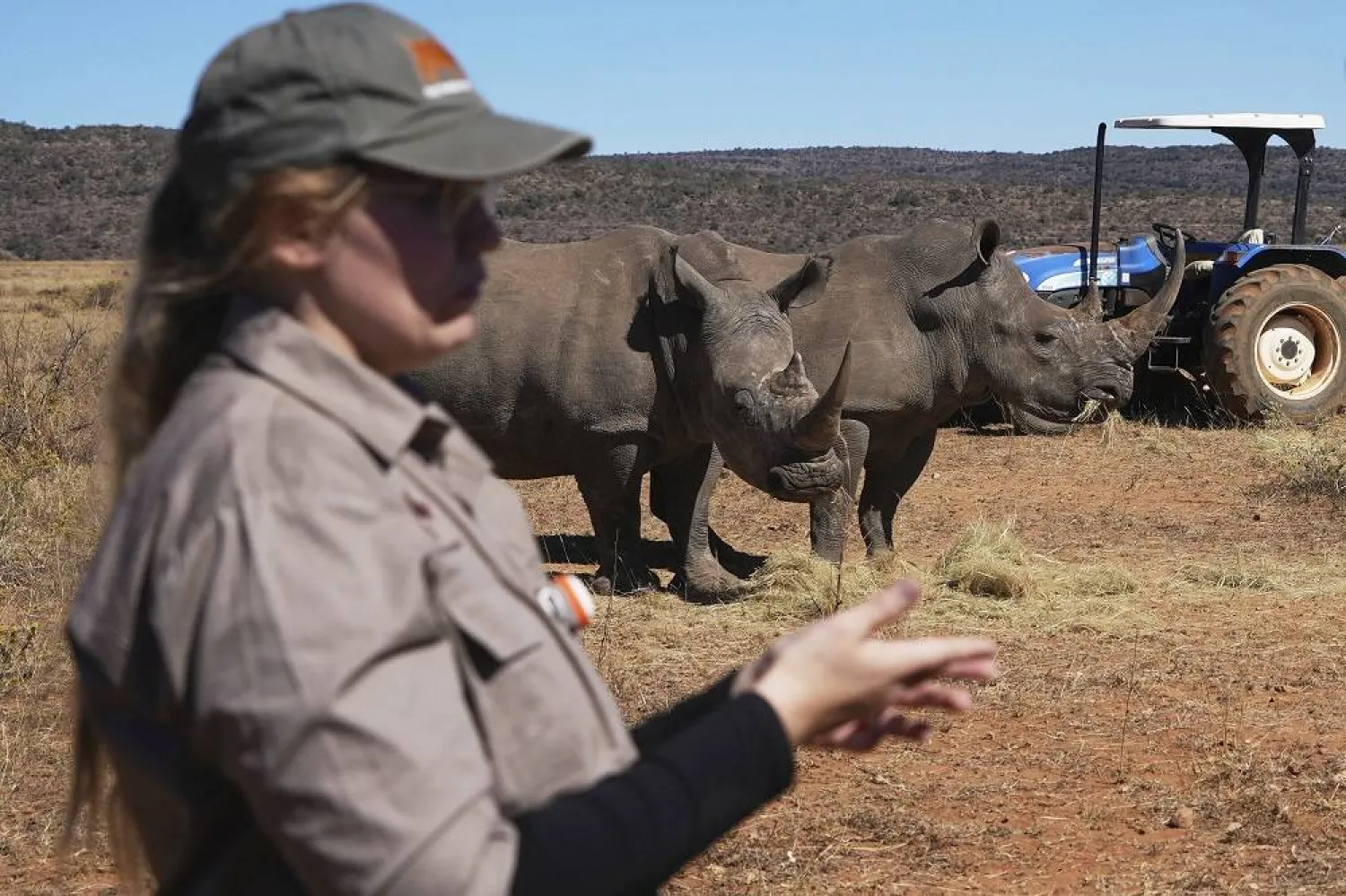
Rhinos are photographed at a rhino orphanage in Mokopane, South Africa, Thursday, July 31, 2025. (AP Photo/Alfonso Nqunjana)
TT
TT
Scientists in South Africa Are Making Rhino Horns Radioactive to Fight Poaching
Rhinos are photographed at a rhino orphanage in Mokopane, South Africa, Thursday, July 31, 2025. (AP Photo/Alfonso Nqunjana)
A South African university launched an anti-poaching campaign Thursday to inject the horns of rhinos with radioactive isotopes that it says are harmless for the animals but can be detected by customs agents.
Under the collaborative project involving the University of the Witwatersrand, nuclear energy officials and conservationists, five rhinos were injected in what the university hopes will be the start of a mass injection of the declining rhino population.
They're calling it the Rhisotope Project.
Last year, about 20 rhinos at a sanctuary were injected with isotopes in trials that paved the way for Thursday's launch. The radioactive isotopes even at low levels can be recognized by radiation detectors at airports and borders, leading to the arrest of poachers and traffickers.
Researchers at Witwatersrand's Radiation and Health Physics Unit say that tests conducted in the pilot study confirmed that the radioactive material was not harmful to the rhinos.
“We have demonstrated, beyond scientific doubt, that the process is completely safe for the animal and effective in making the horn detectable through international customs nuclear security systems,” said James Larkin, chief scientific officer at the Rhisotope Project.
“Even a single horn with significantly lower levels of radioactivity than what will be used in practice successfully triggered alarms in radiation detectors,” said Larkin.
The tests also found that horns could be detected inside full 40-foot shipping containers, he said.
The International Union for Conservation of Nature estimates that the global rhino population stood at around 500,000 at the beginning of the 20th century but has now declined to around 27,000 due to continued demand for rhino horns on the black market.
South Africa has the largest population of rhinos with an estimated 16,000 but the country experiences high levels of poaching with about 500 rhinos killed for their horns every year.
The university has urged private wildlife park owners and national conservation authorities to have their rhinos injected.
Genetic Study Identifies Earliest-known Dog, Dating to 15,800 Years Agohttps://english.aawsat.com/varieties/5255367-genetic-study-identifies-earliest-known-dog-dating-15800-years-ago
FILE PHOTO: A woman gives her dog a kiss as they watch the sunset at Anchor Bay outside Mellieha, Malta, January 26, 2018. REUTERS/Darrin Zammit Lupi/File Photo
Genetic Study Identifies Earliest-known Dog, Dating to 15,800 Years Ago
FILE PHOTO: A woman gives her dog a kiss as they watch the sunset at Anchor Bay outside Mellieha, Malta, January 26, 2018. REUTERS/Darrin Zammit Lupi/File Photo
Dogs have been loyal companions to people since we made them our first domesticated animals, descending long ago from gray wolves - though precisely when, where and why have remained unanswered. New genetic research now is offering valuable insight, including identifying the earliest-known dog, dating to 15,800 years ago, Reuters reported.
This dog, known from bones found at the Pinarbasi rock shelter site in Türkiye used by ancient human hunter-gatherers, is about 5,000 years older than the previous earliest-known, genetically confirmed canine, the researchers said.
The date of the Pinarbasi dog and several others almost as old identified at other sites in Europe shows that dogs already were widely distributed and an integral part of human culture millennia before the advent of agriculture, they said.
The new findings were presented in two scientific papers published on Wednesday in the journal Nature.
William Marsh, a postdoctoral researcher in the Ancient Genomics Laboratory at the Francis Crick Institute in London who was co-lead author of one of the studies, said the DNA evidence suggests dogs were present in various locales in western Eurasia by 18,000 years ago and already were quite different genetically from wolves.
"We putatively predict that dog and wolf populations diverged a lot earlier, likely before the last glacial maximum (of the Ice Age), so before 24,000 years ago. Although saying that, there is still a great degree of uncertainty," Marsh said.
The dog, descended from an ancient wolf population separate from modern wolves, was the first animal domesticated by people, with animals such as goats, sheep, cattle and cats coming later.
"Dogs have been by our side as humans underwent major lifestyle transitions and complex societies emerged," said geneticist Anders Bergström of the University of East Anglia in England, lead author of the other study.
"I think it's also interesting that, unlike most other domesticated animals, dogs do not always have very clearly defined roles or purposes for humans. Perhaps their primary role is often just to provide companionship," Bergström said.
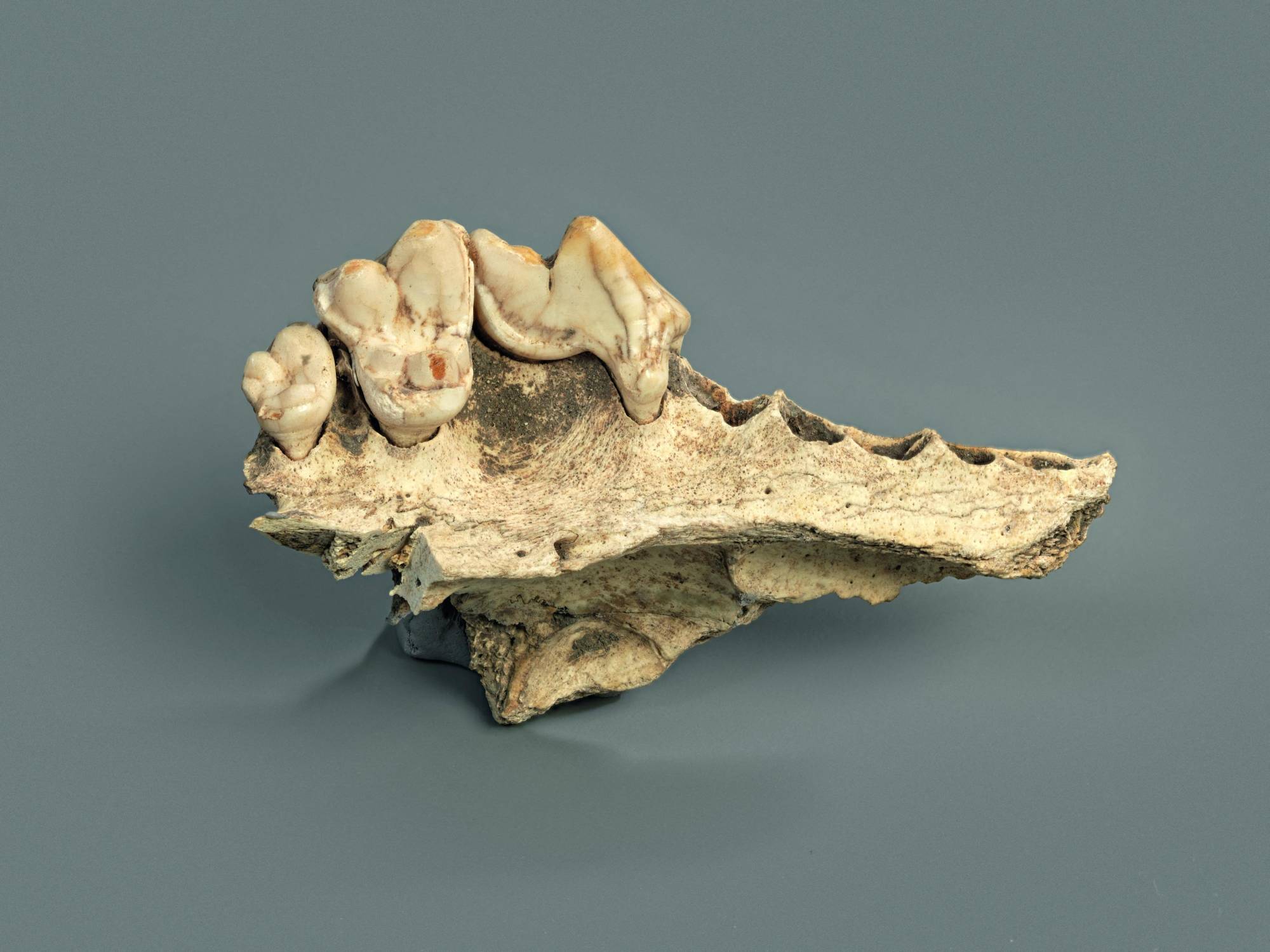
The upper jaw of a domesticated dog from the Kesslerloch cave in Thayngen, Switzerland, dating to about 14,000 years ago, is seen in this photograph from July 2019. Cantonal Archaeological Service of Schaffhausen/Ivan Ivic/Handout via REUTERS
Bergström and his team performed a large-scale search for the early dogs of Europe, using a new method to differentiate genetically between wolves and dogs among 216 ancient remains ranging from 46,000 to 2,000 years old from Belgium, Denmark, France, Germany, the Netherlands, Scotland, Sweden, Switzerland and Türkiye. This was the largest study of such remains to date.
The researchers managed to identify 46 dogs and 95 wolves. Because the skeletons of dogs and wolves were so similar in the early stages of canine domestication, genetic studies are needed to distinguish between them in ancient remains.
The oldest of the dogs identified by Bergström's team was one dating to 14,200 years ago from Switzerland's Kesslerloch Cave site. The oldest of the European dogs identified in this study were found to have shared an origin with dogs in Asia and the rest of the world, showing that these various canine populations did not arise from separate domestication events.
The Pinarbasi dog, identified in the study Marsh worked on, showed how much dogs were valued by the hunter-gatherers who kept them.
"At Pinarbasi, we have both human and dog burials, with dogs buried alongside humans," Marsh said.
There also was evidence that the people at Pinarbasi fed their dogs fish.
This study identified five dogs dating to between 15,800 and 14,300 years ago, including canine remains from Gough's Cave near Cheddar in England.
"At Gough's Cave, we have butchering and processing of humans after death that included cannibalism, as a funerary behavior akin to burial. Similar post-mortem modification, albeit not definitively for consumption, was found on the dog remains," Marsh said.
The Pinarbasi and Gough's Cave dogs were found to be more closely related to the ancestors of present-day European and Middle Eastern breeds such as boxers and salukis than to Arctic breeds like Siberian huskies.
Beyond companionship, the ancient dogs may have helped people hunt or perhaps served as watchdogs, sort of Ice Age alarm systems, according to the researchers. Unlike the many exotic dog breeds around today, these early dogs still likely closely resembled the wolves from which they descended, they said.
"The questions of when, where and why people domesticated dogs still remain largely unanswered," Bergström said. "We think it probably happened somewhere in Asia, but more precisely remains to be determined."
‘Hero’ Australian Dog Who Saved 100 Koalas Retireshttps://english.aawsat.com/varieties/5255043-%E2%80%98hero%E2%80%99-australian-dog-who-saved-100-koalas-retires
This handout picture taken on February 8, 2020 and released by the International Fund for Animal Welfare on March 25, 2026 shows Bear, an Australian Koolie, scanning the Two Thumbs Wildlife Trust Sanctuary for koalas in the Numeralla, Peak View and Nerriga areas of New South Wales. (Handout / International Fund for Animal Welfare (IFAW) / AFP)
TT
TT
‘Hero’ Australian Dog Who Saved 100 Koalas Retires
This handout picture taken on February 8, 2020 and released by the International Fund for Animal Welfare on March 25, 2026 shows Bear, an Australian Koolie, scanning the Two Thumbs Wildlife Trust Sanctuary for koalas in the Numeralla, Peak View and Nerriga areas of New South Wales. (Handout / International Fund for Animal Welfare (IFAW) / AFP)
An Australian dog credited with saving over 100 koalas from bushfires is retiring after a decade of service.
Bear, an 11-year-old Australian Koolie, was one of the first dogs in the country to be trained on the scent of koala fur.
The International Fund for Animal Welfare called using dogs to detect koalas a "novel" approach.
"No one knew if it could be done," IFAW head of programs Josey Sharrad wrote in a statement about Bear on Monday.
As a pup, the four-legged hero's boundless energy made it tough to stay indoors, but he found his true potential in the bush.
"He literally went from chewing the walls of a Gold Coast apartment to roaming through the Aussie bush on a mission to save our most iconic species," Sharrad said.
Bear's skills saved over 100 koalas as the Black Summer bushfires raged across Australia's eastern seaboard from late 2019 to early 2020, razing millions of hectares, destroying thousands of homes and blanketing cities in noxious smoke.
The tail-wagging detective with a "joyful and goofy" personality retires with an extensive list of accolades, including an Animal of the Year award and Puppy Tales Photos Australian Dog of the Year award.
He also features in a "dogumentary" called "Bear: Koala Hero", and in a book, "Bear to the Rescue".
Bear will embark on a slower-paced chapter on the Sunshine Coast with one of his former handlers, getting belly rubs and playing his favorite game, fetch.
One of his former handlers, Romane Cristescu, said Bear had been a "tireless ambassador for koalas for a decade".
"He melted hearts all around the world, and opened many doors so we could have critical and difficult conversations about climate change and its impacts on the threatened koalas, as well as so many other species."
Exotic Pet Trade Thrives in China Despite Welfare Concernshttps://english.aawsat.com/varieties/5255025-exotic-pet-trade-thrives-china-despite-welfare-concerns
Exotic Pet Trade Thrives in China Despite Welfare Concerns
A visitor holds a sugar glider at a pet fair in Beijing on March 19, 2026. (Photo by WANG Zhao / AFP)
Pet lovers eagerly gathered around a container to snap photos of meerkats at a Beijing animal fair, each selling for $320, while nearby a raccoon nervously paced in a cage only slightly bigger than itself.
Throngs of people from across China packed into the cavernous exhibition halls for the annual pet fair, where exotic animals are a more common sight than cats or dogs.
The exotic pet industry is experiencing rapid growth with a market nearing 10 billion yuan ($1.45 billion), Chinese state media have said.
Approximately 17.07 million people in China have exotic pets, Xinhua reported last year, and animal rights groups have raised concerns about welfare standards.
Unconventional pets are particularly popular among young people, with videos on how to raise them widely shared on social media platforms.
An 18-year-old putting down a deposit for a meerkat told AFP he was confident it would be easier to raise the animal than his previous cats and dogs.
"I feel that raising exotic pets is really just child's play by comparison," said Xiong, who had travelled to Beijing from Jiangxi province.
He had previously bought a sugar glider -- a nocturnal palm-sized possum sold at the same store -- and said he found raising exotic pets easier as they did not feel separation anxiety as dogs do.
It was "quite a hassle-free" experience, Xiong said.
"When you want to interact, it's happy to engage with you, but when you're not in the mood, it's perfectly content playing by itself," he told AFP.
In another part of the fair, patterned snakes and spotted geckos squirmed in round plastic containers as people shopped for their latest reptile.
Yang Xurui brought his green Argentine snake to the fair, where he told AFP he was searching for new exotic pets.
"I consider her a friend of mine," said Yang, 24, caressing the slithering creature hanging around his neck.
"Every day, the moment I walk through the door, she stands tall and straight like a giant green onion to welcome me home," he added.
"She keeps me company while I watch TV, and then, come evening, she goes off to bed on her own -- marking the end of our day together."
Yang said he feels a certain sense of responsibility to dispel commonplace fear of snakes as pets.
"I want to tell everyone that she isn't terrible, that she isn't something to be feared."
China's Ministry of State Security has warned against the exotic pet craze it says is driven by trend-seekers.
"The trade, rearing, medical treatment, and abandonment of these exotic animals harbor latent safety risks," it said last year, adding that this warrants "serious attention".
Animal welfare regulations, however, remain lax in China, where pets such as fish, birds and pigs are commonly sold even in shopping malls.
The pandemic, meanwhile, sparked fears that animals may be carriers of diseases including Covid-19, which was widely believed to have originated in bats.
Authorities in China should target the traders, breeders, and retailers who depend on the business -- and its expansion -- for profit, said Peter Li, a specialist in China's animal protection policy at the University of Houston-Downtown.
Businesses engaged in the sale and transport of exotic animals have reportedly used fraudulent labeling, withheld critical information, and engaged in deliberate deception to move these animals through supply chains, Li told AFP.
Abandoned exotic species can reproduce rapidly in the wild, creating significant ecological pressures on local environments, while diseases carried by them could pose public health risks, he said.
Public awareness in China regarding wildlife protection has improved significantly, but some consumers of exotic pets still lack sufficient knowledge before purchasing such animals, conservation charity WWF told AFP.
"Some consumers may not be fully aware of which species are legal to own, whether specific permits are required, the varying levels of care difficulty for different species, long-term financial costs," it added.
At the fair, 26-year-old Zhang Yue agreed that bringing certain animals "into human-inhabited environments could lead to various repercussions".
Nevertheless, Zhang told AFP she would still consider owning a sugar glider as they are "absolutely adorable".
لم تشترك بعد
انشئ حساباً خاصاً بك لتحصل على أخبار مخصصة لك ولتتمتع بخاصية حفظ المقالات وتتلقى نشراتنا البريدية المتنوعة