


Livestream of Deep Sea Creatures Transfixes Argentina and Sparks Calls for Refunding Science 

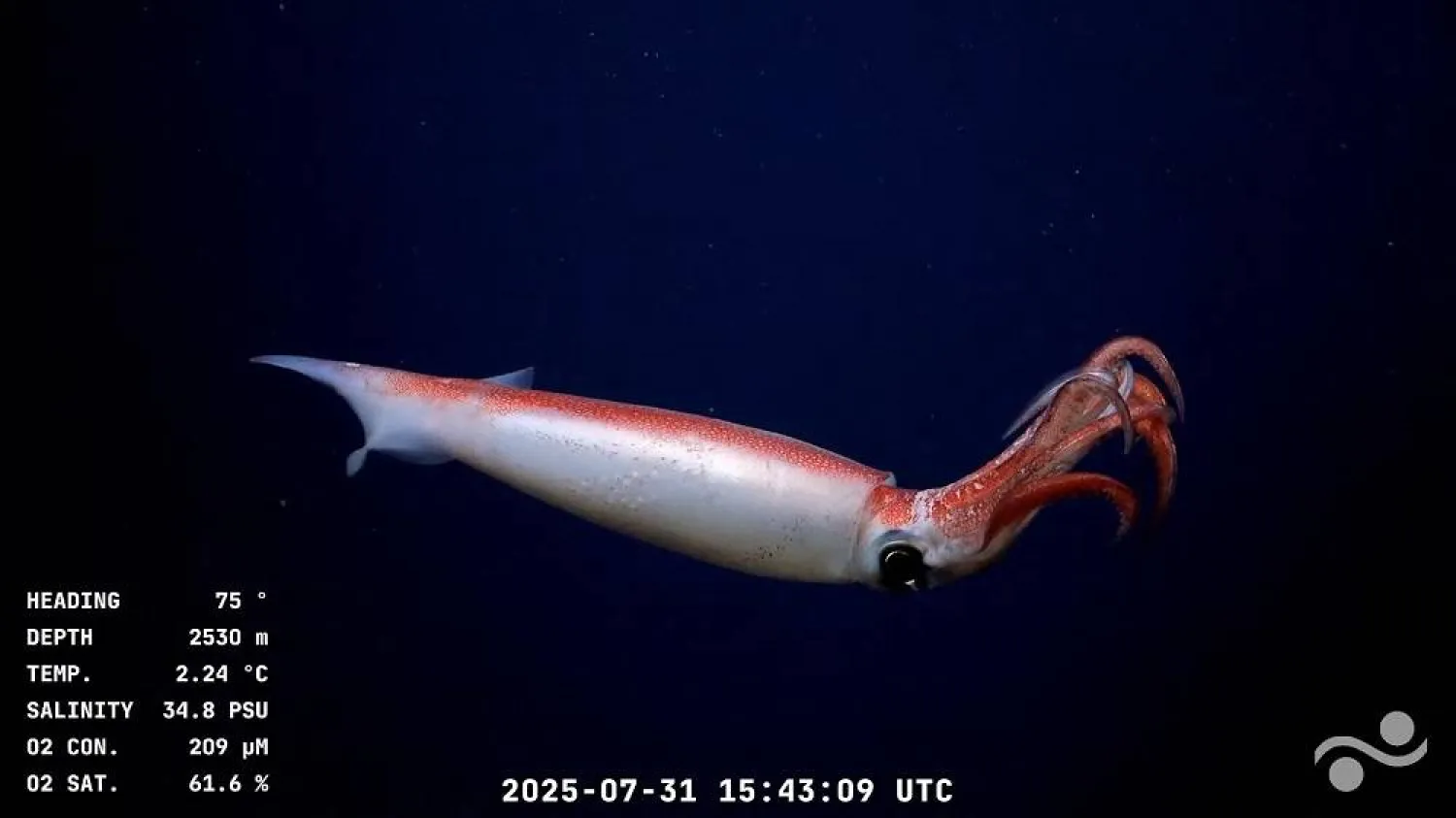
Screen grab taken from a handout video released by the Schmidt Ocean Institute and recorded by the ROV SuBastian while being commanded from the oceanographic research vessel RV Falkor (too) on July 30, 2025, displaying a squid at 2530 meters of depth at the Mar del Plata Canyon in the Argentine Sea, in the Atlantic Ocean about 300 Km off Mar del Plata, Buenos Aires Province, Argentina. (Handout / Schmidt Ocean Institute / ROV SuBastian / AFP)
TT

Livestream of Deep Sea Creatures Transfixes Argentina and Sparks Calls for Refunding Science 

Screen grab taken from a handout video released by the Schmidt Ocean Institute and recorded by the ROV SuBastian while being commanded from the oceanographic research vessel RV Falkor (too) on July 30, 2025, displaying a squid at 2530 meters of depth at the Mar del Plata Canyon in the Argentine Sea, in the Atlantic Ocean about 300 Km off Mar del Plata, Buenos Aires Province, Argentina. (Handout / Schmidt Ocean Institute / ROV SuBastian / AFP)

Transparent-faced fish drift through dusky waters. Snowlike flecks of dead plants sift down from the world above. Soft sponges peek through the soot of the seafloor. Only occasional mutters among marine biologists break the thick silence.

And somehow, this livestream of sea life in the South Atlantic feels like it has everyone in Argentina watching — or talking and making memes about it.

The group of Argentine and American researchers behind this remotely operated vehicle filming life-forms 4,000 meters (13,000 feet) undersea told The Associated Press on Monday that they couldn't have imagined that their expedition would become such a sensation. It has attracted more than 1.6 million views a day on YouTube, dominating TV news broadcasts and even sparking a national conversation about the defunding of Argentine science under libertarian President Javier Milei.

“It was a huge surprise for us,” said expedition leader Daniel Lauretta. “It's something that fills our hearts because we want to spread the word. Perhaps there are young people who are learning, maybe we're awakening some scientific curiosity.”

The vast array of creatures glimpsed via high-definition camera include a placid starfish so orange it evokes Patrick of “SpongeBob SquarePants” cartoon fame, a sea cucumber reminiscent of a sweet potato, a deep sea crab that looks like a hairy spider.

The images have created a sense of collective wonder at the mysteries of the deep sea and with it, a hearty dose of anthropomorphism as viewers assign zodiac stars to invertebrate and take social media quizzes along the lines of “Which deep sea creature are you based on how you handle stress?” (If you ignore the world you’re a translucent squid, if you explode with anger, you’re apparently a pistol shrimp).

Often peaking at 50,000 simultaneous viewers, the livestream began last week and runs everyday until Aug. 10 for up to 10 hours as the scientists map the little-researched submarine gorge off the coast of Buenos Aires, collecting samples and identifying scores of new species.

“The clarity was incredible. The colors, the zoom capability — that really amazed me,” Lauretta said. “I think that feeling reached the public too.”

The project is a collaboration between scientists mostly from Conicet, Argentina's leading scientific funding and research body, and the Schmidt Ocean Institute Foundation, a nonprofit set up by Google’s former executive chairman Eric E. Schmidt to advance oceanographic research. The expedition has also inspired pride in Argentine research at a time when Milei is slashing spending on science in a drive to eliminate Argentina's chronic fiscal deficit.

Researchers and fellows from Conicet have sought to seize on the attention by calling for a 48-hour nationwide strike Wednesday.

“Argentines are very passionate about everything that happens in Argentina,” said Georgina Valanci, 40, who seemed mesmerized by the livestream while crocheting on Monday. “I think it represents a bit of the pride that something like this is being done in our country.”

Milei dissolved the Ministry of Science and Technology after coming to power in late 2023. Conicet suffered a 21% budget cut in real terms last year. Salaries for Conicet researchers have lost 35% of their value in recent months. Industry estimates show state-funded science and technology organizations losing 3,400 jobs in the last year and a half.

Each day as the video shows sea stars regenerating arms or amoeba engulfing prey, comments pop up expressing support for Conicet in real time. “Long live Conicet!” several users posted on Monday.



Surfer Bitten in 4th Shark Attack off Australia’s East Coast in 3 Days

A lifeguard patrols North Steyne beach as beaches are closed after recent shark attacks, in Sydney, Australia, January 20, 2026. (Reuters)
TT

Surfer Bitten in 4th Shark Attack off Australia’s East Coast in 3 Days

A lifeguard patrols North Steyne beach as beaches are closed after recent shark attacks, in Sydney, Australia, January 20, 2026. (Reuters)

A surfer had minor injuries from being bitten by a shark Tuesday in the fourth attack off the coast of Australia's most populous state in three days.

The shark attacked the man's surfboard at Point Plomer, 460 kilometers (290 miles) north of the New South Wales state capital, around 9 a.m., officials said.

The man was lucky to survive with minor cuts, Kempsey-Crescent Head Surf Life Saving Club captain Matt Worrall said.

“The board seemed to take most of the impact,” Worrall told Australian Broadcasting Corp. “He made his own way into shore where he was assisted by locals.”

The bystanders drove the 39-year-old man to a hospital and he was later discharged.

In the earlier attacks, a man and a boy suffered critical leg wounds and the surfboard of another boy was bitten by sharks at Sydney locations Sunday and Monday.

Beaches along New South Wales' northern coast and northern Sydney were closed Tuesday and local authorities said Sydney's northern beaches would remain closed to swimmers and surfers for 48 hours. Electronic drumlines that alert authorities when a large shark has taken bait were deployed off the Sydney coast.

Authorities warned that recent rainfall has left the water off area beaches murky, which increased the risk of bull shark attacks. Bull sharks are responsible for most attacks around Sydney.

“If anyone's thinking of heading into the surf this morning anywhere along the northern beaches, think again. We have such poor water quality that’s really conducive to some bull shark activity,” Surf Life Saving NSW chief executive Steve Pearce said.

“If you're thinking about going for a swim, just go to a local pool because at this stage, we’re advising that beaches are unsafe,” Peace added.

On Sunday, a 12-year-old boy was attacked after jumping from a 6-meter (20-foot) ledge known as Jump Rock near Shark Beach inside Sydney Harbor. Police have credited the boy’s friends with saving his life by jumping from the cliff during the attack and dragging him back to shore.

“Those actions of those young men are brave under the circumstances and very confronting injuries for those boys to see,” Supt. Joseph McNulty said.

News media have reported that the boy lost both legs in the attack.

Around noon Monday, an 11-year-old boy was on a surfboard that was attacked by a shark at Dee Why Beach, an ocean beach north of Manly. The shark bit off a chunk of the board, but the boy escaped uninjured.

A surfer in his 20s was bitten on a leg by a shark off North Steyne Beach on the Pacific Ocean coast in the northern suburb of Manly at 6:20 p.m. Monday, police said. Bystanders pulled him from the water before an ambulance took him to a hospital in a critical condition.

All three Sydney beaches have some form of shark protection netting. It was not immediately clear where the attacks occurred in relation to that netting.

Pearce said the scene of the latest attack was isolated and did not have shark netting.

Dee Why Beach is close to the beach where a 57-year-old surfer was killed by a suspected white shark last September.

In November, a 25-year-old Swiss tourist was killed and her partner was seriously injured trying to save her as they swam off a national park north of Sydney.


Chile Fights Wildfires that Killed 19 and Left 1,500 Homeless

Mirtza Aguilera, right, and her daughter embrace in front of their home burned by wildfires in Tome, Chile, Monday, Jan. 19, 2026. (AP Photo/Javier Torres)
TT

Chile Fights Wildfires that Killed 19 and Left 1,500 Homeless

Mirtza Aguilera, right, and her daughter embrace in front of their home burned by wildfires in Tome, Chile, Monday, Jan. 19, 2026. (AP Photo/Javier Torres)

Firefighters in Chile are battling forest fires that started on Sunday and have killed at least 19 people and left around 1,500 homeless as they swept through thousands of acres in the center and south of the country, officials said.

Five large wildfires were still active Monday in the South American nation, with temperatures higher than usual due to a summer heatwave, said the National Service for the Prevention of Disasters, The AP news reported.

Chilean President Gabriel Boric declared a state of catastrophe in the central Biobio and neighboring Ñuble regions on Sunday. The emergency designation allows greater coordination with the military to rein wildfires.

Boric said on his X account on Monday morning that weather conditions are adverse, which means some of the fires could reignite.

Wildfires are common in Chile during the summer due to high temperatures and dry weather. The current outbreak of fires in central and southern Chile is one of the deadliest in recent years.

In 2024, massive fires ripping across Chile’s central coastline killed at least 130 people, becoming the nation’s deadliest natural disaster since a devastating 2010 earthquake.


Nepal Halts Search after Guide Killed, Iranian Climber Missing

A tourist looks at a view of Mt. Everest from the hills of Syangboche in Nepal December 3, 2009. REUTERS/Gopal Chitrakar
TT

Nepal Halts Search after Guide Killed, Iranian Climber Missing

A tourist looks at a view of Mt. Everest from the hills of Syangboche in Nepal December 3, 2009. REUTERS/Gopal Chitrakar

Bad weather forced Nepali rescuers to suspend the search Monday for an Iranian climber missing for four days after an accident which killed a Nepali team member, expedition organizers said.

Extreme conditions, including fierce winds, made rescue efforts impossible on the 8,481-meter (27,825-feet) high Mount Makalu, the world's fifth highest mountain.

Iranian climber Abolfazl Gozali, 42, and Nepali guide Phurba Ongel Sherpa, 44, were part of a rare winter expedition on the peak.

The four-member team successfully summited on Thursday, but during the descent the guide fell to his death.

Team lead Sanu Sherpa, who has climbed all 14 highest peaks in the world at least twice, and Lakpa Rinji Sherpa went to his aid but found that he had fallen hundreds of meters and did not survive.

When they returned to where they had left Gozali, he was no longer there.

"A team of eight experienced climbers have been sent but the wind has been very strong and affected the search," Madan Lamsal of expedition organizer Makalu Adventure told AFP.

"We hope to resume soon."

Lamsal said the rescuers intend to find Gozali, as well as recover the guide's body.

Phurba Ongel Sherpa was a highly experienced mountaineering guide with multiple summits of Everest and other major peaks.

Gozali is also an accomplished climber, who has climbed two of world's highest peaks and completed the "snow-leopard peaks" -- the five mountains of over 7,000 meters between Tajikistan and Kyrgyzstan.

This was his second attempt to summit Makalu in winter. Last year, freezing temperatures and high winds forced the team to turn back, just 800 meters short of the summit.

Nepal is home to eight of the world's 10 highest peaks, including Mount Everest, and welcomes hundreds of climbers every year during the spring and autumn climbing seasons.

Dangerous terrain and extreme weather can make winter expeditions particularly risky.
