

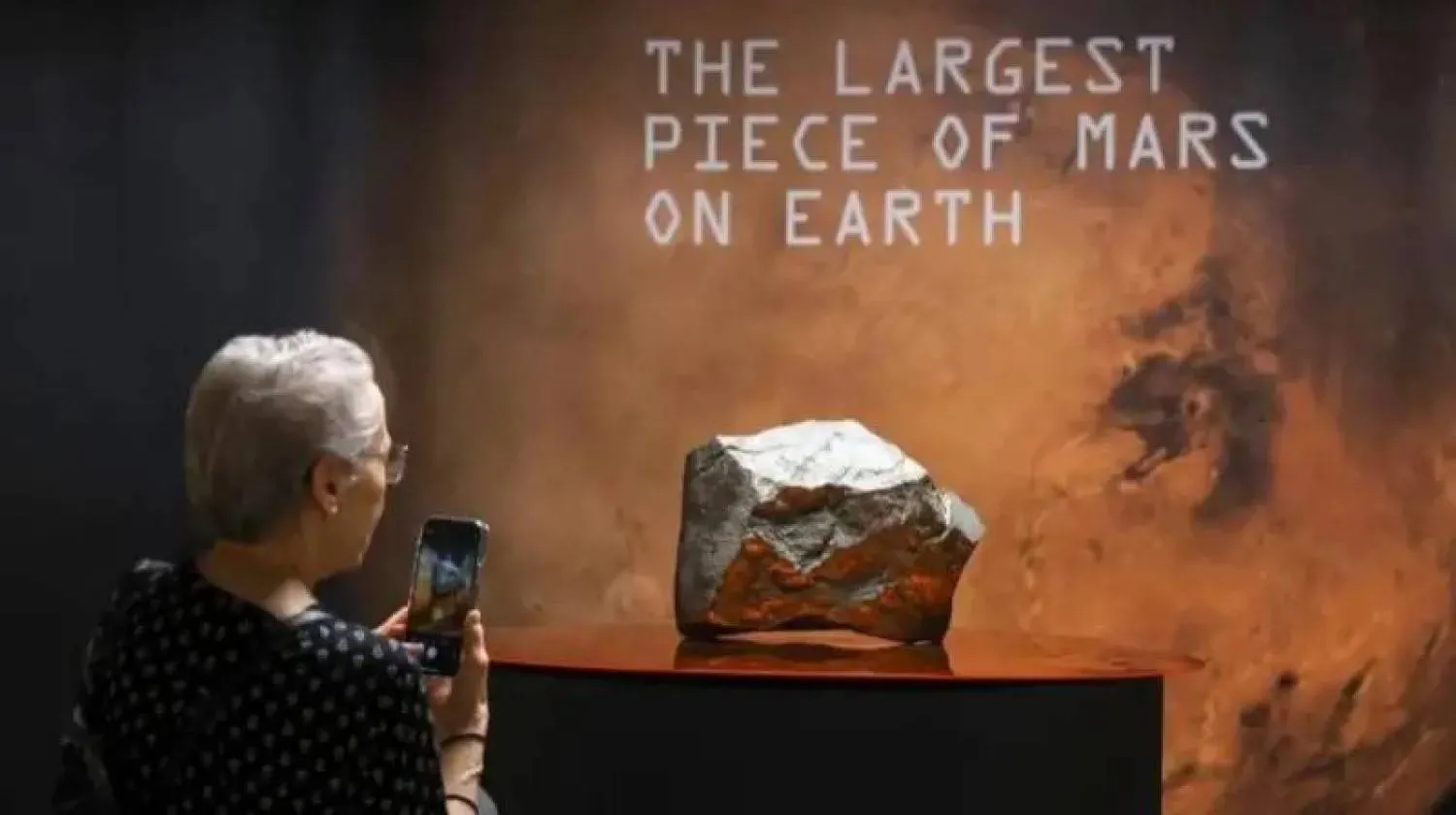

Rare Meteorite from Mars Sparks Controversy between Niger and Sotheby’s

The Martian meteorite found in Niger went on display in New York before it was auctioned (EPA) 
TT

Rare Meteorite from Mars Sparks Controversy between Niger and Sotheby’s

The Martian meteorite found in Niger went on display in New York before it was auctioned (EPA) 

“Brazen! It is brazen!” Professor Paul Sereno said down the phone line from Chicago.

He made no effort to disguise his anger that a rare meteorite from Mars discovered two years ago in the West African nation of Niger ended up being auctioned off in New York last month to an unnamed buyer, according to BBC.

The palaeontologist, who has close connections with the country, said it should be back in Niger.

This millions-of-years-old piece of the Red Planet, the largest ever found on Earth, fetched $4.3 million (3.2 million pounds) at Sotheby’s. Like the buyer, the seller was kept anonymous.

But it is unclear if any of this money went to Niger.

Sotheby's strongly disputes this, saying the correct procedures were followed, but Niger has now launched an investigation into the circumstances of the discovery and sale of the meteorite, which has been given the scientific and unromantic name NWA 16788 (NWA standing for north-west Africa).

An Italian academic article published last year said that it was found on 16 November 2023 in the Sahara Desert in Niger's Agadez region, 90km (56 miles) to the west of the Chirfa Oasis, by “a meteorite hunter, whose identity remained undisclosed.”

The article said NWA 16788 was “sold by the local community to an international dealer” and was then transferred to a private gallery in the Italian city of Arezzo.

A team of scientists from the University of Florence was able to examine it to learn more about its structure and where it came from. The meteorite was then briefly on display last year in Italy, including at the Italian Space Agency in Rome.

It was next seen in public in New York last month, minus two slices that stayed in Italy for more research.

Sotheby's said that NWA 16788 was “exported from Niger and transported in line with all relevant international procedures.”

A series of global agreements, including under the UN's cultural organization UNESCO, have tried to regulate the trade in these objects.

Niger passed its own law in 1997 aimed at protecting its heritage.

Sereno pointed to one section with a detailed list of all the categories included. “Mineralogical specimens” are mentioned among the art works, architecture and archaeological finds but meteorites are not specifically named.

In its statement on the Sotheby's sale, Niger admitted that it “does not yet have specific legislation on meteorites” - a line that the auction house also pointed out. But it remains unclear how someone was able to get such a heavy, conspicuous artefact out of the country without the authorities apparently noticing.

Morocco has faced a similar issue with the huge number of meteorites - more than 1,000 - found within its borders, which include a part of the Sahara.

Professor Hasnaa Chennaoui Aoudjehane has spent much of the past 25 years trying to hold on to some of that extraterrestrial material for her country.

In 2011, Chennaoui was responsible for gathering material in the desert from an observed meteorite fall that turned out to be from Mars.

Later named the Tissint meteorite, it weighed 7kg in all, but now she said only 30g remain in Morocco. Some of the rest is in museums around the world, with the biggest piece on display in London's Natural History Museum.

For his part, Sereno said he hopes that the Sotheby's sale will prove a turning-point - firstly by motivating the Nigerien authorities to act and secondly “if it ever sees the light of day in a public museum, [the museum] is going to have to deal with the fact that Niger is openly contesting it.”


Chile Fights Wildfires that Killed 19 and Left 1,500 Homeless

Mirtza Aguilera, right, and her daughter embrace in front of their home burned by wildfires in Tome, Chile, Monday, Jan. 19, 2026. (AP Photo/Javier Torres)
TT

Chile Fights Wildfires that Killed 19 and Left 1,500 Homeless

Mirtza Aguilera, right, and her daughter embrace in front of their home burned by wildfires in Tome, Chile, Monday, Jan. 19, 2026. (AP Photo/Javier Torres)

Firefighters in Chile are battling forest fires that started on Sunday and have killed at least 19 people and left around 1,500 homeless as they swept through thousands of acres in the center and south of the country, officials said.

Five large wildfires were still active Monday in the South American nation, with temperatures higher than usual due to a summer heatwave, said the National Service for the Prevention of Disasters, The AP news reported.

Chilean President Gabriel Boric declared a state of catastrophe in the central Biobio and neighboring Ñuble regions on Sunday. The emergency designation allows greater coordination with the military to rein wildfires.

Boric said on his X account on Monday morning that weather conditions are adverse, which means some of the fires could reignite.

Wildfires are common in Chile during the summer due to high temperatures and dry weather. The current outbreak of fires in central and southern Chile is one of the deadliest in recent years.

In 2024, massive fires ripping across Chile’s central coastline killed at least 130 people, becoming the nation’s deadliest natural disaster since a devastating 2010 earthquake.


Nepal Halts Search after Guide Killed, Iranian Climber Missing

A tourist looks at a view of Mt. Everest from the hills of Syangboche in Nepal December 3, 2009. REUTERS/Gopal Chitrakar
TT

Nepal Halts Search after Guide Killed, Iranian Climber Missing

A tourist looks at a view of Mt. Everest from the hills of Syangboche in Nepal December 3, 2009. REUTERS/Gopal Chitrakar

Bad weather forced Nepali rescuers to suspend the search Monday for an Iranian climber missing for four days after an accident which killed a Nepali team member, expedition organizers said.

Extreme conditions, including fierce winds, made rescue efforts impossible on the 8,481-meter (27,825-feet) high Mount Makalu, the world's fifth highest mountain.

Iranian climber Abolfazl Gozali, 42, and Nepali guide Phurba Ongel Sherpa, 44, were part of a rare winter expedition on the peak.

The four-member team successfully summited on Thursday, but during the descent the guide fell to his death.

Team lead Sanu Sherpa, who has climbed all 14 highest peaks in the world at least twice, and Lakpa Rinji Sherpa went to his aid but found that he had fallen hundreds of meters and did not survive.

When they returned to where they had left Gozali, he was no longer there.

"A team of eight experienced climbers have been sent but the wind has been very strong and affected the search," Madan Lamsal of expedition organizer Makalu Adventure told AFP.

"We hope to resume soon."

Lamsal said the rescuers intend to find Gozali, as well as recover the guide's body.

Phurba Ongel Sherpa was a highly experienced mountaineering guide with multiple summits of Everest and other major peaks.

Gozali is also an accomplished climber, who has climbed two of world's highest peaks and completed the "snow-leopard peaks" -- the five mountains of over 7,000 meters between Tajikistan and Kyrgyzstan.

This was his second attempt to summit Makalu in winter. Last year, freezing temperatures and high winds forced the team to turn back, just 800 meters short of the summit.

Nepal is home to eight of the world's 10 highest peaks, including Mount Everest, and welcomes hundreds of climbers every year during the spring and autumn climbing seasons.

Dangerous terrain and extreme weather can make winter expeditions particularly risky.


Shark Mauls Surfer in Sydney, 3rd Attack in Two Days

People stand next to warning signs in place, and beaches are closed after a surfer suffered a shark attack at Dee Why Beach in Sydney, Australia, January 19, 2026. REUTERS/Jeremy Piper
TT

Shark Mauls Surfer in Sydney, 3rd Attack in Two Days

People stand next to warning signs in place, and beaches are closed after a surfer suffered a shark attack at Dee Why Beach in Sydney, Australia, January 19, 2026. REUTERS/Jeremy Piper

A shark mauled a surfer off an ocean beach in Sydney on Monday in the Australian city's third shark attack in two days, authorities said.

The surfer, believed to be in his 20s, was in a critical condition in hospital with serious leg injuries after the attack at a northern Sydney beach, police said.

"The man was pulled from the water by members of the public who commenced first aid before the arrival of emergency services," New South Wales state police said in a statement.

All of Sydney's northern beaches were closed until further notice.

The attack at North Steyne Beach in the suburb of Manly came hours after a shark bit a large chunk out of a young surfer's board about 4 kilometers (2.5 miles) north along the coast at Dee Why Point.

That surfer, reportedly a boy aged about 11, was uninjured but the beach was closed immediately, AFP reported.

On Sunday, a large shark bit a 12-year-old boy in the legs as he played with friends at a beach in Sydney harbor, leaving him fighting for survival in hospital.

The boy and his friends were jumping from a six-meter (20-foot) rock into the water off Shark Beach in the eastern suburb of Vaucluse when the predator struck, police said.

"It was a horrendous scene at the time when police attended. We believe it was something like a bull shark that attacked the lower limbs of that boy," said Superintendent Joseph McNulty, New South Wales marine area police commander.

"That boy is fighting for his life now," he told reporters on Monday.

Recent heavy rain had drained into the harbor, and authorities believed the combination of the brackish seawater and the children's splashing created a "perfect storm" for a shark attack, McNulty said.

He warned people not to go swimming in the harbor or other river systems in New South Wales because of the risks.

He praised the boy's "brave" young friends for pulling him out of the water on Sunday.

Officers put the unconscious child in a police boat and gave him first aid, applying two tourniquets to stem the bleeding from his legs, McNulty said.

They tried to resuscitate the boy as they sped across the harbor to a wharf where ambulance paramedics were waiting.

The child, confirmed by police to be 12 years old, was in intensive care at Sydney Children's Hospital surrounded by family and friends, McNulty said.
