




Researchers at the University of Michigan revealed that ants can contribute to improving coffee cultivation by acting as biological pest controllers, also highlighting that these complex interactions involve various ant species.
Their study, supported by the National Science Foundation, was published Monday in the Proceedings of the National Academy of Sciences.
The researchers used two ecological theories to describe a tangle of interactions between three ant species and a recently introduced fly that preys on one of the ant species.
Their work was conducted in a coffee farm in Puerto Rico and it showed that the interaction between the ants and the predator fly creates chaotic patterns—chaos in the classical sense, in that natural populations are subjected to fluctuations depending on the interactions of organisms within a system.
These chaotic patterns mean that any one of the four insect species could be dominant at any point in time. Understanding which ants may be dominant over time may help farmers use the ants to manage pests on their farms.
“Two of the three ant species we studied are really important agents of biological control of two of the important pests in coffee,” said John Vandermeer, professor of ecology and evolutionary biology at the University. “We would like, or a farmer would like, to be able to predict when the ants are going to be there, and when they’re not going to be there. And it turns out that that kind of prediction is going to be pretty difficult.”
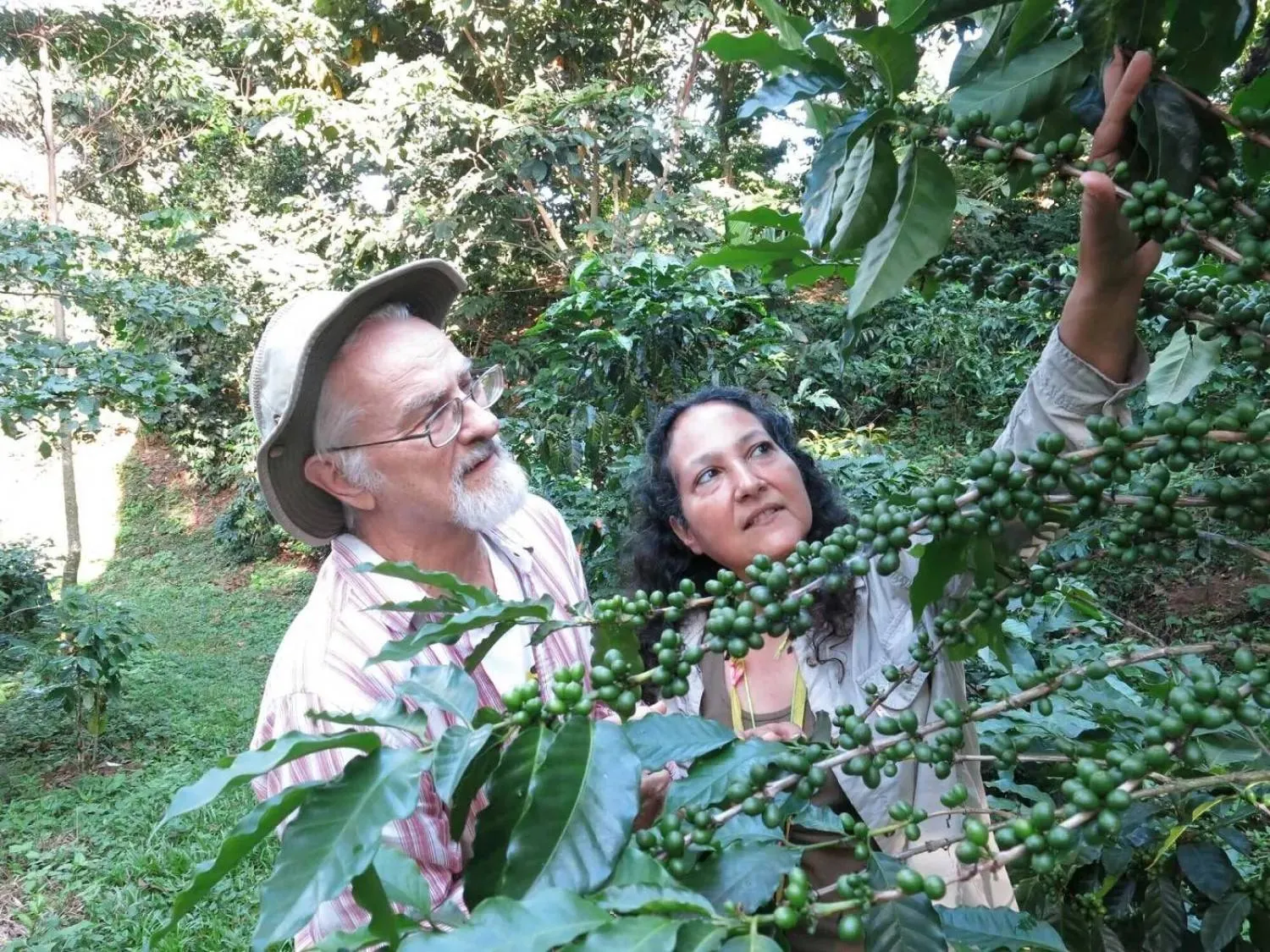
For three decades, Vandermeer and Ivette Perfecto, a professor at the U-M School for Environment and Sustainability, have been studying ant interactions in the coffee farm’s agricultural setting.
Their goal is to help transform how agriculture is done, but they said, “to do so, we need to first understand the ecology of agricultural systems.”
In the tropics, ants are dominant, Vandermeer said, and often involved in agriculture as agents of controlling pests. But using an ant species to control pests can be complicated: The dominance of the ant being used as a biological control depends on what other species of ants—as well as other types of insects—there are in the system.
In this system, Vandermeer and Perfecto examined two types of ecological behavior: intransitive loop cyclic behavior and predator-mediated coexistence. Intransitive loop cyclic behavior means that if there’s a group of three ant species, one ant might be dominant over another in a cyclical dominance hierarchy.
The predator-mediated coexistence is when a predator is thrown into the mix, affecting the dominant ant and also the other two ant species and allowing any of the four species to become the dominant species at different points of time.
“The good news is that the chaotic patterns of the insects are really very interesting from an inherent intellectual sense. The bad news is that it’s not really as simple as it might seem to base agricultural practices on ecological principles because the ecological principles themselves are way more complicated than simply finding a poison that kills the pests,” Vandermeer said.
“What we’re uncovering, we think, over the past 30 years or so are some of those complications that come out if you’re serious about putting ecology into the fundamental operations of the agricultural system,” he added.


