

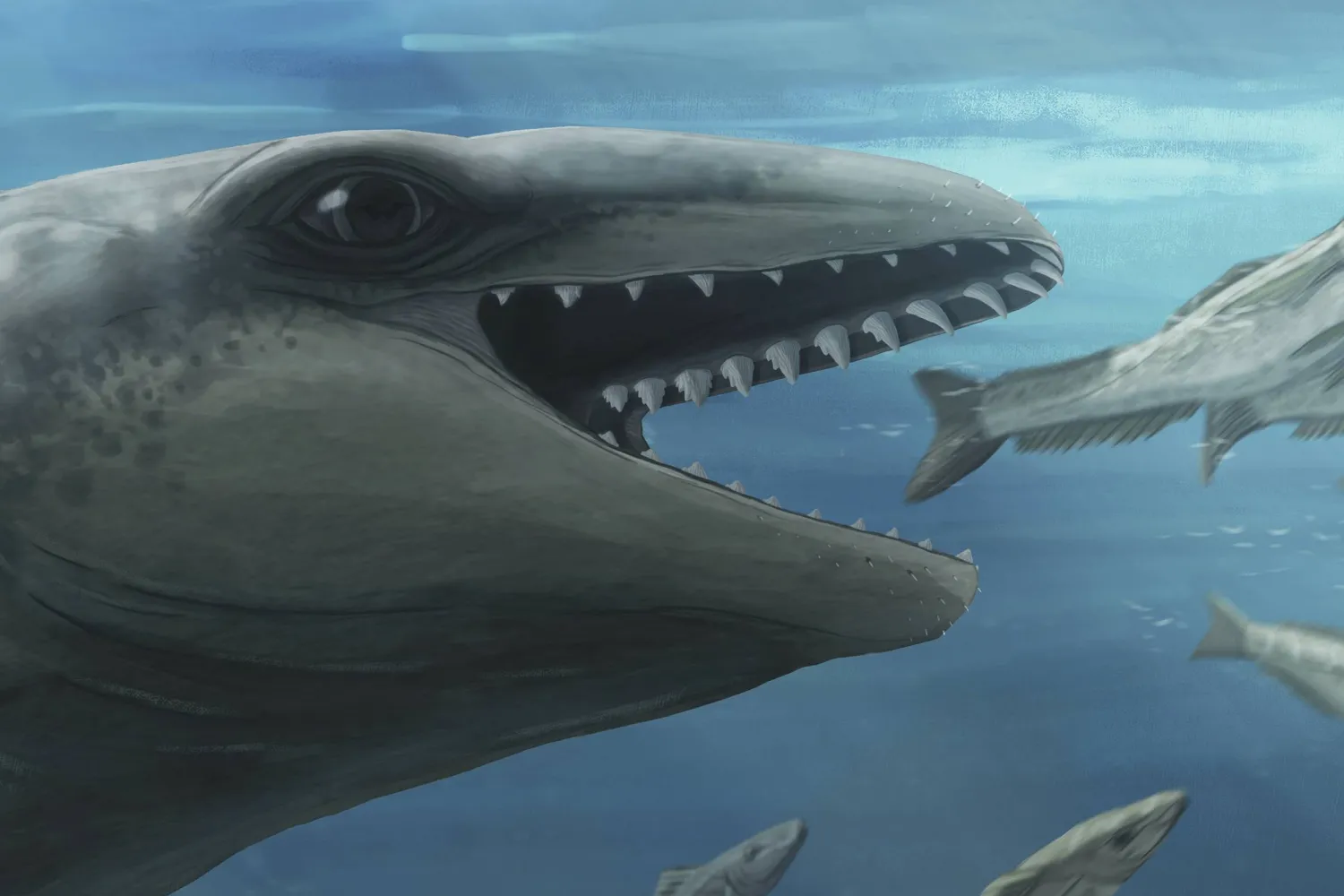

This Prehistoric Whale Had Razor Teeth, Bulging Eyes

In this illustration provided by Ruairidh Duncan a Janjucetus dullardi is depicted chasing a fish. (Ruairidh Duncan via AP)
TT

This Prehistoric Whale Had Razor Teeth, Bulging Eyes

In this illustration provided by Ruairidh Duncan a Janjucetus dullardi is depicted chasing a fish. (Ruairidh Duncan via AP)

Long before whales were majestic, gentle giants, some of their prehistoric ancestors were tiny, weird and feral. A chance discovery of a 25 million-year-old fossil on an Australian beach has allowed paleontologists to identify a rare, entirely new species that could unlock mysteries of whale evolution, The Associated Press reported.

Researchers this week officially named Janjucetus dullardi, a cartoonish creature with bulging eyes the size of tennis balls, in the Zoological Journal of the Linnean Society. Unlike today's whales, the juvenile specimen was small enough to fit in a single bed.

Boasting fiendish teeth and a shark-like snout, however, this oddball of the ocean was nasty, mean and built to hunt.

“It was, let’s say, deceptively cute,” said Erich Fitzgerald, senior curator of vertebrate paleontology at Museums Victoria Research Institute, and one of the paper's authors.

“It might have looked for all the world like some weird kind of mash-up between a whale, a seal and a Pokémon but they were very much their own thing.”

Extinct species was an odd branch on the whale family tree The rare discovery of the partial skull, including ear bones and teeth, was made in 2019 on a fossil-rich stretch of coast along Australia’s Victoria state. Jan Juc Beach, a cradle for some of the weirdest whales in history, is becoming a hotspot for understanding early whale evolution, Fitzgerald said.

Few family trees seem stranger than that of Janjucetus dullardi, only the fourth species ever identified from a group known as mammalodontids, early whales that lived only during the Oligocene Epoch, about 34 to 23 million years ago.

That marked the point about halfway through the known history of whales.

The tiny predators, thought to have grown to 3 meters (10 feet) in length, were an early branch on the line that led to today’s great baleen whales, such as humpbacks, blues and minkes. But the toothy ancestors with powerful jaws would have looked radically different to any modern species.

“They may have had tiny little nubbins of legs just projecting as stumps from the wall of the body,” said Fitzgerald.

That mystery will remain tantalizingly unsolved unless a specimen is uncovered with more of its skeleton intact, which would be something of a miracle. Even the partial skull that allowed the initial identification this week was an astonishing discovery.

For an amateur paleontologist, a life-long obsession paid off Janjucetus dullardi was named by researchers after an amateur fossil hunter who doesn’t mind its looks in the slightest.

“It’s literally been the greatest 24 hours of my life,” said Ross Dullard, who discovered the skull while fossil hunting at Jan Juc Beach. After Wednesday’s confirmation of the new species, the school principal walked like a rock star onto campus with “high fives coming left, right and center,” he said.

His friends and family are probably just relieved it’s over.

“That’s all they’ve heard from me for about the last six years,” he said.

Dullard was on a regular low-tide hunt at Jan Juc the day he spotted something black protruding from a cliff. Poking it dislodged a tooth.

He knew enough to recognize it was unlikely to belong to a dog or a seal.

“I thought, geez, we’ve got something special here,” he said. Dullard sent photos to Museums Victoria, where Fitzgerald saw them and immediately suspected a new species.

Ancient whale finds are rare but significant Confirming the find was another matter. This was the first mammalodontid to be identified in Australia since 2006 and only the third on record in the country.

Fossils of sufficient quality, with enough of the right details preserved to confirm uniqueness, aren’t common.

“Cetaceans represent a fairly miniscule population of all life,” Fitzgerald said. Millions of years of erosion, scavengers and ocean currents take their toll on whale skeletons too.

“It’s only the chosen few, the vast minority of all whales that have ever lived and died in the oceans over millions of years, that actually get preserved as fossils,” he added.

Finds such as Janjucetus dullardi can unlock insights into how prehistoric whales ate, moved, behaved — and evolved. Researchers said the discoveries also helped to understand how ancient cetacean species adapted to warmer oceans, as they study how today’s marine life might respond to climate change.

Meanwhile, Dullard planned to host a fossil party this weekend, featuring cetacean-themed games and whale-shaped treats in jello, to celebrate his nightmare Muppet find, finally confirmed.

“That’s taken my concentration for six years,” he said. “I’ve had sleepless nights. I’ve dreamt about this whale.”



Huge Rotating Structure of Galaxies and Dark Matter Is Detected

A figure depicting the rotation of neutral hydrogen in galaxies residing in an extended filament, where the galaxies exhibit a coherent bulk rotational motion tracing the large-scale cosmic web, is seen in this undated illustration obtained by Reuters on December 4, 2025. (Lyla Jung/Handout via Reuters)
TT

Huge Rotating Structure of Galaxies and Dark Matter Is Detected

A figure depicting the rotation of neutral hydrogen in galaxies residing in an extended filament, where the galaxies exhibit a coherent bulk rotational motion tracing the large-scale cosmic web, is seen in this undated illustration obtained by Reuters on December 4, 2025. (Lyla Jung/Handout via Reuters)

Scientists have observed the largest-known rotating structure in the cosmos - a gargantuan thread-like assemblage of hundreds of galaxies, gas and dark matter that makes up a filament in the macrostructure of the universe called the cosmic web.

The filament, located about 140 million light-years from Earth, was observed by scientists primarily using the MeerKAT radio telescope located in South Africa, an array of 64 interlinked satellite dishes.

The rotating filament is astonishingly large, measuring about 50 million light-years long and 117,000 light-years wide. A light-year is the distance light travels in a year, 5.9 trillion miles (9.5 trillion km). By way of comparison, our Milky Way galaxy, which itself is part of a filament in the cosmic web, measures roughly 100,000 light-years in diameter.

"We believe that the universe on very large scales is made of a network-like distribution of galaxies, gas and dark matter," said University of Cambridge astrophysicist Madalina Tudorache, co-lead author of the study published this month in the journal Monthly Notices of the Royal Astronomical Society.

"This network is called the cosmic web, and it is formed of clusters, which are very dense clumps of matter, often formed of many groups of galaxies; voids - which are empty or almost empty regions of space; and filaments, which are strand-like structures which connect the very dense regions and border the voids," Tudorache said.

The rotating filament described in the new study is populated by nearly 300 galaxies of various sizes as well as gas and dark matter, the mysterious invisible stuff estimated to make up 27% of the cosmos.

Everything visible in the universe is made of ordinary matter - stars, planets, moons and all the stuff on Earth. It can be seen in wavelengths from infrared to visible light and gamma rays, but comprises only about 5% of the universe. Dark matter, on the other hand, does not absorb or reflect or emit light, but its presence is known through its gravitational effects on large scales.

The researchers determined that the filament is spinning by observing that the galaxies on either side of its central axis are moving through space in opposite directions, with the whole thing having a rotational velocity of about 246,000 miles (396,000 km) per hour.

"This is the largest individual spinning structure so far detected. Statistically, we believe there are other spinning structures, some of which could be larger. However, we have not been able to detect them directly with our current data and telescopes," said University of Oxford astrophysicist and study co-lead author Lyla Jung.

The researchers likened what they see in this filament to the amusement park attraction called a teacup ride.

"The teacup ride analogy explains the two levels of spinning motion that make this object unique," Jung said.

"First, each galaxy in the filament spins on its own. The gas and stars in each galaxy orbit around the galaxy center, like each teacup on the ride spins individually. Second, the entire cosmic filament also rotates. The filament is made of many galaxies, and this study demonstrates that the entire structure is rotating, like the teacup platform spins as a whole," Jung added.

In studying the cosmos, astrophysicists examine it at the smallest and largest scales. They look at tiny fundamental particles such as neutrinos. They look at objects such as comets, asteroids, moons, planets and stars that make up solar systems. They look at galaxies comprised of billions of stars and at clusters of galaxies. And then on the largest scales they look at filaments and other components of the cosmic web.

This study looks at the large end of things.

"This is a very exciting time to work in this field, as our capacity of discovering such structures is increasing with the advent of better radio and optical surveys. It will deepen our understanding of the universe," Tudorache said.


NCW Releases 37 Wildlife Species in Hegra Reserve in AlUla

The release included six mountain ibex, 20 sand gazelles (reem), six idmi gazelles, and five ostriches - SPA
TT

NCW Releases 37 Wildlife Species in Hegra Reserve in AlUla

The release included six mountain ibex, 20 sand gazelles (reem), six idmi gazelles, and five ostriches - SPA

The National Center for Wildlife (NCW), in cooperation with the Royal Commission for AlUla, has released 37 wildlife species into Hegra Reserve as part of ongoing breeding and reintroduction programs aimed at restoring natural habitats, enriching biodiversity, supporting ecological balance, and promoting environmental tourism.

The release included six mountain ibex, 20 sand gazelles (reem), six idmi gazelles, and five ostriches, SPA reported.

This effort is part of NCW's continuing work to increase the numbers of threatened native species and expand their presence across suitable natural environments.

NCW CEO Dr. Mohammed Qurban stated that releasing these species into the reserve helps protect wildlife, safeguard ecosystems, and enrich biodiversity, strengthening the sustainability of the reserve and its role as a natural and cultural destination of national significance.

Qurban noted that this release is an extension of the center’s reintroduction efforts across reserves in the Kingdom, aimed at rehabilitating ecosystems, increasing biodiversity, and ensuring long-term sustainability. It aligns with the goals of Saudi Vision 2030, the Saudi Green Initiative, and the National Environment Strategy, while also adhering to global approaches to wildlife conservation.


Australian Bushfires Raze Homes in Two States; Firefighter Dies 

Ruins of buildings and a car smolder after a wildfire destroyed houses in Koolewong, Australia, Saturday, Dec. 6, 2025. (Dan Himbrechts/AAP Image via AP)
TT

Australian Bushfires Raze Homes in Two States; Firefighter Dies 

Ruins of buildings and a car smolder after a wildfire destroyed houses in Koolewong, Australia, Saturday, Dec. 6, 2025. (Dan Himbrechts/AAP Image via AP)

An Australian firefighter was killed overnight after he was struck by a tree while trying to control a bushfire that had destroyed homes and burnt large swathes of bushland north of Sydney, authorities said on Monday.

Emergency crews rushed to bushland near the rural town of Bulahdelah, 200 km (124 miles) north of Sydney, after reports that a tree had fallen on a man. The 59-year-old suffered a cardiac arrest and died at the scene, officials said.

Prime Minister Anthony Albanese said the "terrible news is a somber reminder" of the dangers faced by emergency services personnel as they work to protect homes and families.

"We honor that bravery, every day," Albanese said in a statement.

A fast-moving fire over the weekend destroyed 16 homes in New South Wales state's Central Coast region, home to about 350,000 people and a commuter region just north of Sydney.

Resident Rouchelle Doust, from the hard-hit town of Koolewong, said she and her husband tried to save their home as flames advanced.

"He's up there in his bare feet trying to put it out, and he's trying and trying, and I'm screaming at him to come down," Doust told the Australian Broadcasting Corp.

"Everything's in it: his grandmother's stuff, his mother's stuff, all my stuff - everything, it's all gone, the whole lot."

Conditions eased overnight, allowing officials to downgrade fire danger alerts, though the weather bureau warned some inland towns in the state could hit more than 40 degrees Celsius (104 Fahrenheit) on Tuesday, raising fire dangers.

More than 50 bushfires were burning across New South Wales as of Monday.

On the island state of Tasmania, a 700-hectare (1,729 acres) blaze at Dolphin Sands, about 150 km (93 miles) northeast of the state capital of Hobart, destroyed 19 homes and damaged 40. The fire has been contained, but residents have been warned not to return as conditions remain dangerous, officials said.

Authorities have warned of a high-risk bushfire season during Australia's summer months from December to February, with increased chances of extreme heat across large parts of the country following several relatively quiet years.

In neighboring New Zealand, five helicopters and multiple crews were working to put out a fire near the country's oldest national park, a month after a wildfire burnt through 2,589 hectares (6,400 acres) of alpine bush there.

Police said they had closed a road near the state highway and advised motorists to avoid the area and expect delays after the blaze near Tongariro National Park, a popular hiking spot, spread to 110 hectares (272 acres) by Monday afternoon.