


Italy’s Ventina Glacier Has Melted So Much Geologists Now Can Only Monitor It Remotely 

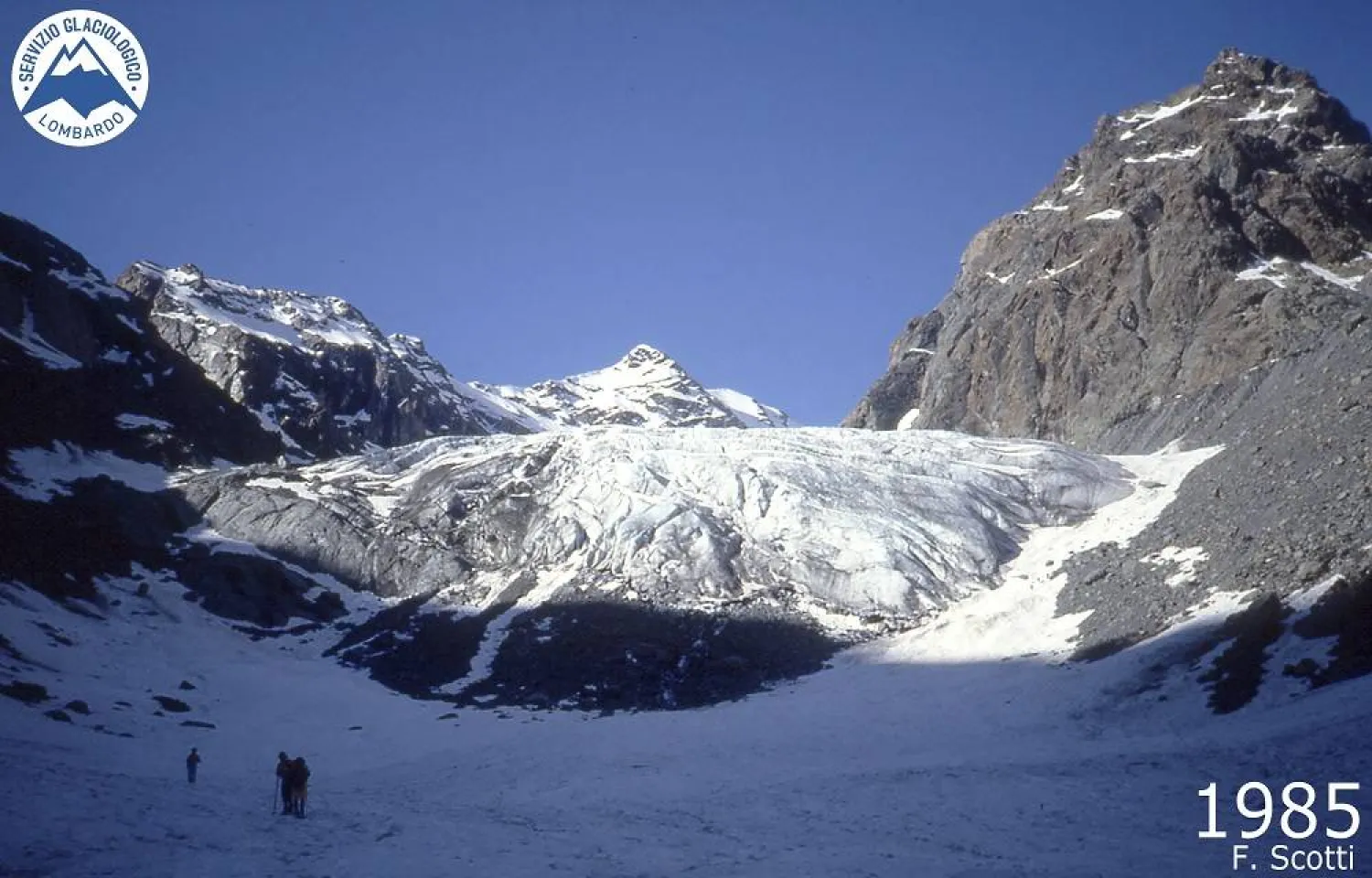
An overview of the Ventina glacier, near Sondrio, northern Italy,1985. (Lombardy Glaciology Service via AP) 
TT

Italy’s Ventina Glacier Has Melted So Much Geologists Now Can Only Monitor It Remotely 

An overview of the Ventina glacier, near Sondrio, northern Italy,1985. (Lombardy Glaciology Service via AP) 

Italy’s Ventina glacier, one of the biggest in northern Lombardy, has melted so much due to climate change that geologists can no longer measure it the way they have for the past 130 years.

After this year’s hot summer, geologists discovered that the simple stakes used as benchmarks to measure the glacier’s retraction each year are now buried under rockslides and debris that have made the terrain too unsteady for future in-person visits.

The Lombardy Glaciological Service said Monday that it will now use drone imagery and remote sensing to keep track of the ongoing shrinkage.

Geologists say that the Ventina glacier has already lost 1.7 kilometers (1 mile) in length since the first measuring benchmarks were positioned at the front of the glacier in 1895.

The melting has accelerated in recent years, with the glacier losing 431 meters (471 yards) in the last 10 years, nearly half of that since 2021, the service said. It's another example of how accelerating global warming is melting and shrinking Europe’s glaciers, causing a host of environmental and other impacts.

“While we could still hope until the 1980s that there would be normal cycles (of retraction) or at least a contained retraction, in the last 40 years something truly striking has occurred,” said Andrea Toffaletti, a member of the Lombardy Glaciological Service.

Italy’s mountain glaciers, which are found throughout the Alps and Dolomites in the north and along the central Apennines, have been receding for years, thanks to inadequate snowfall in the winter and record-setting hot summers. Glaciers always melt some in summer, with the runoff fueling mountain streams and rivers.

But the hot summers are “no longer able to guarantee the survival of the winter snowpack,” that keeps the glacier intact, Toffaletti said.

“In order to regenerate and remain in balance, a certain amount of residual snow from the winter must remain on the glacier's surface at the end of the summer. And this is happening less and less frequently,” said Toffaletti.

According to the Lombardy service, the Alps represent a climate hotspot, recording double the global average of temperature increases since pre-industrial times, resulting in the loss of over 64% of the volume of Alpine glaciers.

In February, the journal Nature reported on a study showing the world’s glaciers lost ice at the rate of about 255 billion tons (231 billion metric tons) annually from 2000 to 2011, but that quickened to about 346 billion tons (314 billion metric tons) annually over about the next decade.



Ariane 6 Lifts Off with 2 European Navigation Satellites

The European Space Agency (ESA) Ariane 6 rocket carrying two Galileo satellites for the the EU's Global Navigation Satellite System (GNSS) launches at the Guiana Space Center in Kourou, on the French overseas department of Guiana, on December 17, 2025. (Photo by Ronan LIETAR / AFP)
TT

Ariane 6 Lifts Off with 2 European Navigation Satellites

The European Space Agency (ESA) Ariane 6 rocket carrying two Galileo satellites for the the EU's Global Navigation Satellite System (GNSS) launches at the Guiana Space Center in Kourou, on the French overseas department of Guiana, on December 17, 2025. (Photo by Ronan LIETAR / AFP)

A European Ariane 6 rocket blasted off from France's Kourou space base in French Guiana early Wednesday, carrying two Galileo global navigation satellites, according to an AFP correspondent.

Lift-off was at 2:01 am local time (0501 GMT) for the fourth commercial flight of the Ariane 6 launch system since the expendable rockets came into service last year.

The rocket was carrying two more satellites of the European Union's Galileo program, a global navigation satellite system that aims to make the bloc less dependent on the US's Global Positioning System (GPS).

The two satellites were set to be placed in orbit nearly four hours after lift-off.

They will bring to 34 the number of Galileo satellites in orbit and "will improve the robustness of the Galileo system by adding spares to the constellation to guarantee the system can provide 24/7 navigation to billions of users. The satellites will join the constellation in medium Earth orbit 23, 222 km (14,429 miles) above Earth’s surface," according to the European Space Agency (ESA) which oversees the program.

Previous Galileo satellites were primarily launched by Ariane 5 and Russian Soyuz rockets from Kourou.

After Russia's invasion of Ukraine, Europe halted space cooperation with Moscow.

Before the Ariane 6 rocket entered into service in July 2024, the EU contracted with Elon Musk's SpaceX to launch two Galileo satellites aboard Falcon 9 rockets in September 2024 from the Kennedy Space Center in Florida.


Delhi Restricts Vehicles, Office Attendance in Bid to Curb Pollution

Children ride a bicycle across a field on smoggy winter morning in New Delhi on December 17, 2025. (Photo by Arun SANKAR / AFP)
TT

Delhi Restricts Vehicles, Office Attendance in Bid to Curb Pollution

Children ride a bicycle across a field on smoggy winter morning in New Delhi on December 17, 2025. (Photo by Arun SANKAR / AFP)

Authorities in India's capital Delhi rolled out strict measures on Wednesday in an attempt to curb pollution, including a ban on vehicles not compliant with latest emission control norms and regulating attendance in private and government offices.

The air quality index (AQI) in the Delhi region, home to 30 million people, has been in the 'severe' category for the past few days, often crossing the 450-mark. In addition, shallow fog in parts of the city worsened visibility that impacted flights and trains.

This prompted the Commission for Air Quality Management to invoke stage four, the highest level, of the Graded Response Action Plan for Delhi and surrounding areas on Saturday.

The curbs ban the entry of older diesel trucks into the city, suspend construction, including on public projects, and impose hybrid schooling, Reuters reported.

Kapil Mishra, a minister in the local government, announced on Wednesday that all private and government offices in the city would operate with 50% attendance, with the remaining working from home.

Additionally, all registered construction workers, many of them earning daily wages, will be given compensation of 10,000 rupees ($110) because of the ban, Mishra said at a press conference in Delhi.

On Tuesday, the government enforced strict anti-pollution measures for vehicles in the city, banning vehicles that are not compliant with the latest emission control standards.

"Our government is committed to providing clean air in Delhi. We will take strict steps to ensure this in the coming days," Delhi's Environment Minister Manjinder Singh Sirsa said late on Tuesday.

Pollution is an annual winter problem in Delhi and its suburbs, when cold, dense air traps emissions from vehicles, construction sites and crop burning in neighboring states, pushing pollution levels to among the highest in the world and exposing residents to severe respiratory risks.

The area, home to 30 million people, gets covered in a thick layer of smog with AQI touching high 450-levels. Readings below 50 are considered good.


Saudi Ministry of Defense Showcases Media Heritage at Jeddah Book Fair 

The pavilion traces the evolution of military publishing, from early traditional printing through technological and editorial transformations to its modern form. (SPA)
TT

Saudi Ministry of Defense Showcases Media Heritage at Jeddah Book Fair 

The pavilion traces the evolution of military publishing, from early traditional printing through technological and editorial transformations to its modern form. (SPA)

The Saudi Ministry of Defense is participating in the Jeddah International Book Fair, featuring a pavilion that documents a key aspect of its cultural and media history, reported the Saudi Press Agency on Wednesday.

The pavilion traces the evolution of military publishing, from early traditional printing through technological and editorial transformations to its modern form as a trusted reference for defense-related content.

The participation builds on the ministry’s presence at national cultural events. It marks its debut at the Jeddah Book Fair, expanding the reach of its documentary content to a broader audience interested in military media history.
