
Gardening’s Hidden Benefits: How Digging in the Dirt Could Bolster Mental Wellbeing 

This May 23, 2023, image provided by Mount Vernon Ladies' Association shows espaliered fruit trees trained against a wall at George Washington's Mount Vernon in Mount Vernon, Va. (Mount Vernon Ladies' Association via AP) 
TT

Gardening’s Hidden Benefits: How Digging in the Dirt Could Bolster Mental Wellbeing 

This May 23, 2023, image provided by Mount Vernon Ladies' Association shows espaliered fruit trees trained against a wall at George Washington's Mount Vernon in Mount Vernon, Va. (Mount Vernon Ladies' Association via AP) 

If you spend any time gardening, you probably understand what I mean when I say it feels good — despite the lifting, sweating and straining involved. Yes, exercise is good for our bodies, but there’s something about digging in the dirt while listening to a bird soundtrack that lifts my spirits. Even the scent of the soil and mulch makes me happy.

As it turns out, there are scientific reasons for this.

In fact, there’s an entire field called horticultural therapy that’s dedicated to using “plant-based and garden-based activities to support people who have identified treatment needs,” according to Karen Haney, a horticultural therapy instructor at UCLA Extension in Long Beach, California.

“Research suggests 20-30 minutes (of gardening) a few times a week can reduce stress and lift mood, with benefits increasing the more regularly one gardens,” says Sarah Thompson, a professionally registered horticultural therapist in Boise, Idaho.

It's not just about being outdoors Yes, the simple act of being in nature can improve mood and restore focus, she said, but “the active engagement of nurturing plants, making decisions and seeing results over time adds a unique layer of meaning and satisfaction that passive time outdoors does not.”

In addition, Thompson said gardening has been shown to ease symptoms of anxiety and depression, and fosters a sense of calm, purpose and accomplishment.

A recent study at the University of Colorado-Boulder backs this up.

The researchers there provided one group of participants with an instructional gardening class, seeds, starter plants and a community gardening plot. They had a second group refrain from gardening for two years.

The gardening cohorts reported stronger social connections, lower stress levels and about a 7% increase in fiber intake, which have been shown to reduce risk factors for some physical and mental illnesses, including depression, high blood pressure, type 2 diabetes and cancer. They also reported a 42-minute weekly increase in physical activity, which the non-gardeners did not.

A mindful, rewarding and versatile activity Previous studies have arrived at similar findings. In 2020, for instance, researchers at the University of Exeter and the Royal Horticultural Society in the UK found the health and well-being of gardeners over non-gardeners to be similar to that of residents of wealthy communities over those who live in poorer areas.

In addition to encouraging mindfulness, grounding people in the present moment and providing a sense of achievement, Thompson said, “research has also shown that exposure to sunlight can boost serotonin levels, while contact with soil introduces beneficial microbes linked to mood enhancement.”

So, it seems you just can’t go wrong with gardening.

“Physically, gardening improves strength, flexibility and balance. Socially, it can foster connection. Cognitively, it engages problem solving and creativity,” Thompson said, adding that it’s a highly adaptable activity.

“Gardening can be scaled to any space, ability or age, and its benefits are accessible to everyone,” she said.

Deep down, we gardeners have always believed this. Now, we have the science to prove it.


Norway Plans to Ban Social Media Use by Children Under 16

FILE PHOTO: Instagram, TikTok, Snapchat, YouTube, Facebook, Twitch and Reddit applications are displayed on a mobile phone ahead of new law banning social media for users under 16 in Australia, in this picture illustration taken on December 9, 2025. REUTERS/Hollie Adams/Illustration/File Photo
TT

Norway Plans to Ban Social Media Use by Children Under 16

FILE PHOTO: Instagram, TikTok, Snapchat, YouTube, Facebook, Twitch and Reddit applications are displayed on a mobile phone ahead of new law banning social media for users under 16 in Australia, in this picture illustration taken on December 9, 2025. REUTERS/Hollie Adams/Illustration/File Photo

Norway said on Friday it would present a bill in parliament by year-end to ban children from using social media until they turn 16, making technology companies responsible for the task of age verification.

Several European nations seeking to rein in children's ⁠use of social media ⁠after Australia took the lead with a world-first ban on under-16s last December.

"We are introducing this legislation because we want a childhood where ⁠children get to be children," Reuters quoted Prime Minister Jonas Gahr Stoere as saying in a statement.

"Play, friendships, and everyday life must not be taken over by algorithms and screens. This is an important measure to safeguard children's digital lives."

The government did not say ⁠which ⁠applications would be targeted.

Australia's ban covers Meta apps such as Instagram and Facebook as well as TikTok, Snapchat, Google's YouTube and Elon Musk's X, formerly Twitter.

Norway will introduce its bill in parliament by the end of 2026, the minority Labour government said.


'Cretaceous Kraken' Prowled the Seas During the Age of Dinosaurs

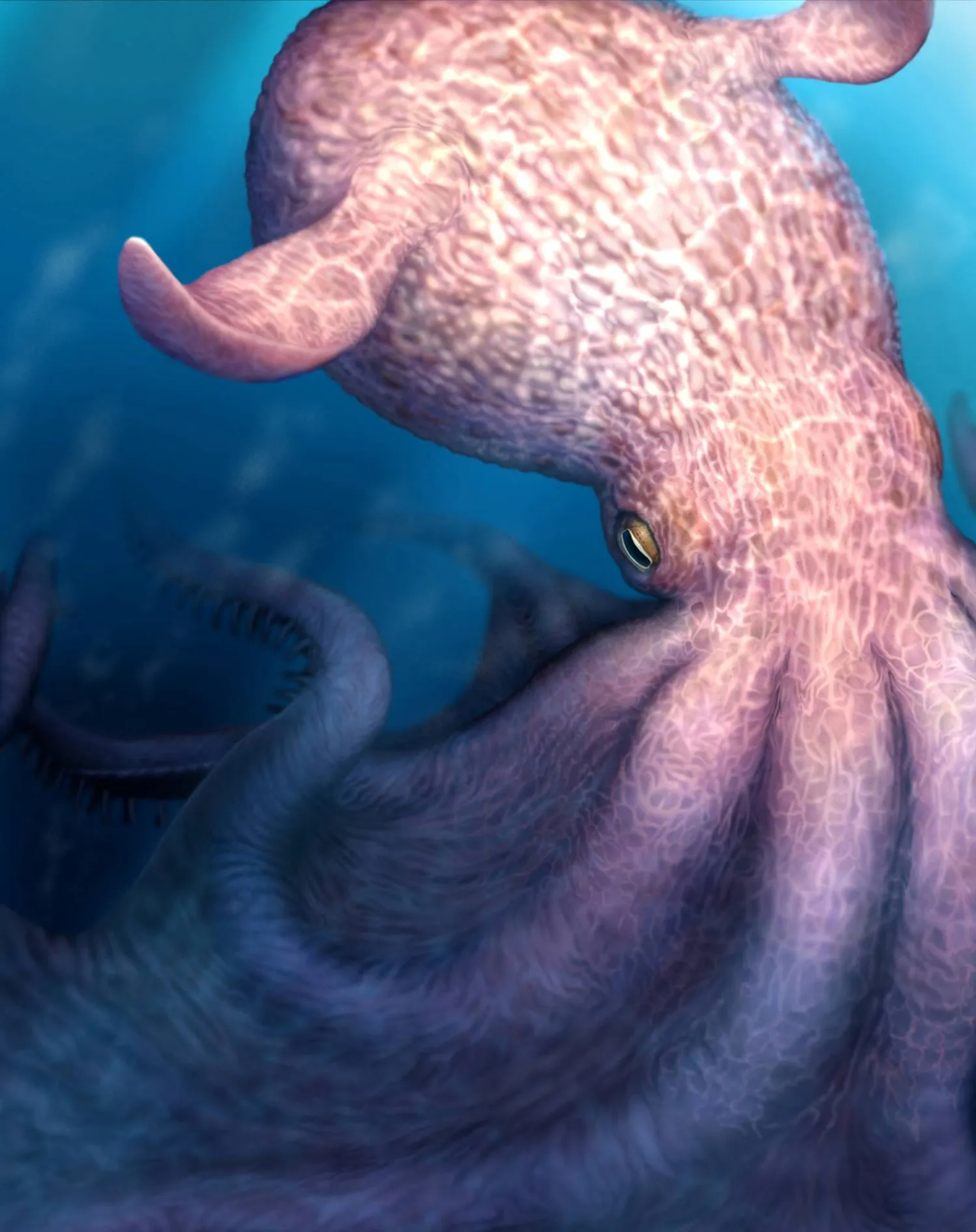
An artist's reconstruction of a finned octopus of the species Nanaimoteuthis haggarti that reached a length estimated at up to 18.6 meters (61.02 feet) and lived about 86 to 72 million years ago during the Cretaceous Period, released on April 23, 2026. Yohei Utsuki/Department of Earth and Planetary Sciences, Hokkaido University/Handout via REUTERS
TT

'Cretaceous Kraken' Prowled the Seas During the Age of Dinosaurs

An artist's reconstruction of a finned octopus of the species Nanaimoteuthis haggarti that reached a length estimated at up to 18.6 meters (61.02 feet) and lived about 86 to 72 million years ago during the Cretaceous Period, released on April 23, 2026. Yohei Utsuki/Department of Earth and Planetary Sciences, Hokkaido University/Handout via REUTERS

The Kraken is a huge tentacled sea monster from Norse folklore that drags ships and sailors down into the deep. During the age of dinosaurs, new research shows, there existed a creature as close to a real-life Kraken as you could possibly get - an enormous octopus that prowled the seas as an apex predator.

Scientists said fossils of beaks - the soft-bodied invertebrate's hard jaw structure - indicate that an octopus species named Nanaimoteuthis haggarti that lived about 86 to 72 million years ago during the Cretaceous Period ranged from 22 to 61 feet (6.6 to 18.6 meters) long.

"These animals were remarkable. With their large bodies, long arms, powerful jaws and advanced behavior, they represent what could be described as a real 'Cretaceous Kraken,'" said paleontologist Yasuhiro Iba of Hokkaido University in Japan, lead author of the research published on Thursday in the journal Science.

"For roughly the past 370 million years, marine ecosystems have been thought to be dominated by large vertebrate predators - first fishes and ⁠sharks, then marine ⁠reptiles and later whales. Our study shows that giant invertebrates, namely octopuses, also functioned as apex predators in the Cretaceous sea," Reuters quoted Iba as saying.

Iba said Nanaimoteuthis haggarti is one of the largest invertebrates on record.

"Until now, the largest-known invertebrate has been the modern giant squid, which can reach about 12 meters (39 feet) in total length," Iba said.

The intense wear observed on the beaks is consistent, the researchers said, with repeated crushing of hard structures such as bones and shells, indicative of a predator that hunted large fish, shelled tentacled creatures, clams and other sizable prey.

"In the largest specimens, about 10% of the ⁠total jaw length appears to have been lost due to wear. This is more severe than what is typically seen in modern octopuses and cuttlefishes that feed on hard prey," Iba said.

The beaks were shaped like those of certain deep-sea octopuses alive today that swim with the help of fins, leading the researchers to conclude that these Cretaceous octopuses also bore fins.

The numerous beak fossils studied in the research came from Japan and Canada's Vancouver Island. The researchers reexamined previously known specimens and discovered new fossils as well.

The researchers also studied the beaks of a close relative called Nanaimoteuthis jeletzkyi that lived about 100 to 72 million years ago. It was not quite as big, ranging from 9 to 25 feet (2.8 to 7.7 meters) long, but also was an active predator.

Because octopuses are soft-bodied animals, they seldom fossilize well. The beak, the only rigid part of the octopus body, is made of a hard and durable material ⁠called chitin, also found in ⁠the exoskeletons of crabs, lobsters and insects.

Guided by modern-day octopus anatomy, the researchers were able to estimate the size of the Cretaceous octopuses based on the dimensions of the beaks.

"Octopuses are not simply biting predators. They use long, flexible arms to capture prey and powerful jaws to process it. As body size increases, their ability to control large prey with their arms and to process it with their jaws also increases," Iba said.

"In addition, octopuses are among the most intelligent invertebrates. In our fossils, the jaws show asymmetric wear, suggesting lateralized behavior - favoring one side over the other, something like handedness. This indicates not only strength, but also advanced and flexible behavior," Iba said.

These octopuses shared the Cretaceous seas with other large predators including marine reptiles called mosasaurs and plesiosaurs that reached up to around 50 feet (15 meters) long as well as sharks rivaling today's great white in size.

"These giant octopuses likely occupied the same ecological tier and may have competed with marine reptiles and sharks within the same ecosystem," Iba said. "Their existence changes how we view ancient oceans. Instead of ecosystems dominated solely by vertebrate predators, we now see that giant invertebrates such as octopuses also occupied the very top of the food web."


Saudi Team Successfully Separates Filipino Conjoined Twins in Highly Complex Surgery

The operation was conducted at King Abdullah Specialist Children’s Hospital in King Abdulaziz Medical City of the Ministry of National Guard in Riyadh. SPA
TT

Saudi Team Successfully Separates Filipino Conjoined Twins in Highly Complex Surgery

The operation was conducted at King Abdullah Specialist Children’s Hospital in King Abdulaziz Medical City of the Ministry of National Guard in Riyadh. SPA

The specialized medical and surgical team of the Saudi Conjoined Twins Program achieved on Thursday a new medical milestone by successfully separating the Filipino conjoined twins Klea and Maurice Ann following a highly complex surgical procedure, considered among the most challenging cases worldwide.

The operation was conducted at King Abdullah Specialist Children’s Hospital in King Abdulaziz Medical City of the Ministry of National Guard in Riyadh.

Advisor at the Royal Court, Supervisor General of the King Salman Humanitarian Aid and Relief Center (KSrelief), and head of the medical and surgical team of the Saudi Conjoined Twins Program Dr. Abdullah Al Rabeeah stated the Filipino twins were separated after 12 hours and 45 minutes from the start of anesthesia.

This marks the completion of the third stage, with the fourth and fifth stages remaining, which are expected to take several more hours and will include reconstruction, cosmetic procedures, and cranial closure.

He added that the operation was carried out with the participation of 30 consultants, specialists, and nursing and technical staff across multiple disciplines, including anesthesia, intensive care, advanced imaging, plastic surgery, and other supporting specialties, ensuring the highest levels of precision and safety throughout all stages of the procedure.

Al Rabeeah noted that this marks the third separation of conjoined twins from the Philippines and the 70th case within the Saudi Conjoined Twins Program, which spans more than 35 years.

The program has covered 27 countries and evaluated 157 cases worldwide, underscoring the Kingdom’s leading role in this rare medical specialty, under the direct support and patronage of Custodian of the Two Holy Mosques King Salman bin Abdulaziz Al Saud and Prince Mohammed bin Salman bin Abdulaziz Al Saud, Saudi Crown Prince and Prime Minister.

Al Rabeeah expressed, on behalf of himself and all members of the medical and surgical team, his deepest gratitude to the Kingdom’s leadership for the continuous support and close follow-up provided to the program.

He also extended his thanks to the surgical team, led by pediatric neurosurgery consultant Dr. Moutasem Azzubi, as well as to all members of anesthesia, plastic surgery, nursing, and technical teams for their efforts, which contributed to the success of the operation and the safety of the twins.

He affirmed that this achievement reflects the Kingdom’s noble humanitarian mission and its position as a global center of excellence in this field.

For their part, the twins’ family expressed their appreciation and gratitude to the Custodian of the Two Holy Mosques and the Crown Prince for the high-quality medical care provided, praising the tremendous efforts exerted by the medical team to ensure the success of the operation.