
'Sea War' Brews off Gambia as Desperate Fishermen Attack Foreign Vessels, and Each Other

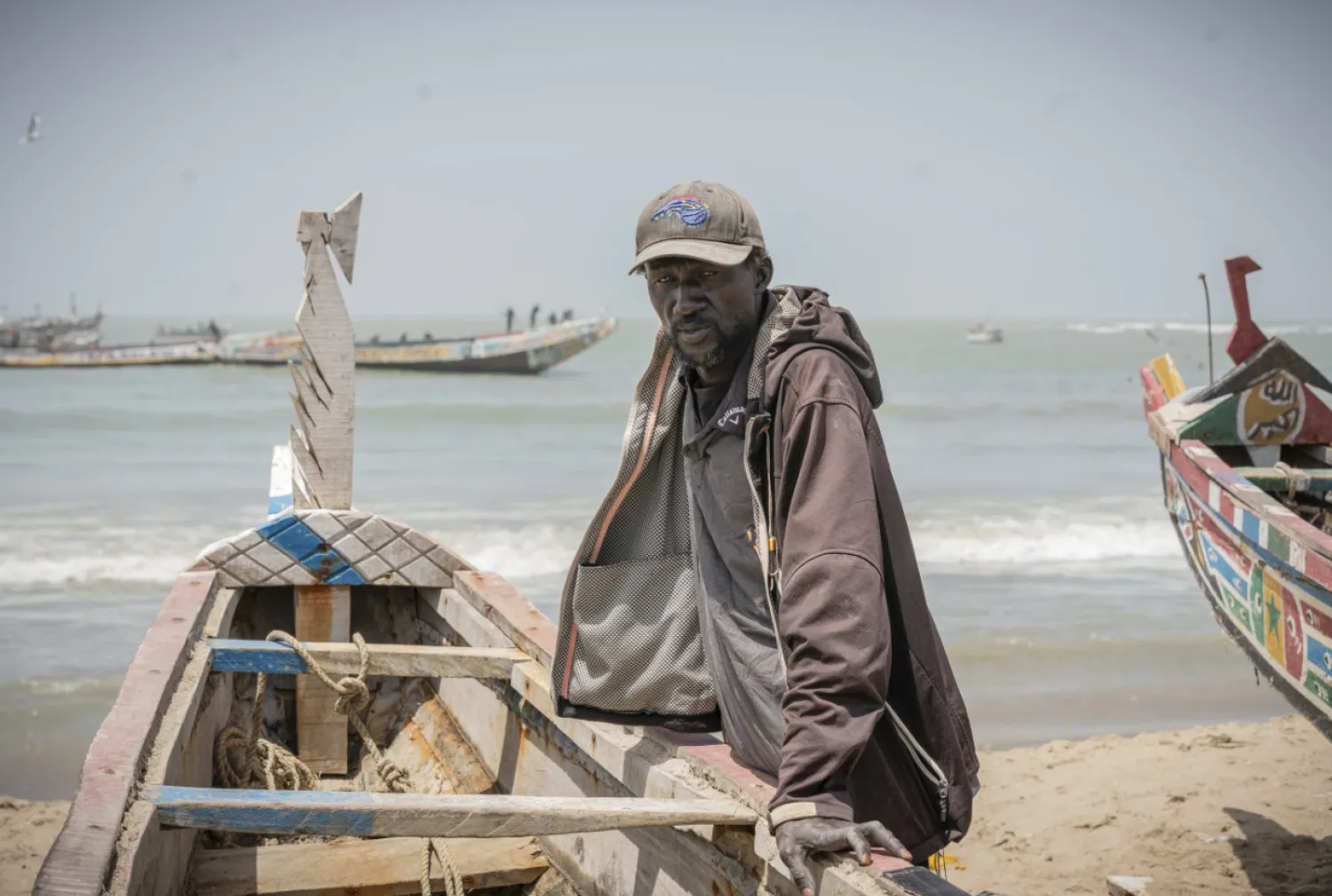
Famara Nudure, a fisherman for more than 40 years, leans against his boat in Gunjur, Gambia, after a day of work, on March 23, 2025. (AP Photo/Grace Ekpu)
TT

'Sea War' Brews off Gambia as Desperate Fishermen Attack Foreign Vessels, and Each Other

Famara Nudure, a fisherman for more than 40 years, leans against his boat in Gunjur, Gambia, after a day of work, on March 23, 2025. (AP Photo/Grace Ekpu)

Kawsu Leigh writhed in pain on the fishing boat, his burned skin as mottled as the paint on the deck beneath him. Raw and slick, the burns covered large parts of his upper body.

His day began as normal, with a shift on one of the foreign-owned vessels that carry out commercial fishing in waters off West Africa. It ended with him so badly injured from an arson attack that he struggles to recover a year later.

Local fishermen, angered by what they call illegal encroachment and sabotage by the foreign vessels off Gambia, had again confronted one of the boats, the Egyptian-owned Abu Islam.

But Leigh was a local sailor, too. Video of the attack, exclusively obtained by The Associated Press, documents an emerging problem in the fight for dominance in West African waters. Gambians are now fighting Gambians at sea, driven by market forces — and foreign appetites – beyond their control.

The problem came from attempted reforms. To give locals more say, and pay, in commercial fishing, Gambia’s government now requires foreign vessels operating offshore to carry a certain percentage of Gambian crew.

Those locals have become accidental targets of an anger they understand well, after trying to compete with the Chinese-owned and other foreign vessels with little more than small wooden boats and their bare hands.

The video was shared by the Association of Gambia Sailors, filmed minutes after the arson attack. The AP reviewed more than 20 such videos from various sources showing confrontations since 2023. Leigh said he is surprised to have survived, and unhappy that Gambians have been made into rivals.

Other clashes in the waters off Gambia have been deadly, with at least 11 local fishermen reportedly killed over the past 15 years.

“It’s like most of them, when they are going for fishing, it’s as if they’re going for war,” said Abdou Sanyang, secretary general of the Association of Gambia Sailors.

The fighting threatens to tear fishing communities apart, while overfishing to supply seafood buyers around the world undermines livelihoods for everyone. There are concerns that the fish population off Gambia could collapse in the coming years. That would be a business and environmental disaster in a small country with two main economic drivers: tourism and seafood.

For generations, Gambia’s fishermen have known no other work. Now, the financial pressures of competing with foreign-owned vessels are leading some to give up. They are tempted to sell their boats for use in another growing industry: migration toward Europe through the risky Atlantic waters.

Some of the fishermen become migrants themselves, hoping for another kind of good fortune at sea. Leigh, unable to support his family, is considering that now.

Two men against 20 Famara and Salif Ndure are brothers in the fishing community of Gunjur. They say they have lost more than half of their fishing nets to foreign trawlers that pull at the nets and damage them.

“You see them cutting your net, but you cannot do anything, because two men cannot go against 20 to 30 men in the sea,” Famara said. The brothers said they oppose attacking vessels with their countrymen aboard.

They said the foreign vessels have become increasingly aggressive during the current government of President Adama Barrow, who took over after the ouster of former dictator Yahya Jammeh in 2017. Gambia reopened its waters to foreign-owned vessels that year.

Famara said fishing nets are often cut at night, when the foreign vessels go beyond authorized zones to fish. Local fishermen have exclusive fishing rights within 9 nautical miles from shore, but they claim the trawlers come as close as 5. That has made clashes at sea inevitable.

“Anywhere they want, they come and feast. That’s why we’re suffering,” Famara said.

He and his brother once had 15 nets. Those have been reduced to three. A single net line can cost $100, making replacement almost impossible in a country where the per capita income is under $1,000.

Compensation from the government for the loss of a net requires the reporting of a violation by an observer with the fisheries ministry who is stationed on a foreign vessel — another attempted reform.

The brothers feel helpless. The trawlers are “destroying the nation,” they said, asserting that incidents are reported but nothing gets done. They think the money the government makes from the licensing of foreign trawlers is the reason. Licensing fees vary, with some vessels paying the equivalent of $275 per ton.

“They tell us that what the trawlers pay, we small boats don’t pay it,” Famara said.

Gambia's government did not respond to questions from the AP.

Most of the foreign trawlers operate without proper documentation and with unauthorized gear, asserted Lamin Jassey, president of the Gunjur Conservationists and Ecotourism Association. The local group works on marine conservation and advocates for better fisheries policy.

The violations are so blatant that the foreign vessels hardly hide their presence when they violate local waters at night, said Omar Gaye with a local cooperative of nongovernmental fisheries groups.

“You even think that here is a town because of the lights,” he said.

One of the brothers, Salif, even went to sea last year with a Gambian naval officer to report a foreign trawler after a confrontation over its alleged encroachment. No action was taken.

He ended up filming what happened at sea and posted it online, hoping for an official response someday.

Violations and little punishment One significant case has reached court in Gambia over fishing conflicts, and another is being prepared. One is the arson attack involving Leigh’s vessel. The other is a collision last year between a foreign trawler, identified by local fishermen as the Majilac 6, and a local vessel that killed three local fishermen.

They are rare cases in a country where the pursuit of justice takes time and cash that many people don’t have.

Gaye expressed his frustration with the Majilac 6, which he claimed was fishing too close to shore, and with Gambian authorities, who he said are not adequately investigating the deaths.

“We don’t know why till now this thing is pending. No one is talking about it. And this is a criminal case, this is a crime against the state!” he said of the case. Authorities haven’t visited the families of the dead or offered restitution, he said.

Omar Abdullah Jagne, the managing director of the Majilac Group of vessels — whose owners come from various countries — did not respond to AP questions. The owner of the Majilac 6 was not clear.

Maget Mbye and his wife, Fatou Jobe, lost their 22-year-old son in the collision.

“This is very painful, and nothing can pay us for his soul," Mbye said. “They are continuing to work as if nothing happened ... We want the government to help.”

The government has been trying to patrol the seas.

In March last year, before the deadly collision, armed maritime interdiction units with Gambia’s navy detained eight foreign trawlers for offenses including fishing in protected waters, fishing without a valid license, misreporting catches and using undersized mesh, which collects fish smaller than allowed. Almost all were accused of fishing inside the area reserved for local fishermen.

It was a rare deployment. Gambia’s poorly resourced navy has relied on international support from nonprofit organizations to watch its waters.

The Majilac 6 was among the vessels detained.

The vessels soon returned to sea, and locals say they continued to fish in Gambian waters.

Gaye and others were angered to learn that the Majilac 6 was blamed in the deadly collision. He said such collisions have killed at least 11 local fishermen over the past decade and a half.

Fines for offenses are not fixed and can be negotiated. Repeat offenders face little punishment. Jassey said many Gambian fishermen believe the trawlers are often tipped off in advance of maritime interdiction unit deployments.

Because Gambia is so small, foreign vessels often dock in neighboring Senegal instead of in Gambia’s capital, meaning fewer chances for local authorities to confront them at all.

But last month, Gambia's military said the navy had detained three vessels for violations including fishing without authorization and the use of illegal fishing gear. One was another vessel with the Majilac Group.

Outside observers of Gambia’s fishing industry are few to none, and data collection is sparse. Sea Shepherd, a nonprofit conservation group, has an agreement with Gambia to jointly patrol the country’s waters but did not visit last year as part of its mission to combat illegal fishing off West Africa.

The Association of Gambia Sailors now encourages fishermen to capture alleged violations by foreign vessels, and violent confrontations, on video. Film, don’t fight, it says.

The same association also provides the foreign trawlers with the government-required local crew members. In the past two years, Gambia’s government has increased the quota from 20% to at least 30% — meaning more potential for Gambians fighting Gambians.

Those fishermen receive no training on what to expect, or on how to protect themselves from what the head of the association, Sanyang, called a “sea war."

Eating fish becomes too expensive The conflict at sea off Gambia is occurring as fish stocks decline. Fish including grouper, cuttlefish, sardinella and bonga are over-exploited, according to an Amnesty International report in May 2023 on the human cost of overfishing there.

The sailors association believes that the foreign vessels eventually will move into the waters of nearby countries like Sierra Leone and Guinea Bissau, seeking more fish and less local opposition.

Declining fish stocks have affected food security in Gambia. Prices have risen, putting fish out of reach even for many people who pull them from the sea.

Instead, the majority of Gambians "depend on chicken that is imported from the world, which is very sad,” Jassey said.

He called the situation for local fishermen “very fragile.” Competition with foreign trawlers has left many unable to afford the work.

Human traffickers are buying their boats.

“These agents have a lot of money. They can buy the fishing boat, like three to four hundred, five hundred thousand dalasi, you know, from the fisherman who is sitting for like six to seven months without fishing,” Jassey said. “So that is very, very serious. That is why we’re losing a lot of our young people.”

The 24-year-old Leigh, still recovering from last year’s arson attack, has spent the money he received from the foreign trawler as compensation -- 51,000 dalasi – along with three months of his 17,000-dalasi salary. He spent it all on medication.

Now he considers giving up fishing and taking his chances on migrating to Europe.

“I just want to work for me and my family to survive,” he said.


Macron’s ‘Top Gun’ Shades Charm Internet as Leaders Wrangle Over Greenland

 French President Emmanuel Macron, wearing sunglasses, speaks during a meeting on the institutional future of New Caledonia at the Elysee Palace in Paris, France, January 16, 2026. (Reuters)
French President Emmanuel Macron, wearing sunglasses, speaks during a meeting on the institutional future of New Caledonia at the Elysee Palace in Paris, France, January 16, 2026. (Reuters)
TT

Macron’s ‘Top Gun’ Shades Charm Internet as Leaders Wrangle Over Greenland

 French President Emmanuel Macron, wearing sunglasses, speaks during a meeting on the institutional future of New Caledonia at the Elysee Palace in Paris, France, January 16, 2026. (Reuters)
French President Emmanuel Macron, wearing sunglasses, speaks during a meeting on the institutional future of New Caledonia at the Elysee Palace in Paris, France, January 16, 2026. (Reuters)

French President Emmanuel Macron's aviator sunglasses have caught the eye, with social media users debating his choice of a "Top Gun" look as he criticized US President Donald Trump over Greenland during his speech in Davos.

As he spoke at the annual World Economic Forum in the Swiss mountain resort of Davos on Tuesday, the French president wore dark, reflective sunglasses.

Memes, comments and speculation over his appearance surged on social media, with some supporters praising him for his "Top Gun" look while opponents dismissed it as bombastic or speculated ‌about his ‌health.

Macron's office said the choice to ‌wear ⁠sunglasses during his ‌speech, which took place indoors, was to protect his eyes because of a burst blood vessel.

One meme, with the headline "Duel in Davos," was styled like a Top Gun parody, with Macron and Trump eyeballing each other, both wearing military-style flight suits, and Macron, looking very small next to Trump, sporting oversized aviator sunglasses.

References to the ⁠1986 movie starring Tom Cruise were ubiquitous.

"Trump: be careful ... Macron is here," one social ‌media user said on X, with a ‍picture of the French ‍president with the aviator glasses. "Could he not find some more sober ‍glasses?" another user asked.

Even Trump weighed in, mocking Macron for his glasses in his own Davos speech on Wednesday.

Meanwhile, some of Macron's colleagues had gotten in on the act, with European Affairs Minister Benjamin Haddad posting a version of the "Soyboy vs Yes Chad" meme with Chad donning aviators and draped in a French flag.

Italian ⁠group iVision Tech, which owns Henry Jullien, said the model worn by Macron was its Pacific S 01, with a price tag of 659 euros ($770) on its website. It said it sent Macron the sunglasses as a gift but that he had insisted on paying for them, and made sure they were made in France.

The Milan-listed stock was up almost 6% on Wednesday.

"The news this morning came as a surprise," the group's chief executive Stefano Fulchir said. "We were flooded with calls and requests on the ‌website ... The site crashed."


3 Authors Win $10,000 Prizes for Blending Science and Literature

This combination of images shows cover art for “Ancient Light” by Kimberly Blaeser, left, “Bog Queen” by Anna North, center, and “Forest Euphoria: The Abounding Queerness of Nature” by Patricia Ononiwu Kaishian. (University of Arizona Press/Bloomsbury Publishing/Spiegel & Grau via AP)
TT

3 Authors Win $10,000 Prizes for Blending Science and Literature

This combination of images shows cover art for “Ancient Light” by Kimberly Blaeser, left, “Bog Queen” by Anna North, center, and “Forest Euphoria: The Abounding Queerness of Nature” by Patricia Ononiwu Kaishian. (University of Arizona Press/Bloomsbury Publishing/Spiegel & Grau via AP)

Three authors who demonstrated how scientific research can be wedded to literary grace have been awarded $10,000 prizes.

On Wednesday, the National Book Foundation and the Alfred P. Sloan Foundation announced the winners of the fifth annual Science + Literature awards. The books include Kimberly Blaeser's poetry collection, “Ancient Light,” inspired in part by the environmental destruction of Indigenous communities; the novel “Bog Queen” by Anna North, the story of a forensic anthropologist and a 2000-year-old Celtic druid; and a work of nonfiction, Patricia Ononiwu Kaishian's “Forest Euphoria: The Abounding Queerness of Nature.”

“These gifted storytellers shine a scientific and poetic light on the beauties and terrors of nature and what they reveal to us about our deepest selves, our humanity, and our existence on this planet,” Doron Weber, vice president and program director at the Sloan Foundation, said in a statement, The AP news reported.

Ruth Dickey, executive director of the National Book Foundation, said in a statement that the new winners continue the awards' mission to highlight “diverse voices in science writing that ... enlighten, challenge, and engage readers everywhere.”

The Book Foundation presents the National Book Awards, one of the literary world's most prestigious events. The Sloan Foundation has a long history of supporting books that join science and the humanities, including Kai Bird's and Martin J. Sherwin’s Pulitzer Prize-winning “American Prometheus,” which director Christopher Nolan adapted into the Oscar-winning “Oppenheimer.”

“At a time when science is under attack, it has become more urgent to elevate books that bring together the art of literature with the wonders of science,” Daisy Hernández, this year's chair of the awards committee and a 2022 Science + Literature honoree, said in a statement.


Meteorologists Blame a Stretched Polar Vortex, Moisture, Lack of Sea Ice for Dangerous Winter Blast

Ice forms along the Lake Michigan shore as People walk their dogs on a beach, Tuesday, Jan. 20, 2026, in Chicago. (AP Photo/Kiichiro Sato)
TT

Meteorologists Blame a Stretched Polar Vortex, Moisture, Lack of Sea Ice for Dangerous Winter Blast

Ice forms along the Lake Michigan shore as People walk their dogs on a beach, Tuesday, Jan. 20, 2026, in Chicago. (AP Photo/Kiichiro Sato)

Warm Arctic waters and cold continental land are combining to stretch the dreaded polar vortex in a way that will send much of the United States a devastating dose of winter later this week with swaths of painful subzero temperatures, heavy snow and powerline-toppling ice.

Meteorologists said the eastern two-thirds of the nation is threatened with a winter storm that could rival the damage of a major hurricane and has some origins in an Arctic that is warming from climate change. They warn that the frigid weather is likely to stick around through the rest of January and into early February, meaning the snow and ice that accumulates will take a long time to melt.

Wednesday’s forecast has the storm stretching from New Mexico to New England, threatening at least 250 million people.

“I think people are underestimating just how bad it’s going to be,” said former National Oceanic and Atmospheric Administration chief scientist Ryan Maue, now a private meteorologist.

The polar vortex, a patch of bitter cold air that often stays penned up in northern Canada and Alaska, is being elongated by a wave in the upper atmosphere that goes back to a relatively ice-free part of the Arctic and snow-buried Siberia. As the bone-chilling temperatures sweep through the US, they'll meet with moisture from off California and the Gulf of Mexico to set up crippling ice and snow in many areas.

Origins of the system in a warming Arctic The origins of the system begin in the Arctic, where relatively warmer temperatures add energy to the polar vortex and help push its cold air south.

“The atmosphere is aligned perfectly that the pattern is locked into this warm Arctic, cold continent," Maue said. "And it’s not just here for us in North America, but the landmass of Eastern Europe to Siberia is also exceptionally cold. The whole hemisphere has gone into the deep freeze.”

As far back as October 2025, changes in the Arctic and low sea ice were setting up conditions for the kind of stretched polar vortex that brings severe winter weather to the US, said winter weather expert Judah Cohen, an MIT research scientist. Heavy Siberian snowfall added to the push-and-pull of weather that warps the shape of the normally mostly circular air pattern. Those conditions “kind of loaded the dice a bit'' for a stretching of the polar vortex, he said, The AP news reported.

Cohen co-authored a July 2025 study that found more stretched polar vortex events linked to severe winter weather bursts in the central and eastern US over the past decade. Cohen said part of the reason is that dramatically low sea ice in the Barents and Kara seas in the Arctic helps set up a pattern of waves that end up causing US cold bursts. A warmer Arctic is causing sea ice in that region to shrink faster than other places, studies have found.

Arctic sea ice is at a record low extent for this time of year, according to the National Snow and Ice Data Center.

Where the winter blast will strike The center of the stretched polar vortex will be somewhere above Duluth, Minnesota, by Friday morning, ushering in “long-lasting brutal cold,” Maue said. Temperatures in the North and Midwest will get about as cold as possible, even down to minus 25 or 30 degrees Fahrenheit (minus 32 to minus 34 degrees Celsius), Maue said. The average low temperature for the Lower 48 states will dance around 11 or 12 degrees (minus 12 to minus 11 degrees Celsius) on Saturday, Sunday and Monday, Maue said.

Two Great Lakes — Erie and Ontario — may freeze up, which would at least reduce the famed lake-effect snow a bit, Maue said.

National Weather Service meteorologist Zack Taylor of the national Weather Prediction Center said most areas east of the Rockies will be impacted by the bitter cold, snow or ice. Treacherous freezing rain could stretch from the southern plains through the mid-South and into the Carolinas, he said.

“We’re looking at the potential for impactful ice accumulation. So the kind of ice accumulation that could cause significant or widespread power outages or potentially significant tree damage,” he said.

And if you don't get ice, you could get “another significant swath of heavy snow,” Taylor said. He said it was too early to predict how many inches will fall, but “significant snowfall accumulations” could hit "the Ozarks region, Tennessee and Ohio valleys, the central Appalachians, and then into the mid-Atlantic, and perhaps into the portions of the northeast.”

Maue said in the mid-Atlantic around the nation's capital, there's a possibility that “you can get two blizzards on top of each other in the next 14 days.”