


Cyprus Steps up Desalination as Worsening Droughts Parch the Island 

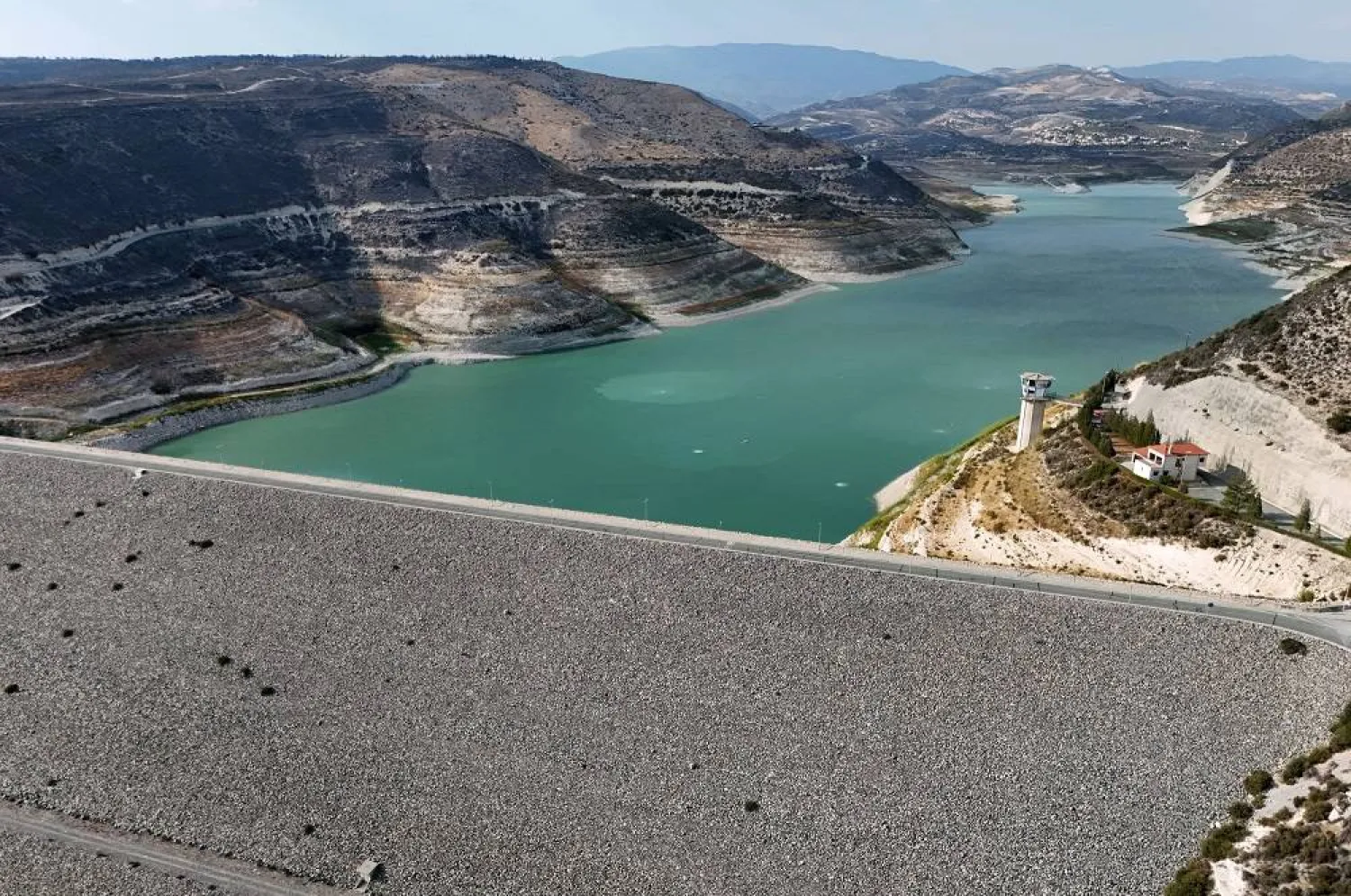
An aerial view of Kouris reservoir in Limassol, Cyprus August 27, 2025. (Reuters)
TT

Cyprus Steps up Desalination as Worsening Droughts Parch the Island 

An aerial view of Kouris reservoir in Limassol, Cyprus August 27, 2025. (Reuters)

Saint Nicholas church in the hills above Limassol, normally submerged in the Kouris Reservoir, offers a stark glimpse of the worsening water crisis in Cyprus. The belfry is fully exposed and the building is surrounded by parched earth.

Lying at the far east of the Mediterranean, Cyprus has always lived with drought. But climate change has turned dry spells into a permanent challenge and authorities are increasingly turning to desalination to meet rising water needs.

Annual rainfall has dropped an estimated 15% in the past 90 years, while temperatures in Nicosia have risen 1.8 degrees Celsius in the past century — double the global average according to official data.

As of September 1, the island’s reservoirs were just 14.7% full.

Demand for water has surged three-fold since 1990 because of population growth and a surge in tourism, leaving Cyprus with a constant water deficit. The country has a population of just under 1 million, and nearly 3 million tourists visit annually.

In 2023 the deficit reached 66 million cubic meters — more than 26,000 Olympic-sized pools - said Yianna Oikonomidou, senior executive engineer at the water development department.

"It really shows how big the problem is, and why we are trying to cover this deficit with non-conventional sources such as desalination, and also re-use of treated water which fully aligns with the principles of a circular economy," she said.

Desalination was first introduced in Cyprus in 1997 and now covers about 70% of drinking water needs. Mobile plants from the United Arab Emirates were installed this summer, with authorities planning more next year. Ultimately, the government wants desalination to meet all household and business needs.

"Our aim is to end reliance on weather," said Maria Panayiotou, minister for Agriculture, Environment and Natural Resources. The present administration, she said, adopted a policy to keep desalination units running whatever the season.

"Rain or no rain, Cyprus must cover its needs in water supply and we can do that only by utilizing technology available to us, improving our networks and developing a water conscience to minimize wastage."

But as the desalination plants hum along the coast, some criticize the reliance on seawater.

"It is very expensive ... and if you are not careful, can cause a lot of damage," warned MP Charalambos Theopemptou, chair of parliament's Environment Committee.

He said fishermen have complained of depleted stocks and "no life" in areas where brine from desalination is discharged. The Agriculture Ministry insists monitoring has found no adverse impact.

Scientists warn the island faces deeper risks. Farming practices, including growing water-intensive crops, are hastening desertification.

"Apart from Troodos and Pentadaktylos (mountain ranges), all other areas are potentially desertified," said Michael Loizides, a chemical and environmental engineer at the AKTI Project and Research Centre.

His group is involved in an EU-funded pilot seeking sustainable ways to prevent land degradation, such as composting to restore soil and improve water retention. "Cyprus is in a devastating situation. This means we have to be creative and innovative," he said.



Chile Fights Wildfires that Killed 19 and Left 1,500 Homeless

Mirtza Aguilera, right, and her daughter embrace in front of their home burned by wildfires in Tome, Chile, Monday, Jan. 19, 2026. (AP Photo/Javier Torres)
TT

Chile Fights Wildfires that Killed 19 and Left 1,500 Homeless

Mirtza Aguilera, right, and her daughter embrace in front of their home burned by wildfires in Tome, Chile, Monday, Jan. 19, 2026. (AP Photo/Javier Torres)

Firefighters in Chile are battling forest fires that started on Sunday and have killed at least 19 people and left around 1,500 homeless as they swept through thousands of acres in the center and south of the country, officials said.

Five large wildfires were still active Monday in the South American nation, with temperatures higher than usual due to a summer heatwave, said the National Service for the Prevention of Disasters, The AP news reported.

Chilean President Gabriel Boric declared a state of catastrophe in the central Biobio and neighboring Ñuble regions on Sunday. The emergency designation allows greater coordination with the military to rein wildfires.

Boric said on his X account on Monday morning that weather conditions are adverse, which means some of the fires could reignite.

Wildfires are common in Chile during the summer due to high temperatures and dry weather. The current outbreak of fires in central and southern Chile is one of the deadliest in recent years.

In 2024, massive fires ripping across Chile’s central coastline killed at least 130 people, becoming the nation’s deadliest natural disaster since a devastating 2010 earthquake.


Nepal Halts Search after Guide Killed, Iranian Climber Missing

A tourist looks at a view of Mt. Everest from the hills of Syangboche in Nepal December 3, 2009. REUTERS/Gopal Chitrakar
TT

Nepal Halts Search after Guide Killed, Iranian Climber Missing

A tourist looks at a view of Mt. Everest from the hills of Syangboche in Nepal December 3, 2009. REUTERS/Gopal Chitrakar

Bad weather forced Nepali rescuers to suspend the search Monday for an Iranian climber missing for four days after an accident which killed a Nepali team member, expedition organizers said.

Extreme conditions, including fierce winds, made rescue efforts impossible on the 8,481-meter (27,825-feet) high Mount Makalu, the world's fifth highest mountain.

Iranian climber Abolfazl Gozali, 42, and Nepali guide Phurba Ongel Sherpa, 44, were part of a rare winter expedition on the peak.

The four-member team successfully summited on Thursday, but during the descent the guide fell to his death.

Team lead Sanu Sherpa, who has climbed all 14 highest peaks in the world at least twice, and Lakpa Rinji Sherpa went to his aid but found that he had fallen hundreds of meters and did not survive.

When they returned to where they had left Gozali, he was no longer there.

"A team of eight experienced climbers have been sent but the wind has been very strong and affected the search," Madan Lamsal of expedition organizer Makalu Adventure told AFP.

"We hope to resume soon."

Lamsal said the rescuers intend to find Gozali, as well as recover the guide's body.

Phurba Ongel Sherpa was a highly experienced mountaineering guide with multiple summits of Everest and other major peaks.

Gozali is also an accomplished climber, who has climbed two of world's highest peaks and completed the "snow-leopard peaks" -- the five mountains of over 7,000 meters between Tajikistan and Kyrgyzstan.

This was his second attempt to summit Makalu in winter. Last year, freezing temperatures and high winds forced the team to turn back, just 800 meters short of the summit.

Nepal is home to eight of the world's 10 highest peaks, including Mount Everest, and welcomes hundreds of climbers every year during the spring and autumn climbing seasons.

Dangerous terrain and extreme weather can make winter expeditions particularly risky.


Shark Mauls Surfer in Sydney, 3rd Attack in Two Days

People stand next to warning signs in place, and beaches are closed after a surfer suffered a shark attack at Dee Why Beach in Sydney, Australia, January 19, 2026. REUTERS/Jeremy Piper
TT

Shark Mauls Surfer in Sydney, 3rd Attack in Two Days

People stand next to warning signs in place, and beaches are closed after a surfer suffered a shark attack at Dee Why Beach in Sydney, Australia, January 19, 2026. REUTERS/Jeremy Piper

A shark mauled a surfer off an ocean beach in Sydney on Monday in the Australian city's third shark attack in two days, authorities said.

The surfer, believed to be in his 20s, was in a critical condition in hospital with serious leg injuries after the attack at a northern Sydney beach, police said.

"The man was pulled from the water by members of the public who commenced first aid before the arrival of emergency services," New South Wales state police said in a statement.

All of Sydney's northern beaches were closed until further notice.

The attack at North Steyne Beach in the suburb of Manly came hours after a shark bit a large chunk out of a young surfer's board about 4 kilometers (2.5 miles) north along the coast at Dee Why Point.

That surfer, reportedly a boy aged about 11, was uninjured but the beach was closed immediately, AFP reported.

On Sunday, a large shark bit a 12-year-old boy in the legs as he played with friends at a beach in Sydney harbor, leaving him fighting for survival in hospital.

The boy and his friends were jumping from a six-meter (20-foot) rock into the water off Shark Beach in the eastern suburb of Vaucluse when the predator struck, police said.

"It was a horrendous scene at the time when police attended. We believe it was something like a bull shark that attacked the lower limbs of that boy," said Superintendent Joseph McNulty, New South Wales marine area police commander.

"That boy is fighting for his life now," he told reporters on Monday.

Recent heavy rain had drained into the harbor, and authorities believed the combination of the brackish seawater and the children's splashing created a "perfect storm" for a shark attack, McNulty said.

He warned people not to go swimming in the harbor or other river systems in New South Wales because of the risks.

He praised the boy's "brave" young friends for pulling him out of the water on Sunday.

Officers put the unconscious child in a police boat and gave him first aid, applying two tourniquets to stem the bleeding from his legs, McNulty said.

They tried to resuscitate the boy as they sped across the harbor to a wharf where ambulance paramedics were waiting.

The child, confirmed by police to be 12 years old, was in intensive care at Sydney Children's Hospital surrounded by family and friends, McNulty said.