

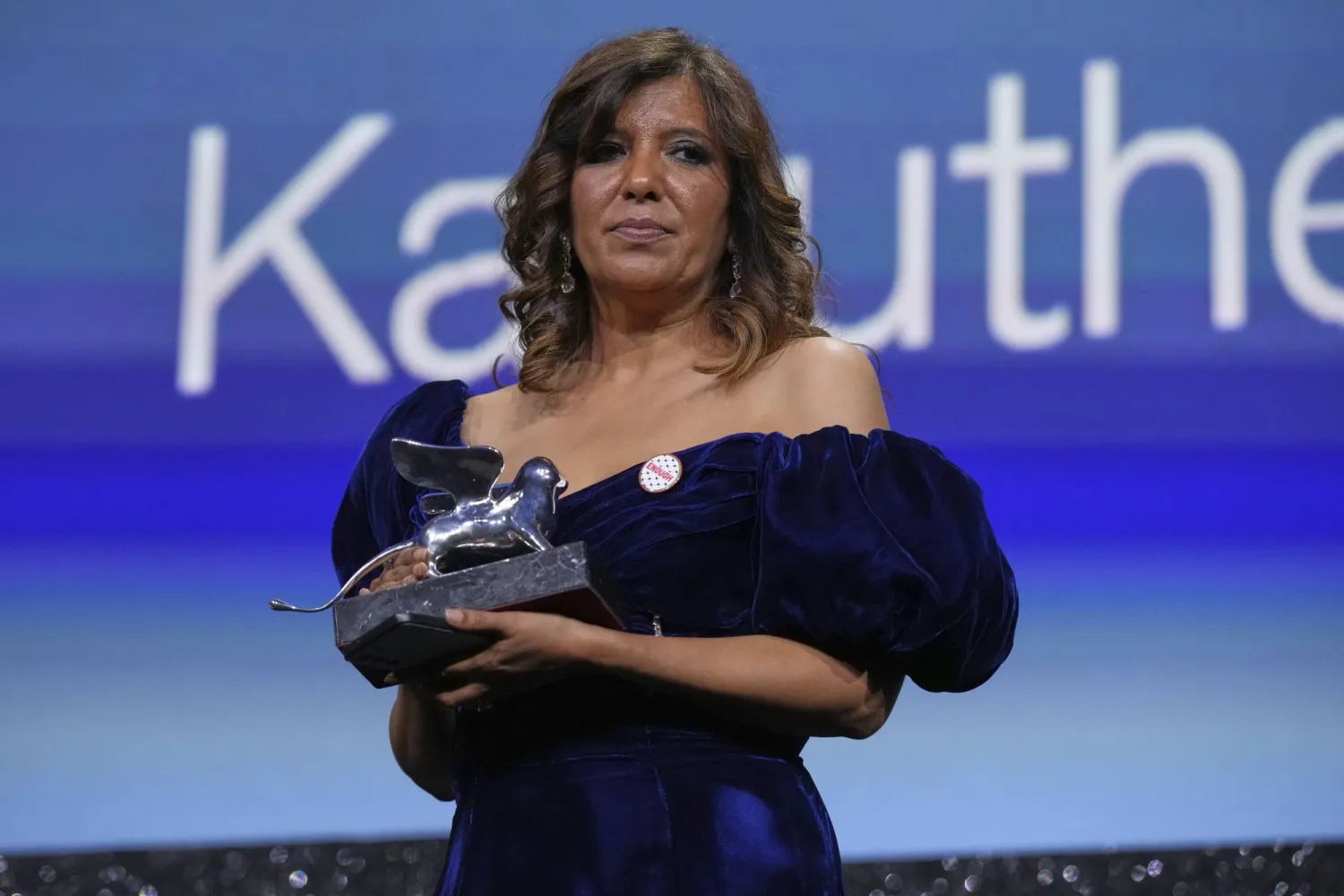

‘The Voice of Hind Rajab’ Wins Silver Lion at the Venice Film Festival

Director Kaouther Ben Hania accepts the grand jury prize for 'The Voice of Hind Rajab' during the awards ceremony of the 82nd edition of the Venice Film Festival in Venice, Italy, on Saturday, Sept. 6, 2025. (Photo by Alessandra Tarantino/Invision/AP)
TT

‘The Voice of Hind Rajab’ Wins Silver Lion at the Venice Film Festival

Director Kaouther Ben Hania accepts the grand jury prize for 'The Voice of Hind Rajab' during the awards ceremony of the 82nd edition of the Venice Film Festival in Venice, Italy, on Saturday, Sept. 6, 2025. (Photo by Alessandra Tarantino/Invision/AP)

“Father Mother Sister Brother,” Jim Jarmusch’s quietly humorous relationship triptych, won the top prize at the Venice Film Festival Saturday. The film about the relationships between adult children, and with their parents, stars Adam Driver, Vicky Krieps and Cate Blanchett.

It was an upset win over some of the festival’s bigger hits, including “The Voice of Hind Rajab,” which won the runner-up award, and Park Chan-wook’s “No Other Choice,” which left empty-handed.

“All of us here who make films are not motivated by competition,” Jarmusch said. “But I truly appreciate this unexpected honor.”

He thanked the festival for “appreciating our quiet film.” He said he related to Japanese filmmaker Akira Kurosawa who once said, while accepting an honor from the Academy Awards at an advanced age, that he was worried he still didn’t know what he was doing.

“I’m learning each time,” Jarmusch said.

Kaouther Ben Hania’s devastating Gaza docudrama “The Voice of Hind Rajab” won the Silver Lion, the runner-up prize. The film is about attempt to rescue a 6-year-old girl from a bullet ridden call in Gaza City in January 2024 and uses the real audio from her call to the Palestine Red Crescent Society.

The film premiered later in the festival, but its impact was not dulled. It received a 22-minute standing ovation after its premiere. She dedicated her award to the Red Crescent and “to all those who have risked everything to save lives in Gaza. They are the real heroes.”

Ben Hania in her remarks also called for an end to “this unbearable situation” in Gaza.

“Enough is enough,” she said.

She added: "The voice of Hind is the voice of Gaza itself. Her voice will continue to echo until accountability is real, until justice is served.”

Venice's acting, directing and other winners The Alexander Payne-led jury named Chinese actor Xin Zhilei best actress for leading Cai Shangjun’s “The Sun Rises on Us All,” a story about a love triangle set in the world of sweatshops in Guangzhou. Italian actor Toni Servillo won best actor for playing a president at the end of his term in Paolo Sorrentino's “La Grazia.”

Benny Safdie took the best director prize for his Mark Kerr MMA biopic “The Smashing Machine,” which has kicked off Oscar buzz for its star, Dwayne Johnson.

“I never thought I’d be up here,” Safdie said. “To be here amongst the giants of the past and the giants here this year, it just blows my mind.”
He also thanked his subject, Kerr, and his stars Emily Blunt and Dwayne Johnson.

“You truly performed with no net, and we jumped off a cliff together,” Safdie said of Johnson.

Valérie Donzelli and Gilles Marchand were recognized with best screenplay for their gig economy drama “At Work,” a French film about a successful photographer who gives up everything to focus on writing, and ends up in poverty.

The special jury prize went to Italian filmmaker Gianfranco Rosi for his lyrical Naples documentary “Below the Clouds.”

They also singled out Swiss actor Luna Wedler with the Marcello Mastroianni Award, which goes to a young actor, for her turn in the film “Silent Friend,” a poetic three-part story about a ginkgo tree in a medieval university town in Germany.

“Nebraska” filmmaker Payne presided over the main competition jury, which included Brazilian actor Fernanda Torres, Iranian director Mohammad Rasoulof, French director Stéphane Brizé, Italian director Maura Delpero, Chinese actor Zhao Tao and Romanian director Cristian Mungiu. The international group selected a particularly diverse batch of winners.

Winners spotlight wars in Gaza and Ukraine Winners for the horizons sidebar, a discovery section led by French filmmaker Julia Ducournau, were announced first. “En El Camino,” about the world of long-haul trucking in Mexico from filmmaker David Pablos, won best film. Anuparna Roy was emotional accepting the best director prize for her debut feature, “Songs of Forgotton Trees,” about two migrant women in Mumbai.

Roy, who is Indian, devoted part of her remarks to the conflict in Gaza.
“Every child deserves peace, freedom, liberation, and Palestine is no exception,” Roy said. “I stand beside Palestine. I might upset my country but it doesn’t matter to me anymore.”

Armani Beauty’s audience award winning filmmaker Maryam Touzani (“Calle Málaga”) also used her remarks to spotlight Gaza.

“How many mothers have been made childless,” she said. “How many more until this horror is brought to an end? We refuse to lose our humanity.”

“Aftersun” filmmaker Charlotte Wells handed out the debut film prize to Nastia Korkia for “Short Summer,” who spoke about the ongoing war in Ukraine. Her film is a loosely autobiographical account of a child living with her grandparents during the Chechen war.

“I very much hope that we will keep our eyes wide-open and that we will find the strength to stop the war,” Korkia said.

Honoring Armani The ceremony also included a tribute to the late Giorgio Armani, who died Thursday, with a standing ovation from the audience. Armani Beauty is a longtime sponsor of the festival.

“Thank you, Giorgio Armani, for teaching us that creativity lives in the spaces where disciplines meet - fashion, cinema, art, new materials, architecture - just as happens every day here at the Venice Biennale,” Italian architect Carlo Ratti said.

Oscars impact This year’s main competition lineup included many possible Oscar heavyweights, though most of Hollywood's flashiest offerings came up short at the awards. Kathryn Bigelow set off a warning shot about nuclear weapons and the apparatus of decision-making with her urgent, and distressingly realistic, thriller “A House of Dynamite.”

Guillermo del Toro unveiled his “Frankenstein,” a sumptuously gothic interpretation of the Mary Shelley classic, with Oscar Isaac portraying Victor Frankenstein as a romantic madman and Jacob Elodri, naive and raw, as the monster. Emma Stone and Jesse Plemons were strange and fierce as kidnapped and kidnapper in Yorgos Lanthimos’s provocative “Bugonia.” While they didn't prevail at the festival's awards, the films could still go on to be in the broader awards conversation.

Since 2014, the Venice Film Festival has hosted four best picture winners, including “The Shape of Water,” “Birdman,” “Spotlight” and “Nomadland.” Last year, they had several eventual Oscar-winning films in the lineup, including Brady Corbet’s “The Brutalist,” which won three including best actor for Adrien Brody, Walter Salles’ best international feature winner “I’m Still Here,” and the animated short “In the Shadow of the Cypress.”

The previous Golden Lion winner, Pedro Almodóvar’s English-language debut “The Room Next Door,” a smash at Venice with an 18-minute standing ovation, received no Oscar nominations.



German Killed in Swiss Avalanche, 4 Other Skiers Hurt

Swiss Air Force's aerobatic team "The Patrouille Suisse" perform prior to the FIS alpine skiing Men's World Cup Super G event in Wengen, Swiss Alps, on January 19, 2026. (Photo by Dimitar DILKOFF / AFP)
TT

German Killed in Swiss Avalanche, 4 Other Skiers Hurt

Swiss Air Force's aerobatic team "The Patrouille Suisse" perform prior to the FIS alpine skiing Men's World Cup Super G event in Wengen, Swiss Alps, on January 19, 2026. (Photo by Dimitar DILKOFF / AFP)

A German man has been killed in an avalanche in the Swiss alps and four other people were hurt as they were cross-country skiing, Swiss police said Saturday.

The incident happened on Friday, on the Piz Badus peak near the village of Tujetsch in the center-south of the country, AFP reported.

Police said a group of seven cross-country skiers were swept up in the avalanche, with five of them buried underneath.

One member of the party raised the alarm in a phone call to local police, who deployed helicopters with rescue workers and dogs to the site.

The German man was found lifeless under the snow and ice, the police said, adding that the four others hurt -- whose nationalities were not given -- suffered light injuries and were flown to nearby hospitals.


NASA's New Moon Rocket Heads to the Pad Ahead of Astronaut Launch

NASA's Artemis II SLS (Space Launch System) rocket and Orion spacecraft, secured to the mobile launcher, is seen inside the Vehicle Assembly building as preparations continue for roll out to Launch Pad 39B, Thursday, Jan. 15, 2026, at NASA's Kennedy Space Center in Florida. (Keegan Barber/NASA via AP)
TT

NASA's New Moon Rocket Heads to the Pad Ahead of Astronaut Launch

NASA's Artemis II SLS (Space Launch System) rocket and Orion spacecraft, secured to the mobile launcher, is seen inside the Vehicle Assembly building as preparations continue for roll out to Launch Pad 39B, Thursday, Jan. 15, 2026, at NASA's Kennedy Space Center in Florida. (Keegan Barber/NASA via AP)

NASA’s giant new moon rocket headed to the launch pad Saturday in preparation for astronauts’ first lunar fly-around in more than half a century.

The out-and-back trip could blast off as early as February.

The 322-foot (98-meter) rocket began its 1 mph (1.6 kph) creep from Kennedy Space Center’s Vehicle Assembly Building at daybreak. The four-mile (six-kilometer) trek was expected to take until nightfall.

Throngs of space center workers and their families gathered in the predawn chill to witness the long-awaited event, delayed for years, The Associated Press reported. They huddled together ahead of the Space Launch System rocket’s exit from the building, built in the 1960s to accommodate the Saturn V rockets that sent 24 astronauts to the moon during the Apollo program. The cheering crowd was led by NASA’s new administrator Jared Isaacman and all four astronauts assigned to the mission.

Weighing in at 11 million pounds (5 million kilograms), the Space Launch System rocket and Orion crew capsule on top made the move aboard a massive transporter that was used during the Apollo and shuttle eras. It was upgraded for the SLS rocket’s extra heft.

The first and only other SLS launch — which sent an empty Orion capsule into orbit around the moon — took place back in November 2022.

“This one feels a lot different, putting crew on the rocket and taking the crew around the moon,” NASA’s John Honeycutt said on the eve of the rocket’s rollout.

Heat shield damage and other capsule problems during the initial test flight required extensive analyses and tests, pushing back this first crew moonshot until now. The astronauts won’t orbit the moon or even land on it. That giant leap will take come on the third flight in the Artemis lineup a few years from now.

Commander Reid Wiseman, pilot Victor Glover and Christina Koch — longtime NASA astronauts with spaceflight experience — will be joined on the 10-day mission by Canadian astronaut Jeremy Hansen, a former fighter pilot awaiting his first rocket ride.

They will be the first people to fly to the moon since Apollo 17’s Gene Cernan and Harrison Schmitt closed out the triumphant lunar-landing program in 1972. Twelve astronauts strolled the lunar surface, beginning with Neil Armstrong and Buzz Aldrin in 1969.

NASA is waiting to conduct a fueling test of the SLS rocket on the pad in early February before confirming a launch date. Depending on how the demo goes, “that will ultimately lay out our path toward launch,” launch director Charlie Blackwell-Thompson said on Friday.

The space agency has only five days to launch in the first half of February before bumping into March.


Iron Age Teeth Fossils Reveal Diet Diversity of Italians 2,500 Years Ago

The fresco on the wall of a house in Pompeii that dates back 2,000 years (AFP)
TT

Iron Age Teeth Fossils Reveal Diet Diversity of Italians 2,500 Years Ago

The fresco on the wall of a house in Pompeii that dates back 2,000 years (AFP)

Italians began exploring a varied diet sometime between the 7th and 6th centuries BC, according to a new analysis of ancient teeth from Iron Age Italians.

Unravelling details about the lifestyles of ancient cultures is a challenging task, as it requires specific, well-preserved fossils of long-deceased individuals, The Independent reported.

Fossil human teeth are an excellent resource to understand ancient diets, acting as archives of each individual’s life history.

However, collecting information from teeth across different eras remains a challenge.

In the new study, researchers combined multiple analyses of teeth remains from the Italian archaeological site of Pontocagnano to interpret the health and diet of people in the region during the 7th and 6th centuries BC.

Scientists assessed the dental tissue of 30 teeth from 10 individuals, obtaining data from canine and molar teeth to reconstruct each ancient person’s history during the first six years of their lives.

Researchers found that the Iron Age Italians had a diet rich in cereals, legumes, abundant carbohydrates, and even fermented foods and drinks.

“We could follow childhood growth and health with remarkable precision and identify traces of cereals, legumes, and fermented foods in adulthood, revealing how this community adapted to environmental and social challenges,” said Roberto Germano, an author of the study.

Emanuela Cristiani, another author of the study said, “In the case of Pontocagnano, the analysis of dental calculus revealed starch granules from cereals and legumes, yeast spores, and plant fibres, providing a very concrete picture of the diet and some daily activities of these Iron Age communities.”

The findings offer strong evidence of this ancient Italian population regularly consuming fermented foods and beverages, researchers said.

Their diets likely diversified at the time as their contact with Mediterranean cultures increased, they added.

The researchers noted that while the study may not be completely representative of the broader Italian population, it provides a “very concrete picture” of the diet and some daily activities of Iron Age communities in the Italian region.

“This and other modern approaches represent a major technological and disciplinary advancement that is revolutionizing the study of the biocultural adaptations of past populations,” said Alessia Nava, another author of the study from Sapienza University of Rome.