


Board of Peace Pledges on Gaza Face Test of Implementation on the Ground

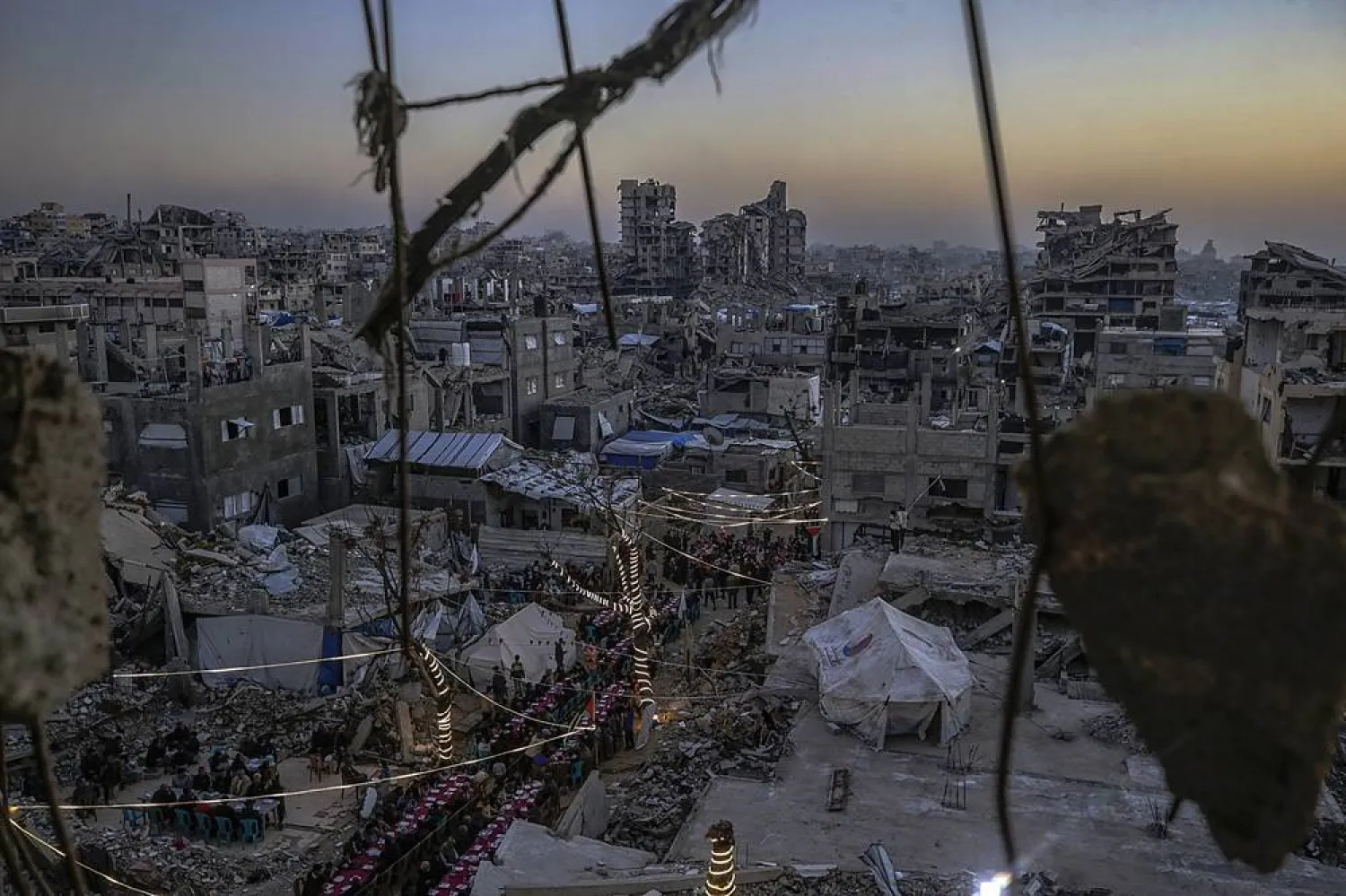
Palestinians gather between destroyed houses to break their fast together during the holy month of Ramadan in the northern Gaza Strip, 20 February 2026. (EPA)
TT

Board of Peace Pledges on Gaza Face Test of Implementation on the Ground

Palestinians gather between destroyed houses to break their fast together during the holy month of Ramadan in the northern Gaza Strip, 20 February 2026. (EPA)

The first meeting of the Board of Peace, chaired by US President Donald Trump and attended by Arab and Israeli representatives in the absence of the Palestinian Authority, set out ambitious goals but left key issues unresolved.

Washington distilled its priorities into two tracks: funding the reconstruction of Gaza and disarming Hamas. Arab participants, however, tied their demands to full implementation of the Gaza ceasefire, deployment of an international stabilization force, and enabling the technocrats’ committee to operate across the enclave without obstruction from Tel Aviv.

The meeting, which drew representatives from more than 40 countries and observers from 12 others, may struggle to translate pledges into practice, experts told Asharq Al-Awsat.

They pointed to formidable hurdles, foremost Israel’s continued deployment in Gaza and the absence of clear understandings on Hamas disarmament, warning that these issues could stall or even freeze the agreement.

Concerns

Indonesian President Prabowo Subianto urged caution against efforts that could derail the peace process in Gaza, Germany’s dpa news agency reported, citing Indonesia’s Antara News on Friday.

Trump announced that the United States would contribute $10 billion to the board, saying Saudi Arabia, Kazakhstan, Azerbaijan, the United Arab Emirates, Morocco, Bahrain, Qatar, Uzbekistan, and Kuwait had pledged more than $7 billion to the Gaza relief package.

He pressed hard on Hamas disarmament, saying the group would hand over its weapons as promised and warning of a harsh response if it did not.

Israel’s Foreign Minister Gideon Saar struck the same note in his address to the board, voicing support for disarming Hamas and other factions. Prime Minister Benjamin Netanyahu had already set the tone ahead of the meeting, declaring that there would be no reconstruction before Gaza is disarmed.

General Jasper Jeffers, commander of the newly formed International Stabilization Force, said Indonesia, Morocco, Kazakhstan, Kosovo, and Albania had pledged troops. Egypt and Jordan, which border Gaza, agreed to train police and security forces.

Egypt, in remarks delivered by Prime Minister Mostafa Madbouly, underscored the need to preserve the link between the West Bank and Gaza to allow the Palestinian Authority to resume its responsibilities in the enclave.

He called for empowering Palestinians to manage their own affairs and for the technocrats’ committee to begin work from inside Gaza and across all its areas.

Qatar’s Prime Minister and Foreign Minister Sheikh Mohammed bin Abdulrahman Al Thani pledged $1 billion from Doha to back the board’s push for a final settlement, saying the Board of Peace under Trump’s leadership would drive full implementation of the 20-point plan without delay.

Saeed Okasha, an Israeli affairs analyst at the Al-Ahram Center for Political and Strategic Studies, said the proposals unveiled by the Board of Peace lack operational clarity and risk creating confusion in implementation, potentially leading to paralysis.

Trump, he said, rushed to launch the board without first resolving core obstacles or forging solid understandings.

Palestinian political analyst Nizar Nazzal shared that view, arguing that the board’s pledges could falter because they emphasize economic measures, such as reconstruction funding, without a clear roadmap, and security measures, such as disarming Hamas, without addressing Israeli withdrawal or the group’s future.

“This sidestepping of political commitments will collide with security complexities and delay implementation of contentious provisions such as deploying stabilization forces, Israeli withdrawal, or empowering the technocrats’ committee,” he said.

Hamas

Hamas, for its part, has avoided direct confrontation with Trump’s recent calls for its disarmament. In a statement on Thursday, it said any arrangements in Gaza must begin with a “complete halt to the Israeli aggression.”

In another statement later that evening, the group said any political track or arrangements discussed regarding the Gaza Strip and the future of our Palestinian people must start with a complete cessation of the aggression, lifting the siege, and guaranteeing our people’s legitimate national rights, foremost among them the right to freedom and self-determination.

US mediator Bishara Bahbah said on Thursday that Hamas disarmament hinges on guarantees and protection for its members.

Okasha said an end to the offensive in Gaza, as Hamas demands, is unlikely so long as disarmament remains unresolved, pointing to US and Israeli statements.

The course Hamas appears to be charting, he said, suggests it wants to remain in place, a stance that could block implementation of the agreement and even pave the way for a return to war, especially as Washington has yet to clarify the mandate and timeline for deploying the stabilization force.

Nazzal said negotiating with Hamas over ending its existence is unrealistic. Its future must be addressed through serious, genuine understandings rather than a continuation of transactional trade-offs, he said.



Libya’s Ramadan Celebrations Tempered by Economic Woes

A family walks on their way to shop for Ramadan decorations ahead of the holy month of Ramadan in Benghazi, Libya, February 16, 2026. (Reuters)
TT

Libya’s Ramadan Celebrations Tempered by Economic Woes

A family walks on their way to shop for Ramadan decorations ahead of the holy month of Ramadan in Benghazi, Libya, February 16, 2026. (Reuters)

Libyans have been enjoying Ramadan with feasts and fireworks -- but soaring prices, a devalued currency and political divisions have left many with little to celebrate.

Fifteen years on from the fall of longtime leader Moammar al-Gaddafi, the country remains split between east and west, while shortages of goods, including fuel, disrupt daily life, despite Libya sitting atop vast oil and gas reserves.

During the holy month of Ramadan, shoppers stock up on treats, as families gather for lavish meals before and after the daytime fast that stretches from sunrise to sunset.

But this year supermarkets have been rationing their goods, while many petrol stations are short of gas. In the capital Tripoli, most ATMs were out of cash this week.

Firas Zreeg, 37, told AFP while weaving through a crowded supermarket that the economy was deteriorating, blaming currency speculators for the fall in the dinar, "which has negative repercussions on our daily lives".

The price of cooking oil has doubled in recent weeks, while meat and poultry prices rose by half.

Refills of gas cylinders, officially priced at 1.5 dinars ($0.24) but often unavailable through state-run distributors, now sell for 75 dinars ($11.85) on the black market and at times more.

- 'Burden on citizens' -

Libya has struggled to recover from the chaos that erupted following the 2011 uprising that toppled Gaddafi.

It remains divided between the Government of National Unity (GNU) based in Tripoli and an eastern administration backed by Libyan National Army (LNA) commander Khalifa Haftar.

The country has largely been stable in recent years although there have been bouts of deadly violence, including the killing of Gaddafi's son and heir apparent Seif al-Islam this month.

With security holding, many Libyans are more focused on their livelihoods.

Last month, the central bank in the western territory devalued the dinar -- the second time in less than a year -- by nearly 15 percent, "aimed at preserving financial and monetary stability and ensuring the sustainability of public resources".

In an address this week, GNU leader Abdulhamid Dbeibah acknowledged that the devaluation had once again "put the burden on citizens".

Hanna Tetteh, head of the United Nations Support Mission in Libya, warned on Wednesday that "poverty and pressure on society [are] increasing".

"The situation, in addition to the fragile security landscape, should be a matter for concern as such conditions can lead to unexpected political and security challenges," she told the UN Security Council.

Libya's other economic problems included the absence of a unified national budget, in light of its political divide, as well as uncoordinated public spending due to parallel state institutions, Tetteh said.

Revenues from the oil industry were also declining, she added, while the central bank has said public spending is growing at an unsustainable pace.

On Tuesday, Libya marked 15 years since the start of the uprising, with fireworks lighting up the sky in Tripoli, but for many Libyans life remains a struggle.

"Minor improvements in security were made over the past three years," Zreeg told AFP, but Libyans are still faced with huge economic challenges.


Libya PM Undergoes 'Successful' Treatment at Heart Hospital

Head of Libya's Government of National Unity (GNU) Abdulhamid Dbeibah. (GNU)
TT

Libya PM Undergoes 'Successful' Treatment at Heart Hospital

Head of Libya's Government of National Unity (GNU) Abdulhamid Dbeibah. (GNU)

Libya's Prime Minister Abdulhamid Dbeibah has undergone "successful" treatment at a heart hospital, his office said Saturday, but his specific ailment was not disclosed.

"I assure you that I am fine, by God's grace," said a statement posted on social media overnight.

The treatment was carried out at a facility in the northwestern Libyan city of Misrata on an undisclosed date, said AFP.

Dbeibah said he later travelled abroad for "additional medical checkups for reassurance", though this was not the primary reason for his trip.

Italian media outlets previously reported he had been admitted to a leading cardiac facility in Milan on Thursday for a general check-up.

"The matter is simply that I underwent some additional medical checkups for reassurance while I was abroad due to a prior external commitment," he said.

"The results confirmed the success of the treatment I received in Libya, praise be to God."

The prime minister leads a UN-recognized government based in Tripoli that controls western Libya, while the country's east is run by another administration backed by military strongman Khalifa Haftar.

Libya has remained divided since chaos erupted following the 2011 Arab Spring uprising that toppled longtime leader Muammar Gaddafi.


Eight Hezbollah Members Killed in Israel’s Friday Strikes on Lebanon

A bulldozer clears debris near heavily-damaged buildings in the village of Bednayel in Lebanon's eastern Bekaa Valley region on February 21, 2026, following Israeli strikes. (AFP)
TT

Eight Hezbollah Members Killed in Israel’s Friday Strikes on Lebanon

A bulldozer clears debris near heavily-damaged buildings in the village of Bednayel in Lebanon's eastern Bekaa Valley region on February 21, 2026, following Israeli strikes. (AFP)

Attacks carried out by Israel on Friday in eastern Lebanon killed eight members of Hezbollah, an official from the group told AFP on Saturday.

Lebanon's health ministry said Friday that a total of 10 people were killed in strikes that hit the eastern Bekaa region.

The Israeli military said it targeted "several terrorists of Hezbollah's missile array in three different command centers in the Baalbek area".

Lebanon's president on Saturday condemned the attacks, the latest despite a ceasefire with Hezbollah.

In a statement, Joseph Aoun called the attacks "a blatant act of aggression aimed at thwarting diplomatic efforts" by the United States and other nations to establish stability.

A lawmaker from Hezbollah called on Beirut to suspend meetings of a multinational committee tasked with monitoring the truce.

Washington is one of five members on the committee overseeing the ceasefire implemented in November 2024, with the body scheduled to meet again next week.

Israel has repeatedly bombed Lebanon despite the ceasefire, usually saying it is targeting Hezbollah but occasionally also the group's Palestinian ally Hamas.

The Friday attacks on southern and eastern Lebanon killed 12 people, according to the health ministry, 10 of them in the east of the country.

Israel's military said it struck "several terrorists of Hezbollah's missile array in three different command centers in the Baalbek area".

Hezbollah said a commander was killed in the raids. Its lawmaker Rami Abu Hamdan said on Saturday the group "will not accept the authorities acting as mere political analysts, dismissing these as Israeli strikes we have grown accustomed to before every meeting of the committee".

He called on Beirut to "suspend the committee's meetings until the enemy ceases its attacks".

Hezbollah, while weakened following war with Israel, remains a strong political force in Lebanon represented in parliament.

Lebanon's government last year committed to disarming the Iran-backed group, with the army saying last month it had completed the first phase of the plan covering the area near the Israeli border.

Israel, which accuses Hezbollah of rearming since the war, has called the Lebanese army's progress on disarming the group insufficient.