


Conservationists Fight to Save Nigeria's Sea Turtles from Pollution and Poachers

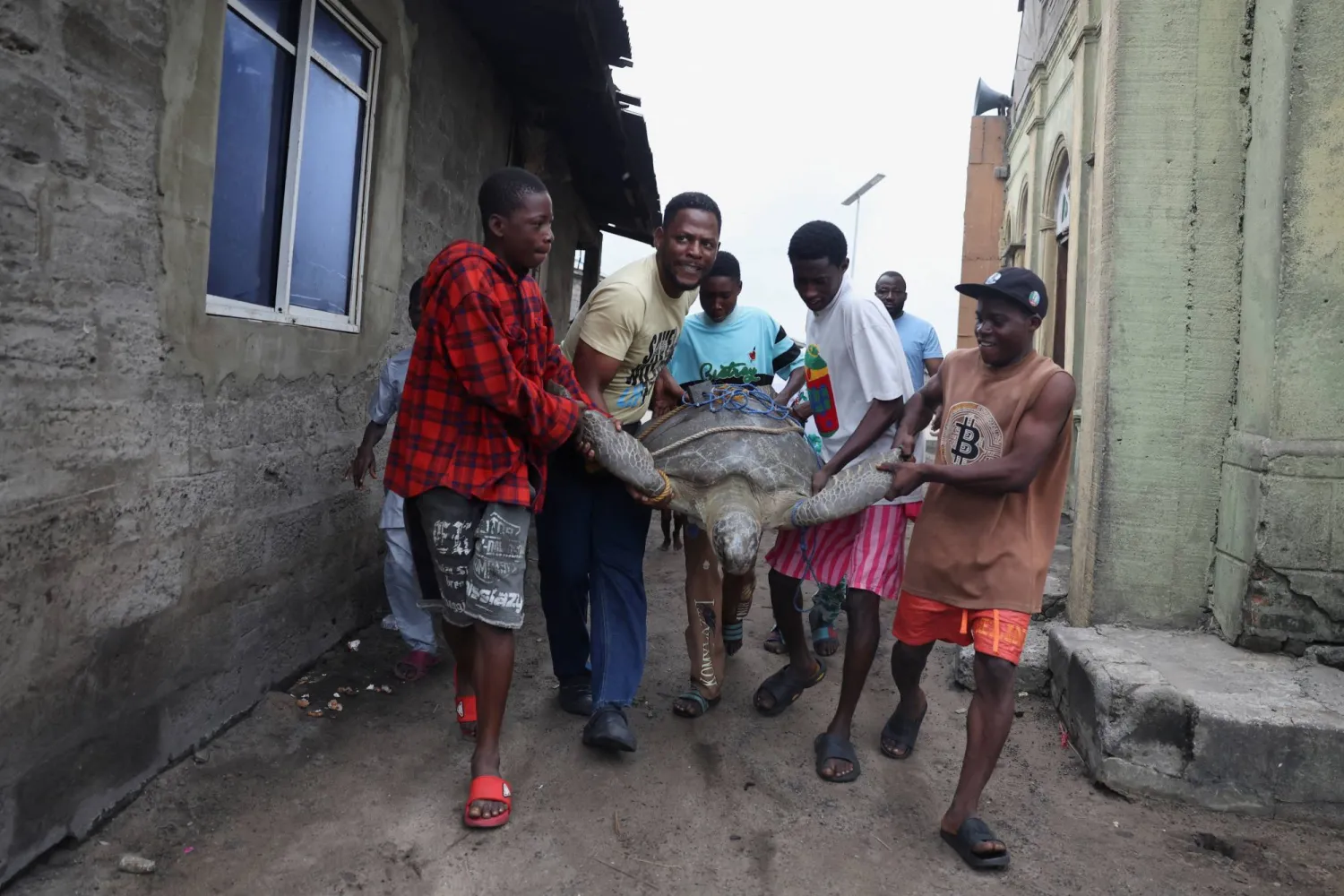
Chinedu Mogbo, a wildlife conservationist, carries Moruf, a sea turtle, after rescuing it from poachers in a fishing community along the Ibeju-Lekki coastline in Lagos, Nigeria, July 29, 2025. REUTERS/Sodiq
TT

Conservationists Fight to Save Nigeria's Sea Turtles from Pollution and Poachers

Chinedu Mogbo, a wildlife conservationist, carries Moruf, a sea turtle, after rescuing it from poachers in a fishing community along the Ibeju-Lekki coastline in Lagos, Nigeria, July 29, 2025. REUTERS/Sodiq

Plastic pollution, discarded fishing nets and coastal development are taking a heavy toll on Nigeria's sea turtles, say conservationists battling to save them.

"We're seeing a drastic decline," said Chinedu Mogbo, founder of the Greenfingers Wildlife Conservation Initiative, which has rescued and released more than 70 turtles over the last five years after treating them at its turtle sanctuary.

At least five endangered or threatened sea turtle species inhabit Nigeria's waters, but exact numbers are not known and resources for monitoring are inadequate, Mogbo said.

His team has rescued Olive Ridley, Hawksbill and Leatherback turtles.

Mostly self-funded, Mogbo's group has been working with local fishermen to save the animals.

"Fishers need income. We offer net repair kits in exchange for rescued turtles or protected nests," he told Reuters at the group's turtle sanctuary in the coastal city of Lagos, Nigeria's commercial capital.

But with no marine protected areas and shrinking nesting grounds, the coastline has become a trap for turtles, Mogbo said, calling for state authorities to do more to protect them.

Nigeria's environmental agency did not respond to requests for comment.

An additional threat to sea turtles comes from brisk demand for their meat, shells and eggs in Nigeria, both for consumption and traditional ritual uses.

"We eat their eggs and sometimes give them to the village elders for voodoo," said Morifat Hassan, who sells fish in the coastal area of Folu on the outskirts of Lagos. Sea turtles fetch up to 90,000 naira ($60) each, Hassan said.

In July, rescuers saved a huge green turtle in the Folu area that was injured after getting tangled in a fishing net. They have named him Moruf.

After negotiating with the fishermen who found Moruf, Mogbo was able to fend off people trying to buy the injured turtle.

"Normally, this turtle would be butchered or sold, but we intervened and will ensure it is returned safely to the sea," Mogbo said as he stood on the shoreline.



Scientists: 'Bleak' Future for Seals Decimated by Bird Flu

(FILES) This photograph shows elephant seals on the Possession Island, part of the Crozet Islands which are a sub-Antarctic archipelago of small islands in the southern Indian Ocean, on December 21, 2022. (Photo by Patrick HERTZOG / AFP)
TT

Scientists: 'Bleak' Future for Seals Decimated by Bird Flu

(FILES) This photograph shows elephant seals on the Possession Island, part of the Crozet Islands which are a sub-Antarctic archipelago of small islands in the southern Indian Ocean, on December 21, 2022. (Photo by Patrick HERTZOG / AFP)

The world's largest species of seal has been devastated by bird flu, which has wiped out half of all breeding females at a key wildlife haven near Antarctica, scientists warned Thursday.

The remote island of South Georgia is the home of a majority of all southern elephant seals. Males of these blubbery giants can grow up to two meters (six feet seven inches) long, weigh nearly four tons (8,800 pounds) -- and have a distinctive elephant-trunk-like proboscis on their face that earned the mammals their name.

Bird flu arrived on South Georgia in 2023 during an outbreak that has seen the virus spread across the world like never before, killing millions of birds and infecting many mammals, including several humans.

Earlier this year, scientists warned that bird flu had sparked the worst die-off on record for southern elephant seals when it spread among a population on Argentina's coast in 2023, AFP reported.

In a study published in the journal Communications Biology on Thursday, a UK team of researchers gave the first estimate for how hard South Georgia's seals have been hit.

"It paints a pretty stark and harrowing picture," Connor Bamford, a marine ecologist at the British Antarctic Survey and lead author of the study, told AFP.

According to the last count in 1995, South Georgia is home to 54 percent of all southern elephant seals.

On the same day of the year in 2022 and 2024, the scientists used hand-launched drones to take images of the island's three biggest breeding beaches.

After bird flu arrived, the number of breeding females plummeted by 47 percent, a loss of around 53,000 seals, according to the study.

Many pups also died on the beach after being abandoned by their bird-flu-infected mothers.

Scientists at the breeding ground on the Valdes Peninsula along Argentina's coast have determined that 97 percent of elephant seal pups died either from being abandoned or contracting bird flu in 2023.

On the peninsula, an even higher rate of breeding females -- 67 percent -- were estimated to have been wiped out.

"If the South Georgia population responds similarly to the modelled outlook at Peninsula Valdes, the future is bleak," the authors of the new study said.

However, Bamford did not think the elephant seals would be pushed "close to extinction".

The South Georgia population is much larger -- numbering in the hundreds of thousands -- so is likely to be more resilient, he said.

"That being said, the impacts to this population will be felt for many years to come," he added.

For the Valdes seals, scientists have estimated that the aftermath of this bird flu outbreak will likely reverberate until the end of the century.

The researchers believe that the seals are transmitting the virus to each other via water droplets, Bamford said.

While elephants spend most of their time in the water, they breed in densely packed colonies on wide, sandy beaches.

"There are thousands of them together, all coughing and splattering," Bamford said, adding that the seals are also particularly "snotty".

The scientist called for "regular check-ups" on South Georgia's elephant seals.


Solar Storms Delay the Launch of Blue Origin's Big New Rocket with Mars Orbiters for NASA

A Blue Origin New Glenn rocket is fueled for launch with NASA's EscaPADE mission, carrying two satellites to orbit Mars, from the Cape Canaveral Space Force Station in Cape Canaveral, Florida, US, November 9, 2025. REUTERS/Joe Skipper
TT

Solar Storms Delay the Launch of Blue Origin's Big New Rocket with Mars Orbiters for NASA

A Blue Origin New Glenn rocket is fueled for launch with NASA's EscaPADE mission, carrying two satellites to orbit Mars, from the Cape Canaveral Space Force Station in Cape Canaveral, Florida, US, November 9, 2025. REUTERS/Joe Skipper

Intense solar storms responsible for breathtaking auroras across the US delayed the launch of Blue Origin’s big new rocket Wednesday.

Already grounded by poor weather, the New Glenn rocket was poised to blast off in the afternoon with two Mars orbiters for NASA from Florida. But five hours before the targeted liftoff, it was called off because of the heightened solar activity, The AP news reported.

Worried about the possible impact of increased radiation on its Mars-bound spacecraft, NASA decided to postpone the launch until conditions improve. Officials said they would try again Thursday.

This will be only the second flight of a New Glenn rocket, which made its debut in January. At 321 feet (98 meters), it is considerably larger and more powerful than the New Shepard rockets that Jeff Bezos' Blue Origin is launching from Texas with passengers.


For First Time, Scientists See the Very Early Stages of a Supernova

An artist's impression shows a star exploding at the end of its lifecycle, called a supernova, in this handout image released by the European Southern Observatory on November 12, 2025. The star is located about 22 million light-years away from Earth in the galaxy NGC 3621. ESO/L. Calcada/Handout via REUTERS
TT

For First Time, Scientists See the Very Early Stages of a Supernova

An artist's impression shows a star exploding at the end of its lifecycle, called a supernova, in this handout image released by the European Southern Observatory on November 12, 2025. The star is located about 22 million light-years away from Earth in the galaxy NGC 3621. ESO/L. Calcada/Handout via REUTERS

The explosive death of a star - a supernova - is among the most violent cosmic events, but precisely how this cataclysm looks as it unfolds has remained mysterious. Scientists now have observed for the first time the very early stages of a supernova, with a massive star exploding in a distinctive olive-like shape, according to Reuters.

The researchers used the European Southern Observatory's Chile-based Very Large Telescope, or VLT, to observe the supernova, which involved a star roughly 15 times the mass of our sun residing in a galaxy called NGC 3621 about 22 million light-years from Earth in the direction of the constellation Hydra. A light-year is the distance light travels in a year, 5.9 trillion miles (9.5 trillion km).

The shape of such explosions has been hard to nail down until now because of how rapidly they take place, so it took quick action with this supernova. The explosion was detected on April 10, 2024, around the time astrophysicist Yi Yang of Tsinghua University in China had landed on a long flight to San Francisco. Yang's formal request just hours later to aim the VLT at the supernova was granted.

The researchers thus were able to observe the explosion just 26 hours after the initial detection and 29 hours after material from inside the star first broke through the stellar surface.

What they saw was the doomed star surrounded at its equator by a preexisting disk of gas and dust, with the explosion pushing material outward from the stellar core to distort the star's shape into one resembling a vertical-standing olive. The explosion notably did not blow the star apart in a spherical shape. Instead, the explosion pushed violently outward at opposite sides of the star.

"The geometry of a supernova explosion provides fundamental information on stellar evolution and the physical processes leading to these cosmic fireworks," said Yang, lead author of the study published on Wednesday in the journal Science Advances.

"The exact mechanisms behind supernova explosions of massive stars, those with more than eight times the mass of the sun, are still debated and are one of the fundamental questions scientists want to address," Yang said.

Big stars like those live relatively short lives. This one, a type called a red supergiant, was about 25 million years old at the time of its demise. In comparison, the sun is more than 4.5 billion years old and has a few more billion years to go.

At the time it exploded, this star's diameter was 600 times greater than the sun. Some of the star's mass was blown into space in the explosion. The remainder is believed to have become a neutron star, a highly compact stellar remnant, according to study co-author Dietrich Baade, a Germany-based astrophysicist at the European Southern Observatory.

When a star exhausts the hydrogen fuel for the nuclear fusion occurring at its center, its core collapses, which then sends material blasting outward, penetrating the stellar surface and into space.

"The first VLT observations captured the phase during which matter accelerated by the explosion near the center of the star shot through the star's surface, the photosphere," Yang said.

"Once the shock breaks through the surface, it unleashes immense amounts of energy. The supernova then brightens dramatically and becomes observable. During a short-lived phase, the supernova's initial 'breakout' shape can be studied before the explosion interacts with the material surrounding the dying star," Yang said.

This shape, Yang said, offers clues about how the explosion was triggered at the heart of the star. The new observations seem to rule out some current scientific models of the explosion process, Yang said, as scientists refine their understanding of the deaths of massive stars.