


Astronomers Spot White Dwarf that Guzzled a Pluto-like World

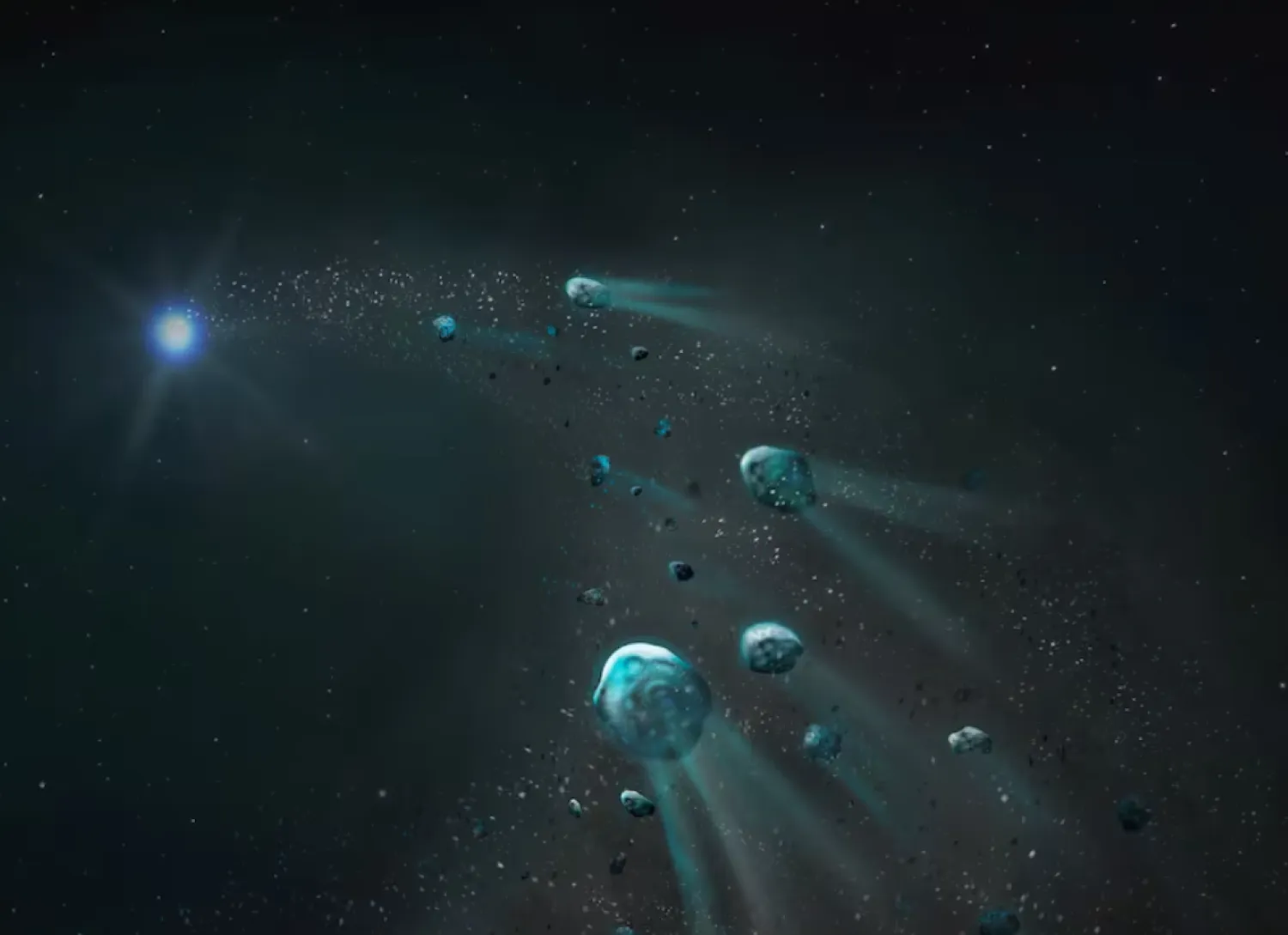
An early stage of an icy body being torn apart by the intense gravity of a white dwarf -a highly compact stellar ember- leaving glowing trails of gas and dust, as its fragments spiral inward, is seen in this handout illustration released on September 24, 2025. Snehalata Sahu/University of Warwick/Handout via REUTERS
TT

Astronomers Spot White Dwarf that Guzzled a Pluto-like World

An early stage of an icy body being torn apart by the intense gravity of a white dwarf -a highly compact stellar ember- leaving glowing trails of gas and dust, as its fragments spiral inward, is seen in this handout illustration released on September 24, 2025. Snehalata Sahu/University of Warwick/Handout via REUTERS

Astronomers using the Hubble Space Telescope have observed a white dwarf - a highly compact stellar ember - that appears to have gobbled up an icy world akin to the dwarf planet Pluto, a finding with implications regarding the likelihood of habitable planets beyond our solar system.

The white dwarf is located in our Milky Way galaxy about 255 light-years from Earth, relatively close in cosmic terms, and has a mass about 57% that of the sun. A light-year is the distance light travels in a year, 5.9 trillion miles (9.5 trillion km).

White dwarfs are among the universe's most compact objects, though not as dense as black holes. Stars with up to eight times the mass of the sun appear destined to end up as a white dwarf. They eventually burn up all the hydrogen they use as fuel. Gravity then causes them to collapse and blow off their outer layers in a "red giant" stage, eventually leaving behind a compact core - the white dwarf, according to Reuters.

The sun appears fated to end its existence as a white dwarf, billions of years from now. The white dwarf in the new study is a remnant of a star estimated to have been 50% more massive than the sun. In its current compact form, its diameter is roughly equivalent to that of Earth despite being perhaps 190,000 times more massive than our planet.

Astronomers previously documented how white dwarfs, thanks to their strong gravitational pull, consume - or accrete, in scientific terms - rocky bodies like planets, moons and asteroids. Scientists use telescopes to spot material on the white dwarf's surface made up of the elements that comprised these objects.

Researchers have now detected a chemical fingerprint in this white dwarf indicating that the object it swallowed was not primarily rocky but instead icy. They suspect the white dwarf's gravitational effects ripped apart a Pluto-like world and that its pieces then plunged onto it.

"The white dwarf likely accreted fragments from the crust and mantle of a Pluto-like icy world," said Snehalata Sahu, a postdoctoral research fellow in astrophysics at the University of Warwick in England, lead author of the study published this month in the journal Monthly Notices of the Royal Astronomical Society.

"If not an entire Pluto, it would be a fragment chipped off a Pluto-like world by the collision with some other body. Either way, once this body gets sufficiently close to the white dwarf, roughly within a distance comparable to the size of the sun, the strong gravity would tidally distort the body, and it eventually would crack and disintegrate," said University of Warwick astrophysicist and study co-author Boris Gänsicke.

KEY EVIDENCE

Chemical evidence indicated that the object was not a comet, another type of icy body.

"The key evidence comes from the unusually high abundance of nitrogen we observed, much higher than in typical cometary material, and consistent with the nitrogen-rich ices that dominate Pluto's surface," Sahu said.

The detection of nitrogen, according to Gänsicke, was made possible through the use of Hubble's Cosmic Origins Spectrograph instrument, which observes ultraviolet light to study the formation and evolution of galaxies, stars and planetary systems.

The rate of material falling onto the white dwarf was equivalent to about the mass of an adult blue whale diving onto it every second and sustained for at least the past 13 years, Sahu said.

These observations provided evidence that icy bodies like those in our solar system exist in other planetary systems. The solar system has an abundance of them, particularly in a frigid region beyond the outermost planet Neptune populated by dwarf planets like Pluto, comets and other icy bodies.

Water is a crucial ingredient for life. But how rocky planets like Earth come to possess large amounts of it is a matter of debate.

"In our solar system, icy bodies such as comets are thought to have played a key role in delivering water to the rocky planets, including Earth. Along with water, they also supplied other volatile and organic compounds such as carbon, sulfur and complex organics that are essential for prebiotic chemistry and, ultimately, the emergence of life," Sahu said.

"Similarly, in other planetary systems, water-rich bodies are expected to serve as carriers of these fundamental building blocks, potentially contributing to the development of habitable environments," Sahu added. "Detecting water-rich bodies around other stars provides observational confirmation that such reservoirs exist beyond our solar system."



Paws on Parade: Nairobi's Dogs Dazzle at 'Pawchella'

Fans and their pets participates in the 2025 Pawchella Shaggy Dog Show at Ngong Racecourse in Nairobi on November 9, 2025. (AFP)
TT

Paws on Parade: Nairobi's Dogs Dazzle at 'Pawchella'

Fans and their pets participates in the 2025 Pawchella Shaggy Dog Show at Ngong Racecourse in Nairobi on November 9, 2025. (AFP)

Nairobi dog lovers showed off their four-legged friends in an array of quirky, colorful outfits Sunday as the Kenyan capital's annual dog show returned with the theme of "Pawchella".

From Mexican-style sombreros to East Africa's Maasai-inspired shukas -- and even coordinated owner-pet outfits -- the fashion spectrum was as bold as it was adorable.

Dubbed the Shaggy Dog Show, the annual event is organized by the Kenya Society for the Protection and Care of Animals (KSPCA) for pups rescued from abuse or the street.

"We get 6,000 calls a year for immediate, urgent help," KSPCA's chief Emma Ngugi told AFP, adding that the emergencies arise from car accidents, human cruelty or sickness.

With the theme "Adopt, don't shop!", many of the rescued dogs stealing the spotlight in full glam are now rehabilitated and thriving in new homes -- but Ngugi said there were still many at the center in desperate condition.

The show aims to raise funds for the NGO, which has been rescuing not just dogs but also cats, donkeys, and horses for over a century.

KSPCA also advocates for pet vaccination, with every furry attendee at the show required to present a vaccination certificate.

Ngugi noted that rabies remains a serious threat in Kenya.

To address the rising number of stray dogs without homes, KSPCA also champions neutering to help control the population.

Many at the show became instant stars, from a cane corso tipping the scales at over 45 kilograms (100 pounds) to a tiny chihuahua weighing just 1.8 kilograms.

A three-year-old Caucasian shepherd won the "shaggiest" category, flaunting its massive grey coat as many festival-goers lined up to strike a pose alongside it.

This is "a chance to come together and celebrate" as dog lovers, Ngugi said.

She noted that pet culture in Kenya had evolved over the decades, with dogs and other animals now treasured "not necessarily for work, but as companions" in a way that was not the case traditionally.

"The majority of people now adopting, especially dogs and cats, are young African Kenyan families," Ngugi said.


Bezos's Blue Origin Set to Launch NASA Mission to Mars

 A Blue Origin New Glenn rocket is fueled for launch with NASA's EscaPADE mission, carrying two satellites to orbit Mars, from the Cape Canaveral Space Force Station in Cape Canaveral, Florida, US, November 9, 2025. (Reuters)
A Blue Origin New Glenn rocket is fueled for launch with NASA's EscaPADE mission, carrying two satellites to orbit Mars, from the Cape Canaveral Space Force Station in Cape Canaveral, Florida, US, November 9, 2025. (Reuters)
TT

Bezos's Blue Origin Set to Launch NASA Mission to Mars

 A Blue Origin New Glenn rocket is fueled for launch with NASA's EscaPADE mission, carrying two satellites to orbit Mars, from the Cape Canaveral Space Force Station in Cape Canaveral, Florida, US, November 9, 2025. (Reuters)
A Blue Origin New Glenn rocket is fueled for launch with NASA's EscaPADE mission, carrying two satellites to orbit Mars, from the Cape Canaveral Space Force Station in Cape Canaveral, Florida, US, November 9, 2025. (Reuters)

New Glenn, the towering rocket built by Jeff Bezos's space company Blue Origin, is set to take off on its second mission Sunday as competition intensifies with Elon Musk's SpaceX.

The 322-foot (98-meter) rocket has the task of sending NASA's ESCAPADE twin spacecraft to Mars, a bid to study the Red Planet's climate history and pave the way for eventual human exploration.

Blue Origin's launch will also serve as a key test of whether it can achieve booster recovery -- what would prove a technical breakthrough for the company if successful.

The rocket is set to blast off Sunday during an 88-minute launch window that will begin at 2:45pm (1945 GMT).

If delayed by weather or a technical glitch, rescheduling could prove challenging given the US government shutdown. To relieve airspace congestion, the Federal Aviation Administration is limiting commercial rocket lift-offs starting Monday.

New Glenn's inaugural flight in January was marked as a success as its payload achieved orbit and successfully performed tests.

But its first-stage booster, which was meant to be reusable, did not stick its landing on a platform in the Atlantic, and instead was lost during descent.

This time it will try once more to recover the booster stage. Thus far, only Musk's company SpaceX has managed to do that.

The competing space companies of billionaires Musk and Bezos are locked in a commercial space race that recently escalated, as the US federal space agency opened up bids for its planned Moon mission as complaints emerged that SpaceX was "behind."

George Nield -- a senior aerospace executive whose work promotes the commercial space industry, and who has flown with Blue Origin in the past -- told AFP the stakes of Sunday's launch are high.

How the launch plays out will be an indicator of "how well they're doing and how much progress they've made," he said.

If all goes to plan, the twin satellites aboard New Glenn are slated to reach Martian orbit in 2027.

US President Donald Trump's second term in the White House has seen the administration pile pressure on NASA to accelerate its progress to send a crewed mission to the moon amid a race with China.

Mason Peck, an aeronautics professor at Cornell University and former NASA chief technologist, said increased competition between SpaceX and Blue Origin could "expand our options with regard to launch."

"More launches means more ideas in space," Peck said. "It can't be a bad thing to have Blue Origin even trailing behind."


King Charles III Leads Britain’s Remembrance Sunday Ceremony for War Dead

 Britain's King Charles attends the annual Remembrance Sunday ceremony at The Cenotaph on Whitehall in London, Sunday Nov. 9, 2025. (AP)
Britain's King Charles attends the annual Remembrance Sunday ceremony at The Cenotaph on Whitehall in London, Sunday Nov. 9, 2025. (AP)
TT

King Charles III Leads Britain’s Remembrance Sunday Ceremony for War Dead

 Britain's King Charles attends the annual Remembrance Sunday ceremony at The Cenotaph on Whitehall in London, Sunday Nov. 9, 2025. (AP)
Britain's King Charles attends the annual Remembrance Sunday ceremony at The Cenotaph on Whitehall in London, Sunday Nov. 9, 2025. (AP)

Thousands of military personnel, veterans and members of the public gathered under blue skies Sunday in London as King Charles III led Britain’s annual ceremony of remembrance for the country’s war dead.

As Parliament’s Big Ben bell tolled 11 am, the crowd fell still for two minutes of silence, broken by a single artillery blast and Royal Marines buglers sounding “The Last Post.”

The 76-year-old king, dressed in the uniform of an army field marshal, laid a wreath of red paper poppies on a black background at the base of the Cenotaph war memorial near Parliament. Erected over a century ago to honor the British and allied troops killed in World War I, it has become the focus of annual ceremonies for members of military and civilian services killed in that war and subsequent conflicts.

The national ceremony of remembrance is held every year on the nearest Sunday to the anniversary of the end of World War I on Nov. 11, 1918, at 11 am. Similar memorial services are held in dozens of towns and cities across Britain and at UK military bases overseas.

A military band played as heir to the throne Prince William followed his father in laying a wreath on the simple Portland stone monument inscribed with the words “the glorious dead.”

Other members of the royal family followed, including the king’s youngest brother, Prince Edward — but not former prince Andrew Mountbatten Windsor. The king stripped his brother Andrew of his titles last month and evicted him from his royal mansion over his relationship with convicted sex offender Jeffrey Epstein.

Wreaths were also laid by Prime Minister Keir Starmer, other political leaders and diplomats from Commonwealth nations.

Queen Camilla, the Princess of Wales and other members of the royal family watched from their traditional place on a balcony of the Foreign, Commonwealth and Development Office.

Many of the wreaths were made of poppies, and most people in attendance wore paper poppies on their lapels. The scarlet flowers that bloomed on the muddy battlefields and makeshift graveyards of northern France and Belgium during World War I — made famous by the poem “In Flanders Fields” — have become a symbol of remembrance in Britain and other countries.