

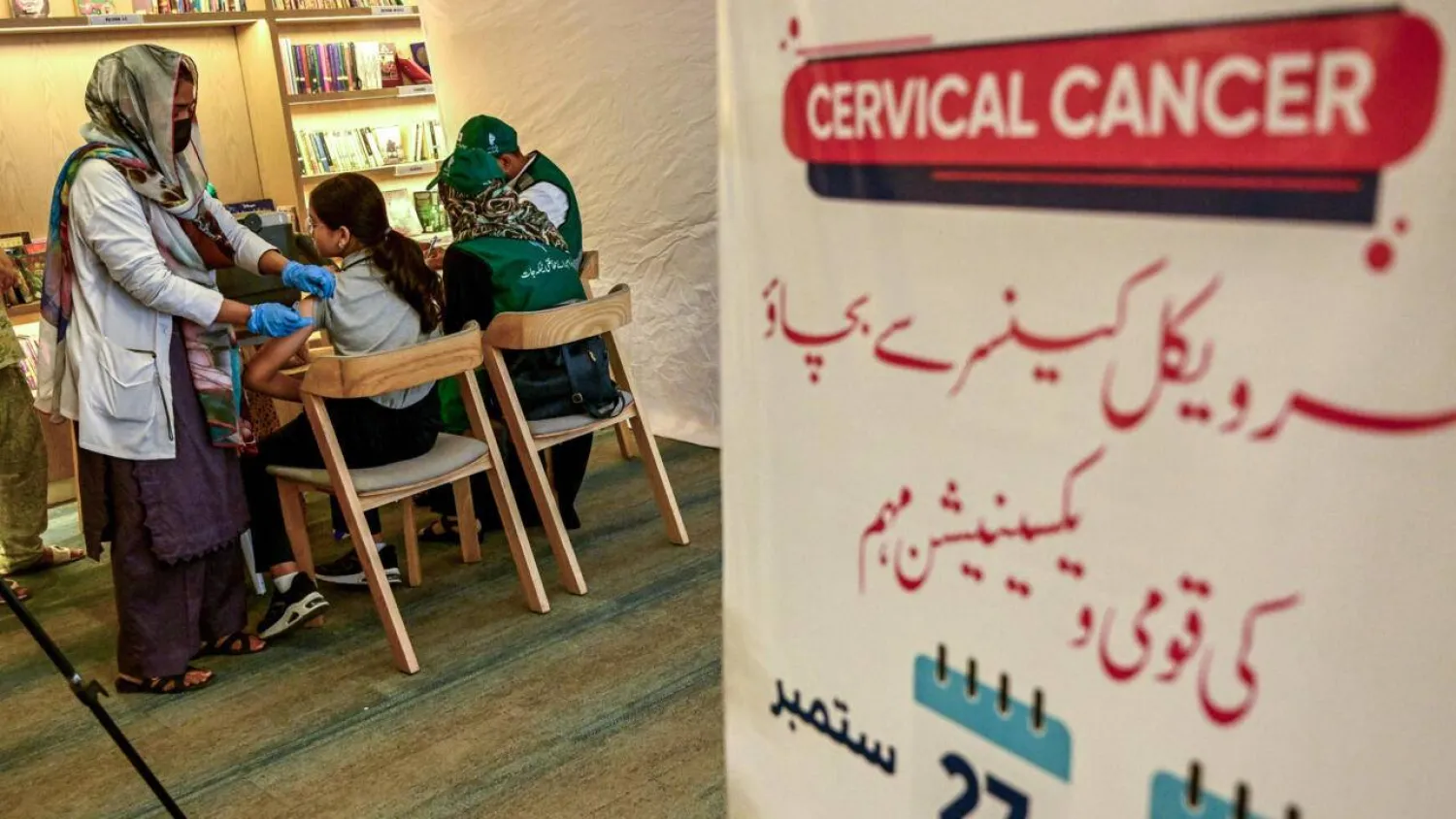

Pakistani Parents Rebuff HPV Vaccine over Infertility Fears

Misinformation and conspiracy theories plagued the first rollout of a vaccine to protect Pakistani girls against cervical cancer. Rizwan TABASSUM / AFP
TT

Pakistani Parents Rebuff HPV Vaccine over Infertility Fears

Misinformation and conspiracy theories plagued the first rollout of a vaccine to protect Pakistani girls against cervical cancer. Rizwan TABASSUM / AFP

Misinformation plagued the first rollout of a vaccine to protect Pakistani girls against cervical cancer, with parents slamming their doors on healthcare workers and some schools shutting for days over false claims it causes infertility.

The country's first HPV vaccine campaign aimed to administer jabs to 11 million girls -- but by the time it ended Saturday only around half the intended doses were administered.

A long-standing conspiracy theory that Western-produced vaccines are used to curb the Muslim population has been circulating online in Pakistan, said AFP.

Misinformation has also spread that the vaccine disrupts the hormones of young girls and encourages sexual activity, in a country where sex before marriage is forbidden.

"Some people have refused, closed their gates on us, and even hid information about their daughter's age," vaccinator Ambreen Zehra told AFP while going door to door in a lower-middle-income neighborhood in Karachi.

Only around half the intended vaccines had been administered, according to a federal health department official who spoke to AFP on condition of anonymity.

"Many girls we aimed to reach are still unvaccinated, but we are committed to ensuring the vaccine remains available even after the campaign concludes so that more women and girls get vaccinated," they said on Friday.

One teacher told AFP on condition of anonymity that not a single vaccine had been administered in her school on the outskirts of Rawalpindi because parents would not give consent, something she said other rural schools had also experienced.

A health official who asked not to be named said some private schools had resorted to closing for several days to snub vaccine workers.

"On the first day we reached 29 percent of our target, it was not good, but it was fine," said Syeda Rashida Batool, Islamabad's top health official who started the campaign by inoculating her daughter.

"The evening of that first day, videos started circulating online and after that it dipped. It all changed."

A video of schoolgirls doubled over in pain after teargas wafted into their classroom during a protest several years ago was re-shared online purporting to show the after-effects of the vaccine.

The popular leader of a right-wing religious party, Rashid Mehmood Soomro, said last week the vaccine, which is voluntary, was being forced on girls by the government.

"In reality, our daughters are being made infertile," he told a rally in Karachi.

'This will control the population'

In 95 percent of cases, cervical cancer is caused by persistent infection with Human Papillomavirus (HPV) –- a virus that spreads through sexual activity, including non-penetrative sex, that affects almost everyone in their lifetime.

The HPV vaccine, approved by the World Health Organization, is a safe and science-based protection against cervical cancer and has a long history of saving lives more than 150 countries.

Cervical cancer is particularly deadly in low and middle income countries such as Pakistan, where UNICEF says around two-thirds of the 5,000 women diagnosed annually will die, although the figure is likely under-reported.

This is because of a significant lack of awareness around the disease, cultural taboos around sexual health and poor screening and treatment services.

It is underlined by the damaging belief that only women with many sexual partners can contract sexually transmitted infections.

In Europe, where the HPV vaccine has been highly effective, there were around 30,000 diagnoses across all 27 EU nations in 2020, of which around one-third of women died, according to the European Commission.

"My husband won't allow it," said Maryam Bibi, a 30-year-old mother in Karachi who told AFP her three daughters would not be vaccinated.

"It is being said that this vaccine will make children infertile. This will control the population."

Humna Saleem, a 42-year-old housewife in Lahore, said she thought the vaccine was "unnecessary".

"All cancers are terrible. Why don't we tell our boys to be loyal to their wives instead of telling our girls to get more vaccines?" she told AFP.

Pakistan –- one of only two countries along with Afghanistan where polio is endemic -– remains stubbornly resistant to vaccines as a result of misinformation and conspiracy theories.

After marking one year without polio cases for the first time in 2023, the crippling disease has resurged with 27 cases reported in 2025 so far.

In response to overwhelming misinformation about the HPV vaccine, Pakistan's minister of health, Syed Mustafa Kamal, took the bold move to have his teenage daughter vaccinated in front of television cameras.

"In my 30-year political career I have never made my family public," he told reporters.

"But the way my daughter is dear to me, the nation's daughters are also dear to me, so I brought her in front of the media."



German Killed in Swiss Avalanche, 4 Other Skiers Hurt

Swiss Air Force's aerobatic team "The Patrouille Suisse" perform prior to the FIS alpine skiing Men's World Cup Super G event in Wengen, Swiss Alps, on January 19, 2026. (Photo by Dimitar DILKOFF / AFP)
TT

German Killed in Swiss Avalanche, 4 Other Skiers Hurt

Swiss Air Force's aerobatic team "The Patrouille Suisse" perform prior to the FIS alpine skiing Men's World Cup Super G event in Wengen, Swiss Alps, on January 19, 2026. (Photo by Dimitar DILKOFF / AFP)

A German man has been killed in an avalanche in the Swiss alps and four other people were hurt as they were cross-country skiing, Swiss police said Saturday.

The incident happened on Friday, on the Piz Badus peak near the village of Tujetsch in the center-south of the country, AFP reported.

Police said a group of seven cross-country skiers were swept up in the avalanche, with five of them buried underneath.

One member of the party raised the alarm in a phone call to local police, who deployed helicopters with rescue workers and dogs to the site.

The German man was found lifeless under the snow and ice, the police said, adding that the four others hurt -- whose nationalities were not given -- suffered light injuries and were flown to nearby hospitals.


NASA's New Moon Rocket Heads to the Pad Ahead of Astronaut Launch

NASA's Artemis II SLS (Space Launch System) rocket and Orion spacecraft, secured to the mobile launcher, is seen inside the Vehicle Assembly building as preparations continue for roll out to Launch Pad 39B, Thursday, Jan. 15, 2026, at NASA's Kennedy Space Center in Florida. (Keegan Barber/NASA via AP)
TT

NASA's New Moon Rocket Heads to the Pad Ahead of Astronaut Launch

NASA's Artemis II SLS (Space Launch System) rocket and Orion spacecraft, secured to the mobile launcher, is seen inside the Vehicle Assembly building as preparations continue for roll out to Launch Pad 39B, Thursday, Jan. 15, 2026, at NASA's Kennedy Space Center in Florida. (Keegan Barber/NASA via AP)

NASA’s giant new moon rocket headed to the launch pad Saturday in preparation for astronauts’ first lunar fly-around in more than half a century.

The out-and-back trip could blast off as early as February.

The 322-foot (98-meter) rocket began its 1 mph (1.6 kph) creep from Kennedy Space Center’s Vehicle Assembly Building at daybreak. The four-mile (six-kilometer) trek was expected to take until nightfall.

Throngs of space center workers and their families gathered in the predawn chill to witness the long-awaited event, delayed for years, The Associated Press reported. They huddled together ahead of the Space Launch System rocket’s exit from the building, built in the 1960s to accommodate the Saturn V rockets that sent 24 astronauts to the moon during the Apollo program. The cheering crowd was led by NASA’s new administrator Jared Isaacman and all four astronauts assigned to the mission.

Weighing in at 11 million pounds (5 million kilograms), the Space Launch System rocket and Orion crew capsule on top made the move aboard a massive transporter that was used during the Apollo and shuttle eras. It was upgraded for the SLS rocket’s extra heft.

The first and only other SLS launch — which sent an empty Orion capsule into orbit around the moon — took place back in November 2022.

“This one feels a lot different, putting crew on the rocket and taking the crew around the moon,” NASA’s John Honeycutt said on the eve of the rocket’s rollout.

Heat shield damage and other capsule problems during the initial test flight required extensive analyses and tests, pushing back this first crew moonshot until now. The astronauts won’t orbit the moon or even land on it. That giant leap will take come on the third flight in the Artemis lineup a few years from now.

Commander Reid Wiseman, pilot Victor Glover and Christina Koch — longtime NASA astronauts with spaceflight experience — will be joined on the 10-day mission by Canadian astronaut Jeremy Hansen, a former fighter pilot awaiting his first rocket ride.

They will be the first people to fly to the moon since Apollo 17’s Gene Cernan and Harrison Schmitt closed out the triumphant lunar-landing program in 1972. Twelve astronauts strolled the lunar surface, beginning with Neil Armstrong and Buzz Aldrin in 1969.

NASA is waiting to conduct a fueling test of the SLS rocket on the pad in early February before confirming a launch date. Depending on how the demo goes, “that will ultimately lay out our path toward launch,” launch director Charlie Blackwell-Thompson said on Friday.

The space agency has only five days to launch in the first half of February before bumping into March.


Iron Age Teeth Fossils Reveal Diet Diversity of Italians 2,500 Years Ago

The fresco on the wall of a house in Pompeii that dates back 2,000 years (AFP)
TT

Iron Age Teeth Fossils Reveal Diet Diversity of Italians 2,500 Years Ago

The fresco on the wall of a house in Pompeii that dates back 2,000 years (AFP)

Italians began exploring a varied diet sometime between the 7th and 6th centuries BC, according to a new analysis of ancient teeth from Iron Age Italians.

Unravelling details about the lifestyles of ancient cultures is a challenging task, as it requires specific, well-preserved fossils of long-deceased individuals, The Independent reported.

Fossil human teeth are an excellent resource to understand ancient diets, acting as archives of each individual’s life history.

However, collecting information from teeth across different eras remains a challenge.

In the new study, researchers combined multiple analyses of teeth remains from the Italian archaeological site of Pontocagnano to interpret the health and diet of people in the region during the 7th and 6th centuries BC.

Scientists assessed the dental tissue of 30 teeth from 10 individuals, obtaining data from canine and molar teeth to reconstruct each ancient person’s history during the first six years of their lives.

Researchers found that the Iron Age Italians had a diet rich in cereals, legumes, abundant carbohydrates, and even fermented foods and drinks.

“We could follow childhood growth and health with remarkable precision and identify traces of cereals, legumes, and fermented foods in adulthood, revealing how this community adapted to environmental and social challenges,” said Roberto Germano, an author of the study.

Emanuela Cristiani, another author of the study said, “In the case of Pontocagnano, the analysis of dental calculus revealed starch granules from cereals and legumes, yeast spores, and plant fibres, providing a very concrete picture of the diet and some daily activities of these Iron Age communities.”

The findings offer strong evidence of this ancient Italian population regularly consuming fermented foods and beverages, researchers said.

Their diets likely diversified at the time as their contact with Mediterranean cultures increased, they added.

The researchers noted that while the study may not be completely representative of the broader Italian population, it provides a “very concrete picture” of the diet and some daily activities of Iron Age communities in the Italian region.

“This and other modern approaches represent a major technological and disciplinary advancement that is revolutionizing the study of the biocultural adaptations of past populations,” said Alessia Nava, another author of the study from Sapienza University of Rome.
