

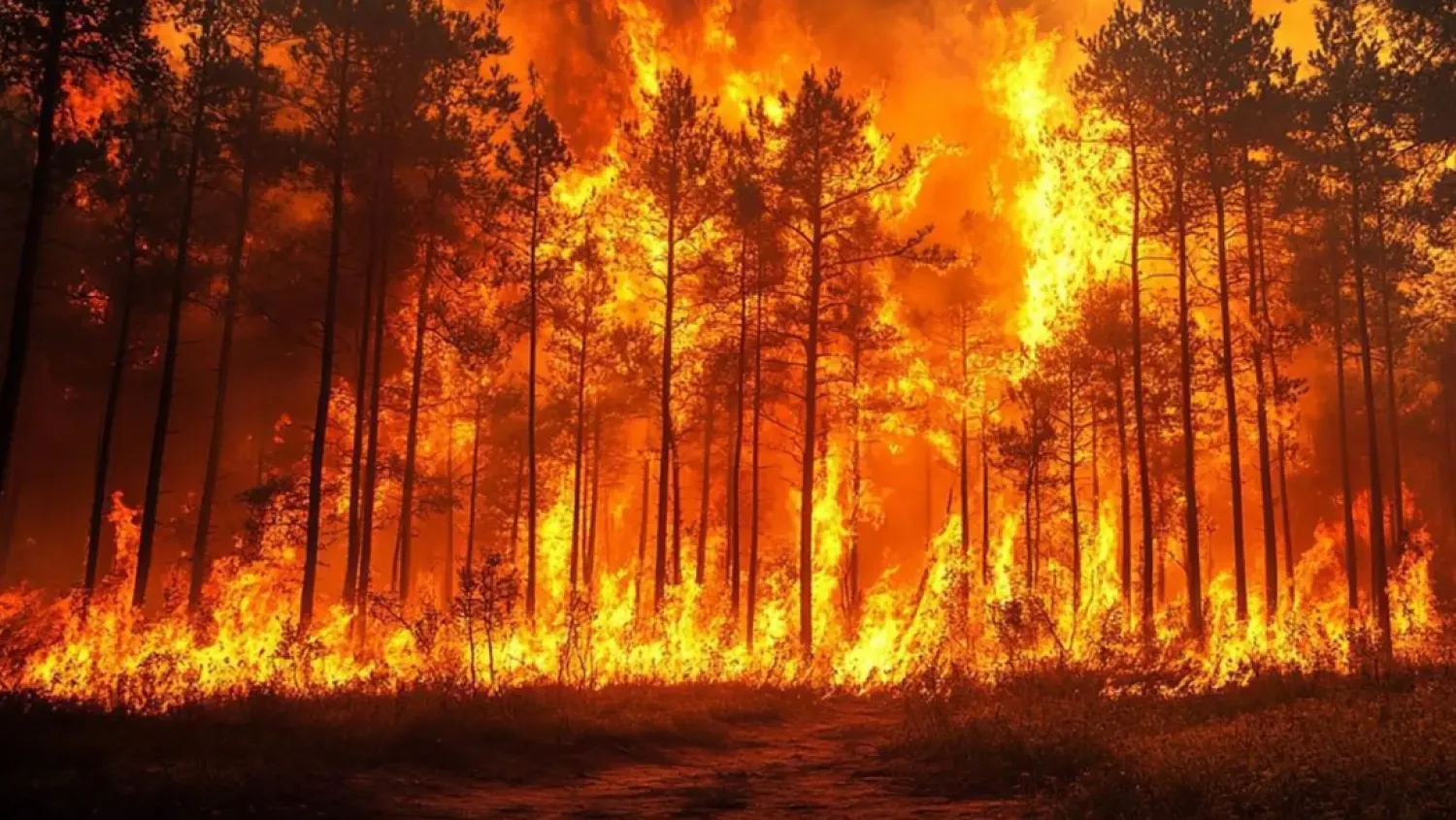

KAUST Joint International Study Shows Sunlight Intensifies Wildfire Smoke Pollution

The findings reveal how wildfire smoke can drive the formation of secondary particulate matter in addition to being a direct source of particulate matter—a major component of urban air pollution - SPA
TT

KAUST Joint International Study Shows Sunlight Intensifies Wildfire Smoke Pollution

The findings reveal how wildfire smoke can drive the formation of secondary particulate matter in addition to being a direct source of particulate matter—a major component of urban air pollution - SPA

Wildfire smoke causes more air pollution than current atmospheric models can predict. A new study published in the journal Science Advances has revealed the hidden chemistry that explains why.

The study, conducted by researchers at King Abdullah University of Science and Technology (KAUST) and the Chinese Academy of Sciences, found that under sunlight, wildfire smoke particles act as tiny chemical factories, producing harmful oxidants such as peroxides, a group of highly reactive pollutants that contribute to smog and haze.

According to a press release issued by the KAUST, the findings help explain why field measurements consistently detect elevated peroxide levels during wildfire events, even in cities where the normal gas-phase chemical routes that create them should be blocked by other pollutants such as nitric oxide, a common gas produced by burning fuel.

Dean of the Physical Science and Engineering Division at KAUST Professor Chak Chan said the study shows how smoke particles can bypass traditional suppression by nitrogen oxides in polluted environments by generating oxidants internally under sunlight. “This particle-driven pathway is surprisingly efficient and faster than what classical pathways can supply,” he said.

He emphasized the importance of updating atmospheric models, which is essential for communities, including Saudi Arabia, to better anticipate the health risks and environmental impacts of global warming.

The release added that the research team discovered that colored organic molecules in biomass-burning aerosols act as photosensitizers. When they absorb sunlight, they enter excited states that trigger rapid chains of reactions, producing peroxy radicals and then peroxides inside the particles.

Peroxides are not greenhouse gases, but they influence atmospheric chemistry in ways that drive haze, secondary particle formation, and respiratory risks. By acting as radical reservoirs, they also affect broader climate and air-quality dynamics.

The findings reveal how wildfire smoke can drive the formation of secondary particulate matter in addition to being a direct source of particulate matter—a major component of urban air pollution.

Wildfires have quadrupled in size in parts of the western United States since the 1980s, while Mediterranean burn areas have more than doubled in the past two decades. As fires become more frequent and intense worldwide, their smoke is emerging as a hidden source of air pollution on a global scale.



Some US States Now Require Public Schools to Teach Kids about Gun Safety

Jailyn Martinez points to a real firearm during a gun safety lesson at Berclair Elementary School, Monday, Oct. 27, 2025, in Memphis, Tenn. (AP Photo/George Walker IV)
TT

Some US States Now Require Public Schools to Teach Kids about Gun Safety

Jailyn Martinez points to a real firearm during a gun safety lesson at Berclair Elementary School, Monday, Oct. 27, 2025, in Memphis, Tenn. (AP Photo/George Walker IV)

This school year, students in elementary, middle and high schools in some states will get a new lesson on safety: what to do if they find a firearm.

Arkansas, Tennessee and Utah are the first states to enact laws that require public schools to teach children as young as 5 the basics of gun safety and how to properly store guns in the home. Only Utah's law allows students to opt out of the lesson if requested by parents or guardians.

A similar law in Arizona was vetoed by the Democratic governor, and lawmakers in at least five other states have introduced such proposals, putting schools at the forefront of yet another debate about gun violence, The AP news reported.

In Tennessee, lesson plans could include stickers, games, quizzes, or videos with music and colorful firearm illustrations, including a gun made out of Lego-style bricks and an explanation of what a muzzleloader is.

The reality is that many children in the US grow up around firearms.

At Berclair Elementary School in Memphis, a class of 16 fifth graders were asked how many had seen a real gun. Nearly all raised their hands.

“It just shows you how much a class like this is needed,” said Tammie Chapman, a health and physical education instructor, who has been leading the lessons at this school.

“While there is some controversy around guns, there doesn’t always have to be,” said Emily Buck, director of public relations for the Tennessee Wildlife Resources Agency, which created a curriculum with the state Department of Education. “I think that having some education and foundational knowledge really can be beneficial in the long run.”

Stop, don’t touch, leave quickly, tell an adult The lessons are often adapted from hunting safety courses already administered by state hunting and wildlife agencies, but with key differences.

Hunter safety courses typically involve hands-on instruction and explanations of how to safely handle and fire a gun. These classroom lessons, on the other hand, emphasize that children should not touch a firearm.

In Tennessee, the legislation prohibits any use of actual firearms, but in Arkansas, the law allows parents to opt into alternative curriculums, such as an off-campus firearm safety course that could include live guns.

The main takeaway is a series of steps for when a child finds a gun: Stop, don't touch, leave quickly, tell an adult. This is consistent with instructions created by other organizations, including one from the National Rifle Association that features animated characters, videos and coloring pages.

At Berclair Elementary School, the faculty designed a relay-race game to keep students engaged. In the gym, students took turns running to buckets that had different photos. Students who found a picture of a gun then reported it to one of the adults. They also listened to a catchy jingle emphasizing the steps.

Buck acknowledged that adults might be the ones responsible for creating unsafe situations at home and said children should be prepared if they find guns in unusual spots, like on shelves or under a mattress.

“We hope that maybe students will take some of what they learned back to their house, back to the parents and maybe they’ll encourage their parents to adjust their storage method,” said Buck.

The lessons are supposed to be neutral Gun legislation is a partisan issue across the US, with Democratic-led states enacting more limits on access to guns and efforts to tighten gun laws often failing in Republican-controlled legislatures.

Republicans sponsored and supported the education bills in Arkansas, Tennessee and Utah. The legislation says the curriculum must have neutral viewpoints on any gun-related topics, such as gun ownership in general.

Voices for a Safer Tennessee, a nonpartisan nonprofit created by parents after The Covenant School shooting in Nashville, supported the legislation. The organization supports gun ownership and advocates for policies like expanded background checks.

These lessons may encourage families to start necessary conversations, said Jessica Jaglois, director of communications for the organization.

“It could possibly prevent a firearm tragedy from occurring, because we know that a moment of access can lead to a lifetime of tragedy,” said Jaglois.

In 2022, the US Centers for Disease Control and Prevention found that firearms were the leading cause of death among children and teens. Arkansas and Tennessee have rates of firearm deaths among children and teens that exceed the national average, according to an AP analysis. But some Democrats and gun control advocates argue this kind of legislation is the wrong approach to gun violence.

“Using the school day to teach kids about guns won’t stop adults from leaving their firearms unsecured or keeping deadly weapons out of dangerous hands,” said Meg Beauregard, policy counsel fellow at Everytown for Gun Safety, in a statement. “If lawmakers were serious about protecting students, they’d pass laws that hold adults accountable, such as secure storage — not put the burden on kids to keep themselves safe.”

How will schools teach the lessons? The states gave school districts some discretion on whether to use provided lesson plans or go with other instructions that adhere to the laws' language. The schools also can decide which faculty or staff will lead the lessons, or in some instances bring in police officers to talk about gun safety.

In Arkansas, schools might choose to incorporate the lessons as a part of annual safety training, such as when they are practicing fire safety or tornado drills, said Spencer Griffith, a deputy director with Arkansas Game and Fish Commission.

“We hope they will interject this in a way that kind of helps to maybe prevent some of these accidents from occurring, but not in a way that puts a political focus or fear around that, because it’s just not the place for that,” said Griffith.

Berclair Principal Clint Davis said the issue of children getting hurt in firearm accidents is not new, even if this curriculum is.

“It’s not something that’s necessarily just become a modern issue. It’s always been there,” said Davis. “And I think we’re just now really responding to the need to provide that sort of training in school.”


Rare Footage Shows Sucker Fish as They Whale-surf in the Ocean's Wildest Joyride

In this image made from video remora fish ride a humpback whale off the coast of south-east Queensland, Australia, on June 15, 2024. (Olaf Meynecke/Whales and Climate Program via AP)
TT

Rare Footage Shows Sucker Fish as They Whale-surf in the Ocean's Wildest Joyride

In this image made from video remora fish ride a humpback whale off the coast of south-east Queensland, Australia, on June 15, 2024. (Olaf Meynecke/Whales and Climate Program via AP)

There are easier ways to cross an ocean, but few are as slick or stylish as the remora’s whale-surfing joyride.

Scientists tracking humpbacks off the coast of Australia have captured rare footage that shows clutches of the freeloading fish peeling away from their host in what looks like a high-speed game of chicken, just moments before the whale breaches.

As the humpback plunges back below the surface the remoras, also known as sucker fish, return to the whale, sticking their landings with the timing and precision of Olympic gymnasts. It’s elegant work for a hitchhiking fish that lives upside-down and survives on dead skin flakes, The AP news reported.

Remora australis spend their lives aboard whales or other large marine mammals, which they ride like giant cruise ships, breeding and feeding their way across stretches of ocean. The species has an adhesive plate on its head that helps to create a kind of vacuum seal, allowing the fish to grab a whale and hang on for the ride.

On whale cams, clingy fish steal the show The marine scientist who recorded the accidental close-ups of the remoras’ high-speed whale surfing had placed suction-cup cameras on humpbacks during their annual migration from Antarctica to the waters off Australia’s Queensland state. Olaf Meynecke planned to study whale behavior, but his video feeds regularly filled with dozens of photobombing remoras, which rode in groups of up to 50 as they clung to the same spots where his cameras were attached.

“Whenever the whale was breaching and doing in particular fast movements it appears that the sucker fish were responding very quickly to the movements,” said Meynecke, from the Whales and Climate Research Program at Griffith University. “They knew exactly when to let go of the body of the whale before it was breaching the surface of the water and then returned to the same spot only seconds later.”

A hitchhiker with good instincts Remoras are harmless to the 40-metric ton (44-U.S. ton) giants of the ocean, feeding on the whales’ dead skin and sea lice in a mutually beneficial arrangement — or at least that’s what scientists say. Meynecke said his footage suggested the whales found their hangers-on annoying.

“We’ve had individuals with high numbers of these remoras and they were continually breaching and there were no other whales that they were communicating with,” he said. “It appeared that they’re trying to just get rid of some of these remoras and they were checking whether they had less after they breached.”

The journey’s end remains a mystery Australia’s so-called humpback highway is a migratory corridor traversed by 40,000 of the mammals, bringing them close to the country’s eastern coastlines for months each year as they move from icy Antarctic waters to the balmy seas off the coast of Queensland and back. How long much of the 10,000-km (6,000-mile) journey is undertaken by the freeloading fish, which only live for about two years, is still a puzzle, Meynecke said.

“I suspect that the majority would probably leave at some point, maybe in temperate waters, but then where do they go?” he said. “Do they find other species that they can then use as a host and wait until the humpback whales have come back?”

In the absence of whales, sucker fish avoid predators by seeking other large creatures to latch onto, including manta rays, dolphins and unlucky scuba divers.

“Much to the annoyance of the divers, of course,” Meynecke said. “They’re not easy to get rid of.”


International Coffee and Chocolate Exhibition Concludes in Jeddah

The exhibition achieved its goal of supporting and empowering Saudi entrepreneurs in this growing sector - SPA
TT

International Coffee and Chocolate Exhibition Concludes in Jeddah

The exhibition achieved its goal of supporting and empowering Saudi entrepreneurs in this growing sector - SPA

The Jeddah International Coffee and Chocolate Exhibition concluded after three days of participation by leading producers, entrepreneurs, and innovators in the field.

Serving as an important annual platform, the event brought together key stakeholders, investors, and experts in the coffee and chocolate sector, according to SPA.

The exhibition achieved its goal of fostering the exchange of expertise, showcasing the latest industry innovations, and supporting and empowering Saudi entrepreneurs in this growing sector.

A highlight of the event was the inaugural Saudi Coffee and Chocolate Championship, which served as a celebration of Saudi coffee culture and chocolate creativity.

The championship provided participants with a platform to demonstrate their skills to an audience of professionals and enthusiasts, reflecting the dynamic blend of heritage and modernity that characterizes the Kingdom’s hospitality industry.
