
'Time Runs Away': Japan's City with a Two-hour Cap on Phone Use

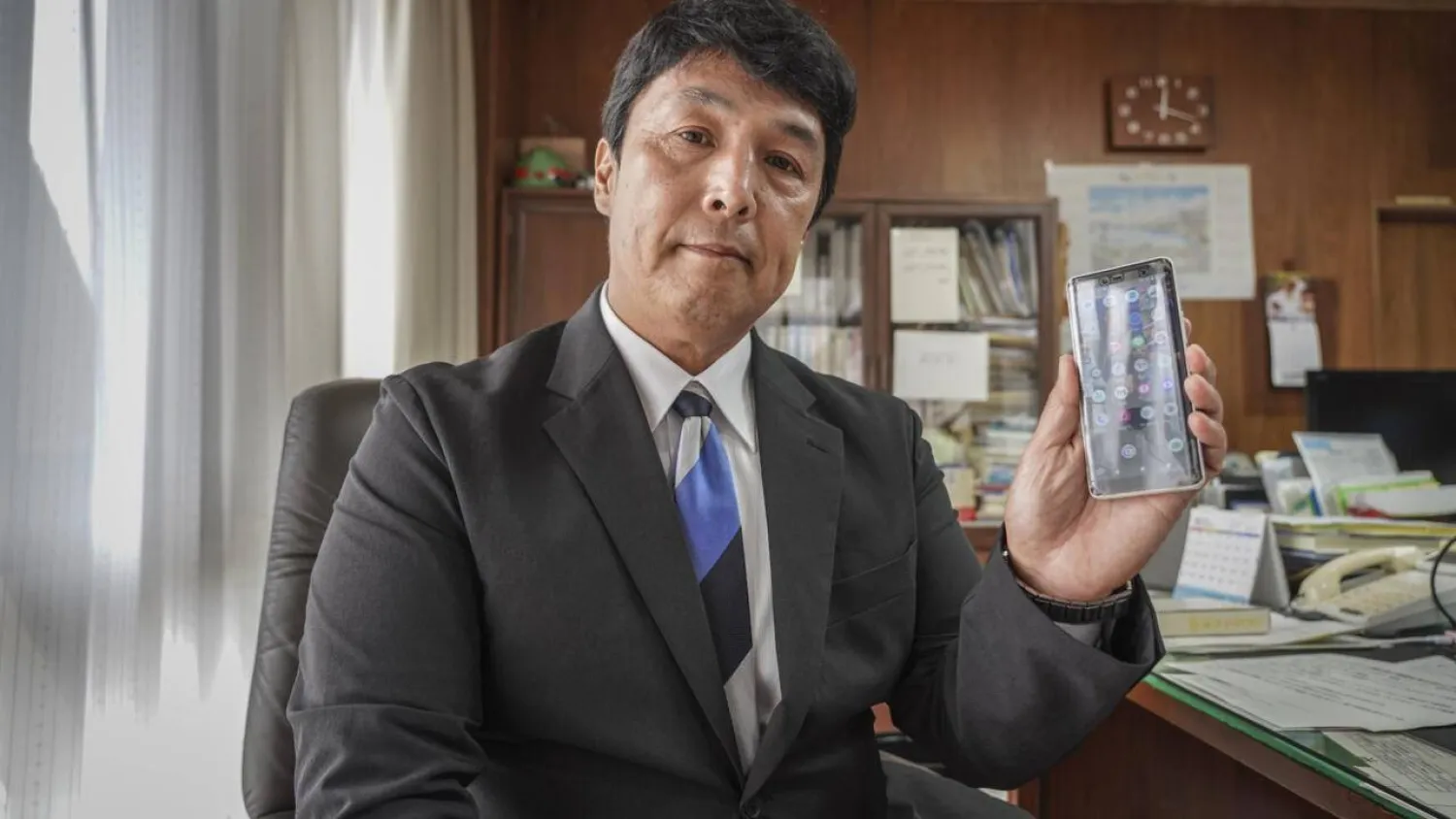
Mayor Masafumi Kouki says he worried for many months about the "negative effects of excessive smartphone use, especially the sharp decrease in direct human communication". Caroline GARDIN / AFP
TT

'Time Runs Away': Japan's City with a Two-hour Cap on Phone Use

Mayor Masafumi Kouki says he worried for many months about the "negative effects of excessive smartphone use, especially the sharp decrease in direct human communication". Caroline GARDIN / AFP

Police won't be rounding up people glued to phones in Japan's Toyoake, but the mayor believes his two-hour limit can help residents find a healthier relationship with their screens.

Masafumi Kouki told AFP he has worried for many months about the "negative effects of excessive smartphone use, especially the sharp decrease in direct human communication".

"Even on trains, everyone just stares at their phones, and no one talks anymore," he said.

"I don't believe this should be considered normal, so I wanted to create an opportunity for our residents to reflect on whether they might be overusing their smartphones."

A local ordinance on the appropriate use of phones, laptops and tablets came into force last week in Toyoake, a largely grey, concrete suburb of the industrial metropolis Nagoya.

There are no penalties for exceeding its recommended two-hour limit, which applies to adults and children alike and was approved by the city council in a 12-7 vote.

Instead, the aim is to encourage self-regulation.

"It's certainly a rare step -- we know that," said the 56-year-old Kouki, whose own phone screen has multiple cracks.

When the ordinance was first proposed, "opposition was almost universal".

But many citizens came round to the idea, he said, when they learned that the daily cap does not include work or study time and is meant as a guideline, not a strict rule.

'Overreach'

Among Toyoake's population of nearly 68,000, not everyone is convinced.

"Nowadays... we do everything -- studying, hobbies, communication -- through a single smartphone," said 22-year-old law student Shutaro Kihara.

So the ordinance is "rather meaningless or ineffective" for young people, he said.

City lawmaker Mariko Fujie, 50, voted against Kouki's decree.

Excessive smartphone use is a social problem that needs addressing, she told AFP.

But "I feel a strong resistance to regulating people's personal free time through an ordinance", she said.

"It feels like an overreach."

Ikka Ito, a middle school student playing a video game near a local station, uses his phone for four to five hours a day.

"I've been voluntarily cutting back compared to before the ordinance was announced," without his parents telling him to, he said.

But there are downsides, too.

"If you reduce smartphone time, you can't stay in touch" with friends, Ito said.

One goal is to improve citizens' health by helping them get more sleep.

Toyoake's ordinance urges elementary school students to avoid smartphones after 9 pm, while junior high students and older are advised not to use them after 10 pm.

Sleepy citizens

Surveys have found that people in Japan get less sleep than those in other developed economies, often due to long working hours.

Toyoake resident Kokuka Hirano, 59, said she is "sleep-deprived" because of her phone.

"I want to research various things I don't understand, so I end up watching news from different countries," she said.

"Time runs away from me."

Hirano wants to limit her smartphone use to devote more time to exercise and cooking.

But "three or four hours would be more reasonable... two hours feels too strict".

Studies show that as well as smartphones interfering with sleep, which can affect mental health, heavy use of social media is linked with loneliness, depression and anxiety.

Global efforts to limit potential harm to children include an upcoming Australian ban on social media for under-16s.

Mayor Kouki has two children aged 10 and seven who don't own smartphones, although the 10-year-old borrows his wife's without permission.

Kouki said he likes using his phone to watch Japanese baseball highlights, but the family now shuns screens during mealtimes.

Yumi Watanabe, a 36-year-old mother-of-three in Toyoake, said most parents she knows let their children explore freely online, which is "scary".

Even so, the ordinance "wasn't really necessary", she said.

"It's something each person can judge for themselves as they go."


Seal Escapes Orca Hunt by Jumping onto Photographer's Boat

In this photo provided by Charvet Drucker, a seal rests on her boat in the Saratoga passage between Camano and Whidbey Island, Sunday, Nov. 2, 2025, north of Seattle, Wash. (Charvet Drucker via AP)
TT

Seal Escapes Orca Hunt by Jumping onto Photographer's Boat

In this photo provided by Charvet Drucker, a seal rests on her boat in the Saratoga passage between Camano and Whidbey Island, Sunday, Nov. 2, 2025, north of Seattle, Wash. (Charvet Drucker via AP)

A wildlife photographer out on a whale watching trip in waters off Seattle captured dramatic video and photos of a pod of killer whales hunting a seal that survived only by clambering onto the stern of her boat.

Charvet Drucker was on a rented 20-foot (6-meter) boat near her home on an island in the Salish Sea about 40 miles northwest of Seattle when she spotted a pod of at least eight killer whales, also known as orcas.

The orcas' coordinated movements and tail slaps suggested they were hunting. Drucker used the zoom lens on her camera to spot a harbor seal that was trying to flee from the pod. One of her shots showed the seal flying through the air above the scrum of orcas frothing the water, and she assumed she was witnessing the seal's last moments alive.

But as the orcas got closer to the boat, Drucker and her group realized the pod was still chasing the seal. In line with wildlife boating regulations, they had cut the engine to prevent any injury to the whales. The seal clambered out of the water and onto a swimming platform at the stern of the boat near the motor — claiming it as a life raft of sorts.

Wildlife regulations also prohibit touching or interfering with the seal, but Drucker began filming video.

“You poor thing,” Drucker can be heard saying, as the seal looks up at her. "You’re good, just stay, buddy.”

The orcas did not give up immediately, but instead appeared to team up to rock the boat and make the seal fall off. Drucker's cellphone video shows the orcas lining up and moving in on the boat with staggered dives to create waves. The “wave-washing” technique has been documented since by scientists since at least the 1980s, according to the National Oceanic and Atmospheric Administration.

The seal on Drucker's boat slid off at least once, but managed to climb back on, and the orcas swam away after about 15 minutes.

Drucker has photographed dead seals in the mouths of orcas before, and she says she’s generally happy when the whales get to eat.

“I’m definitely Team Orca, all day, every day. But once that seal was on the boat, I kind of turned (into) Team Seal,” she said in an interview with The Associated Press on Thursday.

The killer whales that hunt seals and a diverse set of marine animals in the area are known as Bigg’s or “transient” orcas. They are better fed then other more specialized species like the salmon-focused “resident” orcas who are on the endangered species list, according to NOAA.


Third Most Expensive Falcon Sold for SAR351,000 at Saudi Club Auction

The event reinforces facilitates the transfer of falconry expertise to new generations - SPA
TT

Third Most Expensive Falcon Sold for SAR351,000 at Saudi Club Auction

The event reinforces facilitates the transfer of falconry expertise to new generations - SPA

A falcon was sold for SAR351,000 at the 25th session of the Saudi Falcons Club Auction, making it the third most expensive falcon sold to date at this year's event.

Held at the club's headquarters in Malham, north of Riyadh, the auction serves as the primary marketplace for locally trapped falcons, coinciding with the annual trapping season which runs until November 30, SPA reported.

The event reinforces the Kingdom's cultural identity, facilitates the transfer of falconry expertise to new generations, and provides an economic resource for the hundreds of participating trappers.


Italian Fruit Detective Racing to Save Forgotten Varieties

The Archeologia Arborea foundation saves fruit varieties to restore biodiversity and build resilience against climate change. Tiziana FABI / AFP
TT

Italian Fruit Detective Racing to Save Forgotten Varieties

The Archeologia Arborea foundation saves fruit varieties to restore biodiversity and build resilience against climate change. Tiziana FABI / AFP

Isabella Dalla Ragione hunts in abandoned gardens and orchards for forgotten fruits, preserving Italy's agricultural heritage and saving varieties which could help farmers withstand the vagaries of a changing climate.

The 68-year-old's collection of apples, pears, cherries, plums, peaches and almonds, grown using methods of old, are more resilient to the climate shifts and extremes seen increasingly frequently in the southern Mediterranean.

The Italian agronomist-turned-detective seeks descriptions of bygone local fruits in centuries-old diaries or farming documents, and sets out to find them.

Others she identifies by matching them to fruits in Renaissance paintings, where they often appear in depictions of the Madonna and Child.

Of the 150 or so varieties collected from Tuscany, Umbria, Emilia-Romagna and Marche and grown by her non-profit Archeologia Arborea foundation, the small, round Florentine pear is among Dalla Ragione's favorites.

"I'd found it described in documents from the 1500s, but I'd never seen it and believed it lost," she told AFP.

"Then 15 years ago, in the mountains between Umbria and Marche, I found a tree almost in the middle of the woods," thanks to an elderly local woman who told her about it by chance.

While old varieties are flavorsome, most disappeared from markets and tables after the Second World War as Italy's agricultural system modernized.

'Urgent'

Italy is a large fruit producer. Its pear production ranks first in Europe and third globally, but just five modern varieties -- none of which are Italian -- account for over 80 percent of its output.

"There used to be hundreds, even thousands, of varieties because each region, each valley, each place had its own," Dalla Ragione said as she showed off wicker baskets full of fruit, stored in a little church near the orchard.

Modern markets instead demand large crops of fruits that can be harvested quickly, easily stored and last a long time.

But as global warming makes for an increasingly challenging climate, experts say a broader range of plant genetic diversity is key.

"Heirloom varieties... are able to adapt to climate change, to more severe water shortages, to extremes of cold and heat," said Mario Marino, from the climate change division of the UN's Food and Agriculture Organization.

"However, a much more severe disease arrives, one that improved varieties are normally more resistant to... and the local varieties perish, or perhaps don't produce fruit," he told AFP.

The answer lies in creating new varieties by crossing modern and old-fashioned ones, he said.

Marino, who advises Dalla Ragione's foundation, said her work was "urgent" because "preserving one's heritage means preserving the land, preserving biodiversity... and (allowing) us to use that DNA for new genetic resources".

Oral testimonies

Researchers can access the collection, while Dalla Ragione also recreates historical gardens which can host recovered varieties as part of an EU-funded project.

"We don't do all this research and conservation work out of nostalgia, out of romanticism," she said as she harvested pink apples from her trees in the hilly hamlet of San Lorenzo di Lerchi in Umbria.

"We do it because when we lose variety, we lose food security, we lose diversity and the system's ability to respond to various changes, and we also lose a lot in cultural terms."

Dalla Ragione has sought answers to fruit mysteries in monastery orchards, the gardens of nobility and common allotments. She has pored over local texts from the 16th and 17th centuries.

She once traced a pear to a village in southern Umbria after reading about it in the diary of a musical band director.

But one of her richest sources on how best to cultivate such varieties has been oral testimonies -- and as the last generation of farmers that grew the crops die, much local knowledge is lost.

That has made it difficult to know how to divide her time between researching and looking for a new variety, though she has learnt the hard way that the urgency "is always to save it".

"In the past if I've delayed, thinking 'I'll do it next year', I've found the plant has since gone".