


Chronic Drug Shortages Frustrate EU Pharmacists, Patients

Europe depends on Asia for 70 percent of active pharmaceutical ingredients. Nicolas TUCAT / AFP
TT

Chronic Drug Shortages Frustrate EU Pharmacists, Patients

Europe depends on Asia for 70 percent of active pharmaceutical ingredients. Nicolas TUCAT / AFP

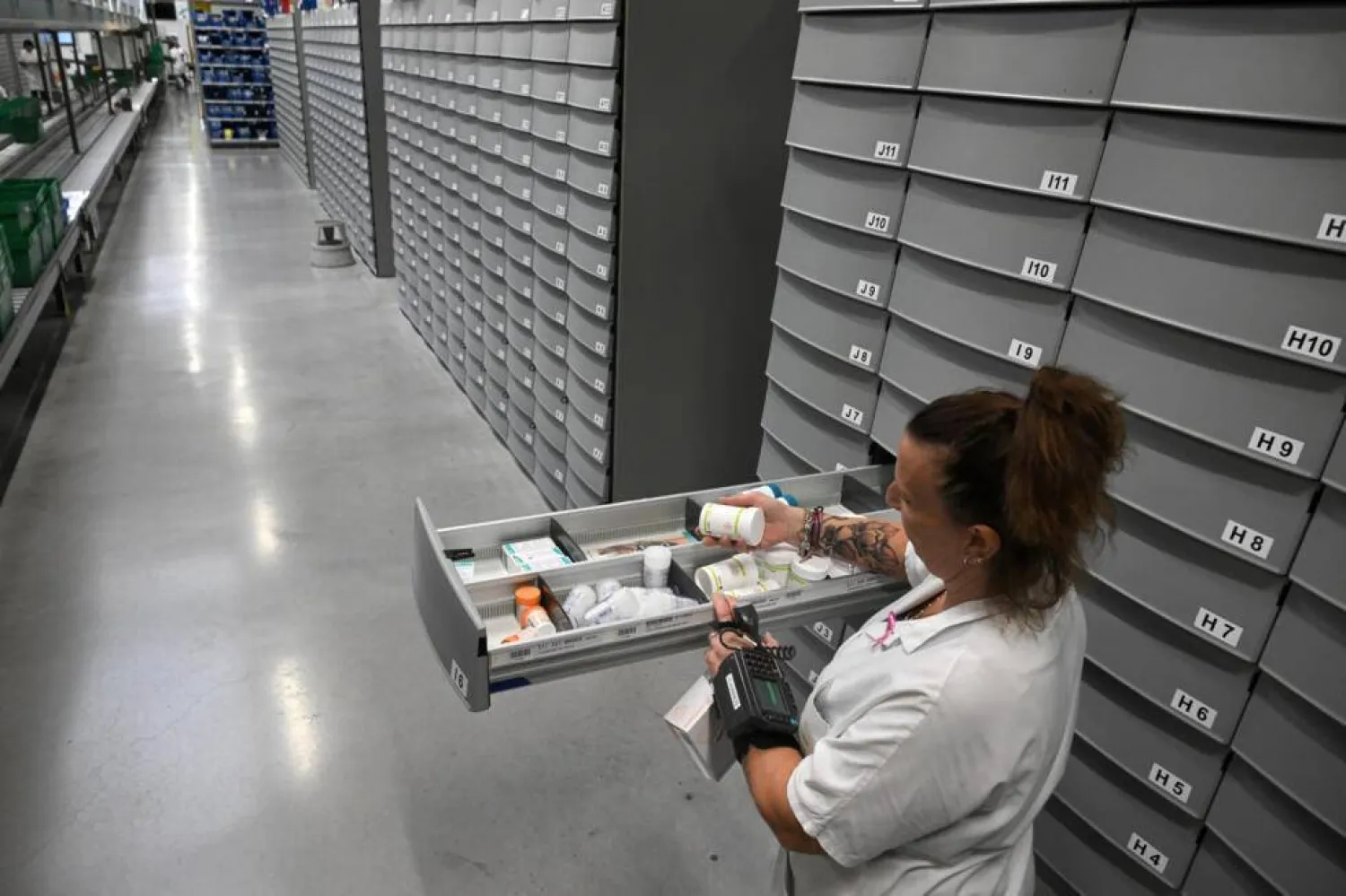
At a drug wholesaler warehouse in Belgium, shelves are emptier than they used to be.

Like other EU nations, Belgium has increasingly experienced medicine shortages that vex pharmacists, exasperate patients and risk overloading public health services.

"There are often several dozen medications that are in short supply simultaneously, which makes our lives very difficult," said Didier Ronsyn, a Brussels pharmacist.

An EU audit last month found shortages were a "chronic headache" across the bloc.

Its 27 states reported running critically short of 136 drugs, including antibiotics and medicines used to treat heart attacks, between 2022 and 2024, the European Court of Auditors (ECA) said.

Belgium reported the most cases, with more than a dozen critical instances -- meaning no alternatives are available -- notified to the European Medicines Agency (EMA) in 2024 only.

The cause partially lies in supply chain snags and Europe's over-reliance on Asia for key drug components, the ECA said.

Cheaper prices mean that Asian producers now supply the EU with 70 percent of the active pharmaceutical ingredients it needs, according to a study cited in the ECA report.

The dependency is particularly acute for painkillers, like paracetamol or ibuprofen, and drugs that ran critically low in recent years, including some antibiotics and salbutamol, an asthma drug sold under the brand name Ventolin.

Yet, EU internal market inefficiencies are also to blame.

'Colossal workload'

Drug prices differ within the bloc as national authorities negotiate individually with producers, explained Olivier Delaere, CEO of Febelco, a wholesale distributor that serves about 40 percent of Belgian pharmacies.

As a consequence, manufacturers tend to deliver more to countries that pay more, and just enough to those who drove a harder bargain -- to avoid drugs being re-exported for profit, he said.

Additionally, the ECA said that most medicines are still authorized at national level and packages differ significantly among countries, which makes internal EU trade "more costly and complex".

This causes so-called "local shortages", when a product is not available in one EU country but can be found just across the border in another member state, said Delaere of Febelco.

"It's a growing problem," he said, as a massive automated dispenser stacked with medicine boxes filled green baskets -- each corresponding to a pharmacist's order -- on a conveyor belt in the warehouse behind him.

Some 70 percent of the about one million client calls the firm receives a year "are focused solely on medicine shortages", Delaere said. "It is an absolutely colossal workload and energy drain."

'Complicated', for now

In 2024, EU pharmacists spent on average 11 hours per week managing shortages, according to PGEU, a pharmacists' trade group.

Ronsyn said he often spends an hour a day "making phone calls, checking information, sending patients away, or calling them back to tell them their medication has arrived or in certain cases, that it hasn't" -- something that did not happen in the past.

"It's also tough for the patient, who might panic a little when they don't get their medication on time," he said.

Brussels has been scrambling to find solutions.

In March, the European Commission proposed a "critical medicines act" aimed at boosting manufacturing in the EU by providing incentives and urging member states to move away from price as the key criterion for awarding procurement contracts.

It was followed in July by a "stockpiling strategy" to coordinate stocks and ensure medicines and other goods are available in case of crisis.

A commission spokeswoman said Brussels was confident that these and other recently introduced proposals "will make a substantial difference" and "significantly help tackling the problem".

The bills are currently being negotiated with the European Parliament and member states, a sometimes lengthy process.

"They are trying to find solutions, but it is always very slow," said Ronsyn, whose pharmacy overlooks the commission offices. "We will probably get there someday, but for now it's complicated."



Move over Larry: Maximus the PM's Cat Grabs Belgium Spotlight

Larry the Downing Street cat is a global celebrity in his own right, with more than 900,000 followers on X. JUSTIN TALLIS / AFP/File
TT

Move over Larry: Maximus the PM's Cat Grabs Belgium Spotlight

Larry the Downing Street cat is a global celebrity in his own right, with more than 900,000 followers on X. JUSTIN TALLIS / AFP/File

It is no secret that a tabby named Larry wields considerable power in Downing Street. Now in Belgium, a rescue cat named Maximus has shot to social media stardom as bewhiskered sidekick and PR weapon of Prime Minister Bart De Wever.

Taken in from a shelter by the Flemish conservative leader over the summer, the grey fluffball has become a fixture on Instagram -- snapped batting at string or lolling around in the boss's office.

But while Larry has risen above politics as Chief Mouser to six British prime ministers, the adventures of De Wever's four-legged friend come with a dose of salty commentary on Belgium's turbulent public life, said AFP.

Cartoon bubbles have captured Maximus musing sardonically -- in Flemish -- on everything from the country's long-running budget showdown to strikes over his boss's austerity measures, or a new voluntary military service for young Belgians.

'Maximus, can you catch a drone?'

Less than six months after his account went live in July, Maximus has caught up with his master when it comes to Instagram followers.

The account name -- @maximustp16 -- stands for "Maximus Textoris Pulcher", a cryptic reference to that of his boss, which means "The Weaver" in Dutch.

Those in the know say the fel-influencer's posts are put up by the prime minister's personal assistant.

But the Belgian leader -- known for his deadpan sense of humor -- is also pretty prolific online, and regularly cross-posts with the cat's account when he wants to strike a lighter note.

Since taking office in February, De Wever has posted a whole series of vignettes of himself with Maximus, pushing him in a stroller or taking a nap by his side.

His first response in October to the news of a foiled plot to attack him using drone-mounted explosives?

A post showing the prime minister and reclining cat with the cartoon caption "Maximus, can you catch a drone?"

"No -- but I'm catching dreams like no one else!" the mog replies.

'Noise and hot air'

All good fun, but what is the strategy at work?

For political analyst Dave Sinardet the spoof account is chiefly a way for the 54-year-old De Wever to freshen up his public image -- and show he does not take himself too seriously.

"It's a smart way to do political PR," said Sinardet, a university professor in Brussels. "It makes politicians seem friendlier, gentler -- considering that most people see them as rational, even arrogant figures."

The Flemish nationalist faces an uphill challenge -- under fire from left-wing parties who accuse him of unpicking social protections with rolling strikes and protests targeting his government all year.

Deploying pets as political PR assets is nothing new: every US president in history, with the exception of Donald Trump, has posed with animals at the White House.

Larry the Downing Street cat is a global celebrity in his own right, with his @Number10cat account on X boasting almost 900,000 followers.

But De Wever's posts with Maximus are not to everyone's liking at home.

A video of the prime minister pretending to play "Amazing Grace" on the bagpipes -- the pipe being Maximus's tail -- during tense budget talks had the opposition hissing.

"Quite the summary of their politics: noise and hot air," snapped the socialist lawmaker Patrick Prevot.


Indonesia Floods Were 'Extinction Level' for Rare Orangutans

Residents rest as they search for the remains of their house, buried under piles of uprooted trees swept by the flash flood, in Lintang Baru village in Aceh Tamiang, northern Sumatra, on December 11, 2025. (Photo by Aditya Aji / AFP)
TT

Indonesia Floods Were 'Extinction Level' for Rare Orangutans

Residents rest as they search for the remains of their house, buried under piles of uprooted trees swept by the flash flood, in Lintang Baru village in Aceh Tamiang, northern Sumatra, on December 11, 2025. (Photo by Aditya Aji / AFP)

Indonesia's deadly flooding was an "extinction-level disturbance" for the world's rarest great ape, the tapanuli orangutan, causing catastrophic damage to its habitat and survival prospects, scientists warned on Friday.

Only scientifically classified as a species in 2017, tapanulis are incredibly rare, with fewer than 800 left in the wild, confined to a small range in part of Indonesia's Sumatra.

One dead suspected tapanuli orangutan has already been found in the region, conservationists told AFP.

"The loss of even a single orangutan is a devastating blow to the survival of the species," said Panut Hadisiswoyo, founder and chairman of the Orangutan Information Centre in Indonesia.

And analysis of satellite imagery combined with knowledge of the tapanuli's range suggests that the flooding which killed nearly 1,000 people last month may also have devastated wildlife in the Batang Toru region.

The scientists focused on the so-called West Block, the most densely populated of three known tapanuli habitats, and home to an estimated 581 tapanulis before the disaster.

There, "we think that between six and 11 percent of orangutans were likely killed," said Erik Meijaard, a longtime orangutan conservationist.

"Any kind of adult mortality that exceeds one percent, you're driving the species to extinction, irrespective of how big the population is at the start," he told AFP.

But tapanulis have such a small population and range to begin with that they are especially vulnerable, he added.

Satellite imagery shows massive gashes in the mountainous landscape, some of which extend for more than a kilometer and are nearly 100 meters wide, Meijaard said.

The tide of mud, trees and water toppling down hillsides would have carried away everything in its path, including other wildlife like elephants.

David Gaveau, a remote sensing expert and founder of conservation start-up The Tree Map, said he was flabbergasted by the before-and-after comparison of the region.

"I have never seen anything like this before during my 20 years of monitoring deforestation in Indonesia with satellites," he told AFP.

The devastation means remaining tapanulis will be even more vulnerable, with sources of food and shelter now washed away.

Over nine percent of the West Block habitat may have been destroyed, the group of scientists estimated.

In a draft paper shared with AFP and set to be published as a pre-print in coming days, they warned the flooding represents an "extinction-level disturbance" for tapanulis.

They are urging an immediate halt to development in the region that will damage remaining habitat, expanded protected areas, a detailed survey of the affected area and orangutan populations and work to restore lowland forests.

The highland homes currently inhabited by tapanulis are not their preferred habitat, but it is where remaining orangutans have been pushed by development elsewhere.

Panut said the region had become eerily quiet after the landslides.

"This fragile and sensitive habitat in West Block must be fully protected by halting all habitat-damaging development," he told AFP.


Study Finds Humans Were Making Fire 400,000 Years Ago, Far Earlier Than Once Thought

Discovery of the first fragment of iron pyrite in 2017, at Barnham, England. (Jordan Mansfield/Pathways to Ancient Britain Project via AP)
TT

Study Finds Humans Were Making Fire 400,000 Years Ago, Far Earlier Than Once Thought

Discovery of the first fragment of iron pyrite in 2017, at Barnham, England. (Jordan Mansfield/Pathways to Ancient Britain Project via AP)

Scientists in Britain say ancient humans may have learned to make fire far earlier than previously believed, after uncovering evidence that deliberate fire-setting took place in what is now eastern England around 400,000 years ago.

The findings, described in the journal Nature, push back the earliest known date for controlled fire-making by roughly 350,000 years. Until now, the oldest confirmed evidence had come from Neanderthal sites in what is now northern France dating to about 50,000 years ago.

The discovery was made at Barnham, a Paleolithic site in Suffolk that has been excavated for decades. A team led by the British Museum identified a patch of baked clay, flint hand axes fractured by intense heat and two fragments of iron pyrite, a mineral that produces sparks when struck against flint, The Associated Press reported.

Researchers spent four years analyzing to rule out natural wildfires. Geochemical tests showed temperatures had exceeded 700 degrees Celsius (1,292 Fahrenheit), with evidence of repeated burning in the same location.

That pattern, they say, is consistent with a constructed hearth rather than a lightning strike.

Rob Davis, a Paleolithic archaeologist at the British Museum, said the combination of high temperatures, controlled burning and pyrite fragments shows "how they were actually making the fire and the fact they were making it."

Iron pyrite does not occur naturally at Barnham. Its presence suggests the people who lived there deliberately collected it because they understood its properties and could use it to ignite tinder.

Deliberate fire-making is rarely preserved in the archaeological record. Ash is easily dispersed, charcoal decays and heat-altered sediments can be eroded.

At Barnham, however, the burned deposits were sealed within ancient pond sediments, allowing scientists to reconstruct how early people used the site.

Researchers say the implications for human evolution are substantial.

Fire allowed early populations to survive colder environments, deter predators and cook food. Cooking breaks down toxins in roots and tubers and kills pathogens in meat, improving digestion and releasing more energy to support larger brains.

Chris Stringer, a human evolution specialist at the Natural History Museum, said fossils from Britain and Spain suggest the inhabitants of Barnham were early Neanderthals whose cranial features and DNA point to growing cognitive and technological sophistication.

Fire also enabled new forms of social life. Evening gatherings around a hearth would have provided time for planning, storytelling and strengthening group relationships, which are behaviors often associated with the development of language and more organized societies.

Archaeologists say the Barnham site fits a wider pattern across Britain and continental Europe between 500,000 and 400,000 years ago, when brain size in early humans began to approach modern levels and when evidence for increasingly complex behavior becomes more visible.

Nick Ashton, curator of Paleolithic collections at the British Museum, described it as "the most exciting discovery of my long 40-year career."

For archaeologists, the find helps address a long-standing question: When humans stopped relying on lightning strikes and wildfires and instead learned to create flame wherever and whenever they needed it.