

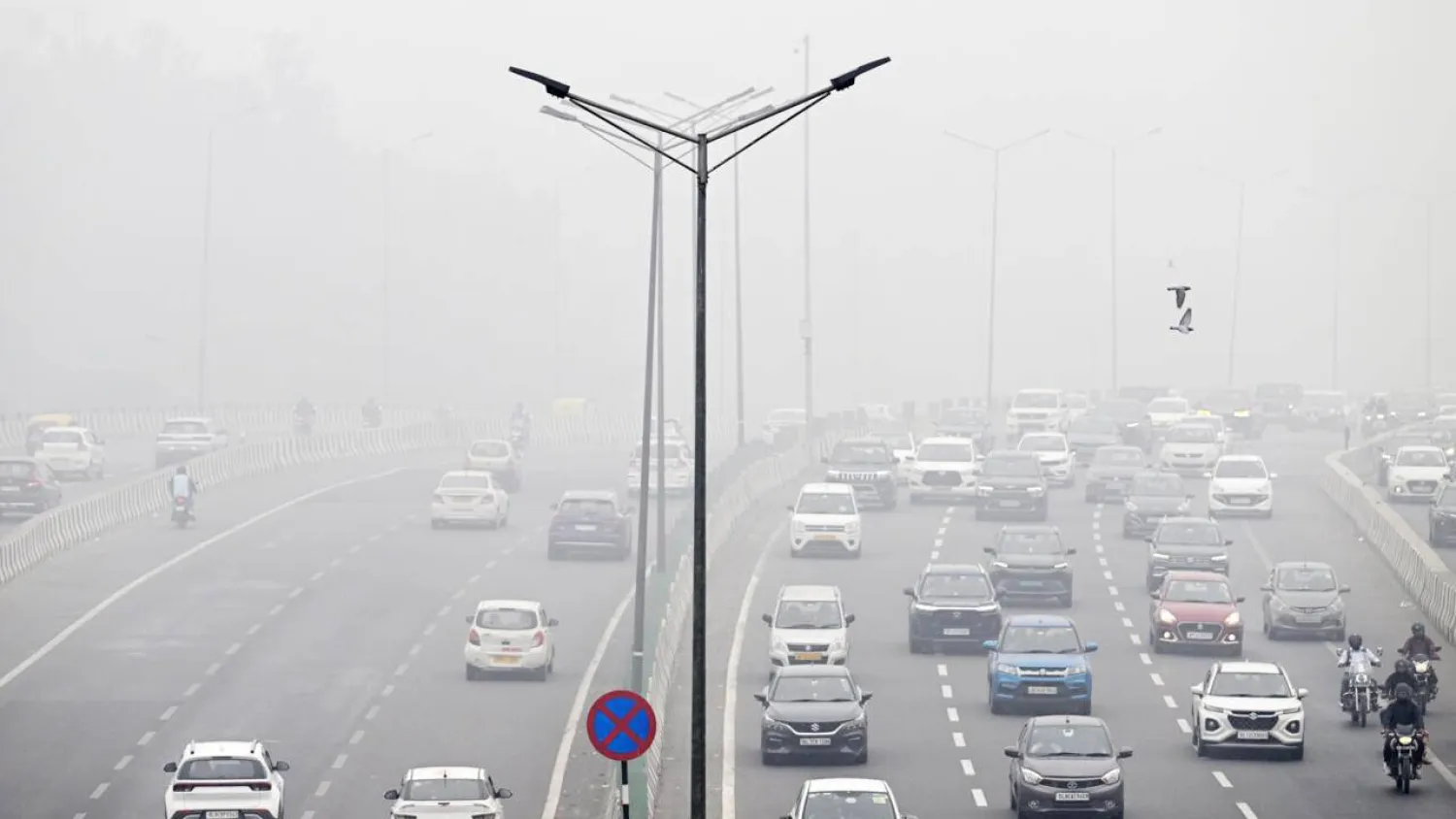

India's Pollution Refugees Fleeing Delhi's Toxic Air

Each winter, Delhi is blanketed in acrid smog, a toxic mix of crop-burning, factory emissions and choking traffic. Arun SANKAR / AFP
TT

India's Pollution Refugees Fleeing Delhi's Toxic Air

Each winter, Delhi is blanketed in acrid smog, a toxic mix of crop-burning, factory emissions and choking traffic. Arun SANKAR / AFP

Pollution levels in India's capital shaped Natasha Uppal and her husband's decision on parenthood -- either raise their child away from the city, or stay put and remain childless.

New Delhi and the surrounding metropolitan area, home to more than 30 million people, consistently tops world rankings for air pollution.

Uppal, who grew up in the city, often considered leaving -- especially on days spent indoors with air purifiers humming, or when she battled severe migraines.

The turning point came when the couple decided to try for a baby.

"When we thought about what we can curate for our child in Delhi," she told AFP, "the air just became such a blocker for so many of those things."

In 2022, they relocated to Bengaluru and, days later, she discovered she was pregnant.

They are among a small but growing number of families leaving Delhi because of health risks linked to air pollution.

Uppal, the 36-year-old founder of maternal health support group Matrescence India, said leaving was the "best decision".

Air pollution in Bengaluru can still sometimes hit three times World Health Organization (WHO) limits.

But that is far below Delhi's months-long haze -- and means her son "is in and out of the house as many times as he likes".

Clean air is "something that is a basic human right", she said. "Everyone should be able to take (it) for granted."

3.8 million deaths

Each winter, Delhi is blanketed in acrid smog, a toxic mix of crop-burning, factory emissions and choking traffic.

Levels of PM2.5 -- cancer-causing microparticles small enough to enter the bloodstream -- have surged to as much as 60 times WHO limits.

Despite pledges of reform, measures such as partial vehicle bans or water trucks spraying mist have done little to clear the air.

This year, authorities promise cloud-seeding trials to cut pollution.

A study in The Lancet Planetary Health last year estimated 3.8 million deaths in India between 2009 and 2019 were linked to air pollution.

The UN children's agency warns that polluted air puts children at heightened risk of acute respiratory infections.

For Vidushi Malhotra, 36, the breaking point came in 2020 as her two-year-old son fell ill repeatedly.

"We had three air purifiers running continuously, and then I needed more," she said.

A year later, Malhotra, her husband and son moved to Goa. She urged friends to follow, starting what she calls a "mini-movement". A few did.

"I have to keep going back and see my loved ones go through this," she added. "That really makes me sad."

Nebulisers, inhalers

Others, like Delhi resident Roli Shrivastava, remain but live in constant anxiety.

The 34-year-old keeps inhalers for her smoke allergies and nebulizers ready for her toddler, whose cough worsens each winter.

"The doctor told us winter will be difficult," she said. "He just told us, 'When your kid starts coughing at night, don't even call me -- just start nebulizing.'"

As winter nears, Shrivastava is preparing for another season indoors -- restricting outdoor play for her son, running air purifiers and checking air quality daily.

When the family visits relatives in the southern city of Chennai, her son's health improves "drastically".

"His nose stops running, his cough goes away," she said.

Shrivastava and her husband, who both work with a global advocacy group, say they would have left Delhi long ago if not for the "jobs we love and the opportunities".

Relocation, she admits, is never far from their minds.

"I don't think at the rate it's going, Delhi is a good place to raise kids -- when it comes to air pollution at least."



Mummified Cheetahs Found in Saudi Caves Shed Light on Lost Populations

This undated image provided by Communications Earth and Environment shows the mummified remains of a cheetah. (Ahmed Boug/Communications Earth and Environment via AP)
TT

Mummified Cheetahs Found in Saudi Caves Shed Light on Lost Populations

This undated image provided by Communications Earth and Environment shows the mummified remains of a cheetah. (Ahmed Boug/Communications Earth and Environment via AP)

Scientists have uncovered the mummified remains of cheetahs from caves in northern Saudi Arabia.

The remains range from 130 years old to over 1,800 years old. Researchers excavated seven mummies along with the bones of 54 other cheetahs from a site near the city of Arar.

Mummification prevents decay by preserving dead bodies. Egypt's mummies are the most well-known, but the process can also happen naturally in places like glacier ice, desert sands and bog sludge.

The new large cat mummies have cloudy eyes and shriveled limbs, resembling dried-out husks.

“It’s something that I’ve never seen before,” said Joan Madurell-Malapeira with the University of Florence in Italy, who was not involved with the discovery.

Researchers aren’t sure how exactly these new cats got mummified, but the caves’ dry conditions and stable temperature could have played a role, according to the new study published Thursday in the journal Communications Earth and Environment.

They also don't know why so many cheetahs were in the caves. It could have been a denning site where mothers birthed and raised their young.

Scientists have uncovered the rare mummified remains of other large cats, including a saber-toothed cat cub in Russia.

It's uncommon for large mammals to be preserved to this degree. Besides being in the right environment, the carcasses also have to avoid becoming a snack for hungry scavengers like birds and hyenas.

Cheetahs once roamed across most of Africa and parts of Asia, but now live in just 9% of their previous range and haven't been spotted across the Arabian Peninsula for decades. That’s likely due to habitat loss, unregulated hunting and lack of prey, among other factors.

In a first for naturally mummified large cats, scientists were also able to peek at the cheetahs' genes and found that the remains were most similar to modern-day cheetahs from Asia and northwest Africa. That information could help with future efforts to reintroduce the cats to places they no longer live.


Vonn Launches Social Media Search Mission After Ski Pole Goes Missing

 US' Lindsey Vonn crosses the finish line to win the Women's Downhill event of the FIS Alpine Ski World Cup in Altenmarkt Zauchensee, Austria, on January 10, 2026. (AFP)
US' Lindsey Vonn crosses the finish line to win the Women's Downhill event of the FIS Alpine Ski World Cup in Altenmarkt Zauchensee, Austria, on January 10, 2026. (AFP)
TT

Vonn Launches Social Media Search Mission After Ski Pole Goes Missing

 US' Lindsey Vonn crosses the finish line to win the Women's Downhill event of the FIS Alpine Ski World Cup in Altenmarkt Zauchensee, Austria, on January 10, 2026. (AFP)
US' Lindsey Vonn crosses the finish line to win the Women's Downhill event of the FIS Alpine Ski World Cup in Altenmarkt Zauchensee, Austria, on January 10, 2026. (AFP)

Lindsey Vonn may be dominating World Cup downhills at 41, but even the US speed queen is not immune to missing equipment.

Vonn took to social media on Thursday with an unusual plea after losing a ski pole in Tarvisio, Italy, ahead of this weekend's World Cup event.

"Someone took ‌my pole ‌in the parking ‌lot ⁠today in ‌Tarvisio. If you have seen it, please respond to this. Thank you," Vonn wrote on X, posting a photo of the matching pole complete with her initials on the ⁠hand strap.

Vonn, a favorite for the speed events ‌at next month's Milano-Cortina ‍Olympics, retired ‍from the sport in 2019 and ‍had a partial knee replacement in April 2024 but returned to competition later that year and has been enjoying a fairy-tale comeback that has defied age and expectation.

Already the oldest ⁠World Cup winner of all time, Vonn continued her astonishing, age-defying form with a downhill victory in Zauchensee, Austria last week.

That triumph marked Vonn's fourth podium from four downhills this season, cementing her lead in the World Cup standings and her status as the woman to ‌beat at next month's Olympics.


ISS Crew Splashes Down on Earth After Medical Evacuation

FILE - This photo provided by NASA shows the Moon's shadow covering portions of Canada and the US during a total solar eclipse as seen from the International Space Station on Monday, Aug. 8, 2024. (NASA via AP, File)
TT

ISS Crew Splashes Down on Earth After Medical Evacuation

FILE - This photo provided by NASA shows the Moon's shadow covering portions of Canada and the US during a total solar eclipse as seen from the International Space Station on Monday, Aug. 8, 2024. (NASA via AP, File)

Four International Space Station (ISS) crewmembers splashed down in the Pacific Ocean early Thursday, video footage from NASA showed, after a medical issue prompted their mission to be cut short.

American astronauts Mike Fincke and Zena Cardman, Russian cosmonaut Oleg Platonov and Japan's Kimiya Yui landed off the coast of San Diego about 12:41 am (0841 GMT), marking the first-ever medical evacuation from the ISS.