

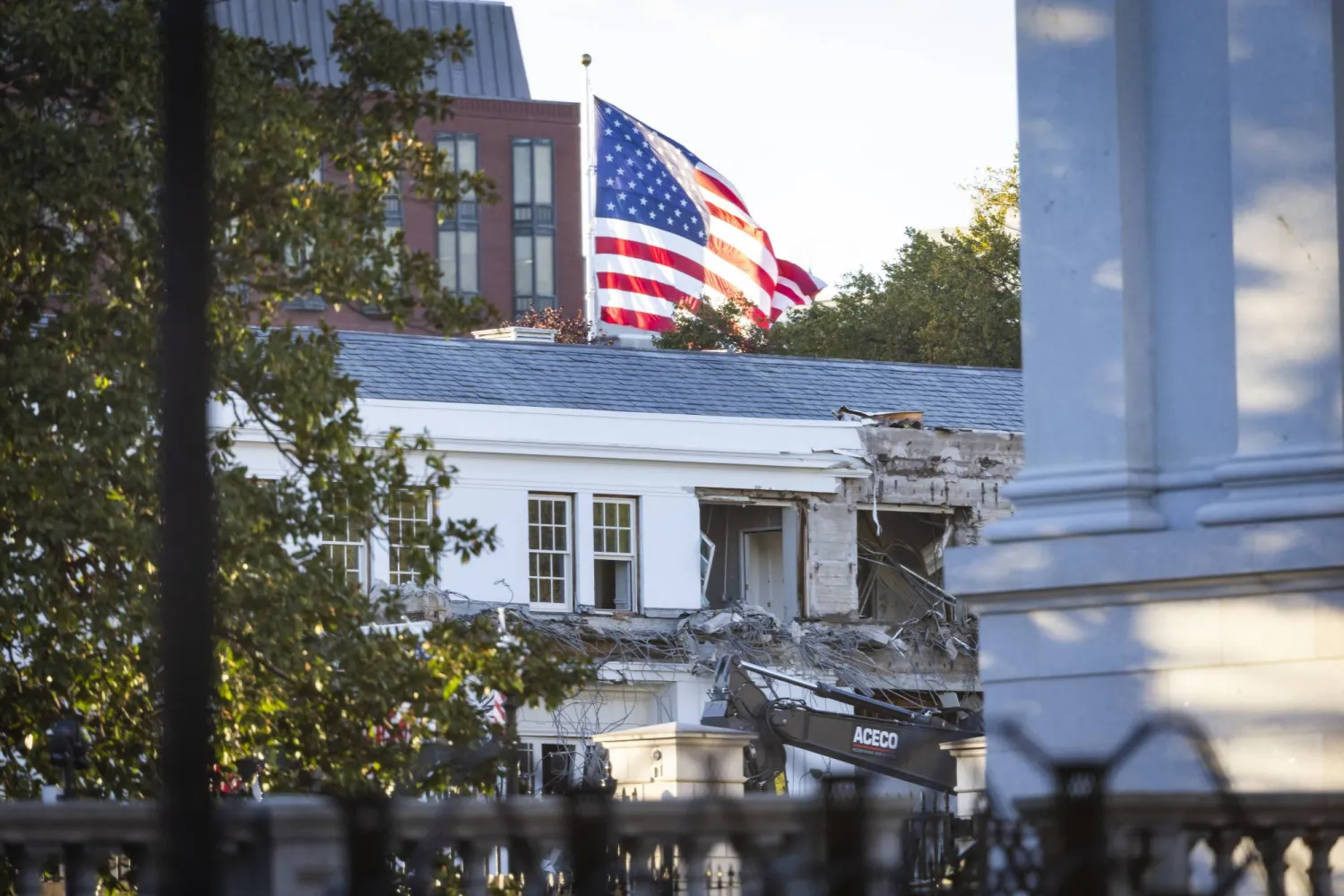

Trump Completes Demolition of White House East Wing

Constructions workers begin demolition of part of the East Wing of the White House for construction of President Trump's ballroom in Washington, DC, USA, 20 October 2025. EPA/JIM LO SCALZO
TT

Trump Completes Demolition of White House East Wing

Constructions workers begin demolition of part of the East Wing of the White House for construction of President Trump's ballroom in Washington, DC, USA, 20 October 2025. EPA/JIM LO SCALZO

Demolition workers have finished tearing down the White House's entire East Wing to make way for US President Donald Trump's giant new $300 million ballroom, satellite pictures showed Thursday.

The completion of the wrecking work came as the White House released a list of donors to the ballroom including Apple, Google and Meta.

A gray and brown patch of rubble can now be seen in the area that used to be occupied by the iconic building, according to the images shared with AFP by Planet Labs PBC and dated Thursday.

Satellite photos taken just under a month earlier show the wing that housed the offices of the US first lady intact.

The complete destruction of part of one of the world's most famous landmarks is a far more extensive demolition than previously announced by Trump -- and happened virtually without warning.

When the former property magnate unveiled his plans in July, Trump said that the 90,000-square-foot ballroom "won't interfere with the current building" and that it would be "near it but not touching it."

But after work started this week, Trump said Wednesday that he had decided after consulting architects that "really knocking it down" was preferable to a partial demolition.

He insists the 1,000-seat ballroom is essential because state dinners and other large events currently have to be held in tents that are temporarily erected on the White House lawn.

Trump also said that the new ballroom would cost $300 million, raising the cost from the $250 million quoted by the White House days before, and the $200 million it cited in July.

White House Press Secretary Karoline Leavitt told an AFP reporter in a briefing that $300 million was now the definitive number but said that "it's not going to cost the taxpayers a dime."

- Tech donors -

Billionaire Trump says the ballroom will be funded entirely by private donors and by himself.

The White House released a list of the donors to AFP on Thursday. They include US tech titans Amazon, Apple, Google, Meta and Palantir, as well as defense giant Lockheed Martin.

Individual donors include the family of Trump's Commerce Secretary Howard Lutnick and twins Cameron and Tyler Winklevoss, who were made famous as jilted investors in the movie "The Social Network" about the birth of Facebook.

"How much am I donating? I won't be able to tell you until it's finished," Trump told reporters on Thursday. "I'll donate whatever's needed, I'll tell you that."

Many US presidents have carried out upgrades to the White House but Trump's ballroom is the biggest in more than a century.

While lower profile than the West Wing where the president works, the East Wing had stood in one form or another for 123 years since the presidency of Theodore Roosevelt.

It received a major makeover in 1942 from President Franklin Roosevelt and was until this week home to the first lady's offices. It was also the main point of entry for guests for tours and parties.

As criticism mounted about the demolition, the White House Historical Association -- an independent group that helps preserve the history of the presidential home -- said it had been helping with preservation work.

The association had carried out a "comprehensive digital scanning project and photography to create a historic record," it said in an email to members obtained by AFP.

It added that "historic artifacts have been preserved and stored."

Trump's wrecking of the East Wing has provoked howls of outrage led by his Democratic opponents, including former first lady and 2016 presidential election rival Hillary Clinton.

Another top US historic group, however, the National Trust for Historic Preservation, had urged Trump to pause the demolition.

It said in a letter on Tuesday that it was "deeply concerned that the massing and height of the proposed new construction will overwhelm the White House itself" and urged the plans be put before the agency that oversees work on government buildings in Washington.

The White House argues that Trump had the authority to go ahead with the demolition without needing the agency's sign-off.


Lonely Tree in Wales Is an Instagram Star, but its Fate Is Inevitable

The Lonely Tree, often pictured submerged in water, was first planted in 2010. (Getty Images)
TT

Lonely Tree in Wales Is an Instagram Star, but its Fate Is Inevitable

The Lonely Tree, often pictured submerged in water, was first planted in 2010. (Getty Images)

It is one of Wales' most-loved beauty spots - but the time of the so-called Lonely Tree being an Instagram star could be slowly coming to an end.

The birch tree's striking setting at Llyn Padarn in Eryri, also known as Snowdonia, draws photographers to capture the sight through the seasons, according to BBC.

But the local authority Cyngor Gwynedd has raised the prospect of the tree, which was planted around 2010, disappearing within the next decade or so.

A lack of nutrients in the soil means birch trees have “a relatively short lifespan” in the area, typically living for around 30 years, but the fact that The Lonely Tree is sometimes submerged in water means its time could be even shorter.

Thousands of walkers and photographers make their way there each year and the tree has many social media sites dedicated to it, including one with 3,500 members on Facebook.

Marc Lock from Bangor, Gwynedd, said: “The Lonely Tree holds a special place in my heart and that of my family.”

He added: “Nestled down by the Lonely Tree, it's a perfect spot for us to sit, reflect and soak in the breath-taking scenery. We often go paddleboarding there in the summer months.”

However, Lock said the area really became his sanctuary after his wife bought him a camera for Christmas and he took up photography.

It was the place he headed to straight away, and he returns regularly at various times of the day and throughout the seasons.

“It's my go-to spot whenever I have some free time and my camera in hand,” he added. “I can't imagine what I would do if anything devastating happened to it like that at the Sycamore Gap tree at Hadrian's Wall. It's simply unthinkable.”

The Sycamore Gap was a much-loved landmark beside Hadrian's Wall in Northumberland that also drew hikers and photographers from far and wide.

It was more than 100 years old and had been the scene of many proposals, with people making the trip there from around the world.

But it was cut down by vandals in September 2023, causing uproar, with thousands of people leaving tributes and posting messages about their love for the beauty spot.

Two men were jailed for four years and three months after admitting the illegal felling.

While maybe not quite as famous as the Sycamore Gap was, The Lonely Tree is every bit as special to those that hold it dear to their heart.


Four Signs You're Self-Sabotaging Your Joy

Threat or uncertainty can reduce cognitive regulation and increase avoidance behaviors. (Indiana University)
TT

Four Signs You're Self-Sabotaging Your Joy

Threat or uncertainty can reduce cognitive regulation and increase avoidance behaviors. (Indiana University)

Most of us, at some point in our lives, have stood in the way of our own growth.

We make progress on a project, start to feel hopeful about a relationship, or finally get on track with a goal, and then we do something that undermines it.

We fall into a procrastination spiral, pick a fight, or simply quit; in doing so, we talk ourselves out of something that could potentially bring us happiness.

There’s a name for this kind of behavior: self-sabotage.

Dr. Mark Travers, an American psychologist with degrees from Cornell University and the University of Colorado Boulder, wrote an essay at Psychology Today about four well-studied reasons why people sabotage good things, based on research in psychology.

Avoiding blame

According to Travers, one of the most consistently researched patterns in self-sabotage comes from what psychologists call self-handicapping.

He said this is a behavior in which people create obstacles to their own success so that if they fail, they can blame external factors instead of internal ability.

A prime example comes from classic research in which researchers observed students who procrastinated studying for an important test. The ones who failed mostly attributed it to a lack of preparation rather than a lack of organization or discipline.

Self-handicapping is not simply laziness or whimsy. Rather, it is a strategy people use to protect their self-worth in situations where they might perform “poorly” or where they might be perceived as inadequate.

Fear of failure or success

People often think of the fear of failure as the main emotional driver behind self-sabotage.

But research points to the fear of success as an equal, yet less-talked-about engine of the phenomenon. Both fears can push people to undermine opportunities that are actually aligned with their long-term goals.

He said people who worry that failure will confirm their negative self-beliefs are more likely to adopt defensive avoidance tactics, like procrastination or quitting early.

Fear of success, though less widely discussed, operates in a similar fashion. What motivates this fear is the anxiety that comes with the consequences of success.

So, self-sabotaging success can be a way to stay within a comfort zone where expectations are familiar, even if that zone is unsatisfying.

Negative self-beliefs

Self-sabotage is tightly intertwined with how people view themselves. When someone doubts their worth, their ability, or their right to be happy, they may unconsciously act in ways that confirm those negative self-views.

Psychological theories help explain this.

Self-discrepancy theory proposes that people experience emotional discomfort when their actual self does not match their ideal self. This mismatch can lead to negative emotions such as shame, anxiety, or depression.

Coping with stress and anxiety

Self-sabotage often emerges in moments of high stress or emotional threat. When people feel overwhelmed, anxious, or stretched thin, their nervous systems shift into protective modes. Instead of moving forward, they retreat, avoid, or defensively withdraw.

Threat or uncertainty can reduce cognitive regulation and increase avoidance behaviors. In situations of perceived threat, even if the threat is potential success or evaluation, people can default to behaviors that feel safer, even if they undermine long-term goals.


2025 Was the World’s Third-Warmest Year on Record, EU Scientists Say

This photograph taken in Lanester, western France on May 31, 2025, shows smoke rising from a factory. (AFP)
TT

2025 Was the World’s Third-Warmest Year on Record, EU Scientists Say

This photograph taken in Lanester, western France on May 31, 2025, shows smoke rising from a factory. (AFP)

The planet experienced its third-warmest year on record in 2025, and average temperatures have ​exceeded 1.5 degrees Celsius of global warming over three years, the longest period since records began, EU scientists said on Wednesday.

The data from the European Union's European Centre for Medium-Range Weather Forecasts (ECMWF) found that the last three years were the planet's three hottest since records began - with 2025 marginally cooler than 2023, by just 0.01 C.

Britain's national weather service, the UK Met Office, confirmed its own data ranked 2025 as the third-warmest in records going back to 1850. The World Meteorological Organization will publish its temperature ‌figures later ‌on Wednesday.

The hottest year on record was 2024.

EXTREME WEATHER EVENTS

ECMWF ‌said ⁠the ​planet ‌also just had its first three-year period in which the average global temperature was 1.5 C above the pre-industrial era - the limit beyond which scientists expect global warming will unleash severe impacts, some of them irreversible.

"1.5 C is not a cliff edge. However, we know that every fraction of a degree matters, particularly for worsening extreme weather events," said Samantha Burgess, strategic lead for climate at ECMWF.

Governments pledged under the 2015 Paris Agreement to try to avoid exceeding ⁠1.5 C of global warming, measured as a decades-long average temperature compared with the pre-industrial era.

But their failure to reduce ‌greenhouse gas emissions means that level could now be ‍breached before 2030 - a decade earlier than ‍had been predicted when the Paris accord was signed in 2015, ECMWF said.

"We are ‍bound to pass it," said Carlo Buontempo, director of the EU's Copernicus Climate Change Service. "The choice we now have is how to best manage the inevitable overshoot and its consequences on societies and natural systems."

POLITICAL PUSHBACK

Currently, the world's long-term warming level is about 1.4 C above the pre-industrial ​era, ECMWF said. Measured on a short-term basis, the world already breached 1.5 C in 2024.

Exceeding the long-term 1.5 C limit - even if ⁠only temporarily - would lead to more extreme and widespread impacts, including hotter and longer heatwaves, and more powerful storms and floods.

In 2025, wildfires in Europe produced the highest total emissions on record, while scientific studies confirmed specific weather events were made worse by climate change, including Hurricane Melissa in the Caribbean and monsoon rains in Pakistan which killed more than 1,000 people in floods.

Despite these worsening impacts, climate science is facing increased political pushback. US President Donald Trump, who has called climate change "the greatest con job", last week withdrew from dozens of UN entities including the scientific Intergovernmental Panel on Climate Change.

The long-established consensus among the world's scientists is that climate change is real, mostly caused by humans, and getting worse. Its main cause ‌is greenhouse gas emissions from burning fossil fuels such as coal, oil and gas, which trap heat in the atmosphere.
