

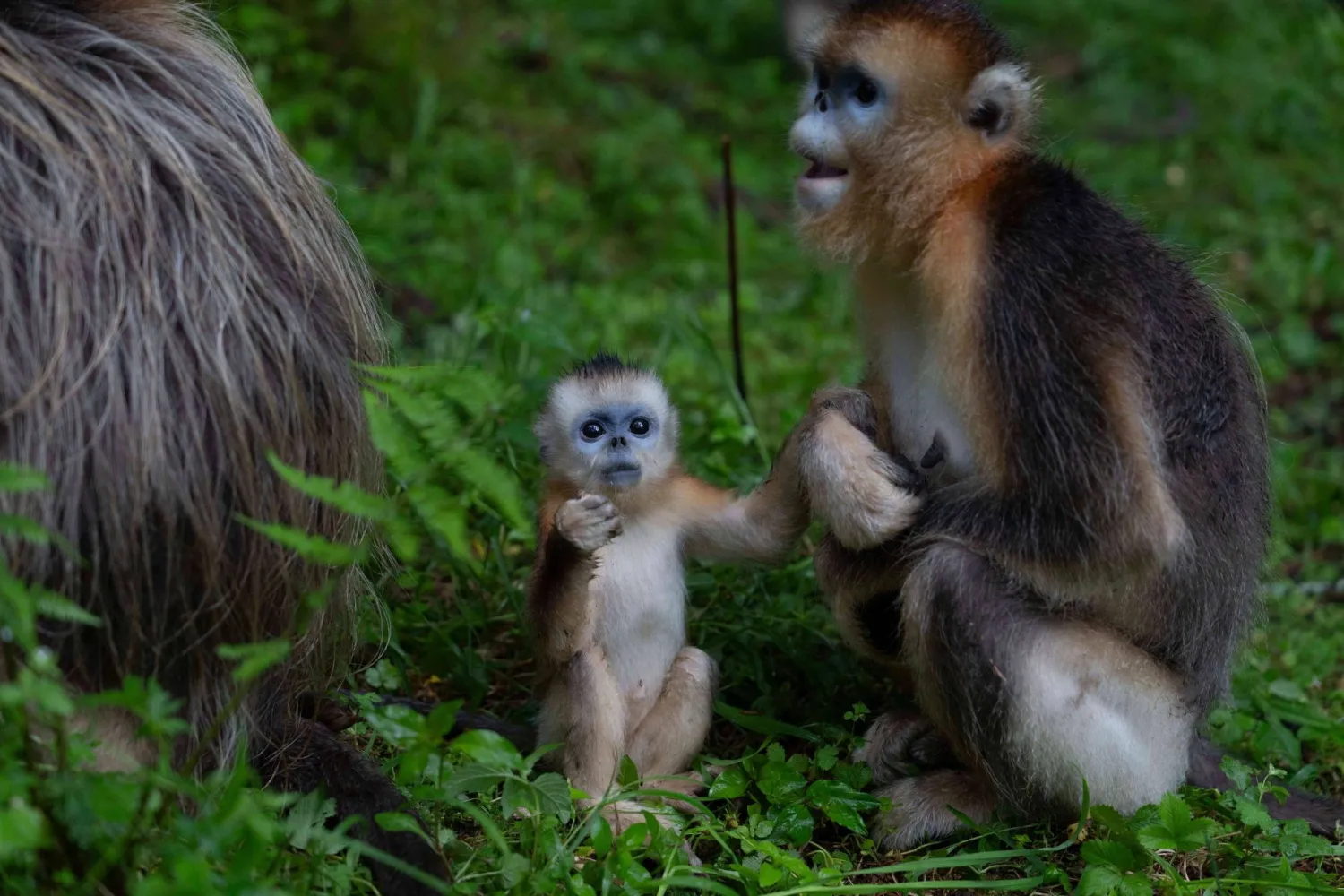

China's Rare Golden Monkeys Debut at European Zoos

Golden snub-nosed monkeys sit together in the Shennongjia National Park in Shennongjia in central China's Hubei province on Wednesday, June 18, 2025. (AP Photo/Ng Han Guan)
TT

China's Rare Golden Monkeys Debut at European Zoos

Golden snub-nosed monkeys sit together in the Shennongjia National Park in Shennongjia in central China's Hubei province on Wednesday, June 18, 2025. (AP Photo/Ng Han Guan)

With their distinctive shaggy orange manes, pale blue faces and dense fur covering their hands and feet, it's hard to mistake China's endangered golden snub-nosed monkeys for any other animal.

These rare and charismatic monkeys, unique to the frigid mountains of central China, have recently joined the country's famous pandas as furry envoys to zoos in Europe for the first time — on loan for 10 years from the same government-overseen group that coordinates official panda exchanges, The Associated Press reported.

As with “ panda diplomacy,” some observers cheer new opportunities for scientific and conservation collaboration, while others raise concerns about the welfare of individual animal ambassadors transported around the world.

Leaping among red and gray-tiled roofs Three golden monkeys arrived at France’s Beauval Zoo in the city of Saint-Aignan this April, following an agreement to mark the 60th anniversary of the establishment of diplomatic relations between the People’s Republic of China and France.

Another trio of golden monkeys arrived at the Pairi Daiza zoo in Hainaut, Belgium, in May. The zoo distributed Belgian and Chinese hand flags to visitors on the day the monkeys arrived.

After a monthlong quarantine, the two sets of monkeys made their public debuts. So far, they appear to be in good health, according to the two zoos, adapting to new climates outside Asia for the first time.

At Pairi Daiza, the habitat enclosure for Liu Yun, Lu Lu and Juan Juan includes traditional Chinese gazebos with red columns and gray-tiled roofs, where the monkeys spend much of their time jumping between logs and rope ladders and scrambling over roofs.

“The diplomatic aspect comes from this cultural awareness,” said Pairi Daiza spokesperson Johan Vreys.

The hope is to build longstanding scientific exchanges between the zoos and Chinese authorities, said Anaïs Maury, the communications director for the Beauval Zoo.

The zoo is in discussions with China to launch joint research and conservation programs “similar to those already in place for other emblematic species like pandas,” Maury said.

A short history of modern animal ambassadors Both giant pandas and golden snub-nosed monkeys are endangered animals that are unique to China and they can only be moved outside the country with approval from the central government, said Elena Songster, an environmental historian at St. Mary’s College of California.

While both species are considered national treasures, only monkeys have deep roots in Chinese art and culture, appearing in countless paintings and as characters in classic literature, including the wily Monkey King in the 16th century novel “Journey to the West."

When pandas stepped, rolled, scratched and stumbled onto the world stage in recent decades, they quickly became symbols of modern China — in part to due to their own “cuddly cuteness” and deft diplomatic presentation, said Susan Brownell, a China historian at the University of Missouri, St. Louis.

The original soft power couple from post-war China was a pair of giant pandas, Ping Ping and Qi Qi, sent to the Soviet Union in 1957 to celebrate the 40th anniversary of the October Revolution, which led to the establishment of the world’s first Communist state.

In 1972, a pair of pandas was sent to the US for the first time, following President Richard Nixon’s historic visit to Beijing. In 1984, China switched from gifting pandas to loaning them.

Following outcry from animal-rights activists, China ended the practice of short-term loans and began longer leases, usually around a decade. In this arrangement through the China Wildlife Conservation Association, part of the money that an overseas zoo pays annually to China must be earmarked for habitat conservation or scientific research to benefit the species.

Still, what benefits a species may not be beneficial to an individual animal.

Transporting animals over long distances and sending their offspring back to China, as the agreements require, may highly stress animals, said Jeff Sebo, an environmental and bioethics researcher at New York University.

“Animal health and welfare matters,” he said, “not just for geopolitical or strategic aims.”

Habitat conservation in China Within China, the golden snub-nosed monkeys today live across a swath of central and southwestern China that includes parts of Sichuan, Shaanxi, Gansu and Hubei provinces.

At the Shennongjia National Park in Hubei, conservation efforts since the 1980s have helped increase the region’s population threefold to around 1,600 monkeys today, said Yang Jingyuan, president of the Academy of Sciences at the park.

It’s unclear exactly how to evaluate the diplomatic track record of furry ambassadors.

Still, in an era of rising global tensions, “I think pandas are a really useful entryway,” said James Carter, a China historian at Saint Joseph’s University in Philadelphia. “Pandas open up an opportunity for people to think something positive about China — they’re cute, they don’t do anything bad.”

The golden snub-nosed monkeys now at zoos in France and Belgium are so far the only ones outside of Asia.

“China’s golden snub-nosed monkeys aren’t globally iconic yet,” said Brownell, “but there may be potential for them to be in the future.”



Thieves Drill into a German Bank Vault and Steal Tens of Millions of Euros Worth of Property

 Police officers stand in front of the savings bank branch in the Buer district in Gelsenkirchen, Germany, Tuesday, Dec. 30, 2025 following a break-in into the bank's vault. (Christoph Reichwein/dpa via AP)
Police officers stand in front of the savings bank branch in the Buer district in Gelsenkirchen, Germany, Tuesday, Dec. 30, 2025 following a break-in into the bank's vault. (Christoph Reichwein/dpa via AP)
TT

Thieves Drill into a German Bank Vault and Steal Tens of Millions of Euros Worth of Property

 Police officers stand in front of the savings bank branch in the Buer district in Gelsenkirchen, Germany, Tuesday, Dec. 30, 2025 following a break-in into the bank's vault. (Christoph Reichwein/dpa via AP)
Police officers stand in front of the savings bank branch in the Buer district in Gelsenkirchen, Germany, Tuesday, Dec. 30, 2025 following a break-in into the bank's vault. (Christoph Reichwein/dpa via AP)

Thieves stole tens of millions of euros worth of property from safety deposit boxes inside a German bank vault that they drilled into Monday during the holiday lull, police said.

Some 2,700 bank customers were affected by the theft in Gelsenkirchen, police and the Sparkasse bank said.

Thomas Nowaczyk, a police spokesperson, said investigators believe the theft was worth between 10 and 90 million euros ($11.7 to 105.7 million).

German news agency dpa reported that the theft could be one of Germany's largest heists.

The bank remained closed Tuesday, when some 200 people showed up demanding to get inside, dpa reported.

A fire alarm summoned police officers and firefighters to the bank branch shortly before 4 a.m. Monday. They found a hole in the wall and the vault ransacked. Police believe a large drill was used to break through the vault's basement wall.

Witnesses told investigators they saw several men carrying large bags in a nearby parking garage over the weekend. Video footage from the garage shows masked people inside a stolen vehicle early Monday, police said.

Gelsenkirchen is about 192 kilometers (119 miles) northwest of Frankfurt.


The Year's First Meteor Shower and Supermoon Clash in January Skies

People look up to the sky from an observatory near the village of Avren, Bulgaria, Aug. 12, 2009. (AP Photo/Petar Petrov, File)
TT

The Year's First Meteor Shower and Supermoon Clash in January Skies

People look up to the sky from an observatory near the village of Avren, Bulgaria, Aug. 12, 2009. (AP Photo/Petar Petrov, File)

The year's first supermoon and meteor shower will sync up in January skies, but the light from one may dim the other.

The Quadrantid meteor shower peaks Friday night into Saturday morning, according to the American Meteor Society. In dark skies during the peak, skygazers typically see around 25 meteors per hour, but this time they'll likely glimpse less than 10 per hour due to light from Saturday's supermoon, The AP news reported.

“The biggest enemy of enjoying a meteor shower is the full moon,” said Mike Shanahan, planetarium director at Liberty Science Center in New Jersey.

Meteor showers happen when speedy space rocks collide with Earth’s atmosphere, burning up and leaving fiery tails in their wake — the end of a “shooting star.” A handful of meteors are visible on any given night, but predictable showers appear annually when Earth passes through dense streams of cosmic debris.

Supermoons occur when a full moon is closer to Earth in its orbit. That makes it appear up to 14% bigger and 30% brighter than the faintest moon of the year, according to NASA. That difference can be tough to notice with the naked eye.

Supermoons, like all full moons, are visible in clear skies everywhere that it's night. The Quadrantids, on the other hand, can be seen mainly from the Northern Hemisphere. Both can be glimpsed without any special equipment.

To spot the Quadrantids, venture out in the early evening away from city lights and watch for fireballs before the moon crashes the party, said Jacque Benitez with the Morrison Planetarium at the California Academy of Sciences. Skygazers can also try looking during early dawn hours on Sunday.

Wait for your eyes to get used to the darkness, and don’t look at your phone. The space rocks will look like fast-moving white dots and appear over the whole sky.

Meteor showers are named for the constellation where the fireballs appear to come from. The Quadrantids — space debris from the asteroid 2003 EH1 — are named for a constellation that's no longer recognized.

The next major meteor shower, called the Lyrids, is slotted for April.

Supermoons happen a few times a year and come in groups, taking advantage of the sweet spot in the moon’s elliptical orbit. Saturday night’s event ends a four-month streak that started in October. There won't be another supermoon until the end of 2026.


New Maritime Theater in Jazan to Host the City's Festival Opening

The site also includes various amenities, such as shopping zones, kiosks for dining, an art gallery - SPA
TT

New Maritime Theater in Jazan to Host the City's Festival Opening

The site also includes various amenities, such as shopping zones, kiosks for dining, an art gallery - SPA

The Jazan city theater on the southern corniche will host the opening ceremony of the Jazan Festival 2026 on Friday. This event will take place at a 35-square-kilometer site that features the Kingdom's largest maritime theater, SPA reported.

The theater accommodates more than 10,000 spectators and features five VIP areas. To ensure a smooth experience, the venue offers parking for over 9,000 vehicles, providing easy access during peak times.

Built specifically for the festival, the stage meets stringent safety and technical standards, providing a high-quality audiovisual experience against the stunning backdrop of the Red Sea.

The site also includes various amenities, such as shopping zones, kiosks for dining, an art gallery, a play area for children, a bird garden, and a regional museum, showcasing the region's history and culture.

This temporary maritime theater aims to provide a cohesive experience, integrating entertainment, culture, shopping, and services in one location, further establishing Jazan as a year-round destination for tourism and entertainment.