


How a Naples Museum Protects its Treasures with Forensic Mapping

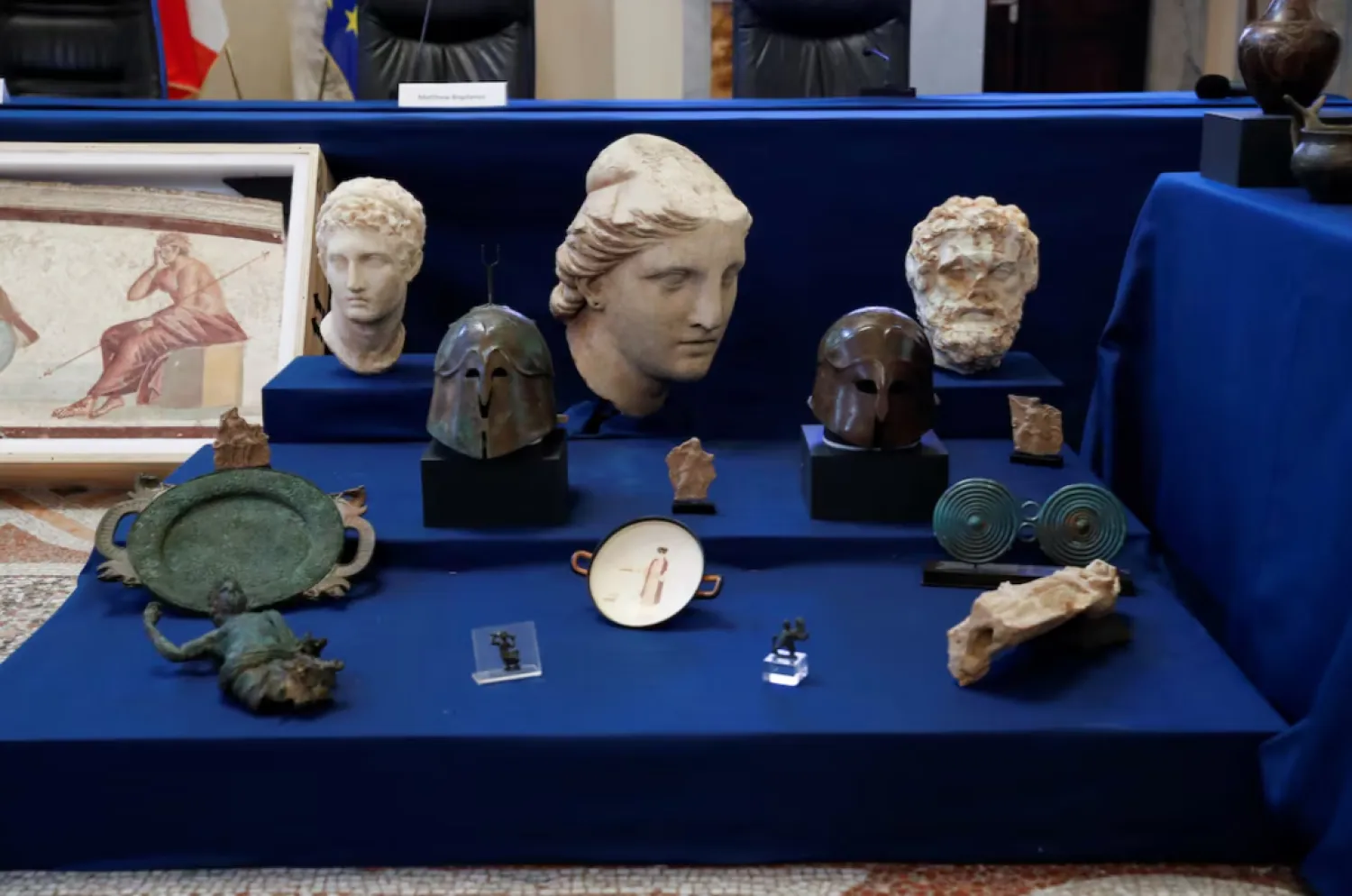
Some of the antiquities worth an estimated $19 million are seen after being returned to Italy by New York City, in Rome, Italy, January 23 2023. REUTERS/Remo Casilli
TT

How a Naples Museum Protects its Treasures with Forensic Mapping

Some of the antiquities worth an estimated $19 million are seen after being returned to Italy by New York City, in Rome, Italy, January 23 2023. REUTERS/Remo Casilli

With the art world on high alert for any sign of the missing Louvre jewels, one Italian collection says its method of creating a photographic fingerprint of its own priceless gems and artefacts could make them harder to break apart and sell on.

A team of gemology experts has spent more than a decade studying the most valuable pieces of the collection at Naples' Tesoro di San Gennaro. Using microscopes and specialised equipment, the team has photographed more than 10,000 stones, Reuters reported.

As well as the armed security and alarmed displays that provide physical protection for the site, the process has allowed them to certify the unique characteristics of the gems to provide a kind of forensic fingerprint that experts liken to DNA.

Major European museums have declined to comment on their security protocols in the wake of the Louvre theft, but the Naples method offers a rare insight into some of the measures used by institutions.

LOUVRE DIRECTOR HAD WARNED ABOUT SECURITY

"If the Louvre had adopted this security system, thieves would not be able to resell the stones from the stolen jewellery," Ciro Paolillo, a former professor of investigative gemology at La Sapienza University in Rome, who led the mapping work, told Reuters.

"The stones would be identified, even if cut, at the first official quality certification by an international body."

Reuters was unable to verify whether the French museum had undertaken a comparable analysis of the stolen stones. The museum did not respond to requests for comment.

Louvre director Laurence des Cars has said she had repeatedly warned that the centuries-old building's security was in a dire state. She said exterior security cameras did not offer full coverage of the facade, adding that the window through which the thieves broke in was not monitored by CCTV.

The Paris prosecutor said on Sunday suspects had been arrested over the robbery, but declined to give further details, saying newspaper reports about the arrests would hinder the search for the stolen jewellery and the perpetrators.

MUSEUM WAS MAFIA TARGET IN 1975

The San Gennaro treasures, a trove of sacred art and jewels, have been assembled over seven centuries from donations from popes, royals and the wealthy. It includes a cross adorned with emeralds and diamonds given by Joseph Bonaparte, the eldest brother of Napoleon, who was king of Naples in the 1800s.

Nestled beside Naples' cathedral, the museum houses over 21,000 pieces, among them a mitre encrusted with nearly 4,000 precious stones and a necklace with over 1,500 gems.

It is named after the fourth-century martyr who is the patron saint of the southern Italian port.

Although no official appraisal of the collection has ever been conducted, Francesca Ummarino, the museum's director, told Reuters that the mitre and the necklace together have an estimated value of around 100 million euros ($116 million).

It also includes 53 silver busts, most dating back to the 17th and 18th centuries, each weighing around 200 kg, she said.

The Italian team led by Paolillo analysed samples of silver and gold to trace their origins to specific workshops in Naples' historic Goldsmiths' Quarter.

However such metallurgical mapping, no longer possible as alloys are now standardized by law, would not help in case of a heist.

"The criminals would melt down the masterpieces, making it impossible to understand the alloy," Paolillo said.

Unlike most religious artefacts in Italy, the collection does not belong to the Vatican or the state. It is owned by the people of Naples and managed by the "Deputazione", a lay institution founded in 1527.

The Treasure of San Gennaro was kept in the vault of the Bank of Naples for nearly 30 years following an aborted robbery attempt orchestrated by the local mafia, the Camorra, in 1975.

It was reopened to the public in 2003, and since then, no robbery has been reported, despite the city's crime index remaining high.

"We have anti-theft security windows, all equipped with alarms. We have a military patrol on duty 24 hours a day at the museum entrance, and if, unfortunately, any objects were to be stolen, the mapping of the stones would allow us to recognise them," said Riccardo Carafa d'Andria, vice president of the Deputation.

"Out of deep devotion to their patron saint, Neapolitans do not touch the Treasure of San Gennaro — and they would never allow anyone else to touch it either."



Israel Cleared to Stay in Eurovision; Spain, Ireland and Others Quit in Protest

Pro-Palestinian protestors hold a flag and a banner outside the RTE (Radio Telefis Eireann) Irish public service broadcaster television studios as demonstrators call for an Irish boycott of the 2026 Eurovision Song Contest if there is Israeli participation, in Dublin, Ireland, November 1, 2025. (Reuters)
TT

Israel Cleared to Stay in Eurovision; Spain, Ireland and Others Quit in Protest

Pro-Palestinian protestors hold a flag and a banner outside the RTE (Radio Telefis Eireann) Irish public service broadcaster television studios as demonstrators call for an Irish boycott of the 2026 Eurovision Song Contest if there is Israeli participation, in Dublin, Ireland, November 1, 2025. (Reuters)

Israel was cleared on Thursday to enter the 2026 Eurovision Song Contest by the organizer, prompting Spain, the Netherlands, Ireland and Slovenia to withdraw over the Gaza war and plunging the competition into one of the biggest rows in its history.

The broadcasters who had threatened to boycott the event cited the death count in Gaza and accused Israel of flouting rules meant to guard the contest's neutrality. Israel accuses its critics of mounting a global smear campaign against it.

After a meeting in Geneva, the European Broadcasting Union, or EBU, decided not to call a vote on Israel's participation, saying it had instead passed new rules aimed at discouraging governments from influencing the contest, Reuters said.

Right after that announcement by the contest organizer, the Dutch, Spanish, Irish and Slovenian broadcasters said they would withdraw, meaning singers from their countries would not compete in the contest that draws millions of viewers worldwide.

Ben Robertson, a Eurovision expert from fan website ESC Insight, said the contest's integrity was at its lowest ebb.

"Never in the history of the contest have we had such a vote, and such a split, between the member broadcasters of the European Broadcasting Union," he said.

Both the Israeli government and opposition leaders celebrated the country's inclusion.

Golan Yochpaz, CEO of Israeli broadcaster KAN, likened the efforts to exclude Israel to a form of "cultural boycott."

Rounding on the countries withdrawing, Foreign Minister Gideon Saar said on X: "The disgrace is upon them."

IRELAND SAYS ITS PARTICIPATION 'UNCONSCIONABLE'

The Eurovision Song Contest dates back to 1956 and reaches around 160 million viewers, according to the EBU - more than the almost 128 million recorded for this year's US Super Bowl, according to figures from Nielsen.

Israel's participation has divided opinion in the competition that has a history of entanglement in national rivalries, international issues and political voting.

Its 2025 entrant, Yuval Raphael, was at the Nova music festival, a target of the October 7, 2023 attack by Palestinian group Hamas on Israel that triggered the Gaza war.

A total of 1,200 people were killed and 251 taken hostage in the assault by Hamas, according to Israeli tallies. More than 70,000 people have been killed in Gaza in the ensuing conflict, according to health authorities in the enclave.

Irish broadcaster RTE said it felt "Ireland's participation remains unconscionable given the appalling loss of lives in Gaza and the humanitarian crisis there which continues to put the lives of so many civilians at risk".

Jose Pablo Lopez, head of Spanish state broadcaster RTVE said on X: "What happened in the EBU Assembly confirms that Eurovision is not a song contest but a festival dominated by geopolitical interests and fractured."

RTV Slovenija said it together with Spain, Montenegro, the Netherlands, Türkiye, Algeria and Iceland requested a secret vote on Israel's participation, but it was not held.

Icelandic public broadcaster RUV said its board will make a decision on Wednesday on whether to participate in the next Eurovision, which will be held in Vienna in May.

"I feel sad that other countries are not going to compete next year," said 33-year-old Tel Aviv Eurovision fan Jurij Vlasov, adding the Netherlands' song this year was his favorite.

In Austria, which backed Israel, Eurovision fans welcomed its inclusion, even as some in Spain took the opposite view.

"Why should the population, or a part of the population, not participate?," said Vienna resident Bernhard Kleemann. "If countries decide not to participate because they condemn the government and the prime minister, that's their decision."

"BORN FROM THE ASHES OF THE SECOND WORLD WAR"

Instead of voting on Israel, the EBU said its members backed rules intended to discourage governments and third parties from disproportionately promoting songs to sway voters after allegations that Israel unfairly boosted its 2025 entrant.

"This vote means that all EBU Members who wish to participate in the Eurovision Song Contest 2026 and agree to comply with the new rules are eligible to take part," it said.

Israel's President Isaac Herzog thanked his country's supporters, saying he hoped the song contest would continue to champion "culture, music, friendship between nations".

Germany, a major Eurovision backer, had signaled it would not take part if Israel was barred. Germany's culture minister Wolfram Weimer told the Bild newspaper he welcomed the decision.

"Israel belongs to the Eurovision Song Contest like Germany belongs to Europe," he said.

Martin Green, the contest's director, said EBU members showed they wanted to protect the neutrality of the competition.

"Eurovision was born from the ashes of the Second World War," he said. "It was designed to bring us together, and it will hit bumps in the road, and we have a complicated world, but we hope it's a temporary situation, and we'll move forward."


Study Says African Penguins Starved En Masse Off South Africa

Yellow-eyed penguins fights in their colony in Katiki Point, on the southern end of the Moeraki Peninsula in New Zealand's South Island, about 80 kilometers north of Dunedin on November 12, 2025. (Photo by Sanka VIDANAGAMA / AFP)
TT

Study Says African Penguins Starved En Masse Off South Africa

Yellow-eyed penguins fights in their colony in Katiki Point, on the southern end of the Moeraki Peninsula in New Zealand's South Island, about 80 kilometers north of Dunedin on November 12, 2025. (Photo by Sanka VIDANAGAMA / AFP)

Endangered penguins living off South Africa's coast have likely starved en masse due to food shortages, a study said Friday, with some populations dropping by 95 percent in just eight years.

Fewer than 10,000 breeding pairs of the small, black and white African Penguin are left globally, according to scientists, and the species was listed as critically endangered last year by the International Union for Conservation of Nature (IUCN).

Two of the most important breeding colonies near Cape Town had collapsed between 2004 and 2011, with some 62,000 birds estimated to have died, the study by the UK's University of Exeter and the South African Department of Forestry, Fisheries and the Environment said.

In those eight years, sardine populations in South African waters -- a main food source for penguins -- were consistently below 25 percent of their peak abundance, Agence France Presse quoted co-author and biologist Richard Sherley as saying.

This drop in sardine stocks was due to fishing practices combined with environmental causes such as changes in water temperatures and salinity.

This "appears to have caused severe food shortage for African penguins, leading to an estimated loss of about 62,000 breeding individuals", Sherley said.

The global population of the species had declined by nearly 80 percent in the past 30 years, the scientists said.

Conservationists say that at the current rate of population decrease, the bird could be extinct in the wild by 2035.

For 10 years, authorities have imposed a commercial fishing ban around six penguin colonies, including Robben and Dassen islands, the two sites observed in the study.

Other initiatives underway include artificial nests and creating new colonies.

The birds are a strong attraction for tourists to South Africa, with thousands of people visiting colonies each year.

But the pressure from tourism also disturbs the birds and causes enhanced stress.


Saudi Post Issues Stamp Marking Int’l Day of Persons with Disabilities

Saudi Post (SPL) issued a set of commemorative stamps to mark the International Day of Persons with Disabilities.
TT

Saudi Post Issues Stamp Marking Int’l Day of Persons with Disabilities

Saudi Post (SPL) issued a set of commemorative stamps to mark the International Day of Persons with Disabilities.

Saudi Post (SPL), the Kingdom's national postal and logistics provider, has issued a set of commemorative stamps valued at SAR3 to mark the International Day of Persons with Disabilities, observed annually on December 3.

The day is celebrated worldwide, including in the Kingdom of Saudi Arabia, to reinforce care for persons with disabilities, empower them to achieve their aspirations, enhance their quality of life, ensure their rights, and include them in all activities and events by highlighting their talents and diverse abilities, said the Saudi Press Agency on Thursday.

The launch took place during a ceremony organized by the Authority for the Care of People with Disabilities (APD).

The event included the unveiling of a campaign titled “Say It Right,” which promotes the correct and officially adopted terminology for persons with disabilities.

The stamp features several individuals with disabilities who participated in the campaign.

APD continues to work collaboratively with various sectors to enhance service quality and raise awareness of the rights of persons with disabilities.
