


Hornless Rhino Roamed Canadian High Arctic 23 Million Years Ago

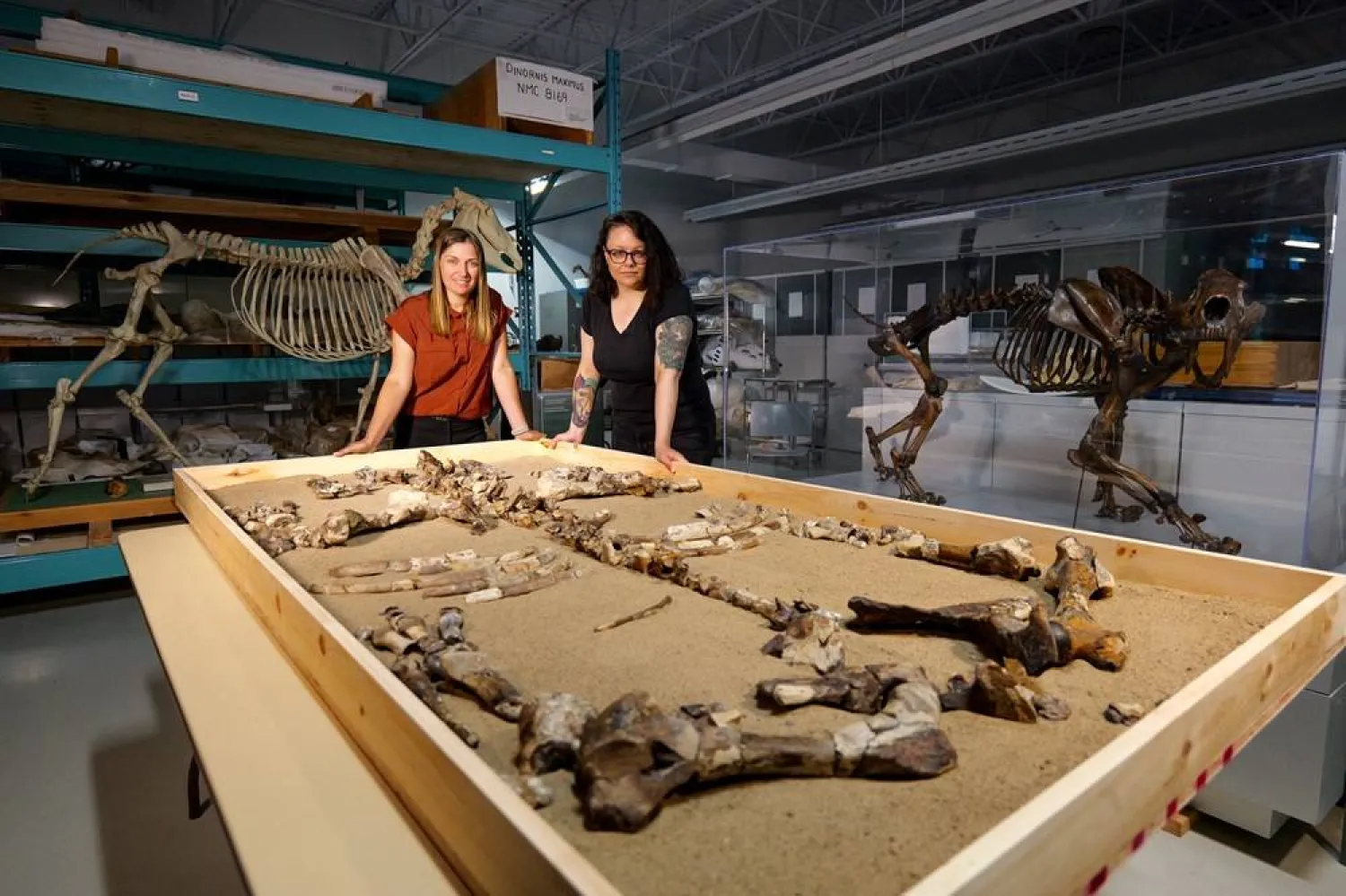
Scientists Marisa Gilbert and Danielle Fraser pose with the fossil of the ancient hornless rhino Epiaceratherium itjilik, which lived 23 million years ago in the Canadian High Arctic, laid out in the collections of the Canadian Museum of Nature in Ottawa, Ontario, Canada, in this photograph released on October 27, 2025. (Pierre Poirier/Canadian Museum of Nature/Handout via Reuters)
TT

Hornless Rhino Roamed Canadian High Arctic 23 Million Years Ago

Scientists Marisa Gilbert and Danielle Fraser pose with the fossil of the ancient hornless rhino Epiaceratherium itjilik, which lived 23 million years ago in the Canadian High Arctic, laid out in the collections of the Canadian Museum of Nature in Ottawa, Ontario, Canada, in this photograph released on October 27, 2025. (Pierre Poirier/Canadian Museum of Nature/Handout via Reuters)

About 23 million years ago, a species of rhinoceros - similar in size to the modern Indian rhino but lacking a horn - made its home in the challenging environment of the Canadian High Arctic, which at the time was warmer than it is now but still experienced snow and months of wintertime darkness.

Fossils of the polar rhino, named Epiatheracerium itjilik, were found on Devon Island, a landscape underlain by permafrost, in Canada's Arctic archipelago. With about 75% of its skeleton intact, scientists gained a good understanding of the animal. Its remains were discovered in Haughton Crater, one of Earth's northernmost impact craters, about 14 miles (23 km) wide.

The polar rhino lived early in the Miocene epoch, a time of diversification of many mammalian groups. Until this discovery, no rhinoceros was known to have lived in such a high latitude. The fossil site is in Nunavut, Canada's northernmost territory.

About three feet (one meter) tall at the shoulder, this species approximated the size of the modern Indian rhinoceros, and was smaller than modern African rhinos.

"Devon Island during the Miocene was much more temperate and forested, quite unlike the polar desert that is there today," said Danielle Fraser, head of palaeobiology at the Canadian Museum of Nature in Ottawa and lead author of the study published on Tuesday in the journal Nature Ecology and Evolution.

Summers would have been warm but winters cold enough for snowfall. Fraser compared the climate to that of southern Ontario or northern New York state in modern times, though there would have been months of winter darkness and months of summer daylight.

"So, it remains a mystery as to how animals like a rhino survived, though we know modern mammals dig through snow using hooves and antlers to access plants," Fraser said.

"Our study highlights the importance of the Arctic in mammal evolution," Fraser said. "We often think about the tropics as centers for biodiversity - and they are. But the more fossil discoveries we make in the Arctic, the more it is becoming clear that it was an essential region in the evolution of mammals."

The polar rhino fed on the leaves of trees and shrubs as it roamed a forest that, based on fossilized pollen at the site, featured pines, larch, alder, spruce and birch. Its fossils indicate it had a narrow muzzle, like browsing animals today.

The polar rhino may have had a coat of fur given the freezing winter temperatures, Fraser said. Large horned rhinos with extensive fur coats called woolly rhinoceroses lived during the last Ice Age, but they were not closely related to this species.

Other fossils from the site include those of the early seal Puijila darwini, which had feet rather than flippers.

Rhinos first appeared roughly 48 million years ago and spread to every continent but South America and Antarctica. Five species live today, whereas more than 50 are known from the fossil record.

While horns already had evolved in some rhinos, this species did not have one. It also was quite different from other Miocene North American rhinos such as Teleoceras, which was big, short-legged and barrel-chested like a hippo, with a small horn.

As detailed in a study published in July in which Fraser was a co-author, scientists were able to extract and sequence ancient proteins from the tooth enamel of the polar rhino. Proteins offer valuable information about an organism and survive much longer than DNA. That discovery helped the researchers better understand the rhinoceros family tree.

The polar rhino's closest relatives lived in Europe and in the Middle East and southwestern Asia. This indicates that its ancestors crossed from Europe into North America across a land bridge that previously was thought to have disappeared about 50 million years ago.

"Our study says rhinos were crossing for at least 20 million years longer than we thought. This is, in fact, supported by newer geological studies that show that the two North Atlantic routes - one from the UK over Iceland to Greenland and the other from Finland over Svalbard to Greenland - were potentially crossable into the Miocene," Fraser said.



Israel Cleared to Stay in Eurovision; Spain, Ireland and Others Quit in Protest

Pro-Palestinian protestors hold a flag and a banner outside the RTE (Radio Telefis Eireann) Irish public service broadcaster television studios as demonstrators call for an Irish boycott of the 2026 Eurovision Song Contest if there is Israeli participation, in Dublin, Ireland, November 1, 2025. (Reuters)
TT

Israel Cleared to Stay in Eurovision; Spain, Ireland and Others Quit in Protest

Pro-Palestinian protestors hold a flag and a banner outside the RTE (Radio Telefis Eireann) Irish public service broadcaster television studios as demonstrators call for an Irish boycott of the 2026 Eurovision Song Contest if there is Israeli participation, in Dublin, Ireland, November 1, 2025. (Reuters)

Israel was cleared on Thursday to enter the 2026 Eurovision Song Contest by the organizer, prompting Spain, the Netherlands, Ireland and Slovenia to withdraw over the Gaza war and plunging the competition into one of the biggest rows in its history.

The broadcasters who had threatened to boycott the event cited the death count in Gaza and accused Israel of flouting rules meant to guard the contest's neutrality. Israel accuses its critics of mounting a global smear campaign against it.

After a meeting in Geneva, the European Broadcasting Union, or EBU, decided not to call a vote on Israel's participation, saying it had instead passed new rules aimed at discouraging governments from influencing the contest, Reuters said.

Right after that announcement by the contest organizer, the Dutch, Spanish, Irish and Slovenian broadcasters said they would withdraw, meaning singers from their countries would not compete in the contest that draws millions of viewers worldwide.

Ben Robertson, a Eurovision expert from fan website ESC Insight, said the contest's integrity was at its lowest ebb.

"Never in the history of the contest have we had such a vote, and such a split, between the member broadcasters of the European Broadcasting Union," he said.

Both the Israeli government and opposition leaders celebrated the country's inclusion.

Golan Yochpaz, CEO of Israeli broadcaster KAN, likened the efforts to exclude Israel to a form of "cultural boycott."

Rounding on the countries withdrawing, Foreign Minister Gideon Saar said on X: "The disgrace is upon them."

IRELAND SAYS ITS PARTICIPATION 'UNCONSCIONABLE'

The Eurovision Song Contest dates back to 1956 and reaches around 160 million viewers, according to the EBU - more than the almost 128 million recorded for this year's US Super Bowl, according to figures from Nielsen.

Israel's participation has divided opinion in the competition that has a history of entanglement in national rivalries, international issues and political voting.

Its 2025 entrant, Yuval Raphael, was at the Nova music festival, a target of the October 7, 2023 attack by Palestinian group Hamas on Israel that triggered the Gaza war.

A total of 1,200 people were killed and 251 taken hostage in the assault by Hamas, according to Israeli tallies. More than 70,000 people have been killed in Gaza in the ensuing conflict, according to health authorities in the enclave.

Irish broadcaster RTE said it felt "Ireland's participation remains unconscionable given the appalling loss of lives in Gaza and the humanitarian crisis there which continues to put the lives of so many civilians at risk".

Jose Pablo Lopez, head of Spanish state broadcaster RTVE said on X: "What happened in the EBU Assembly confirms that Eurovision is not a song contest but a festival dominated by geopolitical interests and fractured."

RTV Slovenija said it together with Spain, Montenegro, the Netherlands, Türkiye, Algeria and Iceland requested a secret vote on Israel's participation, but it was not held.

Icelandic public broadcaster RUV said its board will make a decision on Wednesday on whether to participate in the next Eurovision, which will be held in Vienna in May.

"I feel sad that other countries are not going to compete next year," said 33-year-old Tel Aviv Eurovision fan Jurij Vlasov, adding the Netherlands' song this year was his favorite.

In Austria, which backed Israel, Eurovision fans welcomed its inclusion, even as some in Spain took the opposite view.

"Why should the population, or a part of the population, not participate?," said Vienna resident Bernhard Kleemann. "If countries decide not to participate because they condemn the government and the prime minister, that's their decision."

"BORN FROM THE ASHES OF THE SECOND WORLD WAR"

Instead of voting on Israel, the EBU said its members backed rules intended to discourage governments and third parties from disproportionately promoting songs to sway voters after allegations that Israel unfairly boosted its 2025 entrant.

"This vote means that all EBU Members who wish to participate in the Eurovision Song Contest 2026 and agree to comply with the new rules are eligible to take part," it said.

Israel's President Isaac Herzog thanked his country's supporters, saying he hoped the song contest would continue to champion "culture, music, friendship between nations".

Germany, a major Eurovision backer, had signaled it would not take part if Israel was barred. Germany's culture minister Wolfram Weimer told the Bild newspaper he welcomed the decision.

"Israel belongs to the Eurovision Song Contest like Germany belongs to Europe," he said.

Martin Green, the contest's director, said EBU members showed they wanted to protect the neutrality of the competition.

"Eurovision was born from the ashes of the Second World War," he said. "It was designed to bring us together, and it will hit bumps in the road, and we have a complicated world, but we hope it's a temporary situation, and we'll move forward."


Study Says African Penguins Starved En Masse Off South Africa

Yellow-eyed penguins fights in their colony in Katiki Point, on the southern end of the Moeraki Peninsula in New Zealand's South Island, about 80 kilometers north of Dunedin on November 12, 2025. (Photo by Sanka VIDANAGAMA / AFP)
TT

Study Says African Penguins Starved En Masse Off South Africa

Yellow-eyed penguins fights in their colony in Katiki Point, on the southern end of the Moeraki Peninsula in New Zealand's South Island, about 80 kilometers north of Dunedin on November 12, 2025. (Photo by Sanka VIDANAGAMA / AFP)

Endangered penguins living off South Africa's coast have likely starved en masse due to food shortages, a study said Friday, with some populations dropping by 95 percent in just eight years.

Fewer than 10,000 breeding pairs of the small, black and white African Penguin are left globally, according to scientists, and the species was listed as critically endangered last year by the International Union for Conservation of Nature (IUCN).

Two of the most important breeding colonies near Cape Town had collapsed between 2004 and 2011, with some 62,000 birds estimated to have died, the study by the UK's University of Exeter and the South African Department of Forestry, Fisheries and the Environment said.

In those eight years, sardine populations in South African waters -- a main food source for penguins -- were consistently below 25 percent of their peak abundance, Agence France Presse quoted co-author and biologist Richard Sherley as saying.

This drop in sardine stocks was due to fishing practices combined with environmental causes such as changes in water temperatures and salinity.

This "appears to have caused severe food shortage for African penguins, leading to an estimated loss of about 62,000 breeding individuals", Sherley said.

The global population of the species had declined by nearly 80 percent in the past 30 years, the scientists said.

Conservationists say that at the current rate of population decrease, the bird could be extinct in the wild by 2035.

For 10 years, authorities have imposed a commercial fishing ban around six penguin colonies, including Robben and Dassen islands, the two sites observed in the study.

Other initiatives underway include artificial nests and creating new colonies.

The birds are a strong attraction for tourists to South Africa, with thousands of people visiting colonies each year.

But the pressure from tourism also disturbs the birds and causes enhanced stress.


Saudi Post Issues Stamp Marking Int’l Day of Persons with Disabilities

Saudi Post (SPL) issued a set of commemorative stamps to mark the International Day of Persons with Disabilities.
TT

Saudi Post Issues Stamp Marking Int’l Day of Persons with Disabilities

Saudi Post (SPL) issued a set of commemorative stamps to mark the International Day of Persons with Disabilities.

Saudi Post (SPL), the Kingdom's national postal and logistics provider, has issued a set of commemorative stamps valued at SAR3 to mark the International Day of Persons with Disabilities, observed annually on December 3.

The day is celebrated worldwide, including in the Kingdom of Saudi Arabia, to reinforce care for persons with disabilities, empower them to achieve their aspirations, enhance their quality of life, ensure their rights, and include them in all activities and events by highlighting their talents and diverse abilities, said the Saudi Press Agency on Thursday.

The launch took place during a ceremony organized by the Authority for the Care of People with Disabilities (APD).

The event included the unveiling of a campaign titled “Say It Right,” which promotes the correct and officially adopted terminology for persons with disabilities.

The stamp features several individuals with disabilities who participated in the campaign.

APD continues to work collaboratively with various sectors to enhance service quality and raise awareness of the rights of persons with disabilities.