

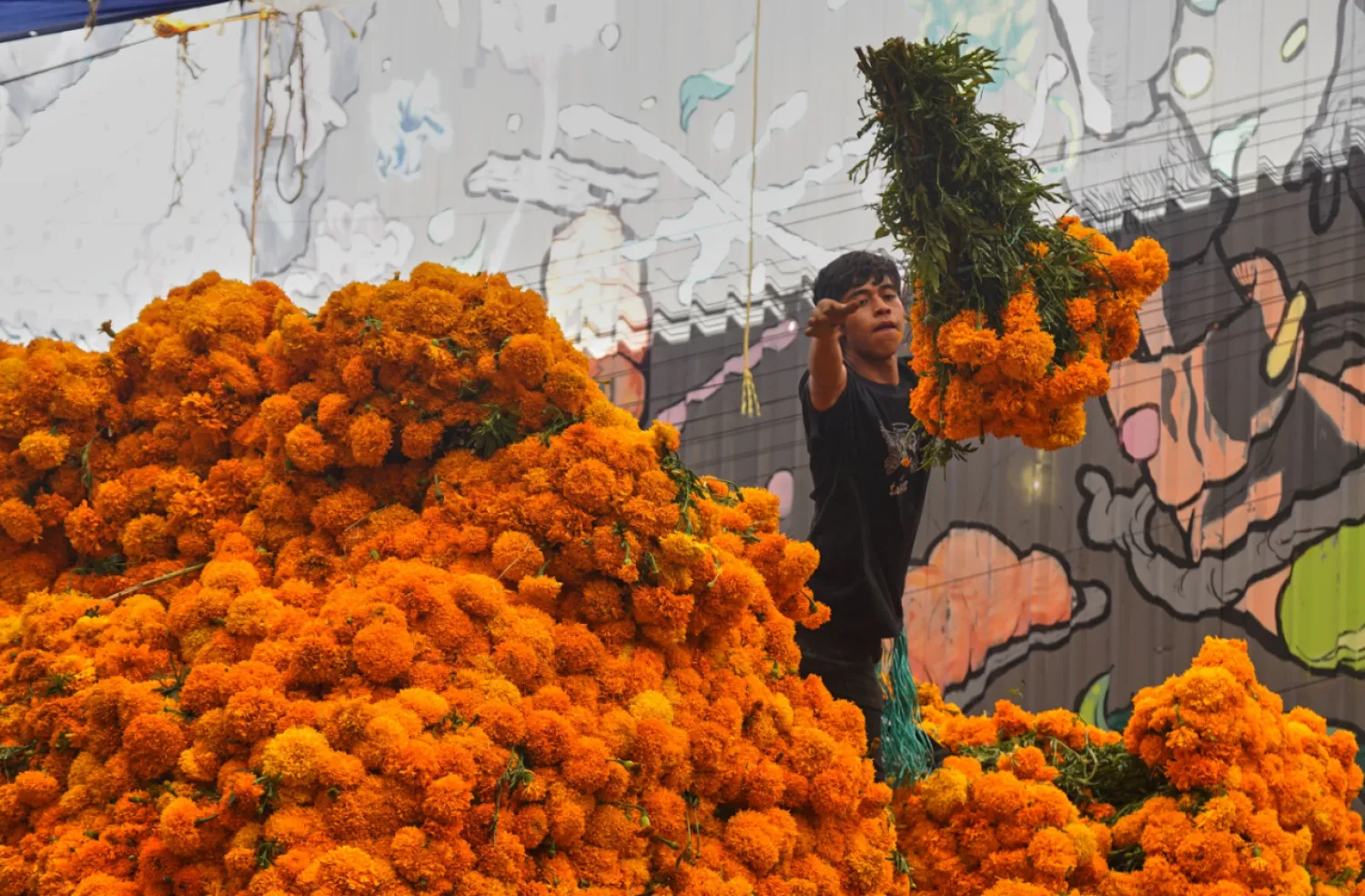

Climate Change Endangers Orange Flower that Cloaks Mexico during Day of Dead

A worker unloads marigold flowers, known as cempasuchil, used during Day of the Dead celebrations, at the Jamaica flower market in Mexico City, Monday, Oct. 27, 2025. (AP Photo/Jon Orbach)
TT

Climate Change Endangers Orange Flower that Cloaks Mexico during Day of Dead

A worker unloads marigold flowers, known as cempasuchil, used during Day of the Dead celebrations, at the Jamaica flower market in Mexico City, Monday, Oct. 27, 2025. (AP Photo/Jon Orbach)

Lucia Ortíz trudges through endless fields of cempasuchil flowers, the luminescent orange petals of which will soon cloak everything from city streets to cemeteries across Mexico.

Here, in the winding canals and farms on the fringes of Mexico City, the flower also known as the Mexican marigold has been farmed for generations, and takes the spotlight every year in the country's Day of the Dead celebrations.

But as 50-year-old Ortíz and other farmers busily bundle clusters of the plant to sell in markets around the capital, they quietly wonder what will be left of their livelihood down the line, The AP news reported.

That’s because cempasuchil growers say they’ve been left reeling by torrential rains, stretching drought and other impacts from climate change — caused by the burning of fuels like gas, oil and coal — that have grown increasingly common.

Farmers, who depend on the ebbs and flows of the weather to cultivate their crops, are on the front line on the climate crisis. This year alone, cempasuchil producers said they lost up to half their flower crop from heavy rains and flooding.

“This year, we lost a lot. We struggled to even grow the cempasuchil. There were moments in which we didn’t have the money to buy fertilizer we needed,” Ortíz said. “With the cempasuchil plants, we’ve sometimes been left with nothing.”

‘Flower of the dead’ The orange flower has become a symbol of the country’s celebrations that take place every Nov. 1 and 2. Also known as the “flower of the dead”, the cempasuchil is believed to be a point of connection between the worlds of the dead and the living, with bright petals that light the path of dead souls to the altars set out by their family.

The flowers are also a crucial economic engine across Mexico, which commerce groups predict will rake in nearly 2.7 million dollars for farmers in 2025.

Ortíz and her family began growing the flower 30 years ago in their small plot of land in Xochimilco, a rural borough in the south of Mexico City where residents have continued to carry on ancient farming techniques using canals that wind through farmlands like a maze.

Every year, locals begin to plant the marigold seeds in July, and grow the plants as the rainy season winds down. But they say that they’ve been dealt a heavy blow for consecutive years as heavy rains, drought, floods and other climate shifts have made it increasingly difficult to keep their crops alive.

This year, torrential rains stretching on for months wiped out more than 37,000 acres of crops across the country, according to government figures. In a visit to cempasuchil fields earlier this month in Xochimilco, Mexico City Mayor Clara Brugada said that as many of 2 million marigold plants were put at risk. Despite that, she said that production this year simultaneously broke a record of 6 million plants as farmers ramp up to meet increasing demand even as growing the flower has become more precarious.

Ortíz said the excess of rain has brought on pests, diseases and rotted the roots of her plants. She estimates she lost at least 30% of her crop, while others say they’ve lost closer to 50%.

The family has been forced to drop money on insecticides, fertilizer and more to save their crops. As they have, razor thin profit margins have turned into losses, and they’ve had to cut back on basics like beef and sweets to make ends meet.

“If I were to take a hard look at all our losses, I’d be incredibly disillusioned and even not want to grow them anymore,” she said. “We’re just trying to push forward and make sure this keeps going on.”

Adapting to climate change Just down the road from Ortíz’s farm, government scientists are searching for long-term solutions beyond the short-term economic relief provided by the local government. In a small seed bank known as Toxinachcal, men in white suits meticulously pick through sprouts in a lab dish.

The scientists have been at work for a year and a half saving up thousands of seed variants of native plant species, including 20 variants of cempasuchil, in jars lining giant freezers in the hopes that the storage facility will be a key tool in fighting the most adverse effects of climate change.

Biologist Clara Soto Cortés, head of the seed bank, said part of the reason that the crop has been devastated is because farmers in recent years have elected to use a hybrid marigold seed variant from the United States.

The seed produces a shorter, more uniform-looking plant that is easier to sell en-masse and in places like supermarkets.

But that means farmers have turned away from sturdier, native breeds, which have longer stocks and widely vary in color, size and texture. The genetic diversity of these Mexican breeds makes them more resilient to drastic climate shifts like the ones seen this year, Soto said.

“These native seeds have adapted to different geographies, in high altitudes and low, in places where there's a lot of rain or there's none at all, or where they need to be resistant to insects,” she said.

“The (hybrid) seeds have been bred for another purpose. It doesn't have the genetic diversity needed to take on climate change.”

If more climate events, like the floods that roiled producers wipe out an entire crop, Soto said the bank will make seeds available to local producers to recover their crops – this time with a more resilient variant that their ancestors have been farming for centuries.

Carrying on an ancient tradition Meanwhile, growers are scrambling to bounce back in the short term, saying the losses also represent a threat to the farming tradition their families have struggled to maintain on the edge of the dense city of 23 million people.

Carlos Jiménez, 61, has long worked the fields of Xochimilco, but began to grow the shorter marigold plants eight years ago when he noticed the hybrid was more marketable. As he's lost more crops and gotten lower prices for the plants because of the mildew gathering at their roots, he said he's begun considering ways to adapt, like building greenhouses.

“The plants get sick, they rot, and our business is snuffed out,” Jiménez said. “And with it goes our tradition because it's our economy."

Producers like Ortíz have considered the same. But their losses mean they have no money to build added infrastructure. Her family and other farmers have called on local authorities for help, but say they've received just pennies on the dollar of what they need to bounce back. Though the local government has said it continues to work to help offset the blow felt by farmers.

She said she's begun to look at other crops she might be able to farm that are more resilient than the crinkled orange flowers.

Others like Jiménez said that while the roots of plants may rot around him, for now he's holding strong.

“This plant has a deeper meaning to our lost loved ones,” he said. “These are traditions we carry down from our ancestors. They can't just disappear.”


Ashfall Warning in Japan as Volcano Erupts

Mount Fuji and city's skyline are pictured from Tower Hall Funabori Observation Deck in Edogawa district of Tokyo on November 12, 2025. (Photo by Philip FONG / AFP)
TT

Ashfall Warning in Japan as Volcano Erupts

Mount Fuji and city's skyline are pictured from Tower Hall Funabori Observation Deck in Edogawa district of Tokyo on November 12, 2025. (Photo by Philip FONG / AFP)

A volcano in southern Japan erupted early Sunday sending a plume of ash and smoke into the sky and prompting a warning over ashfall.

Sakurajima, one of Japan's most active volcanoes, erupted before dawn, sending ash and smoke up to 4,400 meters (14,400 feet) into the sky, the Japan Meteorological Agency said.

No damage has been reported, an official in Kagoshima prefecture, where the volcano is located, told AFP.

But the weather agency forecast ashfall in part of Kagoshima and neighboring Miyazaki prefecture, as the eruption continued several times.

"In areas where a moderate amount of ashfall is expected, please take measures to protect yourself from ash, such as using umbrellas or masks, and make sure to drive slowly," the agency said.

The agency has kept its alert level unchanged at three on a scale of five, which restricts access to the mountain.


Qiddiya City Announces Opening of Six Flags Qiddiya City on December 31

Located at the heart of the Tuwaiq Mountains, just 40 minutes from Riyadh, Six Flags Qiddiya City will bring world-class entertainment, sports, and cultural experiences together in a way never seen before. (SPA)
TT

Qiddiya City Announces Opening of Six Flags Qiddiya City on December 31

Located at the heart of the Tuwaiq Mountains, just 40 minutes from Riyadh, Six Flags Qiddiya City will bring world-class entertainment, sports, and cultural experiences together in a way never seen before. (SPA)

Six Flags Qiddiya City, Saudi Arabia's first of its kind theme park and entertainment destination, will welcome visitors from December 31, reported the Saudi Press Agency on Saturday.

Qiddiya City is the world's first global destination built entirely upon the Power of Play. Located at the heart of the Tuwaiq Mountains, just 40 minutes from Riyadh, this vibrant city will bring world-class entertainment, sports, and cultural experiences together in a way never seen before.

Six Flags Qiddiya City, Qiddiya City's inaugural entertainment destination, will bring next-level thrills and unforgettable experiences to families, friends, and adventure-seekers from across the Kingdom and beyond. It will feature 28 rides, including record-breaking experiences, such as Falcons Flight, the world's tallest, fastest, and longest roller coaster; Iron Rattler, the world's tallest tilt coaster, and Spitfire, the world's tallest inverted coaster.

With 18 rides specially designed for families and younger entertainment-seekers, the park ensures entertainment for all generations. Guests can also look forward to a variety of international dining options, along with retail outlets offering exclusive Six Flags merchandise and souvenirs.

The theme park is designed to be accessible to all guests, including individuals with special needs, senior citizens, and their companions, ensuring an enjoyable and inclusive experience for everyone.

Park President of Six Flags Qiddiya City Brian Machamer said: "Six Flags Qiddiya City not only opens its door to the public for the first time, it starts to showcase everything Qiddiya City stands for: bold imagination, unforgettable experiences, and a new benchmark for global entertainment".

With flexible and inclusive ticketing options, guests can look forward to an unforgettable experience filled with world-class thrills and nonstop fun.

Guests can reach Six Flags Qiddiya City by car, taxi, or shuttle. Metro schedules are available on the Riyadh Public Transport website, and only guests with valid tickets may board.

The Six Flags Qiddiya City is the first Six Flags theme park outside North America, promising an unforgettable blend of thrills, culture, and sustainability in Qiddiya City, Saudi Arabia. With 28 exclusive rides and attractions across six immersive lands, anchored by the vibrant Citadel, visitors will embark on a dynamic journey through the rich heritage of Saudi Arabia in a sustainable setting.

Qiddiya City is Qiddiya Investment Company's inaugural new global destination built from scratch on the foundations of play. Located at the heart of the Tuwaiq Mountains, just 40 minutes from Riyadh, the vibrant master-planned city brings entertainment, sports, and culture together in a way never seen before.

With Qiddiya's Power of Play philosophy at its heart, the city is designed to host some of the world's biggest sports competitions, festivals, concerts, and cultural events.

At scale, Qiddiya City will offer residents and visitors a high quality of life with hundreds of attractions and experiences, coupled with residential, retail, office, hospitality, healthcare, and educational offerings set in a thoughtfully planned, smart, and sustainable urban fabric.


Brazilian 'Superman' Cheers Child Cancer Patients in Ghana

 Leonardo Muylaert, known as the "Brazilian Superman", poses with patients and their relatives during a visit at the Korle Bu Teaching Hospital in Accra, on November 14, 2025. (AFP)
Leonardo Muylaert, known as the "Brazilian Superman", poses with patients and their relatives during a visit at the Korle Bu Teaching Hospital in Accra, on November 14, 2025. (AFP)
TT

Brazilian 'Superman' Cheers Child Cancer Patients in Ghana

 Leonardo Muylaert, known as the "Brazilian Superman", poses with patients and their relatives during a visit at the Korle Bu Teaching Hospital in Accra, on November 14, 2025. (AFP)
Leonardo Muylaert, known as the "Brazilian Superman", poses with patients and their relatives during a visit at the Korle Bu Teaching Hospital in Accra, on November 14, 2025. (AFP)

The three-storey Child Health Department of the Korle Bu Teaching Hospital in Ghana's capital Accra is a place with hushed corridors, labored breathing and parents clutching on to hope.

But on Friday, the gloom gave way to shrieks of joy as children with drips taped to their arms sat upright for the first time in days.

Others, too weak to stand, managed faint but determined smiles. Nurses paused mid-rounds, phones raised in the cancer ward. Even exhausted mothers lit up.

The reason was nearly six feet seven inches (2.03-meter) tall, dressed in the iconic blue-and-red Superman suit and cape.

In real life Leonardo Muylaert is a lawyer specialized in civil rights who needs reading glasses to work.

Muylaert - known worldwide as the "Brazilian Superman" - was rounding up his one-week maiden visit to Ghana, his first trip to Africa, and the cancer ward erupted into life.

Everywhere he walked, children reached for his hands. Parents scrambled for selfies. Medical staff crowded the hallways.

"He moved from bed to bed, giving each child attention," a nurse whispered. "For some of them, this is the first time we’ve seen them smile in weeks."

For 35-year-old Regina Awuku, whose five-year-old son is battling leukemia, the moment was miraculous.

"My son was so happy to see Superman. This means a lot to us," she told AFP.

"You saw my son lying quietly on the bed, but he had the energy to wake up as soon as he saw him."

"I chose Ghana to visit for my birthday," Muylaert, who studied in the United States on a basketball scholarship, said.

"I feel I identify with the culture, with the heritage, with the happiness.”

His sudden fame began in 2022 at the Comic-Con convention in Sao Paulo when a stranger surreptitiously shot a cell phone video of him, amazed at his resemblance to Superman film star Christopher Reeve.

"Am I seeing Clark Kent?" asked the star-struck comic book fan, in a clip that soon racked up thousands of views on TikTok - unbeknownst to Muylaert, who did not even have a social media account at the time.

Weeks later, Muylaert learned through friends that he had become an online sensation.

"It was funny and crazy to read that so many people think I look like Superman," he told AFP then.

That's when an idea took root in the back of his mind, he said: get a Superman suit and try the alter ego on for size. He ordered an old-fashioned costume online, and started travelling around Brazil as Superman.

Muylaert visits hospitals, schools and charities, poses for pictures with commuters on random street corners, and generally tries to be what he calls a symbol of kindness and hope - all free of charge.

He now visits vulnerable people worldwide.

In Accra, after leaving the hospital, he went to a prosthetics workshop on the city’s outskirts, where amputee children screamed "Superman! Superman!" as he joined their football match.

For Akua Sarpong, founder of Lifeline for Childhood Cancer Ghana, the impact was immediate.

"It has been a fun-filled day," she said.

"I have seen so many children smiling and happy, even children undergoing treatment sitting up that I haven’t seen in a long time. He has brought such positive change."

Muylaert said the visit reinforced his belief in small acts of kindness. "Everybody can be a hero... you don’t need a cape," he told AFP.

"The smile on their faces changes the world."

As he prepared to fly back to Brazil, he said "the idea is to spread happiness all over."

"Maybe we won’t change the whole world, but as long as we inspire one person, that person inspires the other."
