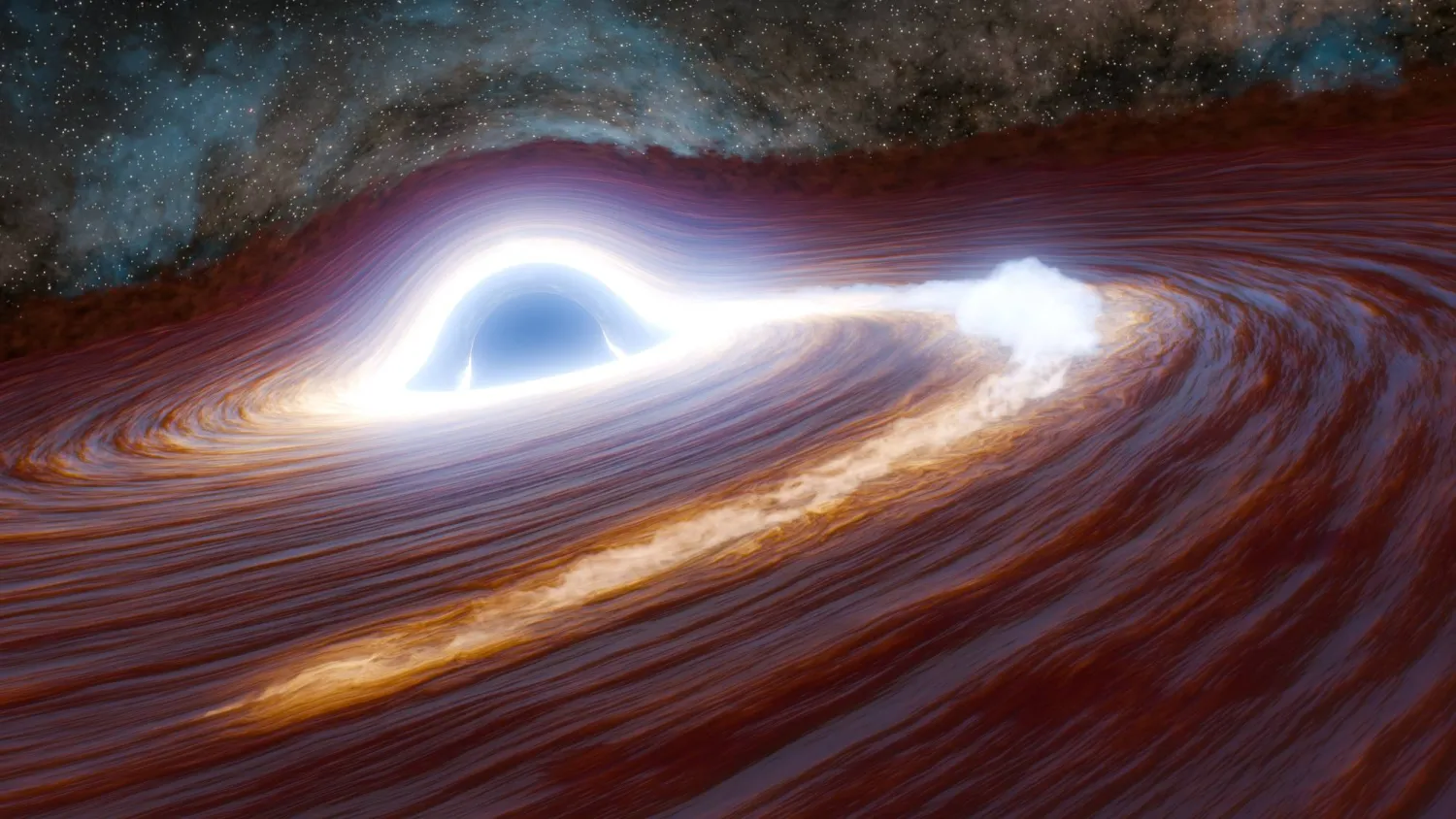

Star-Eating Black Hole Unleashes Record-Setting Energetic Flare 

This illustration provided by Caltech shows a supermassive black hole shredding a large star to pieces, leading to a bright flare. (Robert Hurt, Caltech (IPAC) via AP) 
TT

Star-Eating Black Hole Unleashes Record-Setting Energetic Flare 

This illustration provided by Caltech shows a supermassive black hole shredding a large star to pieces, leading to a bright flare. (Robert Hurt, Caltech (IPAC) via AP) 

Scientists are observing the most energetic flare ever seen emanating from a supermassive black hole, apparently caused when this celestial beast shredded and swallowed a huge star that strayed too close.

The researchers said the flare at its peak was 10 trillion times brighter than the sun. It was unleashed by a black hole roughly 300 million times the mass of the sun residing inside a faraway galaxy, about 11 billion light-years from Earth. A light-year is the distance light travels in a year, 5.9 trillion miles (9.5 trillion km).

Black holes are extraordinarily dense objects with gravitational pull so strong that not even light can escape. Most galaxies are thought to have one at their center. The black hole in this research is extremely massive - more so, for instance, than the one at the center of our Milky Way that possesses roughly 4 million times the mass of the sun.

The researchers said the most likely explanation for the flare is a large star being pulled into the black hole. As material from the ill-fated star falls inward, it causes a flare of energy when it reaches the black hole's point of no return.

The researchers believe the star was at least 30 times, and perhaps up to 200 times, the mass of the sun. It may have been part of a population of stars orbiting in the vicinity of the black hole and somehow was sent too close through some interaction with another object in the neighborhood, the researchers said.

"It seems reasonable that it was involved in a collision with another more massive body in its original orbit around the supermassive black hole which essentially knocked it in," said Caltech astronomer Matthew Graham, lead author of the study published on Tuesday in the journal Nature Astronomy.

"It was put on a much more elliptical orbit, which brought it much closer to the supermassive black hole at its closest pass - too close, it turns out," Graham added.

Supermassive black holes are surrounded by a disk of gas and dust being drawn inward after being caught by their gravitational strength.

"However it happened, the star wandered close enough to the supermassive black hole that it was 'spaghettified' - that is, stretched out to become long and thin, due to the gravity of the supermassive black hole strengthening as you get very close to it. That material then spiraled around the supermassive black hole as it fell in," said astronomer and study co-author K.E. Saavik Ford of City University of New York Borough of Manhattan Community College and Graduate Center.

The flare would be the result of the gas from the shredded star heating up and shining as it falls into oblivion.

The star thought to be involved was unusually massive.

"Stars this massive are spectacularly rare both because smaller stars are born more often than massive ones, and because very massive stars live very short lives," Ford said.

The researchers suspect that stars that orbit near a supermassive black hole can increase in mass by attracting some of the material swirling around the black hole, making them abnormally large.

The researchers observed the flare using telescopes in California, Arizona and Hawaii. They considered other possible causes such as a star exploding at the end of its lifetime, a jet of material streaming outward from the black hole or a phenomenon called gravitational lensing that could have made a fainter event look more powerful. None of these scenarios fit the data.

Because of the time it takes for light to travel, when astronomers observe faraway events like this they are looking back in time to an earlier epoch of the universe.

The flare brightened by a factor of 40 during the observations, apparently as more and more material from the star fell into the black hole, and peaked in June 2018. It was 30 times more luminous than any previously observed black hole flare. It is still ongoing but diminishing in luminosity, with the entire process expected to take about 11 years to complete.

"The flare is still fading," Graham said.


Study Questions Melatonin Use and Heart Health but Don't Lose Sleep Over it

FILE - The label for a bottle of melatonin pills is seen in New York on Thursday, June 2, 2022. (AP Photo/Patrick Sison, File)
TT

Study Questions Melatonin Use and Heart Health but Don't Lose Sleep Over it

FILE - The label for a bottle of melatonin pills is seen in New York on Thursday, June 2, 2022. (AP Photo/Patrick Sison, File)

Don’t lose sleep over headlines linking melatonin to heart failure.

That’s the message after some scary-sounding reports about a preliminary study involving the sleep-related supplement. It raised questions about the safety of long term use of melatonin for insomnia.

Doctors have long known that too little or interrupted sleep raises the risk of heart disease. But heart experts say this kind of so-called observational study can't prove that melatonin use plays any role — instead of the insomnia patients were trying to treat.

“We should not raise the alarm and tell patients to stop taking all their melatonin,” said Dr. Pratik Sandesara, an interventional cardiologist at Emory Healthcare who wasn’t involved with the research.

Our bodies naturally produce melatonin, a hormone that regulates our sleep cycles. Levels normally increase as it gets darker in the evening, triggering drowsiness.

People may take lab-produced melatonin to help them fall asleep or to adjust for jet lag or time changes.

The new study used international electronic health records, tracking adults diagnosed with insomnia who had a melatonin prescription that suggested they used the supplement for at least a year.

Over five years, 4.6% of the chronic melatonin users developed heart failure compared to 2.7% of insomnia patients whose charts showed no melatonin use, the researchers found. The study is being presented at an American Heart Association meeting but hasn’t undergone peer review.

But only certain countries require a melatonin prescription. It’s over-the-counter in the US, meaning Americans in the study might have used the supplements without it being recorded, said Northwestern University cardiology chief Dr. Clyde Yancy, who wasn't involved in the study. The study also did not show dosages, The Associated Press reported.

Also, US supplements don’t require government approval, meaning brands can vary in their ingredients. The researchers, from SUNY Downstate Health Sciences University, characterized the findings as a call for more research.

Meanwhile, patients wondering about melatonin should talk it over with their doctors, said Emory’s Sandesara. Generally doctors recommend it for short-term use, like for jet lag.

Yancy noted that while the study doesn't prove there's a danger from long term melatonin use, there's also no evidence that people should use melatonin indefinitely.

And one key to better shut-eye is to practice better sleep hygiene, like making sure your room is dark.

“When we expose ourselves to blue light in particular at night, we are diminishing our melatonin levels. That’s science,” he said. Sleep problems aren’t about “just being sleepy and tired — they’re putting yourself at risk.”


Prince Harry Apologizes to Canada Over Hat

Prince Harry (right) and Meghan Markle sit during the eight inning between the Toronto Blue Jays and the Los Angeles Dodgers during Game 4 of the 2025 MLB World Series at Dodger Stadium (Shutterstock)
TT

Prince Harry Apologizes to Canada Over Hat

Prince Harry (right) and Meghan Markle sit during the eight inning between the Toronto Blue Jays and the Los Angeles Dodgers during Game 4 of the 2025 MLB World Series at Dodger Stadium (Shutterstock)

The Duke of Sussex has apologized to Canada for wearing a Los Angeles Dodgers hat while attending a World Series game against the Toronto Blue Jays.

Prince Harry joked that he was “under duress” when he wore the bright blue cap during the epic Game 4 of the World Series in Los Angeles.

He thought it was “the polite thing to do” after being invited to the game by the Dodgers' owner.

According to BBC, his headgear choice upset many in Canada - a Commonwealth nation- who criticized him for not showing his allegiance to the realm, or to the only Canadian team in Major League Baseball.

Prince Harry's father King Charles is the head of state of Canada and of 13 other Commonwealth realms.

“Firstly, I would like to apologize to Canada for wearing it,” he said in a CTV interview. “Secondly, I was under duress. There wasn't much choice.”

The prince - wearing a Blue Jays hat during the interview - quipped that “when you're missing a lot of hair on top, and you're sitting under flood lights, you'll take any hat that's available.”

He plans to wear a Blue Jays hat from now on and rooted for the Toronto team in subsequent games, appearing to do so in a clip posted on social media by the Duchess of Sussex - a Los Angeles native - when the Dodgers won the series in Game 7 a few days later.

Prince Harry, who was given a Blue Jays hat while meeting with Canada's oldest veterans for a Remembrance event on Thursday, also said that admitting that he is a Toronto fan would likely make his reception in California more difficult.

The prince and his wife, a former actress who lived in Canada while filming her TV drama Suits, moved to California after stepping back as full-time royals in 2020.

The couple's presence in the Chavez Ravine-set stadium in Los Angeles also disgruntled many Dodgers fans in the US.

They took to social media to voice their upset over the couple's plum front-row seats during the 18-inning game, while local legends such as Magic Johnson and former pitcher Dodgers Sandy Koufax were seated behind them.


Gilead's Breast Cancer Drug Fails to Meet Main Goal of Late-stage Study

Gilead Sciences Inc pharmaceutical company is seen in Oceanside, California, US, April 29, 2020. REUTERS/Mike Blake/File Photo
TT

Gilead's Breast Cancer Drug Fails to Meet Main Goal of Late-stage Study

Gilead Sciences Inc pharmaceutical company is seen in Oceanside, California, US, April 29, 2020. REUTERS/Mike Blake/File Photo

Gilead Sciences said on Friday its breast cancer drug Trodelvy did not significantly lower the risk of disease progression in patients when used as a first-line treatment, failing to meet the main goal of a late-stage study, Reuters reported.

Gilead said an early trend for extending overall survival, a key measure of treatment efficacy, was observed favoring patients treated with Trodelvy, compared to chemotherapy.

The data for overall survival, however, was not mature at the time of the primary analysis, the company said, adding that the study will continue to assess this secondary goal.

Trodelvy was being tested in patients with HR+/HER2-negative metastatic breast cancer, the most common subtype of the cancer, as a first-line treatment following hormone therapy.