

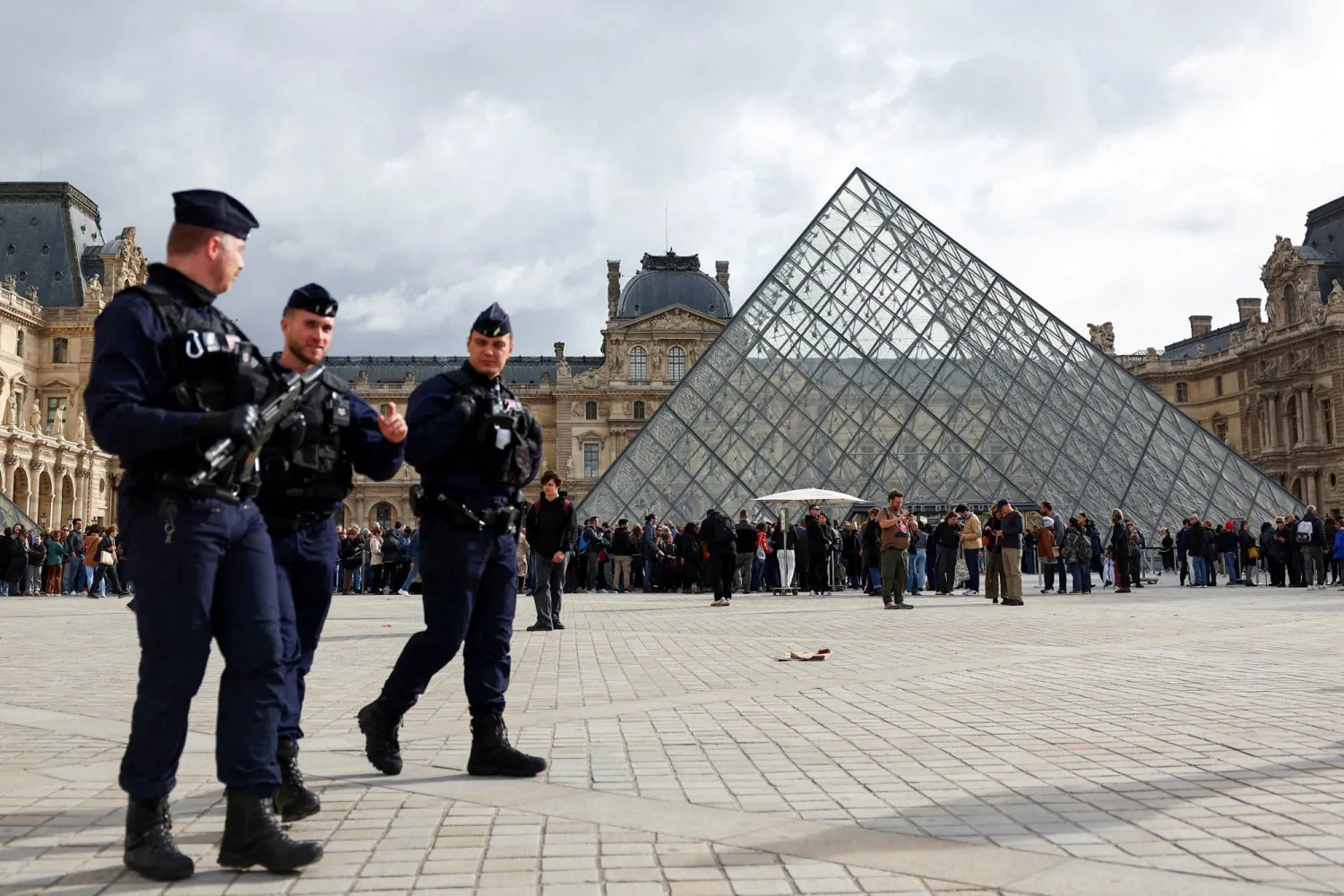

Louvre Museum Will Need Years to Fix Security Issues

FILE PHOTO: French CRS riot police officers walk near the glass Pyramid of the Louvre Museum, after French police arrested suspects in the Louvre heist case, in Paris, France October 27, 2025. REUTERS/Abdul Saboor/File Photo
TT

Louvre Museum Will Need Years to Fix Security Issues

FILE PHOTO: French CRS riot police officers walk near the glass Pyramid of the Louvre Museum, after French police arrested suspects in the Louvre heist case, in Paris, France October 27, 2025. REUTERS/Abdul Saboor/File Photo

France's Louvre Museum began a security audit a decade ago but the recommended upgrades will not be completed until 2032, the state auditor said in a report on Thursday compiled before a spectacular heist there last month.

The daylight robbery, in which four robbers made off with jewels worth $102 million, raised doubts over the credibility of the world's most-visited museum as a guardian for its myriad works. Officials have admitted security was not up to scratch, Reuters said.

While investigators have charged four suspects for involvement in the raid, the treasures have yet to be recovered.

Excerpts from the report, which was published on Thursday by the national audit office, known as the Cour des Comptes, had already leaked in the media days after the raid.

Only 39% of the museum's rooms had cameras as of 2024, the report said, and a security audit begun in 2015, which found the museum was not sufficiently monitored or prepared for a crisis, only led to a tender for security works at the end of last year.

"It will take several years to complete the project, which, according to the museum, is not expected to be finished until 2032," the report said.

It said the museum's inability to update its infrastructure was exacerbated by excessive spending to buy artwork, only a quarter of which is exposed to the public, and post-pandemic relaunch projects, as well as inefficiencies and ticket fraud.

Even the development initiatives it announced this year were not based on feasibility studies, whether technical or financial, and did not consider staffing needs, the report said.

The report provided 10 recommendations including a drop in the number of acquisitions by the museum, an increase in its ticket prices and a refurbishment of its digital infrastructure and governance.

In the face of a "chronic under-investment in information systems", the auditor said, "the museum must strengthen its internal control function, which remains underdeveloped for an institution the size of the Louvre".

The theft only reinforces some of the considerations made in the report, the auditor's head Pierre Moscovici told journalists on Thursday.

"The theft of the crown jewels was without a doubt a deafening alarm bell: this pace [of security upgrades] is far from sufficient," Moscovici said. "The authorities are now realizing that they have heard these alarm bells."

He said the Louvre has sufficient funds for the upgrades needed, and "now it must do so without fail".

After the robbery, French officials said the Louvre would introduce extra security, including anti-intrusion devices and anti-vehicle ramming barriers on nearby public roads, by the end of the year.

In January, amid growing complaints about disarray at the museum, France launched an ambitious development project involving a new space dedicated to Leonardo's Mona Lisa, the world's most famous painting, and new security steps to protect its visitors and precious exhibits.

In written remarks published by the audit office, Culture Minister Rachida Dati said she agreed on the urgency of the technical work and reiterated calls for swift corrective measures.

Louvre director Laurence des Cars said in the same document she supported most of the auditor's recommendations but insisted the museum's long-term transformation plan is essential to address its structural challenges.



China Has Slashed Air Pollution, but the ‘War’ Isn’t Over 

This picture taken on February 11, 2026 shows pedestrians walking along an overpass as traffic snarls in Beijing. (AFP)
TT

China Has Slashed Air Pollution, but the ‘War’ Isn’t Over 

This picture taken on February 11, 2026 shows pedestrians walking along an overpass as traffic snarls in Beijing. (AFP)

Fifteen years ago, Beijing's Liangma riverbanks would have been smog-choked and deserted in winter, but these days they are dotted with families and exercising pensioners most mornings.

The turnaround is the result of a years-long campaign that threw China's state power behind policies like moving factories and electrifying vehicles, to improve some of the world's worst air quality.

Pollution levels in many Chinese cities still top the World Health Organization's (WHO) limits, but they have fallen dramatically since the "airpocalypse" days of the past.

"It used to be really bad," said Zhao, 83, soaking up the sun by the river with friends.

"Back then when there was smog, I wouldn't come out," she told AFP, declining to give her full name.

These days though, the air is "very fresh".

Since 2013, levels of PM2.5 -- small particulate that can enter the lungs and bloodstream -- have fallen 69.8 percent, Beijing municipality said in January.

Particulate pollution fell 41 percent nationwide in the decade from 2014, and average life expectancy has increased 1.8 years, according to the University of Chicago's Air Quality Life Index (AQLI).

China's rapid development and heavy coal use saw air quality decline dramatically by the 2000s, especially when cold winter weather trapped pollutants close to the ground.

There were early attempts to tackle the issue, including installing desulphurization technology at coal power plants, while factory shutdowns and traffic control improved the air quality for events like the 2008 Olympics.

But the impact was short-lived, and the problem worsened.

- Action plan -

Public awareness grew, heightened by factors like the US embassy in Beijing making monitoring data public.

By 2013, several international schools had installed giant inflatable domes around sport facilities to protect students.

That year, multiple episodes of prolonged haze shrouded Chinese cities, with one in October bringing northeastern Harbin to a standstill for days as PM2.5 levels hit 40 times the WHO's then-recommended standard.

The phrase "I'm holding your hand, but I can't see your face" took off online.

Later that year, an eight-year-old became the country's youngest lung cancer patient, with doctors directly blaming pollution.

As concerns mounted, China's ruling Communist Party released a ten-point action plan, declaring "a war against pollution".

It led to expanded monitoring, improved factory technology and the closure or relocation of coal plants and mines.

In big cities, vehicles were restricted and the groundwork was laid for widespread electrification.

For the first time, "quantitative air quality improvement goals for key regions within a clear time limit" were set, a 2016 study noted.

These targets were "the most important measure", said Bluetech Clean Air Alliance director Tonny Xie, whose non-profit worked with the government on the plan.

"At that time, there were a lot of debates about whether we can achieve it, because (they were) very ambitious," he told AFP.

The policy targeted several key regions, where PM2.5 levels fell rapidly between 2013 and 2017, and the approach was expanded nationwide afterwards.

"Everybody, I think, would agree that this is a miracle that was achieved in China," Xie said.

China's success is "entirely" responsible for a decline in global pollution since 2014, AQLI said last summer.

- 'Low-hanging fruits' gone -

Still, in much of China the air remains dangerous to breathe by WHO standards.

This winter, Chinese cities, including financial hub Shanghai, were regularly among the world's twenty most polluted on monitoring site IQAir.

Linda Li, a running coach who has lived in both Beijing and Shanghai, said air quality has improved, but she still loses up to seven running days to pollution in a good month.

A top environment official last year said China aimed to "basically eliminate severe air pollution by 2025", but the government did not respond when AFP asked if that goal had been met.

Official 2025 data found nationwide average PM2.5 concentrations decreased 4.4 percent on-year.

Eighty-eight percent of days featured "good" air quality.

However, China's current definition of "good" is PM2.5 levels of under 35 micrograms per cubic meter, significantly higher than the WHO's recommended five micrograms.

China wants to tighten the standard to 25 by 2035.

The last five years have also seen pollution reduction slow.

The "low-hanging fruits" are gone, said Chengcheng Qiu from the Center for Research on Energy and Clean Air (CREA).

Qiu's research suggests pollution is shifting west as heavy industry relocates to regions like Xinjiang, and that some cities in China have seen double-digit percentage increases in PM2.5 in the last five years.

"They can't just stop all industrial production. They need to find cleaner ways to produce the output," Qiu said.

There is hope for that, given China's status as a renewable energy powerhouse, with coal generation falling in 2025.

"Cleaner air ultimately rests on one clear direction," said Qiu.

"Move beyond fossil fuels and let clean energy power the next stage of development."


Sydney Man Jailed for Mailing Reptiles in Popcorn Bags 

Investigators recovered 101 Australian reptiles from parcels destined for Hong Kong, South Korea, Sri Lanka and Romania. (AFP file)
TT

Sydney Man Jailed for Mailing Reptiles in Popcorn Bags 

Investigators recovered 101 Australian reptiles from parcels destined for Hong Kong, South Korea, Sri Lanka and Romania. (AFP file)

A Sydney man who tried to post native lizards, dragons and other reptiles out of Australia in bags of popcorn and biscuit tins has been sentenced to eight years in jail, authorities said Tuesday.

The eight-year term handed down on Friday was a record for wildlife smuggling, federal environment officials said.

A district court in Sydney gave the man, 61-year-old Neil Simpson, a non-parole period of five years and four months.

Investigators recovered 101 Australian reptiles from seized parcels destined for Hong Kong, South Korea, Sri Lanka and Romania, the officials said in a statement.

The animals -- including shingleback lizards, western blue-tongue lizards, bearded dragons and southern pygmy spiny-tailed skinks -- were posted in 15 packages between 2018 and 2023.

"Lizards, skinks and dragons were secured in calico bags. These bags were concealed in bags of popcorn, biscuit tins and a women's handbag and placed inside cardboard boxes," the statement said.

The smuggler had attempted to get others to post the animals on his behalf but was identified by government investigators and the New South Wales police, it added.

Three other people were convicted for taking part in the crime.

The New South Wales government's environment department said that "the illegal wildlife trade is not a victimless crime", harming conservation and stripping the state "and Australia of its unique biodiversity".


Two Snowboarders Dead after Austrian Avalanche

A member of the CRS Alpes Grenoble mountain rescue team operates as he searches for potential buried victims during an avalanche emergency response rescue mission in an off-piste area of the Ecrins massif, French Alps on January 29, 2026. (Photo by JEFF PACHOUD / AFP)
TT

Two Snowboarders Dead after Austrian Avalanche

A member of the CRS Alpes Grenoble mountain rescue team operates as he searches for potential buried victims during an avalanche emergency response rescue mission in an off-piste area of the Ecrins massif, French Alps on January 29, 2026. (Photo by JEFF PACHOUD / AFP)

Two snowboarders have been confirmed dead after their bodies were recovered following an avalanche in western Austria over the weekend, police said Monday.

Avalanches across the Alps have claimed several victims in recent days following heavy snowfall.

An avalanche struck two 37-year-old off-piste snowboarders on the Stubai glacier in Tyrol province, burying them under the snow, police said in a statement.

The two Austrian men were reported missing after they had not returned from their snowboarding trip, prompting a large-scale search operation that included dogs and drones.

The buried snowboarders were located on Sunday night, but emergency services "could only confirm the death of the two men", Reuters quoted the statement as saying.

A level-four avalanche risk warning -- out of five -- is currently in place in the area following heavy snowfall in recent days.

In neighboring Italy, two skiers were killed on Sunday and another was in serious condition after an avalanche struck a slope near Courmayeur.

Avalanches have already killed several dozen people across the French, Swiss, Italian and Austrian Alps so far this season.