


For First Time, Scientists See the Very Early Stages of a Supernova

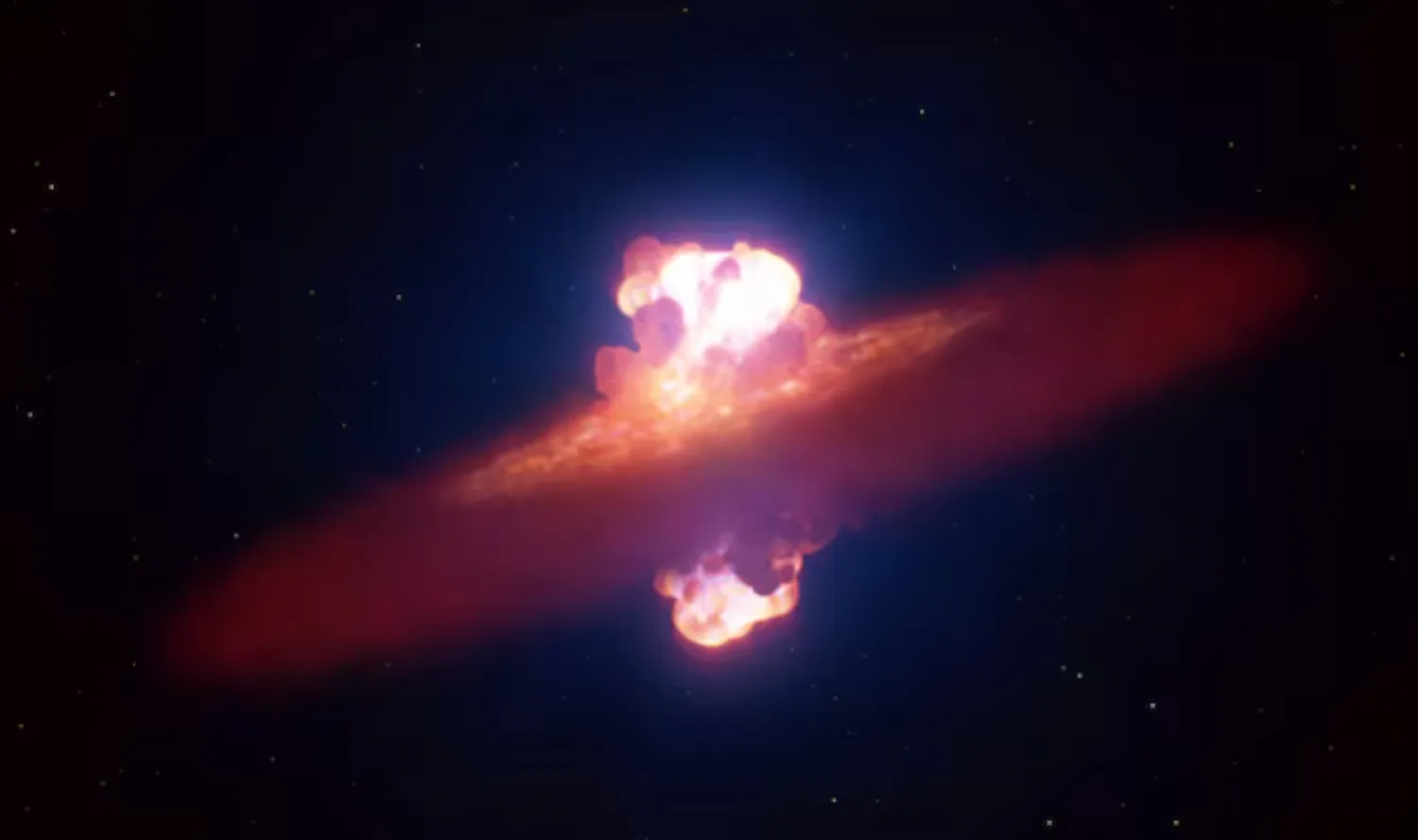
An artist's impression shows a star exploding at the end of its lifecycle, called a supernova, in this handout image released by the European Southern Observatory on November 12, 2025. The star is located about 22 million light-years away from Earth in the galaxy NGC 3621. ESO/L. Calcada/Handout via REUTERS
TT

For First Time, Scientists See the Very Early Stages of a Supernova

An artist's impression shows a star exploding at the end of its lifecycle, called a supernova, in this handout image released by the European Southern Observatory on November 12, 2025. The star is located about 22 million light-years away from Earth in the galaxy NGC 3621. ESO/L. Calcada/Handout via REUTERS

The explosive death of a star - a supernova - is among the most violent cosmic events, but precisely how this cataclysm looks as it unfolds has remained mysterious. Scientists now have observed for the first time the very early stages of a supernova, with a massive star exploding in a distinctive olive-like shape, according to Reuters.

The researchers used the European Southern Observatory's Chile-based Very Large Telescope, or VLT, to observe the supernova, which involved a star roughly 15 times the mass of our sun residing in a galaxy called NGC 3621 about 22 million light-years from Earth in the direction of the constellation Hydra. A light-year is the distance light travels in a year, 5.9 trillion miles (9.5 trillion km).

The shape of such explosions has been hard to nail down until now because of how rapidly they take place, so it took quick action with this supernova. The explosion was detected on April 10, 2024, around the time astrophysicist Yi Yang of Tsinghua University in China had landed on a long flight to San Francisco. Yang's formal request just hours later to aim the VLT at the supernova was granted.

The researchers thus were able to observe the explosion just 26 hours after the initial detection and 29 hours after material from inside the star first broke through the stellar surface.

What they saw was the doomed star surrounded at its equator by a preexisting disk of gas and dust, with the explosion pushing material outward from the stellar core to distort the star's shape into one resembling a vertical-standing olive. The explosion notably did not blow the star apart in a spherical shape. Instead, the explosion pushed violently outward at opposite sides of the star.

"The geometry of a supernova explosion provides fundamental information on stellar evolution and the physical processes leading to these cosmic fireworks," said Yang, lead author of the study published on Wednesday in the journal Science Advances.

"The exact mechanisms behind supernova explosions of massive stars, those with more than eight times the mass of the sun, are still debated and are one of the fundamental questions scientists want to address," Yang said.

Big stars like those live relatively short lives. This one, a type called a red supergiant, was about 25 million years old at the time of its demise. In comparison, the sun is more than 4.5 billion years old and has a few more billion years to go.

At the time it exploded, this star's diameter was 600 times greater than the sun. Some of the star's mass was blown into space in the explosion. The remainder is believed to have become a neutron star, a highly compact stellar remnant, according to study co-author Dietrich Baade, a Germany-based astrophysicist at the European Southern Observatory.

When a star exhausts the hydrogen fuel for the nuclear fusion occurring at its center, its core collapses, which then sends material blasting outward, penetrating the stellar surface and into space.

"The first VLT observations captured the phase during which matter accelerated by the explosion near the center of the star shot through the star's surface, the photosphere," Yang said.

"Once the shock breaks through the surface, it unleashes immense amounts of energy. The supernova then brightens dramatically and becomes observable. During a short-lived phase, the supernova's initial 'breakout' shape can be studied before the explosion interacts with the material surrounding the dying star," Yang said.

This shape, Yang said, offers clues about how the explosion was triggered at the heart of the star. The new observations seem to rule out some current scientific models of the explosion process, Yang said, as scientists refine their understanding of the deaths of massive stars.



Study Says African Penguins Starved En Masse Off South Africa

Yellow-eyed penguins fights in their colony in Katiki Point, on the southern end of the Moeraki Peninsula in New Zealand's South Island, about 80 kilometers north of Dunedin on November 12, 2025. (Photo by Sanka VIDANAGAMA / AFP)
TT

Study Says African Penguins Starved En Masse Off South Africa

Yellow-eyed penguins fights in their colony in Katiki Point, on the southern end of the Moeraki Peninsula in New Zealand's South Island, about 80 kilometers north of Dunedin on November 12, 2025. (Photo by Sanka VIDANAGAMA / AFP)

Endangered penguins living off South Africa's coast have likely starved en masse due to food shortages, a study said Friday, with some populations dropping by 95 percent in just eight years.

Fewer than 10,000 breeding pairs of the small, black and white African Penguin are left globally, according to scientists, and the species was listed as critically endangered last year by the International Union for Conservation of Nature (IUCN).

Two of the most important breeding colonies near Cape Town had collapsed between 2004 and 2011, with some 62,000 birds estimated to have died, the study by the UK's University of Exeter and the South African Department of Forestry, Fisheries and the Environment said.

In those eight years, sardine populations in South African waters -- a main food source for penguins -- were consistently below 25 percent of their peak abundance, Agence France Presse quoted co-author and biologist Richard Sherley as saying.

This drop in sardine stocks was due to fishing practices combined with environmental causes such as changes in water temperatures and salinity.

This "appears to have caused severe food shortage for African penguins, leading to an estimated loss of about 62,000 breeding individuals", Sherley said.

The global population of the species had declined by nearly 80 percent in the past 30 years, the scientists said.

Conservationists say that at the current rate of population decrease, the bird could be extinct in the wild by 2035.

For 10 years, authorities have imposed a commercial fishing ban around six penguin colonies, including Robben and Dassen islands, the two sites observed in the study.

Other initiatives underway include artificial nests and creating new colonies.

The birds are a strong attraction for tourists to South Africa, with thousands of people visiting colonies each year.

But the pressure from tourism also disturbs the birds and causes enhanced stress.


Saudi Post Issues Stamp Marking Int’l Day of Persons with Disabilities

Saudi Post (SPL) issued a set of commemorative stamps to mark the International Day of Persons with Disabilities.
TT

Saudi Post Issues Stamp Marking Int’l Day of Persons with Disabilities

Saudi Post (SPL) issued a set of commemorative stamps to mark the International Day of Persons with Disabilities.

Saudi Post (SPL), the Kingdom's national postal and logistics provider, has issued a set of commemorative stamps valued at SAR3 to mark the International Day of Persons with Disabilities, observed annually on December 3.

The day is celebrated worldwide, including in the Kingdom of Saudi Arabia, to reinforce care for persons with disabilities, empower them to achieve their aspirations, enhance their quality of life, ensure their rights, and include them in all activities and events by highlighting their talents and diverse abilities, said the Saudi Press Agency on Thursday.

The launch took place during a ceremony organized by the Authority for the Care of People with Disabilities (APD).

The event included the unveiling of a campaign titled “Say It Right,” which promotes the correct and officially adopted terminology for persons with disabilities.

The stamp features several individuals with disabilities who participated in the campaign.

APD continues to work collaboratively with various sectors to enhance service quality and raise awareness of the rights of persons with disabilities.


Police 'Recover' Faberge Egg Swallowed by Thief

This handout photo release by New Zealand Police on December 5, 2025 shows an officer displaying a recovered diamond-encrusted green Fabergé egg in Auckland after keeping a six-day watch over the thief accused of swallowing it. (Photo by Handout / NEW ZEALAND POLICE / AFP)
TT

Police 'Recover' Faberge Egg Swallowed by Thief

This handout photo release by New Zealand Police on December 5, 2025 shows an officer displaying a recovered diamond-encrusted green Fabergé egg in Auckland after keeping a six-day watch over the thief accused of swallowing it. (Photo by Handout / NEW ZEALAND POLICE / AFP)

New Zealand police have recovered a diamond-encrusted green Faberge egg after keeping a six-day watch over the thief accused of swallowing it.

The 32-year-old allegedly gulped down the egg late last week from a store in the country's largest city, Auckland, but was arrested before he could flee.

"Police can confirm the pendant was recovered," they said in a statement Friday.

Police had assigned an officer to watch over the man while waiting for nature to deliver the trinket -- valued at around US$20,000, AFP reported.

The special edition locket was inspired by the James Bond film "Octopussy", which revolves around a plot to steal a rare Faberge egg.

"The exterior of the egg closely follows the design of the Faberge egg featured in the film Octopussy, with a beautiful 18k gold lattice framework which is delicately set with blue sapphires and white diamonds in a floral-like design," reads an online description.

A small golden octopus is nestled inside.

Russia's House of Faberge gained international fame in the late 19th century by designing opulent Easter eggs decorated with gold and precious gems.