
From Guardrails to Potholes, AI is Becoming the New Eyes on America’s Roads

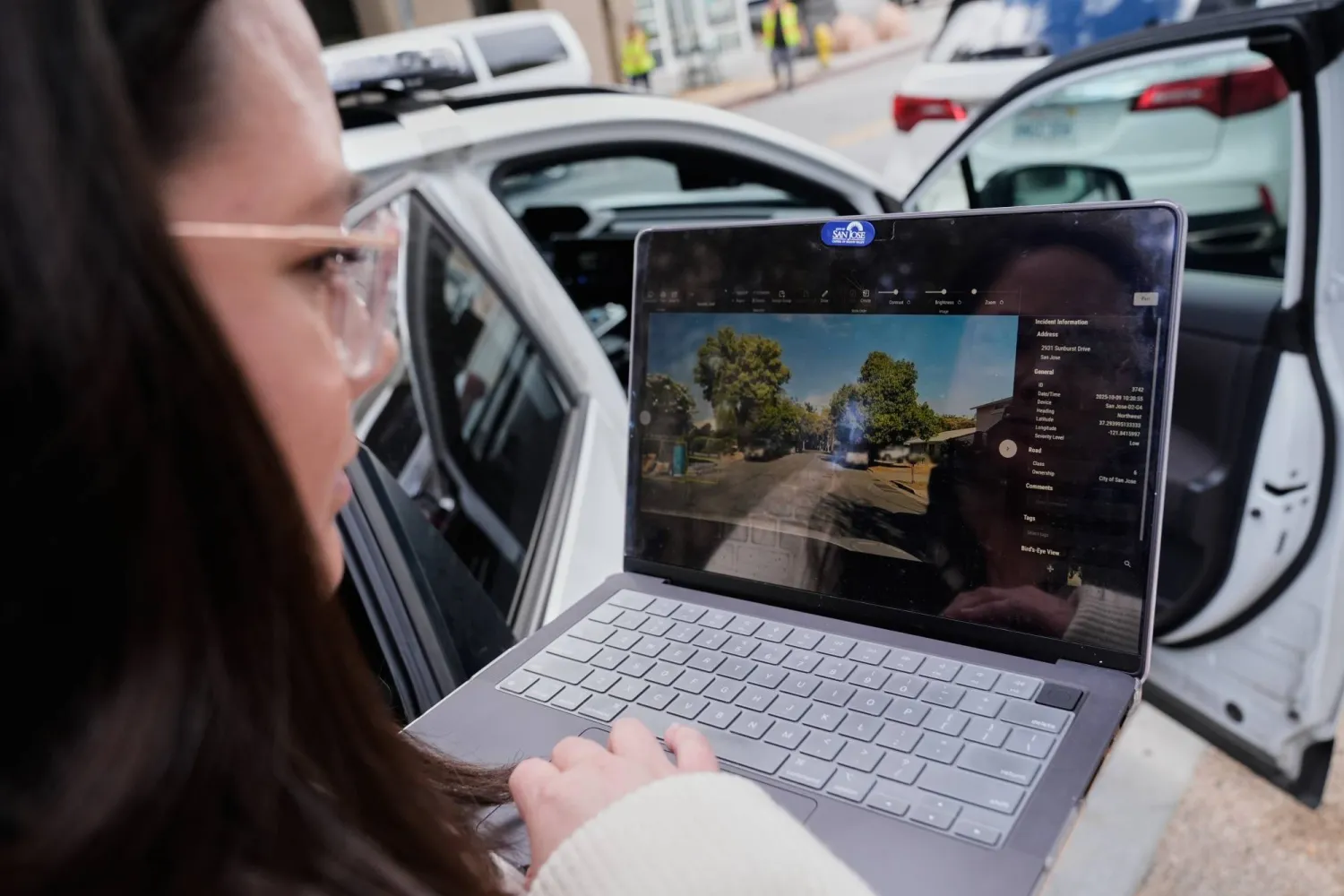
Chelsea Palacio, public information manager for the City of San Jose, showcases how a small detection camera uses AI to detect road hazards and potholes, in San Jose, Calif., Wednesday, Nov. 12, 2025. (AP Photo/Godofredo A. Vásquez)
TT

From Guardrails to Potholes, AI is Becoming the New Eyes on America’s Roads

Chelsea Palacio, public information manager for the City of San Jose, showcases how a small detection camera uses AI to detect road hazards and potholes, in San Jose, Calif., Wednesday, Nov. 12, 2025. (AP Photo/Godofredo A. Vásquez)

As America’s aging roads fall further behind on much-needed repairs, cities and states are turning to artificial intelligence to spot the worst hazards and decide which fixes should come first.

Hawaii officials, for example, are giving away 1,000 dashboard cameras as they try to reverse a recent spike in traffic fatalities. The cameras will use AI to automate inspections of guardrails, road signs and pavement markings, instantly discerning between minor problems and emergencies that warrant sending a maintenance crew, said The Associated Press.

“This is not something where it’s looked at once a month and then they sit down and figure out where they’re going to put their vans,” said Richard Browning, chief commercial officer at Nextbase, which developed the dashcams and imagery platform for Hawaii.

After San Jose, California, started mounting cameras on street sweepers, city staff confirmed the system correctly identified potholes 97% of the time. Now they're expanding the effort to parking enforcement vehicles.

Texas, where there are more roadway lane miles than the next two states combined, is less than a year into a massive AI plan that uses cameras as well as cellphone data from drivers who enroll to improve safety.

Other states use the technology to inspect street signs or build annual reports about road congestion.

Every guardrail, every day Hawaii drivers over the next few weeks will be able to sign up for a free dashcam valued at $499 under the “Eyes on the Road” campaign, which was piloted on service vehicles in 2021 before being paused due to wildfires.

Roger Chen, a University of Hawaii associate professor of engineering who is helping facilitate the program, said the state faces unique challenges in maintaining its outdated roadway infrastructure.

“Equipment has to be shipped to the island,” Chen said. “There’s a space constraint and a topography constraint they have to deal with, so it’s not an easy problem.”

Although the program also monitors such things as street debris and faded paint on lane lines, the companies behind the technology particularly tout its ability to detect damaged guardrails.

“They’re analyzing all guardrails in their state, every single day,” said Mark Pittman, CEO of Blyncsy, which combines the dashboard feeds with mapping software to analyze road conditions.

Hawaii transportation officials are well aware of the risks that can stem from broken guardrails. Last year, the state reached a $3.9 million settlement with the family of a driver who was killed in 2020 after slamming into a guardrail that had been damaged in a crash 18 months earlier but never repaired.

In October, Hawaii recorded its 106th traffic fatality of 2025 — more than all of 2024. It's unclear how many of the deaths were related to road problems, but Chen said the grim trend underscores the timeliness of the dashboard program.

Building a larger AI database San Jose has reported strong early success in identifying potholes and road debris just by mounting cameras on a few street sweepers and parking enforcement vehicles.

But Mayor Matt Mahan, a Democrat who founded two tech startups before entering politics, said the effort will be much more effective if cities contribute their images to a shared AI database. The system can recognize a road problem that it has seen before — even if it happened somewhere else, Mahan said.

“It sees, ‘Oh, that actually is a cardboard box wedged between those two parked vehicles, and that counts as debris on a roadway,’” Mahan said. “We could wait five years for that to happen here, or maybe we have it at our fingertips.”

San Jose officials helped establish the GovAI Coalition, which went public in March 2024 for governments to share best practices and eventually data. Other local governments in California, Minnesota, Oregon, Texas and Washington, as well as the state of Colorado, are members.

Some solutions are simple Not all AI approaches to improving road safety require cameras.

Massachusetts-based Cambridge Mobile Telematics launched a system called StreetVision that uses cellphone data to identify risky driving behavior. The company works with state transportation departments to pinpoint where specific road conditions are fueling those dangers.

Ryan McMahon, the company's senior vice president of strategy & corporate development, was attending a conference in Washington, D.C., when he noticed the StreetVision software was showing a massive number of vehicles braking aggressively on a nearby road.

The reason: a bush was obstructing a stop sign, which drivers weren't seeing until the last second.

“What we’re looking at is the accumulation of events,” McMahon said. “That brought me to an infrastructure problem, and the solution to the infrastructure problem was a pair of garden shears."

Texas officials have been using StreetVision and various other AI tools to address safety concerns. The approach was particularly helpful recently when they scanned 250,000 lane miles (402,000 kilometers) to identify old street signs long overdue for replacement.

“If something was installed 10 or 15 years ago and the work order was on paper, God help you trying to find that in the digits somewhere,” said Jim Markham, who deals with crash data for the Texas Department of Transportation. “Having AI that can go through and screen for that is a force multiplier that basically allows us to look wider and further much faster than we could just driving stuff around.”

Autonomous vehicles are next Experts in AI-based road safety techniques say what's being done now is largely just a stepping stone for a time when a large proportion of vehicles on the road will be driverless.

Pittman, the Blyncsy CEO who has worked on the Hawaii dashcam program, predicts that within eight years almost every new vehicle — with or without a driver — will come with a camera.

“How do we see our roadways today from the perspective of grandma in a Buick but also Elon and his Tesla?” Pittman said. “This is really important nuance for departments of transportation and city agencies. They're now building infrastructure for humans and automated drivers alike, and they need to start bridging that divide.”


Saudi Arabia: Newest State-of-the-Art Film Production Hub Launched in Qiddiya City

Located at the heart of Qiddiya City, PlayMaker Studios sits just 40 minutes from Riyadh
TT

Saudi Arabia: Newest State-of-the-Art Film Production Hub Launched in Qiddiya City

Located at the heart of Qiddiya City, PlayMaker Studios sits just 40 minutes from Riyadh

Qiddiya Investment Company has announced the official opening of PlayMaker Studios at Qiddiya City, marking the launch of Saudi Arabia’s newest state-of-the-art film production hub. The opening represents a major milestone in the Kingdom’s rapidly advancing film and creative industries.

The launch of PlayMaker Studios marks a strategic addition to Saudi Arabia’s production infrastructure. The studios feature two high-spec, purpose-built soundstages, flexible workshops, and fully integrated production facilities designed to meet the needs of large-scale international and regional productions. The complex also includes modern production offices and on-site support amenities, offering a seamless, end-to-end production environment.

With strong demand already recorded for studio space, construction has begun on two additional world-class soundstages, scheduled for completion in 2026, which will significantly expand PlayMaker Studios’ capacity and enable it to host multiple major productions simultaneously.

Qiddiya Investment Company has also established a dedicated on-the-ground team to provide hands-on support for producers across permitting, logistics, and operational services. In addition, PlayMaker Studios offers streamlined access to Saudi Arabia’s industry-leading 40% production cash rebate, one of the most competitive incentives globally.

As part of its long-term development strategy, PlayMaker Studios will introduce dedicated post-production, visual effects, volumetric, and music studios, further strengthening the Kingdom’s creative and production ecosystem. The complex is set to become both a creative powerhouse and a core pillar of Qiddiya City’s entertainment offering.

Qiddiya Investment Company Managing Director Abdullah Aldawood said: “PlayMaker Studios is a cornerstone of Qiddiya City’s ambition and builds on Saudi Arabia’s growing success in the creative industries. It marks an important step in strengthening this momentum and realizing our vision to create a world class destination where innovation, culture and entertainment come together, and where the global film industry can find a new home in the Kingdom.”

Located at the heart of Qiddiya City - the world’s first destination where culture, sport, and creativity converge - PlayMaker Studios sits just 40 minutes from Riyadh, offering producers integrated logistics solutions, premium accommodation options for production teams, and direct access to a dynamic entertainment environment designed to inspire world-class content creation.


Brigitte Macron Visits an Old Friend in China: Giant Panda Called Yuan Meng

FILE - French First lady Brigitte Macron attends a naming ceremony of the panda born at the Beauval Zoo, in Saint-Aignan-sur-Cher, France, on Dec. 4, 2017. (AP Photo/Thibault Camus, Pool, File)
TT

Brigitte Macron Visits an Old Friend in China: Giant Panda Called Yuan Meng

FILE - French First lady Brigitte Macron attends a naming ceremony of the panda born at the Beauval Zoo, in Saint-Aignan-sur-Cher, France, on Dec. 4, 2017. (AP Photo/Thibault Camus, Pool, File)

French first lady Brigitte Macron caught up with an old friend — a giant panda born in France — at the tail end Friday of a visit to China with President Emmanuel Macron.

At a panda reserve in southwest China that Yuan Meng now calls home, the first lady marveled at how big he has grown. She helped choose his name — which means “accomplishment of a dream” — when he was born in a French zoo in 2017.

“When they're born, they're like this,” she said, holding up two fingers a short distance apart. Meanwhile, the chunky male roamed in his enclosure, feasting on bamboo and ignoring bystanders who cried out his name, hoping to elicit a reaction.

“They have a very independent character,” she said. “They do only what they want.”

For decades, China has deployed what's often called “panda diplomacy” to smooth and promote relations with other countries, gifting the animals to friendly nations and lending pandas to zoos overseas on commercial terms.

Emmanuel Macron’s state visit this week to China, his fourth as president, included meetings with Chinese leader Xi Jinping and other officials, discussing Russia’s war in Ukraine, trade ties and other issues.

The China Wildlife Conservation Association said during the visit that it signed a letter of intent to send two of the animals to the Beauval Zoo south of Paris in 2027 under what would be a new 10-year round of panda cooperation with France.

The French zoo sent two 17-year-old pandas — Huan Huan, a female, and her partner Yuan Zi — back to China last month after 13 years on loan in France.

Yuan Meng was their cub, conceived using artificial insemination.

Despite being made in France, he officially belonged to the Chinese government. Yuan Meng bid ‘’adieu’’ to France in 2023, sent off to a new life in the Chengdu Research Base of Giant Panda Breeding in southwest China where Brigitte Macron, considered to be his “godmother,” dropped in to see him.

Huan Huan and Yuan Zi also produced female twins in France in 2021.

Huanlili and Yuandudu are also expected to leave the Beauval Zoo for China in the future. The China Wildlife Conservation Association has previously said that it expects them to remain at the French zoo until January 2027.


Florida Kicks Off 1st Black Bear Hunt in a Decade, Despite Pushback

FILE - A black bear is weighed by FWC Biologists Alyssa Simmons and Mike Orlando at the Rock Springs Run Wildlife Management Area near Lake Mary, Fla., Oct. 24, 2015. (Luis Santana/Tampa Bay Times via AP, file)
TT

Florida Kicks Off 1st Black Bear Hunt in a Decade, Despite Pushback

FILE - A black bear is weighed by FWC Biologists Alyssa Simmons and Mike Orlando at the Rock Springs Run Wildlife Management Area near Lake Mary, Fla., Oct. 24, 2015. (Luis Santana/Tampa Bay Times via AP, file)

For the first time in a decade, hunters armed with rifles and crossbows are fanning out across Florida's swamps and flatwoods to legally hunt the Florida black bear, over the vocal opposition of critics.

The state-sanctioned hunt began Saturday, after drawing more than 160,000 applications for a far more limited number of hunting permits, including from opponents who are trying to reduce the number of bears killed in this year's hunt, the state's first since 2015, The Associated Press reported.

The Florida Fish and Wildlife Conservation Commission awarded 172 bear hunt permits by random lottery for this year's season, allowing hunters to kill one bear each in areas where the population is deemed large enough. At least 43 of the permits went to opponents of the hunt who never intend to use them, according to the Florida chapter of the Sierra Club, which encouraged critics to apply in the hopes of saving bears.

The Florida black bear population is considered one of the state's conservation success stories, having grown from just several hundred bears in the 1970s to an estimated more than 4,000 today.

Opponents have questioned whether the hunt was necessary, but they were unable to convince the courts to halt it.

Here's what to know.

A limit of one bear per hunter The 172 people who were awarded a permit through a random lottery will be able to kill one bear each during the 2025 season, which runs from Dec. 6 to Dec. 28. The permits are specific to one of the state's four designated bear hunting zones, each of which have a hunting quota set by state officials based on the bear population in each region.

In order to participate, hunters must hold a valid hunting license and a bear harvest permit, which costs $100 for residents and $300 for nonresidents, plus fees. Applications for the permits cost $5 each.

The regulated hunt will help incentivize maintaining healthy bear populations, and help fund the work that is needed, according to Mark Barton of the Florida chapter of Backcountry Hunters and Anglers, an advocacy group that supported the hunt.

Having an annual hunt will help guarantee funding to "keep moving conservation for bears forward,” Barton said.

Hunting as a management tool According to state wildlife officials, the bear population has grown enough to support a regulated hunt and warrant population management. The state agency sees hunting as an effective tool that is used to manage wildlife populations around the world, and allows the state to monetize conservation efforts through permit and application fees.

"While we have enough suitable bear habitat to support our current bear population levels, if the four largest subpopulations continue to grow at current rates, we will not have enough habitat at some point in the future," reads a bear hunting guide published by the state wildlife commission.

Opponents meanwhile have called the hunt cruel, unnecessary and an excuse for hunters to bag a trophy animal when the real issue is the ever-growing human population encroaching on bear habitat.

Stricter regulations than the last hunt This year’s hunting plan has more stringent rules than the 2015 hunt, in which permits were provided to anyone who could pay for them, resulting in more than 3,700 permits issued. That led to a chaotic event that was shut down days early. Of the 304 bears killed, at least 38 were females with cubs, meaning the young bears may have died too.

Ultimately, wildlife officials decided to call off the hunt after its second day after a higher than expected number of bears were killed, though hunters did not exceed the statewide quota.

Doug Moore regularly sees bears on the more than 6,000 acres of timberland that he manages in northeast Florida. The president of a local hunting club, Moore is generally supportive of the new regulations for the bear hunt, even though he and his family members weren't issued a permit this year.

Moore described the management of the 2015 hunt as “fouled up” and “totally wrong" but said, “they’re doing it right this time."

Activists were issued dozens of permits Backers of the hunt have said that growing numbers of bears present a safety problem, with local officials sharing reports of bears on porches, rooting through garbage cans and roaming neighborhoods and playgrounds.

Activists have argued that the state should instead focus on other means of curbing nuisance bears and assuring safety through better trash management.

While opponents failed to convince a judge to stop the hunt, they were issued about a quarter of the overall permits, after activists applied for hunting tags they never intend to use.

“Somewhere out there a bear will be walking the grounds of the Panhandle, and I gave them a stay of execution,” said Joel Cleveland, an opponent of the hunt who was issued one of the permits.