

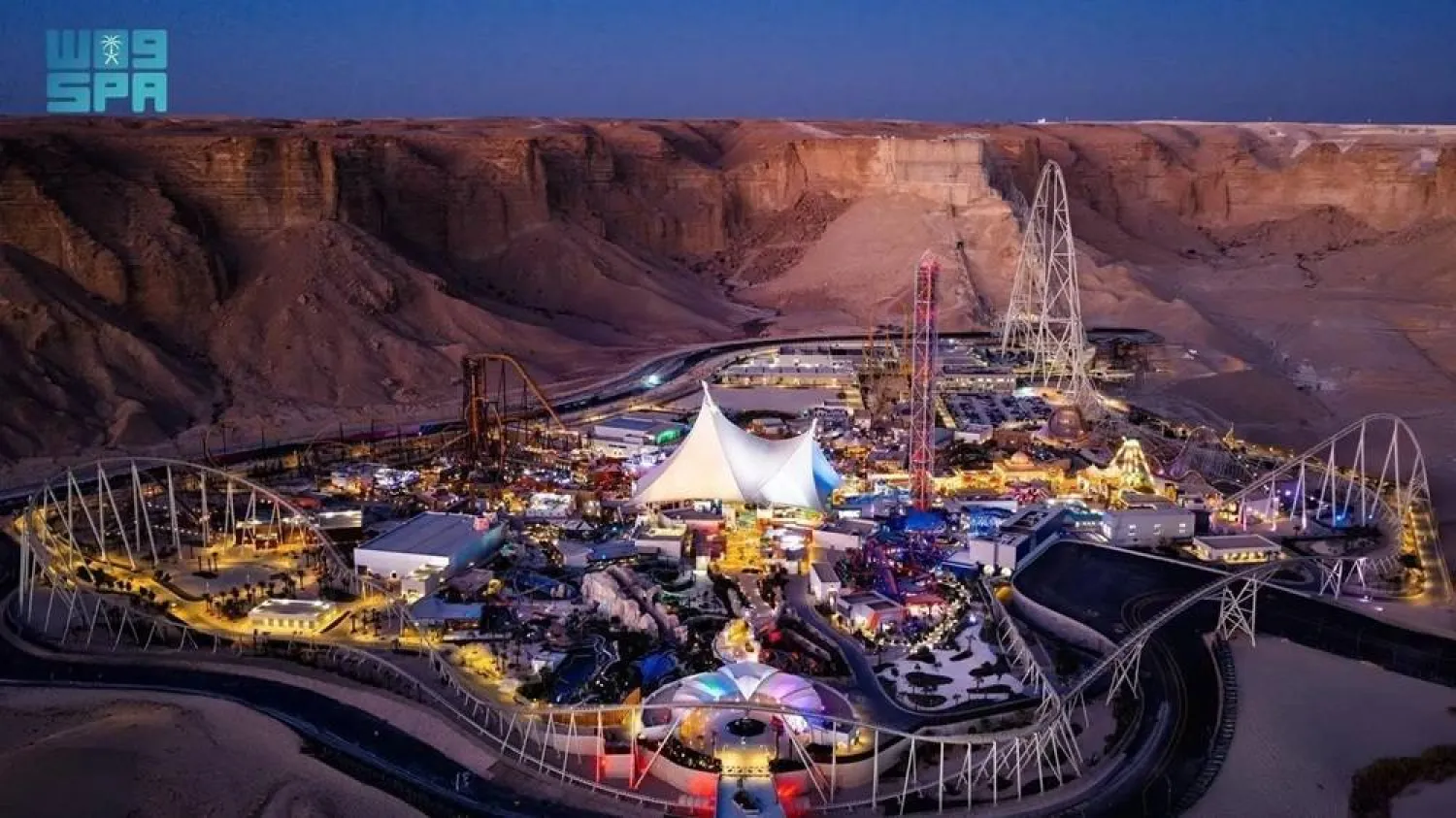

Qiddiya City Announces Opening of Six Flags Qiddiya City on December 31

Located at the heart of the Tuwaiq Mountains, just 40 minutes from Riyadh, Six Flags Qiddiya City will bring world-class entertainment, sports, and cultural experiences together in a way never seen before. (SPA)
TT

Qiddiya City Announces Opening of Six Flags Qiddiya City on December 31

Located at the heart of the Tuwaiq Mountains, just 40 minutes from Riyadh, Six Flags Qiddiya City will bring world-class entertainment, sports, and cultural experiences together in a way never seen before. (SPA)

Six Flags Qiddiya City, Saudi Arabia's first of its kind theme park and entertainment destination, will welcome visitors from December 31, reported the Saudi Press Agency on Saturday.

Qiddiya City is the world's first global destination built entirely upon the Power of Play. Located at the heart of the Tuwaiq Mountains, just 40 minutes from Riyadh, this vibrant city will bring world-class entertainment, sports, and cultural experiences together in a way never seen before.

Six Flags Qiddiya City, Qiddiya City's inaugural entertainment destination, will bring next-level thrills and unforgettable experiences to families, friends, and adventure-seekers from across the Kingdom and beyond. It will feature 28 rides, including record-breaking experiences, such as Falcons Flight, the world's tallest, fastest, and longest roller coaster; Iron Rattler, the world's tallest tilt coaster, and Spitfire, the world's tallest inverted coaster.

With 18 rides specially designed for families and younger entertainment-seekers, the park ensures entertainment for all generations. Guests can also look forward to a variety of international dining options, along with retail outlets offering exclusive Six Flags merchandise and souvenirs.

The theme park is designed to be accessible to all guests, including individuals with special needs, senior citizens, and their companions, ensuring an enjoyable and inclusive experience for everyone.

Park President of Six Flags Qiddiya City Brian Machamer said: "Six Flags Qiddiya City not only opens its door to the public for the first time, it starts to showcase everything Qiddiya City stands for: bold imagination, unforgettable experiences, and a new benchmark for global entertainment".

With flexible and inclusive ticketing options, guests can look forward to an unforgettable experience filled with world-class thrills and nonstop fun.

Guests can reach Six Flags Qiddiya City by car, taxi, or shuttle. Metro schedules are available on the Riyadh Public Transport website, and only guests with valid tickets may board.

The Six Flags Qiddiya City is the first Six Flags theme park outside North America, promising an unforgettable blend of thrills, culture, and sustainability in Qiddiya City, Saudi Arabia. With 28 exclusive rides and attractions across six immersive lands, anchored by the vibrant Citadel, visitors will embark on a dynamic journey through the rich heritage of Saudi Arabia in a sustainable setting.

Qiddiya City is Qiddiya Investment Company's inaugural new global destination built from scratch on the foundations of play. Located at the heart of the Tuwaiq Mountains, just 40 minutes from Riyadh, the vibrant master-planned city brings entertainment, sports, and culture together in a way never seen before.

With Qiddiya's Power of Play philosophy at its heart, the city is designed to host some of the world's biggest sports competitions, festivals, concerts, and cultural events.

At scale, Qiddiya City will offer residents and visitors a high quality of life with hundreds of attractions and experiences, coupled with residential, retail, office, hospitality, healthcare, and educational offerings set in a thoughtfully planned, smart, and sustainable urban fabric.



Thai Cops Go Undercover as Lion Dancers to Nab Suspected Thief

People gather to watch performers outside Emsphere shopping mall on the first day of the Lunar New Year of the Horse, in Bangkok on February 17, 2026. (Photo by Lillian SUWANRUMPHA / AFP)
TT

Thai Cops Go Undercover as Lion Dancers to Nab Suspected Thief

People gather to watch performers outside Emsphere shopping mall on the first day of the Lunar New Year of the Horse, in Bangkok on February 17, 2026. (Photo by Lillian SUWANRUMPHA / AFP)

Thai police donned a lion dance costume during this week's Lunar New Year festivities to arrest a suspect accused of stealing about $64,000 worth of Buddhist artifacts, police said Thursday.

Officers dressed as a red-and-yellow lion made the arrest on Wednesday evening after receiving a report earlier this month of a home burglary in the suburbs of the capital, Bangkok, AFP reported.

Capital police said the reported break-in involved "numerous Buddhist objects and two 12-inch Buddha statues", along with evidence of repeated attempts to enter the house, according to a statement.

With few leads, police kept watch for weeks before hatching an unusual plan to join a lion dance procession at a nearby Buddhist temple.

"Officers gradually moved closer to the suspect before arresting him," police said.

A video released by police showed the festive lion dancers approaching the suspect before an officer suddenly emerged from the head of the costume and, with help from colleagues, pinned him to the ground.

Police estimated the value of the stolen items at around two million baht ($64,000).

The suspect, a 33-year-old man, has a criminal record involving drug offences and theft, police added.


Sudan's Historic Acacia Forest Devastated as War Fuels Logging

Little is left of the once sprawling acacia forest south of Sudan's capital. Ebrahim Hamid / AFP
TT

Sudan's Historic Acacia Forest Devastated as War Fuels Logging

Little is left of the once sprawling acacia forest south of Sudan's capital. Ebrahim Hamid / AFP

Vast stretches of a once-verdant acacia forest south of Sudan's capital Khartoum have been reduced to little more than fields of stumps as nearly three years of conflict have fueled deforestation.

What was once a 1,500-hectare natural reserve has been "completely wiped out", Boushra Hamed, head of environmental affairs for Khartoum state, told AFP.

Al-Sunut forest had long served as a haven for migratory birds and a vital green shield against the Nile's seasonal floods.

"During the war, Khartoum state has lost 60 percent of its green cover," Hamed said, describing how century-old trees "were cut down with electric saws" for commercial timber and charcoal production.

Where tall acacias once cast cool shade over a wetland just upstream from the confluence of the Blue and White Nile, barren ground now lies exposed, criss-crossed by people gathering whatever wood remains.

Hamed called it "methodical destruction", though the perpetrators remain unknown and there has been no investigation.

Similar devastation is unfolding across several regions -- including western Darfur, neighboring Kordofan and the central states of Sennar and Al-Jazirah -- as insecurity and economic collapse drive unchecked logging, according to Sudan's Forests National Corporation.

According to a 2019 study by the Nairobi-based African Forest Forum, Sudan had already lost nearly half of its forested land since 1960 due to agricultural expansion, firewood collection and overgrazing.

By 2015, the country ranked among Africa's least forested nations, with around 10 percent of its territory still covered by woodland, the study said.

The report had also warned of further degradation if reforestation and sustainable management efforts were not implemented -- concerns now compounded by the ongoing conflict.

- 'Barrier' -

Aboubakr Al-Tayeb, who oversees Khartoum's forestry administration, said the damage "affects not only Khartoum, but Sudan and the wider African continent."

"The forest was home to several migratory species from Europe," he told AFP.

More than a hundred bird species, including ducks, geese, terns, ibis, herons, eagles and vultures, had been recorded in the area, alongside monkeys and small mammals.

Al-Nazir Ali Babiker, an agronomist, said the loss of tree cover could cause more severe seasonal flooding because the "forest acted as a barrier" against rising waters.

Flooding strikes Sudan every year, destroying homes, farmland and infrastructure and leaving many families with no choice but to flee to safer areas.

The war in Sudan, which erupted in April 2023, has already killed tens of thousands, displaced 11 million and shattered critical infrastructure.

Before the fighting, forests supplied roughly 70 percent of Sudan's energy consumption, primarily through charcoal and firewood, according to data from the African Forest Forum.

Al-Sunut had also been a popular leisure spot for Khartoum residents.

"We used to come in groups to study and have a good time," recalls Adam Hafiz Ibrahim, a student at Omdurman Islamic University.

Today, wood gatherers have supplanted the usual walkers. Disregarding army notices alerting them to landmines, men and women traverse the dry, open ground that now stands where the ancient forest once grew.

"We're not cutting the trees. We just pick up whatever wood's already on the ground to use for the fire," said Nafisa, a woman in her forties navigating the dry grasslands.

"We found the trees down. We collect the wood to sell to bakeries and families," said Mohamed Zakaria, a construction worker who lost his job because of the war.

Experts say that the economic hardship caused by the war combined with a lack of enforcement has encouraged logging.

"The logging continues, because those responsible for forest protection cannot access many areas," said Mousa el-Sofori, head of Sudan's Forests National Corporation.

Efforts to replant acacias are underway, Tayeb of the Khartoum forestry administration said, but seedlings grow slowly and can take years to mature.

Restoring the lost woodlands would be "long and costly", said Sofori.

"Some of these forests were centuries old," he added.


Coffee Regions Hit by Extra Days of Extreme Heat, Say Scientists 

17 April 2012, North Rhine-Westphalia, Vluyn: A general view of Arabica Coffee beans. (dpa)
TT

Coffee Regions Hit by Extra Days of Extreme Heat, Say Scientists 

17 April 2012, North Rhine-Westphalia, Vluyn: A general view of Arabica Coffee beans. (dpa)

The world's main coffee-growing regions are roasting under additional days of climate change-driven heat every year, threatening harvests and contributing to higher prices, researchers said Wednesday.

An analysis found that there were 47 extra days of harmful heat per year on average in 25 countries representing nearly all global coffee production between 2021 and 2025, according to independent research group Climate Central.

Brazil, Vietnam, Colombia, Ethiopia and Indonesia -- which supply 75 percent of the world's coffee -- experienced on average 57 additional days of temperatures exceeding the threshold of 30C.

"Climate change is coming for our coffee. Nearly every major coffee-producing country is now experiencing more days of extreme heat that can harm coffee plants, reduce yields, and affect quality," said Kristina Dahl, Climate Central's vice president for science.

"In time, these impacts may ripple outward from farms to consumers, right into the quality and cost of your daily brew," Dahl said in a statement.

US tariffs on imports from Brazil, which supplies a third of coffee consumed in the United States, contributed to higher prices this past year, Climate Central said.

But extreme weather in the world's coffee-growing regions is "at least partly to blame" for the recent surge in prices, it added.

Coffee cultivation needs optimal temperatures and rainfall to thrive.

Temperatures above 30C are "extremely harmful" to arabica coffee plants and "suboptimal" for the robusta variety, Climate Central said. Those two plant species produce the majority of the global coffee supply.

For its analysis, Climate Central estimated how many days each year would have stayed below 30C in a world without carbon pollution but instead exceeded that level in reality -- revealing the number of hot days added by climate change.

The last three years have been the hottest on record, according to climate monitors.