
Rural Greece Struggles to Cope with Predator Comeback

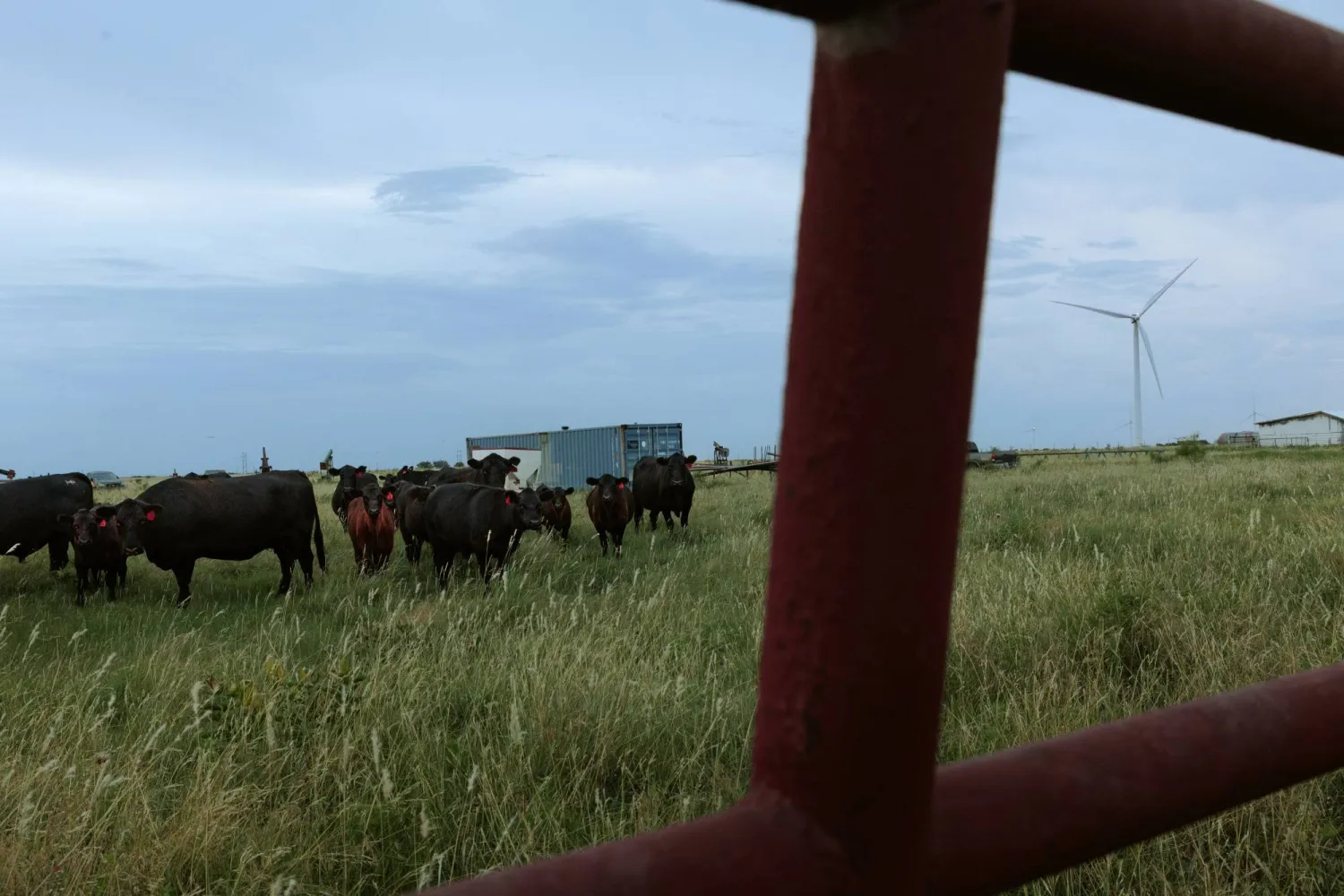
Cows graze near the Trinity Hills wind farm near Olney, Texas on June 26, 2025. (Shelby Tauber/The Texas Tribune via AP)
TT

Rural Greece Struggles to Cope with Predator Comeback

Cows graze near the Trinity Hills wind farm near Olney, Texas on June 26, 2025. (Shelby Tauber/The Texas Tribune via AP)

It was a shocking sight for the farmer — three of his sheep lying dead on the ground, signs of their mauling unmistakable. The large paw prints in the earth left no doubt they had been killed by a bear, a once rare but now increasingly frequent visitor in this part of northwestern Greece.

“It was a bear, a very big one, and they come often now. I wasn’t the only one, it struck elsewhere too,” said Anastasios Kasparidis, adding that another farmer had lost some chickens and pigs. He decided to move the rest of his small flock into a sheep pen near his house for protection.

“Because in the end I wouldn’t have any sheep," The Associated Press quoted Kasparidis as saying. "The bears would eat them all.”

Environmentalists have welcomed the rebound of bear and wolf populations in Greece thanks to the protected species designation that banned them being hunted.

But some farmers and residents of rural areas say they now fear for their livelihoods and, in some cases, their safety. They are calling for greater protection in a phenomenon playing out elsewhere in Europe, with some arguing conservation has gone too far and pushing to roll back restrictions.

Bears, wolves and boars Brown bears, Greece’s largest predator, have made a remarkable comeback. Their numbers have increased roughly fourfold since the 1990s, said Dimitris Bakaloudis, a professor at the Aristotle University of Thessaloniki who specializes in wildlife management and conservation.

Up to an estimated 870 brown bears roam the forests of northern Greece, according to the most recent survey by Arcturos, an environmental organization set up in 1992 that provides a sanctuary for rescued bears and wolves.

And it's not just bears. Wolves also have seen their numbers rise. While wolves could only be found as far south as central Greece in 2010, they have now spread to the outskirts of Athens and into the Peloponnese in southern Greece, Bakaloudis said.

Their recovery has been sustained in part by the also increasing population of wild boars, which is unrelated to conservation efforts. Rather, a combination of a number of factors, including a reduction of hunting, milder winters and cross-breeding with domestic pigs have led them to reproduce at a faster rate, Bakaloudis explained.

Viewed by many as pests that destroy crops, the sight of a dozen or more boars trotting along sidewalks or snuffling through backyards are no longer uncommon in many parts of Greece.

The larger number of wild animals has also resulted in more contact with humans — the vast majority of whom are unfamiliar with how to behave during an encounter.

Lack of familiarity has led to fear in some communities, particularly following a small number of serious incidents this year: a child bitten by a wolf, an elderly man injured by a bear in his yard, a hiker bitten by a bear and another hiker who died after falling into a ravine during a bear encounter.

In Levea, a village of about 660 people surrounded by fields in northwestern Greece, several bear encounters were reported in October, while boars frequently roam through the village, said community president Tzefi Papadopoulou. The bears especially had frightened residents.

“As soon as they heard a dog bark, they were ready to go out with the gun,” she said.
It's similar in the nearby village of Valtonera, 170 kilometers west of Greece’s second largest city, Thessaloniki.

“The village used to be without wild animals. In the past, a wolf would appear once in a while,” said Konstantinos Nikolaidis, community president. Now, wild boars, foxes, bears or wolves roam around or even inside the village, he noted.

“This has caused concern among all residents. It’s now difficult for a person to walk around outside at night,” he said.

The burgeoning wild boar population, meanwhile, has led to calls for the hunting season to be extended.

Giorgos Panagiotidis, deputy mayor of the nearby small town of Amyntaio, said boars had been increasingly encroaching on houses. In May, he asked authorities for hunters to be allowed to shoot boars out of season to tackle the problem.

It’s an issue that isn’t unique to Greece. In a victory of farmers over environmentalists, European Union lawmakers voted in May to reduce protections for wolves across the EU’s 27 member states. The movement even gained support from European Commission President Ursula von der Leyen, whose pony Dolly was killed by a wolf three years ago.

Solutions Experts note it isn't just the larger number of wild animals that has led to encroachment on urban areas. Many factors are at play, they say, from loss of habitat due to wildfires, to noise disturbances from wind turbines and recreational vehicles, and animals emboldened by dwindling human populations in villages.

“There is of course fragmentation of the bears’ habitat, frequently there is drought, there’s a lack of food in the natural environment, there’s a desertification of villages which makes inhabited areas more attractive to bears, so they approach and find food,” said Panos Stefanou, communications officer at Arcturos.

Measures to keep wolves and bears at bay have been developed and approved by scientists, said Bakaloudis, the Thessaloniki university professor, including using lights around property, proper disposal of trash and dead livestock and avoiding feeding strays.

In exceptional circumstances more invasive methods are used, he said, such as in the case of the wolf attack on the child in northern Greece, where authorities decided to capture and remove the animal.

With so many factors contributing to increasing encounters between wild animals and humans, Stefanou cautioned against overly simplistic solutions.

“Killing the animals is not what will solve the problem,” he said.


Three Million Pounds to Save Polar Explorer Shackleton's Villa

A person taking a photo of Ernest Shackleton's grave, polar explorer, who died after a heart attach in 1922 (Shutterstock)
TT

Three Million Pounds to Save Polar Explorer Shackleton's Villa

A person taking a photo of Ernest Shackleton's grave, polar explorer, who died after a heart attach in 1922 (Shutterstock)

Work is under way on a South Atlantic island to preserve a key building in the story of polar explorer Ernest Shackleton.

Shackleton famosly reached the whaling station of Stromness on South Georgia in 1916 after spending 18 months stranded on Antarctica with his crew.

The now-dilapidated Stromness Manager's Villa was used as a base by Shackleton while he orchestrated the rescue of his men.

The Dundee-based South Georgia Heritage Trust have been working to stabilize the structure, with plans to create a digital “twin” of the building for people around the world to see it.

A 2022 survey found the building was very close to collapse.

Alison Neil, chief executive of the South Georgia Heritage Trust, said: “The reason for that is rotting timbers. This is an old-fashioned version of a flat-pack house. They would've been brought down from Norway on ships and then assembled on the island.”

The trust raised more than £3 million to send a team to South Georgia.
They arrived in October and have been working on stabilizing the structure.

Alison said: “It's in the middle of a whaling station that's full of asbestos, dangerous debris, and is not accessible to the public. Our plan is not to open it up to the public, our plan is to maintain it for the future.”

Shackleton's extraordinary story of survival has fascinated and inspired people for more than a century.

His most famous mission was his plan to cross Antarctica through the South Pole after travelling on board his ship The Endurance.

In 1915, The Endurance became trapped in ice, and his crew abandoned ship, crossing onto floating ice, which they hoped would drift towards land.

But by April 1916, the ice floes were breaking up, so Shackleton took his crew in lifeboats first to Elephant Island, then led a smaller group to find help for the others.

They crossed about 800 miles (1,300km) of ocean in the open boat before reaching the island of South Georgia.

Leaving three of the men behind with the boat, Shackleton, Frank Worsley and Tom Crean trekked across the island for three days until they reached Stromness whaling station on the far side of the island.

Alison said the men made it to the villa in a dishevelled state.

She said: “No-one recognized them, they must've looked terrifying. They knocked on the door of the villa and famously the whaling manager opened the door and said, 'who the hell are you?' Shackleton allegedly said: 'My name is Shackleton'.”

It was the men's first contact with the outside world for 17 months.

Shackleton, Worsley and Crean were invited in to the villa where they had a hot meal and a bath, before immediately starting the rescue of the rest of their crew with the help of the whalers.

Alison said: “That's a really important part of The Endurance story and it effectively is the next chapter on from the sinking of the vessel.”


James Cameron Describes Strategy for Surviving Titanic Disaster

Titanic ocean liner after it struck an iceberg in 1912 off the coast of Newfoundland in the Atlantic Ocean (Shutterstock/3d illustration)
TT

James Cameron Describes Strategy for Surviving Titanic Disaster

Titanic ocean liner after it struck an iceberg in 1912 off the coast of Newfoundland in the Atlantic Ocean (Shutterstock/3d illustration)

James Cameron, the filmmaker behind the hit 1997 disaster movie Titanic, has revealed his strategy for hypothetically surviving the famed 1912 cruise liner sinking.

Titanic starred Leonardo DiCaprio and Kate Winslet and is one of the highest-grossing films of all time. The film was set during the sinking of the RMS Titanic, which claimed the lives of more than 1,500 people.

In a new interview with The Hollywood Reporter, Cameron was asked: “If you were traveling by yourself as a second-class passenger on Titanic when it hit an iceberg, what would you have done?”

As the filmmaker explained, third-class passengers were trapped below decks, while first-class passengers were more likely to secure a spot on the lifeboats, according to the interview reported by The Independent.

“I think there were interesting ways to what-if or second-guess the whole thing,” Cameron replied. “One I like to play with my Titanic experts is – with what we know now, and if you had the captain’s ear – how could you save everybody?

“The other is: What if you’re a time traveler, you go back and want to experience the sinking, and your little time-travel thing that gets you back fails, and you’re like, ‘I’m really on the ship, I’ve got to get off it.'”

In this latter scenario, Cameron argued that the best thing to do would be to stand by the edge of the deck, and wait for a lifeboat to launch during the early stages of the evacuation. At this point, he would jump off, and swim to the boat, relying on the passengers to pull him aboard.

“Most people wouldn’t have had the courage to jump into the water,” he continued. “They couldn’t quite believe that the ship was really going to sink. But if you knew for sure it was going to sink and you weren’t on a lifeboat, you jump in the water next to the boat the second it casts off."


Hiker Killed in Rare Suspected Mountain Lion Attack in Colorado

FILE - The General Store is seen Oct. 24, 2006, in Glen Haven, Colo. (AP Photo/The Denver Post, Karl Gehring, File)
TT

Hiker Killed in Rare Suspected Mountain Lion Attack in Colorado

FILE - The General Store is seen Oct. 24, 2006, in Glen Haven, Colo. (AP Photo/The Denver Post, Karl Gehring, File)

A hiker in Colorado has died in the state's first suspected fatal mountain lion attack in over 25 years, authorities said.

The woman was found unresponsive by other hikers on the Crosier Mountain trail northeast of Estes Park around noon on Thursday.

The hikers saw a mountain lion near the woman's body and scared it away by throwing rocks. A doctor was among the hikers and attended to the woman but found no pulse, Colorado Parks and Wildlife spokesperson Kara Van Hoose told reporters, according to Reuters.

CPW officers responded to the ⁠scene and shot dead two lions in the area. It is not known whether one or multiple animals were involved in the suspected attack, the agency said in a statement. It is believed the woman was hiking alone.

“There were signs that this was consistent with a mountain lion attack,” Van Hoose told a press ⁠conference.

Mountain lion attacks on humans in Colorado are rare, with 28 reported to CPW since 1990. The last fatal attack was in 1999.

CPW pathologists are performing necropsies on the dead animals to check for abnormalities and neurological diseases like rabies and avian influenza, as well as human DNA, Van Hoose said.

CPW policy mandates the killing of any mountain lion involved in an attack on a human so as to prevent repeat incidents. If human DNA is not found on either dead lion, authorities will continue to ⁠search for animals that may have been involved, Van Hoose said.

Larimer County Coroner will release the identity of the victim and cause of death, she said.

Colorado has a healthy mountain lion population, estimated by CPW to be between 3,800 and 4,400 adults. Conservation efforts have brought the species back from near extinction in the 1960s due to bounty hunting.

Mountain lions are common in the Front Range area where the woman was found, Van Hoose said. The animals go down to lower elevations in winter in search of prey like deer and elk, increasing chances of encounters with humans.