

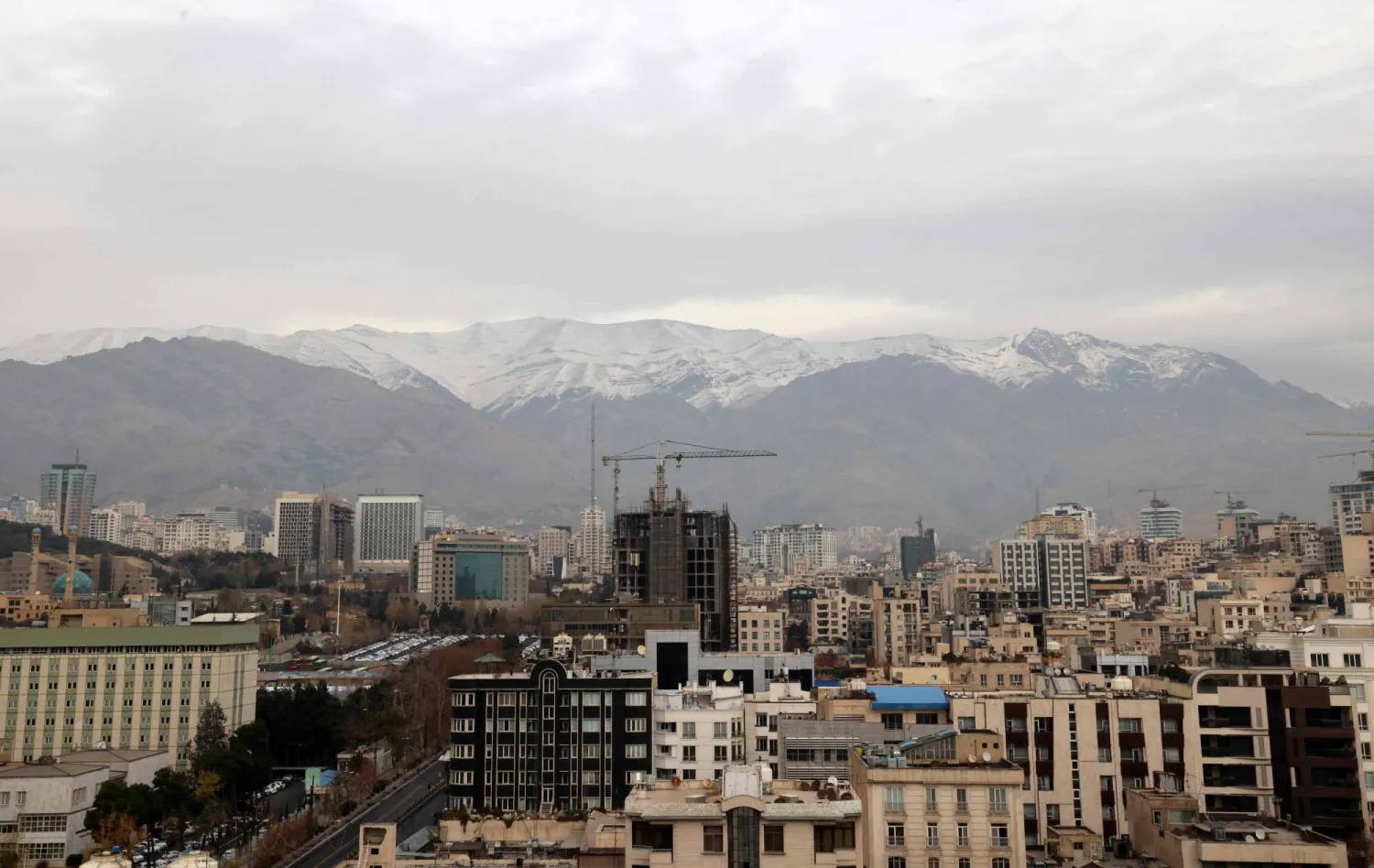

First Rain of Autumn Falls in Iran’s Capital, but the Drought-Ravaged Nation Needs Far More 

A general view shows the Iranian capital Tehran with the snow-covered Alborz mountain range in the background on December 9, 2025, after a year of drought and water shortage in Iran. (AFP)
TT

First Rain of Autumn Falls in Iran’s Capital, but the Drought-Ravaged Nation Needs Far More 

A general view shows the Iranian capital Tehran with the snow-covered Alborz mountain range in the background on December 9, 2025, after a year of drought and water shortage in Iran. (AFP)

Rain fell for the first time in months in Iran's capital Wednesday, providing a brief respite for the parched country as it suffers through the driest autumn in over a half century.

The drought gripping Iran has seen its president warn the country it may need to move its government out of Tehran by the end of December if there's not significant rainfall to recharge dams around the capital.

Meteorologists have described this fall as the driest in over 50 years across the country — from even before its 1979 revolution — further straining a system that expends vast amounts of water inefficiently on agriculture.

The water crisis has even become a political issue in the country, particularly as Israeli Prime Minister Benjamin Netanyahu has repeatedly offered his country's help to Iran, a nation he launched a 12-day war against in June. Water shortages also have sparked localized protests in the past, something Iran has been trying to avoid as its economy struggles under the weight of international sanctions over its nuclear program.

"The water crisis in Iran has, in recent years, escalated from a recurring drought issue into a profound political and security problem that has the regime leadership concerned," the New York-based Soufan Center said.

Drying reservoirs, light snowpack

The drought has been a long subject of conversation across Tehran and wider Iran, from government officials openly discussing it with visiting journalists to people purchasing water tanks for their homes. In the capital, government-sponsored billboards call on the public not to use garden hoses outside to avoid waste. Water service reportedly goes out for hours in some neighborhoods of Tehran, home to 10 million people.

Snowpack on the surrounding Alborz Mountains remains low as well, particularly after a summer that saw temperatures rise near 50 degrees Celsius (122 degrees Fahrenheit) in some areas of the country, forcing government buildings to shut down.

Ahad Vazifeh, an official in the government's Iran Meteorological Organization office, called the drought "unprecedented" in an interview with the Fararu news outlet last week. Precipitation now stands at about 5% of what's considered a normal autumn, he added.

"Even if rain in the winter and spring will be normal, we will have 20% shortage," Vazifeh warned.

Social media videos show people standing in some reservoirs, the water lines clearly visible. Satellite pictures analyzed by The Associated Press also show reservoirs noticeably depleted. That includes the Latyan Dam — one of five key reservoirs — which is now under 10% full as Tehran has entered its sixth consecutive year of drought.

The state-owned Tehran Times newspaper, often following the theocracy's line, was blunt about the scale of the challenge.

"Iran is facing an unprecedented water crisis that threatens not only its agricultural sector but also regional stability and global food markets," the newspaper said in a story this past weekend. The faithful have also offered prayers for rain at the country's mosques.

Climate change challenge

Iran, straddling the Middle East and Asia, long has been arid due to its geography. Its Alborz and Zagros mountain ranges cause a so-called "rain shadow" across much of the nation, blocking moisture coming from the Caspian Sea and the Arabian Gulf.

But the drain on the country's water supplies has been self-inflicted. Agriculture uses an estimated 90% of the country's water supplies. That hasn't been stopped even through these recent drought years. That's in part due to policies stemming from Iran's 1979 revolution and then-Supreme Leader Khomeini, who pledged water would be free for all.

The intervening years of the Iran-Iraq war saw the country push for self-sufficiency above all else, irrigating arid lands to grow water-intensive crops like wheat and rice, and over-drilling wells.

Experts have described Iran as facing "water bankruptcy" over its decisions. In the past, Iranian officials have blamed their neighbors in part for their water shortage, with hard-line former President Mahmoud Ahmadinejad at one point falsely suggesting that "the enemy destroys the clouds that are headed towards our country and this is a war Iran will win."

But that's changed with the severity of the crisis leading to current President Masoud Pezeshkian warning the capital may need to be moved. However, such a decision would cost billions of dollars the country likely doesn't have as it struggles through a major economic crisis.

Meanwhile, climate change likely has accelerated the droughts plaguing Iraq, which has seen the driest year on record since 1933, as well as Syria and Iran, said World Weather Attribution, a group of international scientists who study global warming’s role in extreme weather.

With the climate warmed by 1.3 degrees Celsius (2.3 degrees Fahrenheit) due to fossil fuel burning, the severity of drought seen in Iran over the last year can be expected to return every 10 years, the group said. If the temperature hadn't risen by that much, it could be expected between every 50 to 100 years, it added.

"The current acute crisis is part of a longer term water crisis in Iran and the wider region that results from a range of issues including, frequent droughts with increasing evaporation rates, water-intensive agriculture and unsustainable groundwater extraction," World Weather Attribution said in a recent report.

"These combined pressures contribute to chronic water stress in major urban centers including Tehran, reportedly at risk of severe water shortages and emergency rationing, while also straining agricultural productivity and heightening competition over scarce resources."



Mummified Cheetahs Found in Saudi Caves Shed Light on Lost Populations

This undated image provided by Communications Earth and Environment shows the mummified remains of a cheetah. (Ahmed Boug/Communications Earth and Environment via AP)
TT

Mummified Cheetahs Found in Saudi Caves Shed Light on Lost Populations

This undated image provided by Communications Earth and Environment shows the mummified remains of a cheetah. (Ahmed Boug/Communications Earth and Environment via AP)

Scientists have uncovered the mummified remains of cheetahs from caves in northern Saudi Arabia.

The remains range from 130 years old to over 1,800 years old. Researchers excavated seven mummies along with the bones of 54 other cheetahs from a site near the city of Arar.

Mummification prevents decay by preserving dead bodies. Egypt's mummies are the most well-known, but the process can also happen naturally in places like glacier ice, desert sands and bog sludge.

The new large cat mummies have cloudy eyes and shriveled limbs, resembling dried-out husks.

“It’s something that I’ve never seen before,” said Joan Madurell-Malapeira with the University of Florence in Italy, who was not involved with the discovery.

Researchers aren’t sure how exactly these new cats got mummified, but the caves’ dry conditions and stable temperature could have played a role, according to the new study published Thursday in the journal Communications Earth and Environment.

They also don't know why so many cheetahs were in the caves. It could have been a denning site where mothers birthed and raised their young.

Scientists have uncovered the rare mummified remains of other large cats, including a saber-toothed cat cub in Russia.

It's uncommon for large mammals to be preserved to this degree. Besides being in the right environment, the carcasses also have to avoid becoming a snack for hungry scavengers like birds and hyenas.

Cheetahs once roamed across most of Africa and parts of Asia, but now live in just 9% of their previous range and haven't been spotted across the Arabian Peninsula for decades. That’s likely due to habitat loss, unregulated hunting and lack of prey, among other factors.

In a first for naturally mummified large cats, scientists were also able to peek at the cheetahs' genes and found that the remains were most similar to modern-day cheetahs from Asia and northwest Africa. That information could help with future efforts to reintroduce the cats to places they no longer live.


Vonn Launches Social Media Search Mission After Ski Pole Goes Missing

 US' Lindsey Vonn crosses the finish line to win the Women's Downhill event of the FIS Alpine Ski World Cup in Altenmarkt Zauchensee, Austria, on January 10, 2026. (AFP)
US' Lindsey Vonn crosses the finish line to win the Women's Downhill event of the FIS Alpine Ski World Cup in Altenmarkt Zauchensee, Austria, on January 10, 2026. (AFP)
TT

Vonn Launches Social Media Search Mission After Ski Pole Goes Missing

 US' Lindsey Vonn crosses the finish line to win the Women's Downhill event of the FIS Alpine Ski World Cup in Altenmarkt Zauchensee, Austria, on January 10, 2026. (AFP)
US' Lindsey Vonn crosses the finish line to win the Women's Downhill event of the FIS Alpine Ski World Cup in Altenmarkt Zauchensee, Austria, on January 10, 2026. (AFP)

Lindsey Vonn may be dominating World Cup downhills at 41, but even the US speed queen is not immune to missing equipment.

Vonn took to social media on Thursday with an unusual plea after losing a ski pole in Tarvisio, Italy, ahead of this weekend's World Cup event.

"Someone took ‌my pole ‌in the parking ‌lot ⁠today in ‌Tarvisio. If you have seen it, please respond to this. Thank you," Vonn wrote on X, posting a photo of the matching pole complete with her initials on the ⁠hand strap.

Vonn, a favorite for the speed events ‌at next month's Milano-Cortina ‍Olympics, retired ‍from the sport in 2019 and ‍had a partial knee replacement in April 2024 but returned to competition later that year and has been enjoying a fairy-tale comeback that has defied age and expectation.

Already the oldest ⁠World Cup winner of all time, Vonn continued her astonishing, age-defying form with a downhill victory in Zauchensee, Austria last week.

That triumph marked Vonn's fourth podium from four downhills this season, cementing her lead in the World Cup standings and her status as the woman to ‌beat at next month's Olympics.


ISS Crew Splashes Down on Earth After Medical Evacuation

FILE - This photo provided by NASA shows the Moon's shadow covering portions of Canada and the US during a total solar eclipse as seen from the International Space Station on Monday, Aug. 8, 2024. (NASA via AP, File)
TT

ISS Crew Splashes Down on Earth After Medical Evacuation

FILE - This photo provided by NASA shows the Moon's shadow covering portions of Canada and the US during a total solar eclipse as seen from the International Space Station on Monday, Aug. 8, 2024. (NASA via AP, File)

Four International Space Station (ISS) crewmembers splashed down in the Pacific Ocean early Thursday, video footage from NASA showed, after a medical issue prompted their mission to be cut short.

American astronauts Mike Fincke and Zena Cardman, Russian cosmonaut Oleg Platonov and Japan's Kimiya Yui landed off the coast of San Diego about 12:41 am (0841 GMT), marking the first-ever medical evacuation from the ISS.