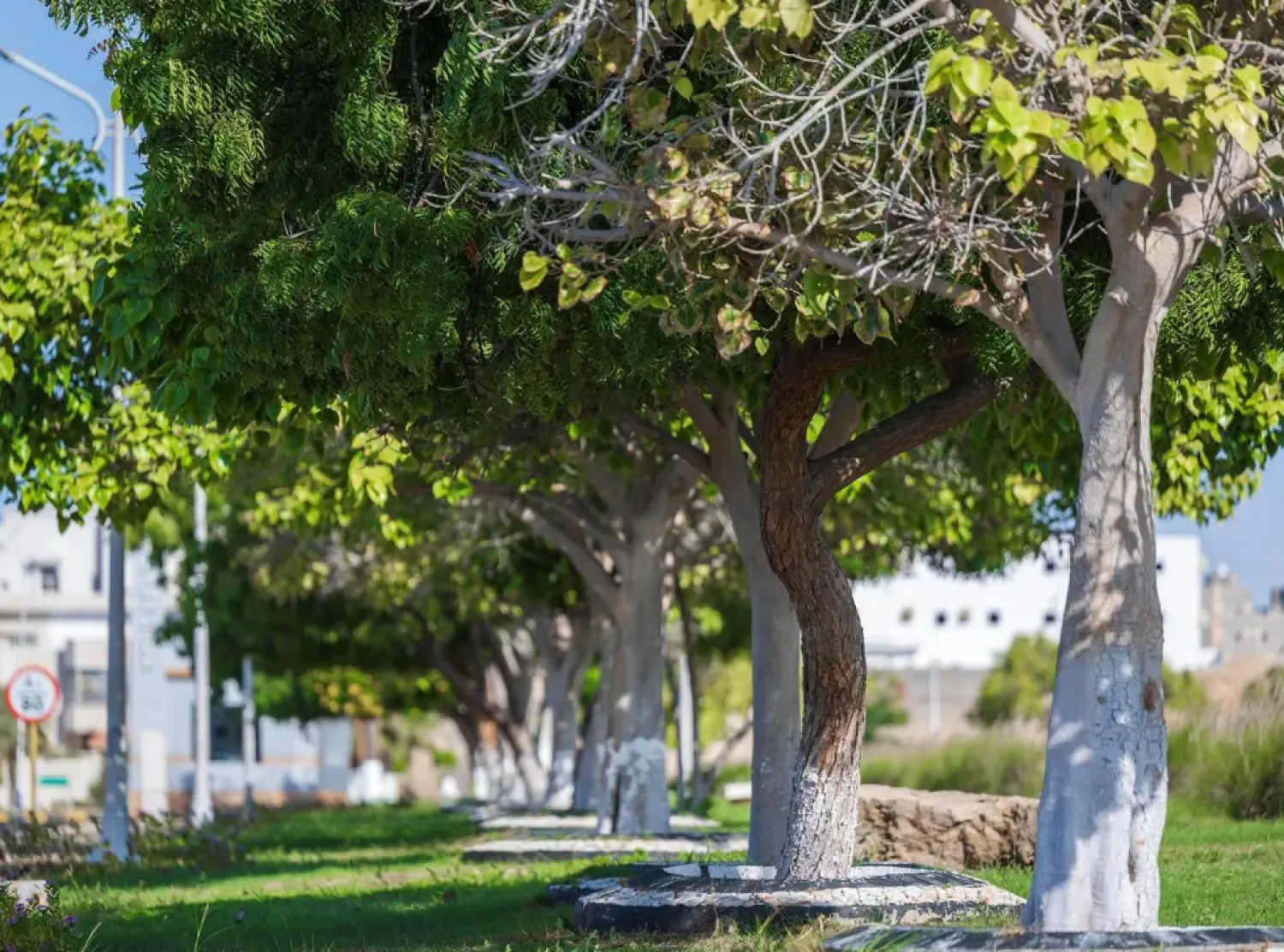
National Greening Program to Plant 400,000 Seedlings in North Riyadh Geopark

The projects falls in line with the objectives of the Kingdom’s Vision 2030 - SPA
TT

National Greening Program to Plant 400,000 Seedlings in North Riyadh Geopark

The projects falls in line with the objectives of the Kingdom’s Vision 2030 - SPA

The National Greening Program, affiliated with the National Center for Vegetation Cover Development and Combating Desertification (NCVC), has launched its first afforestation project in the North Riyadh Geopark, located in Thadiq Governorate.

The project aims to plant 400,000 seedlings by 2030 as part of the program’s efforts to help rehabilitate environmentally degraded sites, in line with the objectives of the Kingdom’s Vision 2030, SPA reported.

Representatives from government agencies, environmental associations, and some students and staff from the local schools participated in the first phase of the afforestation project.


Louvre Thieves Escaped With 30 Seconds to Spare, Probe Reveals

The daring robbery at the Louvre took place in broad daylight © Dimitar DILKOFF / AFP
TT

Louvre Thieves Escaped With 30 Seconds to Spare, Probe Reveals

The daring robbery at the Louvre took place in broad daylight © Dimitar DILKOFF / AFP

The thieves who stole priceless crown jewels from the Louvre in October escaped with just 30 seconds to spare due to avoidable security failures at the Paris museum, a damning investigation revealed on Wednesday.

The probe, ordered by the culture ministry after the embarrassing daylight heist, revealed that only one of two security cameras was working near the site where the thieves broke in on the morning of Sunday October 19, according to AFP.

Agents in the security headquarters also did not have enough screens to follow the images in real-time, while a lack of coordination meant police were initially sent to the wrong place once the alarm was raised, the report unveiled at the French Senate's Culture Commission, stated.

"It highlights an overall failure of the museum, as well as its supervisory authority, to address security issues," the head of the commission, Laurent Lafon, said at the start of a hearing.

One of the most startling revelations was that the robbers left only 30 seconds before police and private security guards arrived on the scene.

"Give or take 30 seconds, the Securitas (private security) guards or the police officers in a car could have prevented the thieves from escaping," the head of the investigation, Noel Corbin, told senators.

He said that measures such as a modern security camera system, more resistant glass in the door cut open with angle grinders, or better internal coordination could have prevented the loss of the crown jewels -- worth an estimated $102 million -- which have still not been found.

Security risks were highlighted in several reports commissioned by management of the Louvre, including a 2019 audit by the jewellery company Van Cleef & Arpels.

The evaluation said the balcony used by the thieves was a weak point in security and could be reached by using an extendable ladder -- exactly what transpired in the heist.

Corbin confirmed that under-fire Louvre boss Laurence des Cars had been unaware of the audit which was carried out by her predecessor, Jean-Luc Martinez.

"The recommendations were not acted on and they would have enabled us to avoid this robbery," Corbin said, adding that there had been a lack of coordination between the two state-appointed administrators.

Police believe they have arrested all four thieves, who escaped on powerful motorbikes, having carried out the heist in the Apollo Gallery in around 10 minutes in total.

The revelations on Wednesday are likely to pile more pressure on des Cars, who was already facing calls to resign.


Prince Mohammed bin Salman Royal Reserve Launches Live Turtle Tracking Program

This data will fill a critical regional knowledge gap and drive unified, cross-border conservation strategies for these globally endangered species - SPA
TT

Prince Mohammed bin Salman Royal Reserve Launches Live Turtle Tracking Program

This data will fill a critical regional knowledge gap and drive unified, cross-border conservation strategies for these globally endangered species - SPA

In a milestone for marine conservation, Prince Mohammed bin Salman Royal Reserve has launched a live satellite tracking program for hawksbill and green turtles, including the first known tagging of a pre-nesting, egg-carrying green turtle in the Red Sea, SPA reported.

This data will fill a critical regional knowledge gap and drive unified, cross-border conservation strategies for these globally endangered species.

The team, led by Senior Marine Ecologist at Prince Mohammed bin Salman Royal Reserve Dr. Ahmed Mohammed and KAUST Beacon Development’s Senior Marine Megafauna Specialist Dr. Hector Barrios-Garrido, successfully in-water captured and tagged three critically endangered (IUCN) hawksbill turtles and seven green turtles. The tags transmit real-time movement data identifying foraging grounds, migratory corridors, and most crucially the nesting site of the egg-carrying green turtle, ensuring the appropriate protection and management is in place. The program continues the reserve’s long-term commitment to marine conservation, expanding its turtle nest monitoring and protection program in operation since 2023.

The reserve protects 4,000km² of Red Sea waters, 1.8% of the Kingdom’s marine area, and a coastline of 170km, the longest coastline under management by a single entity in the Kingdom. Linking NEOM and Red Sea Global, this forms an 800km corridor of protected Red Sea coastline. It is a refuge for five of the world’s seven turtle species and a breeding ground for green and hawksbill turtles. The reserve’s ranger teams monitor turtle activity both on shore and at sea, protecting nesting sites critical to natal homing, the biological instinct that drives turtles to return to the same beaches where they were born.

‘’Critically endangered hawksbill turtles face an extremely high risk of extinction in the wild within our lifetime. With fewer than 200 breeding-age females remaining in the Red Sea, their survival depends on closing vital knowledge gaps to enable their effective conservation,” said CEO of Prince Mohammed bin Salman Royal Reserve Andrew Zaloumis.

He added, “Hawksbill turtles hatching on the reserve’s protected beaches range across 438,000 km² of open sea bordered by eight MENA countries, before returning some three decades later to the same sandy beach to lay their eggs. Our satellite tagging and tracking program is a game-changer, providing the real-time data needed to identify their critical staging, foraging, and rookery areas across the Red Sea. The data will support national and regional conservation efforts to drive forward a much-needed unified ecosystem-wide turtle conservation management plan.’’

The reserve’s ongoing turtle conservation supports Saudi Arabia’s commitments under the UNEP Convention on Migratory Species and the IOSEA Marine Turtle Memorandum of Understanding by strengthening habitat protection and regional cooperation through scientific knowledge-sharing across the Red Sea.

Senior Marine Ecologist at the reserve Dr. Ahmed Mohammed stated, ‘’These state-of-the-art, lightweight tags are designed to operate for at least 12 months, providing continuous data that will enable detailed analysis of seasonal patterns, developmental habitats, and contribute valuable insights to regional and global sea turtle research. Additionally, depth sensors will reveal sea grass meadows, essential foraging grounds for green turtles and critical blue carbon sinks."

Despite the recent global reclassification of green turtles by the IUCN, regionally, they are still regarded as vulnerable and conservation dependent. All five marine turtle species resident in the Red Sea are listed under the Convention on Migratory Species (CMS), to which Saudi Arabia became a party in 1979. Turtles remain at risk from entanglement in fishing nets, habitat degradation, and illegal poaching. While these threats are absent within the reserve’s protected waters, ecosystem-wide management strategies that span political boundaries are necessary and the reserve continues to share data with the wider conservation and scientific community and partner with SHAMS on local and regional conservation strategies.

One of eight Royal Reserves, the 24,500 km² Prince Mohammed bin Salman Royal Reserve stretches from the lava plains of the Harrats to the deep Red Sea in the west, connecting NEOM, Red Sea Global, and AlUla. It is home to the Public Investment Fund's (PIF) Wadi Al Disah project and Red Sea Global’s Destination AMAALA.

The reserve encompasses 15 distinct ecosystems. At just 1% of the Kingdom’s terrestrial area and 1.8% of its marine area, it boasts over 50% of the Kingdom’s species, making it one of the most biodiverse protected areas in the Middle East.

Prince Mohammed bin Salman Royal Reserve is one of eight royal reserves established by royal decree and overseen by the Royal Reserves Council chaired by His Royal Highness Prince Mohammed bin Salman bin Abdulaziz Al Saud, Crown Prince and Prime Minister. The reserve’s program is integrated with Saudi Arabia’s wider sustainability and conservation programs, including the Saudi Green and Middle East Green Initiatives.


First Rain of Autumn Falls in Iran’s Capital, but the Drought-Ravaged Nation Needs Far More 

A general view shows the Iranian capital Tehran with the snow-covered Alborz mountain range in the background on December 9, 2025, after a year of drought and water shortage in Iran. (AFP)
TT

First Rain of Autumn Falls in Iran’s Capital, but the Drought-Ravaged Nation Needs Far More 

A general view shows the Iranian capital Tehran with the snow-covered Alborz mountain range in the background on December 9, 2025, after a year of drought and water shortage in Iran. (AFP)

Rain fell for the first time in months in Iran's capital Wednesday, providing a brief respite for the parched country as it suffers through the driest autumn in over a half century.

The drought gripping Iran has seen its president warn the country it may need to move its government out of Tehran by the end of December if there's not significant rainfall to recharge dams around the capital.

Meteorologists have described this fall as the driest in over 50 years across the country — from even before its 1979 revolution — further straining a system that expends vast amounts of water inefficiently on agriculture.

The water crisis has even become a political issue in the country, particularly as Israeli Prime Minister Benjamin Netanyahu has repeatedly offered his country's help to Iran, a nation he launched a 12-day war against in June. Water shortages also have sparked localized protests in the past, something Iran has been trying to avoid as its economy struggles under the weight of international sanctions over its nuclear program.

"The water crisis in Iran has, in recent years, escalated from a recurring drought issue into a profound political and security problem that has the regime leadership concerned," the New York-based Soufan Center said.

Drying reservoirs, light snowpack

The drought has been a long subject of conversation across Tehran and wider Iran, from government officials openly discussing it with visiting journalists to people purchasing water tanks for their homes. In the capital, government-sponsored billboards call on the public not to use garden hoses outside to avoid waste. Water service reportedly goes out for hours in some neighborhoods of Tehran, home to 10 million people.

Snowpack on the surrounding Alborz Mountains remains low as well, particularly after a summer that saw temperatures rise near 50 degrees Celsius (122 degrees Fahrenheit) in some areas of the country, forcing government buildings to shut down.

Ahad Vazifeh, an official in the government's Iran Meteorological Organization office, called the drought "unprecedented" in an interview with the Fararu news outlet last week. Precipitation now stands at about 5% of what's considered a normal autumn, he added.

"Even if rain in the winter and spring will be normal, we will have 20% shortage," Vazifeh warned.

Social media videos show people standing in some reservoirs, the water lines clearly visible. Satellite pictures analyzed by The Associated Press also show reservoirs noticeably depleted. That includes the Latyan Dam — one of five key reservoirs — which is now under 10% full as Tehran has entered its sixth consecutive year of drought.

The state-owned Tehran Times newspaper, often following the theocracy's line, was blunt about the scale of the challenge.

"Iran is facing an unprecedented water crisis that threatens not only its agricultural sector but also regional stability and global food markets," the newspaper said in a story this past weekend. The faithful have also offered prayers for rain at the country's mosques.

Climate change challenge

Iran, straddling the Middle East and Asia, long has been arid due to its geography. Its Alborz and Zagros mountain ranges cause a so-called "rain shadow" across much of the nation, blocking moisture coming from the Caspian Sea and the Arabian Gulf.

But the drain on the country's water supplies has been self-inflicted. Agriculture uses an estimated 90% of the country's water supplies. That hasn't been stopped even through these recent drought years. That's in part due to policies stemming from Iran's 1979 revolution and then-Supreme Leader Khomeini, who pledged water would be free for all.

The intervening years of the Iran-Iraq war saw the country push for self-sufficiency above all else, irrigating arid lands to grow water-intensive crops like wheat and rice, and over-drilling wells.

Experts have described Iran as facing "water bankruptcy" over its decisions. In the past, Iranian officials have blamed their neighbors in part for their water shortage, with hard-line former President Mahmoud Ahmadinejad at one point falsely suggesting that "the enemy destroys the clouds that are headed towards our country and this is a war Iran will win."

But that's changed with the severity of the crisis leading to current President Masoud Pezeshkian warning the capital may need to be moved. However, such a decision would cost billions of dollars the country likely doesn't have as it struggles through a major economic crisis.

Meanwhile, climate change likely has accelerated the droughts plaguing Iraq, which has seen the driest year on record since 1933, as well as Syria and Iran, said World Weather Attribution, a group of international scientists who study global warming’s role in extreme weather.

With the climate warmed by 1.3 degrees Celsius (2.3 degrees Fahrenheit) due to fossil fuel burning, the severity of drought seen in Iran over the last year can be expected to return every 10 years, the group said. If the temperature hadn't risen by that much, it could be expected between every 50 to 100 years, it added.

"The current acute crisis is part of a longer term water crisis in Iran and the wider region that results from a range of issues including, frequent droughts with increasing evaporation rates, water-intensive agriculture and unsustainable groundwater extraction," World Weather Attribution said in a recent report.

"These combined pressures contribute to chronic water stress in major urban centers including Tehran, reportedly at risk of severe water shortages and emergency rationing, while also straining agricultural productivity and heightening competition over scarce resources."