


Iran Launches New Attacks Targeting Israel as It Seeks to Ramp up Pressure on US

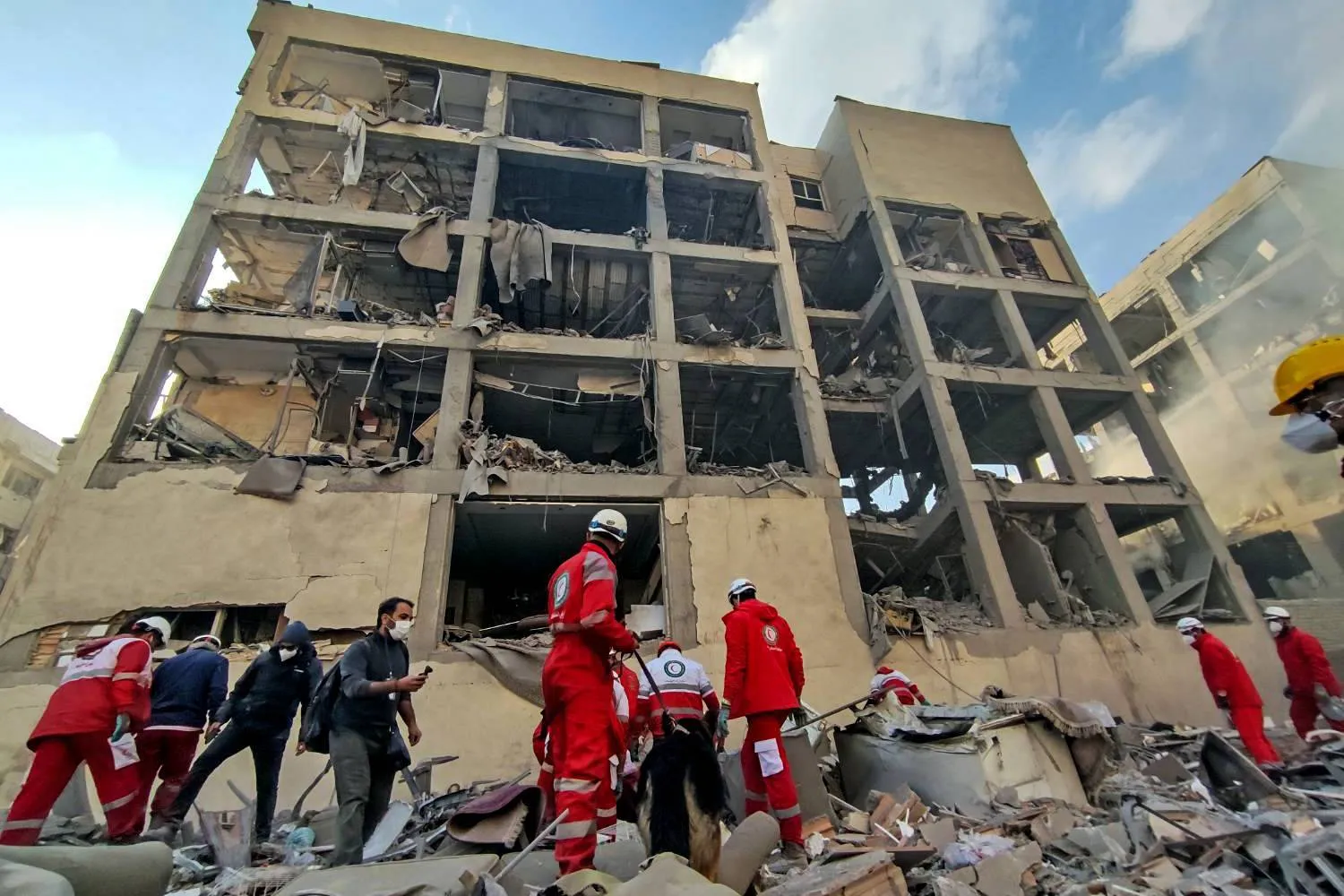
 10 March 2026, Iran, Tehran: Members of the Iranian Red Crescent Society (IRCS) rescue teams work at the site of a building damaged in a US-Israeli airstrike in Resalat Square. (dpa)
10 March 2026, Iran, Tehran: Members of the Iranian Red Crescent Society (IRCS) rescue teams work at the site of a building damaged in a US-Israeli airstrike in Resalat Square. (dpa)
TT

Iran Launches New Attacks Targeting Israel as It Seeks to Ramp up Pressure on US

 10 March 2026, Iran, Tehran: Members of the Iranian Red Crescent Society (IRCS) rescue teams work at the site of a building damaged in a US-Israeli airstrike in Resalat Square. (dpa)
10 March 2026, Iran, Tehran: Members of the Iranian Red Crescent Society (IRCS) rescue teams work at the site of a building damaged in a US-Israeli airstrike in Resalat Square. (dpa)

Iran launched new attacks on Tuesday at Israel and Gulf Arab countries as it kept up pressure on the Middle East in a war started by Israel and the United States that has sent oil prices surging and stunned global economies.

Sirens warned of incoming missiles in the futuristic business hub of Dubai, and in Bahrain, authorities said an Iranian attack hit a residential building in the capital, killing a 29-year-old woman and wounding eight others. Saudi Arabia said it destroyed two drones over the Eastern Region and Kuwait's National Guard said it shot down six drones.

Later in the morning, sirens also sounded in Jerusalem, and sounds of explosions could be heard in Tel Aviv as Israel's defense systems worked to intercept incoming fire, not long after the military said it detected an Iranian missile launch.

“We are definitely not looking for a ceasefire,” Iran's parliament speaker, Mohammad Bagher Qalibaf, wrote on X. “We believe that the aggressor should be punched in the mouth so that he learns a lesson so that he will never think of attacking our beloved Iran again.”

Another top Iranian security official, Ali Larijani, appeared to threaten US President Donald Trump himself, writing on X that “Iran doesn’t fear your empty threats. Even those bigger than you couldn’t eliminate Iran. Be careful not to get eliminated yourself.” Iran has been accused of plotting attempts to kill Trump in the past.

Witnesses reported hearing several explosions in Tehran in the afternoon as Israel commenced a new wave of airstrikes.

Attacks aimed at pressuring the US

Along with firing missiles and drones at Israel and at American bases in the region, Iran has also been targeting energy infrastructure and traffic through the Strait of Hormuz, a vital waterway for traded oil, sending oil prices soaring. The attacks appear aimed at generating enough global economic pain to pressure the US and Israel to end their strikes.

Brent crude, the international standard, spiked to nearly $120 on Monday before falling back but was still at around $90 a barrel on Tuesday, nearly 24% higher than when the war started on Feb. 28.

Trump, who has previously said that the war could last for a month or longer, sought to downplay growing fears that it could take even longer, saying it was “going to be a short-term excursion.”

Still, Israeli Prime Minister Benjamin Netanyahu vowed the strikes on Iran would continue.

“Our aim is to bring the Iranian people to cast off the yoke of tyranny, (but) ultimately it depends on them,” Netanyahu said during a meeting with Israel’s hospital and health system leaders. “There is no doubt that with the actions taken so far, we are breaking their bones.”

Oil is rerouted

Iran has effectively stopped tankers from using the Strait of Hormuz, which connects the Gulf and the Gulf of Oman — the gateway to the Indian Ocean — through which 20% of the world's oil is carried. Attacks on merchant ships near the strait have killed at least seven sailors, according to the International Maritime Organization.

A bulk carrier likely came under attack in the Gulf on Tuesday off the coast of the United Arab Emirates, with the captain reporting a splash and a loud bang nearby, according to a monitoring center run by the British military.

In a post on social media, Trump seemed not to acknowledge that, saying that “If Iran does anything that stops the flow of Oil within the Strait of Hormuz, they will be hit by the United States of America TWENTY TIMES HARDER than they have been hit thus far.”

Iran's paramilitary Revolutionary Guard doubled down, saying in a statement that it “will not allow the export of even a single liter of oil from the region to the hostile side and its partners until further notice.”

Meanwhile, Amin Nasser, the president and CEO of Saudi Arabia’s oil giant Aramco, said tankers were being rerouted to avoid the Strait of Hormuz, and that its East-West pipeline would reach its full capacity of 7 million barrels a day being brought to the Red Sea port of the Yanbu this week.

“The situation at the Strait of Hormuz is blocking sizable volumes of oil from the whole region,” he said, adding that tighter supplies would likely push the price per barrel globally even higher, translating to higher costs for gasoline and jet fuel.

“If this takes a long time, that will have serious impact on the global economy,” Nasser said.

Airstrike on Iran-linked militia in Iraq kills 5

As the conflict spread across the region, Israel launched multiple attacks on the Hezbollah group in Lebanon, which responded by firing missiles into Israel.

Iran-backed militias in Iraq have also launched attacks at US bases in the country since the beginning of the conflict.

Early Tuesday, one such militia — the 40th Brigade of the Popular Mobilization Forces in the city of Kirkuk — was hit with an airstrike that killed at least five militiamen and wounded four, according to officials who spoke on condition of anonymity because they were not authorized to talk to reporters.

It was not immediately clear who was behind the strikes.

Israel's military meanwhile reiterated a call for all residents of southern Lebanon to evacuate their homes, saying it planned to “operate forcefully” there against Hezbollah.

Since the war began, at least 1,230 people have been killed in Iran, at least 397 in Lebanon and 11 in Israel, according to officials.

A total of seven US service members have been killed.


Suspected Measles Cases Kill Nearly 1,000 as Bangladesh Struggles to Contain Outbreak

A child receives treatment for measles, at Bangladesh Shishu Hospital & Institute in Dhaka on September 3, 2026. (Photo by Salahuddin Ahmed / AFP)
TT

Suspected Measles Cases Kill Nearly 1,000 as Bangladesh Struggles to Contain Outbreak

A child receives treatment for measles, at Bangladesh Shishu Hospital & Institute in Dhaka on September 3, 2026. (Photo by Salahuddin Ahmed / AFP)

Eight-month-old Rojatun Jannat Ramisa is struggling to breathe in a hospital in Bangladesh’s capital as her parents sit helplessly beside her. She's one of thousands of children sickened by a measles outbreak that's sweeping across the country and has killed hundreds of children following setbacks to the country's vaccine program.

Ramisa’s mother Ranu Akhter traveled hundreds of kilometers (miles) after doctors in eastern Bangladesh referred her to a specialized child hospital in Dhaka to seek treatment for the life-threatening condition, The Associated Press said.

“Fourteen days ago, when we were at the district hospital, there were other children being treated alongside my daughter. I saw that those children also had red rashes on their bodies, sores in their mouths and fevers,” Akhter told The Associated Press at Dhaka Shishu Hospital.

“It made me realize how widespread the measles outbreak is,” she said.

Every day, the death toll is rising.

Bangladesh races to vaccinate children Bangladesh has been racing to halt the outbreak's spread since March, when more than 100 children died in less than a month. By Tuesday, the death toll from suspected measles cases reached 999 since the start of the year, according to the government’s Directorate General of Health Services.

Since March, the country has recorded more than 166,000 suspected measles cases, including 19,835 laboratory-confirmed infections, according to the Ministry of Health.

The government launched an emergency vaccination drive in March together with the World Health Organization, the UN children’s agency and the Gavi vaccine alliance. It began with a focus on children from 6 months to 5 years old and later expanded nationwide in phases.

Measles is a highly contagious airborne disease that causes fever, respiratory symptoms and a characteristic rash. It can sometimes have severe or fatal complications, especially in young children, according to the WHO.

Two doses of a vaccine provide strong protection against measles, but the WHO says 95% of the population has to be vaccinated in order to stop the disease from spreading — which protects children like Ramisa who are too young to be vaccinated as well as immunocompromised people.

The pandemic and political upheaval set back vaccinations

A few years ago, Bangladesh had measles largely under control, with a vaccination program that was credited for decades for protecting children and mothers from the deadly diseases of tuberculosis, diphtheria, whooping cough, tetanus, poliomyelitis and measles. Between 2021 and 2025, the country recorded just 100 to 300 cases per year, down from 2,410 cases in 2020.

But in the last few years, disruptions to the vaccine program have left a growing number of children unvaccinated.

First the pandemic interrupted routine vaccinations, and then in 2024 the government largely missed a vaccination campaign previously carried out every four years.

Atiqul Islam, a neonatal and child specialist at Bangladesh Shishu Hospital and Institute, said during the pandemic period in 2021 and 2022, many did not take their children to get vaccinated.

“So, if you look at children who are now four or five years old, many of them missed their vaccinations. That created a gap. During the previous interim government, vaccines were also unavailable at many vaccination centers,” he said.

Rival politicians trade blame for vaccine shortfall Bangladesh's current government, headed by Prime Minister Tarique Rahman, said the failures in planning under ousted Prime Minister Sheikh Hasina and interim leader Muhammad Yunus left the country with shortages of vaccines and far behind on coverage.

The 2024 measles vaccination campaign was disrupted during the political upheaval that led to Hasina’s ouster. She left the country in the face of a mass uprising in August 2024, and was followed by Yunus, who led an interim administration that transferred power to an elected government after an election in February.

From exile in India, Hasina blamed the Yunus-led government for the disaster.

Doctor says things are getting better, but not fast enough At Bangladesh Shishu Hospital, Islam said the situation has improved, but not enough.

The doctor said his colleagues are struggling to treat infected children who often arrive at the hospital with serious complications like pneumonia, diarrhea and encephalitis, or brain swelling.

“For the past six months, we have been treating measles patients continuously, and we are exhausted,” he said.


Merz Says Disaster Narrowly Averted in Russia-Prepared Drone Attack at Airport

German Chancellor Friedrich Merz looks on during a debate at the German parliament, the Bundestag, in Berlin, Germany, 09 September 2026. (EPA)
TT

Merz Says Disaster Narrowly Averted in Russia-Prepared Drone Attack at Airport

German Chancellor Friedrich Merz looks on during a debate at the German parliament, the Bundestag, in Berlin, Germany, 09 September 2026. (EPA)

German Chancellor Friedrich Merz said on Wednesday that an attempted drone attack at Leipzig/Halle airport had been prepared in Russia over an extended period and that a disaster was only narrowly ‌averted.

"This attack ‌was planned in ‌Russia ⁠for months and ⁠was specifically targeted at Germany, and only by pure chance was major material damage and harm to people ⁠prevented," Merz told the lower ‌house ‌of parliament.

Merz spoke after ‌the far-right Alternative for ‌Germany scored a major victory in a state election in Saxony-Anhalt on Sunday, running ‌on a platform that includes calls for ⁠closer ties ⁠with Moscow.

Russia has rejected any involvement in the drone incident at Leipzig airport, and its foreign minister has said these accusations were "the start of a real war".


UK Rejects Israel’s ‘Damaging’ Sanctions Retaliation

A view shows the British Consulate General in East Jerusalem, 09 September 2026. (EPA)
TT

UK Rejects Israel’s ‘Damaging’ Sanctions Retaliation

A view shows the British Consulate General in East Jerusalem, 09 September 2026. (EPA)

British foreign minister Ed Miliband on Wednesday condemned as "regrettable and damaging" Israel's decision to order the closure of the UK's consulate in Jerusalem as retaliation for London-led Western sanctions over settler violence. 

"We anticipated this might happen because we saw other countries, the Dutch, for example, who had announced sanctions, who had seen these reprisals from Israel. I think they're regrettable and damaging," Miliband told BBC Radio. 

Israel on Tuesday ordered the closure after 12 countries including Britain, Canada and France announced they would sanction trade with Israeli settlements in the West Bank, following a surge in settler attacks against Palestinians in the occupied West Bank. 

Israel said it would also expel British representatives at a center monitoring the US-brokered ceasefire plan in Gaza, bar British training for Palestinian Authority forces and ban 12 Britons, mostly members of parliament, from visiting the country. 

Miliband rejected suggestions that the sanctions would impact intelligence cooperation with Israel. 

"We have important intelligence and security relationships with Israel, and I'm confident they will continue," he said, declining to go into details. 

"And I was very clear yesterday that we do believe in working with our Israeli partners when it comes to the threats they face from Iran," he added. 

Miliband also dismissed the criticism of the sanctions by Britain's chief rabbi. 

Ephraim Mirvis on Tuesday called the measures "little more than political flag-bearing". 

He said it was a "truly a dark day for British Jews", predicting that the measures "will succeed only in bolstering the very extremism they seek to target". 

Several antisemitic attacks in London this year have targeted synagogues and other Jewish sites.
