


Prince Mohammed bin Salman Royal Reserve Launches Live Turtle Tracking Program

This data will fill a critical regional knowledge gap and drive unified, cross-border conservation strategies for these globally endangered species - SPA
TT

Prince Mohammed bin Salman Royal Reserve Launches Live Turtle Tracking Program

This data will fill a critical regional knowledge gap and drive unified, cross-border conservation strategies for these globally endangered species - SPA

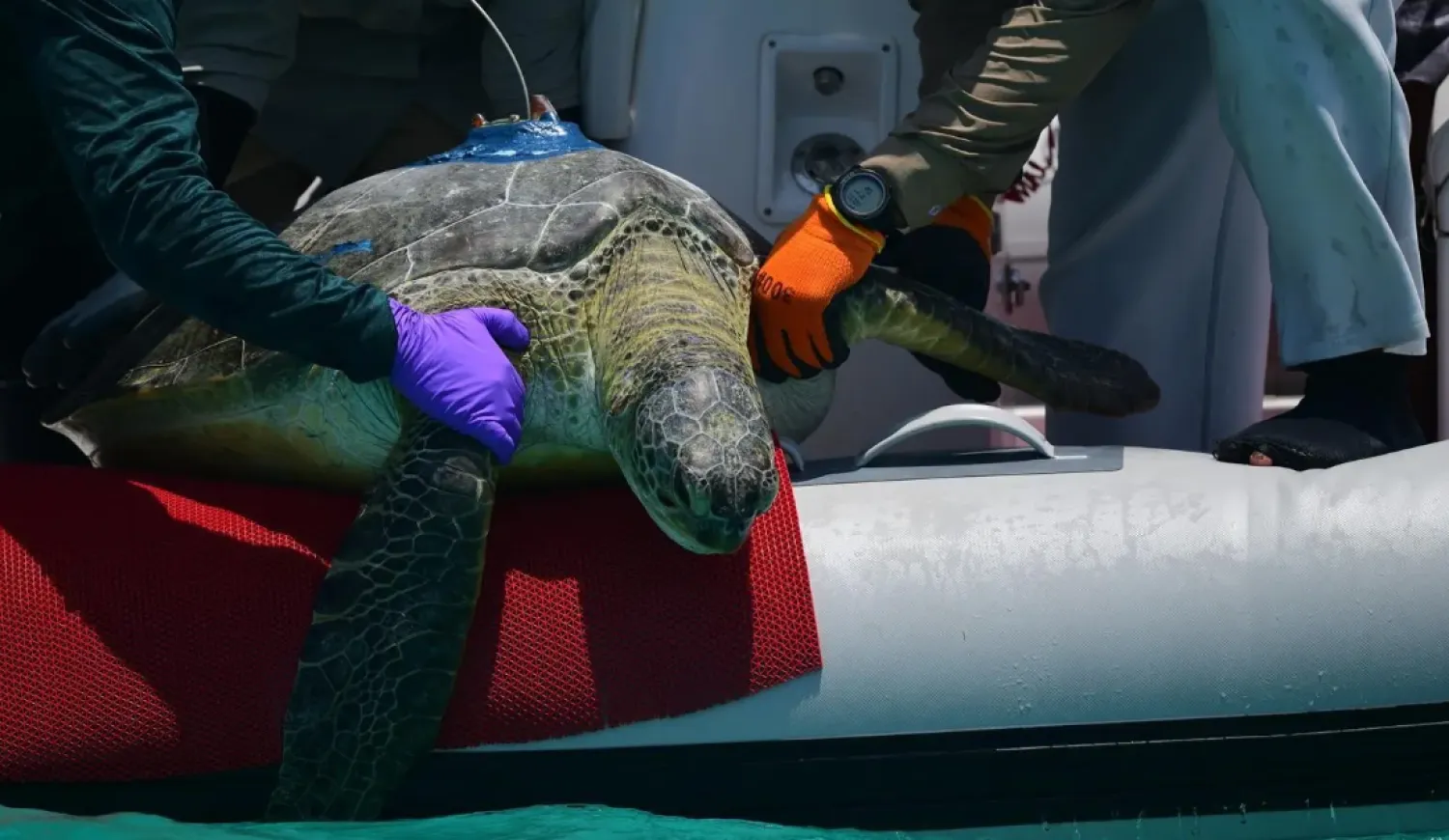
In a milestone for marine conservation, Prince Mohammed bin Salman Royal Reserve has launched a live satellite tracking program for hawksbill and green turtles, including the first known tagging of a pre-nesting, egg-carrying green turtle in the Red Sea, SPA reported.

This data will fill a critical regional knowledge gap and drive unified, cross-border conservation strategies for these globally endangered species.

The team, led by Senior Marine Ecologist at Prince Mohammed bin Salman Royal Reserve Dr. Ahmed Mohammed and KAUST Beacon Development’s Senior Marine Megafauna Specialist Dr. Hector Barrios-Garrido, successfully in-water captured and tagged three critically endangered (IUCN) hawksbill turtles and seven green turtles. The tags transmit real-time movement data identifying foraging grounds, migratory corridors, and most crucially the nesting site of the egg-carrying green turtle, ensuring the appropriate protection and management is in place. The program continues the reserve’s long-term commitment to marine conservation, expanding its turtle nest monitoring and protection program in operation since 2023.

The reserve protects 4,000km² of Red Sea waters, 1.8% of the Kingdom’s marine area, and a coastline of 170km, the longest coastline under management by a single entity in the Kingdom. Linking NEOM and Red Sea Global, this forms an 800km corridor of protected Red Sea coastline. It is a refuge for five of the world’s seven turtle species and a breeding ground for green and hawksbill turtles. The reserve’s ranger teams monitor turtle activity both on shore and at sea, protecting nesting sites critical to natal homing, the biological instinct that drives turtles to return to the same beaches where they were born.

‘’Critically endangered hawksbill turtles face an extremely high risk of extinction in the wild within our lifetime. With fewer than 200 breeding-age females remaining in the Red Sea, their survival depends on closing vital knowledge gaps to enable their effective conservation,” said CEO of Prince Mohammed bin Salman Royal Reserve Andrew Zaloumis.

He added, “Hawksbill turtles hatching on the reserve’s protected beaches range across 438,000 km² of open sea bordered by eight MENA countries, before returning some three decades later to the same sandy beach to lay their eggs. Our satellite tagging and tracking program is a game-changer, providing the real-time data needed to identify their critical staging, foraging, and rookery areas across the Red Sea. The data will support national and regional conservation efforts to drive forward a much-needed unified ecosystem-wide turtle conservation management plan.’’

The reserve’s ongoing turtle conservation supports Saudi Arabia’s commitments under the UNEP Convention on Migratory Species and the IOSEA Marine Turtle Memorandum of Understanding by strengthening habitat protection and regional cooperation through scientific knowledge-sharing across the Red Sea.

Senior Marine Ecologist at the reserve Dr. Ahmed Mohammed stated, ‘’These state-of-the-art, lightweight tags are designed to operate for at least 12 months, providing continuous data that will enable detailed analysis of seasonal patterns, developmental habitats, and contribute valuable insights to regional and global sea turtle research. Additionally, depth sensors will reveal sea grass meadows, essential foraging grounds for green turtles and critical blue carbon sinks."

Despite the recent global reclassification of green turtles by the IUCN, regionally, they are still regarded as vulnerable and conservation dependent. All five marine turtle species resident in the Red Sea are listed under the Convention on Migratory Species (CMS), to which Saudi Arabia became a party in 1979. Turtles remain at risk from entanglement in fishing nets, habitat degradation, and illegal poaching. While these threats are absent within the reserve’s protected waters, ecosystem-wide management strategies that span political boundaries are necessary and the reserve continues to share data with the wider conservation and scientific community and partner with SHAMS on local and regional conservation strategies.

One of eight Royal Reserves, the 24,500 km² Prince Mohammed bin Salman Royal Reserve stretches from the lava plains of the Harrats to the deep Red Sea in the west, connecting NEOM, Red Sea Global, and AlUla. It is home to the Public Investment Fund's (PIF) Wadi Al Disah project and Red Sea Global’s Destination AMAALA.

The reserve encompasses 15 distinct ecosystems. At just 1% of the Kingdom’s terrestrial area and 1.8% of its marine area, it boasts over 50% of the Kingdom’s species, making it one of the most biodiverse protected areas in the Middle East.

Prince Mohammed bin Salman Royal Reserve is one of eight royal reserves established by royal decree and overseen by the Royal Reserves Council chaired by His Royal Highness Prince Mohammed bin Salman bin Abdulaziz Al Saud, Crown Prince and Prime Minister. The reserve’s program is integrated with Saudi Arabia’s wider sustainability and conservation programs, including the Saudi Green and Middle East Green Initiatives.



Thieves Drill into a German Bank Vault and Steal Tens of Millions of Euros Worth of Property

 Police officers stand in front of the savings bank branch in the Buer district in Gelsenkirchen, Germany, Tuesday, Dec. 30, 2025 following a break-in into the bank's vault. (Christoph Reichwein/dpa via AP)
Police officers stand in front of the savings bank branch in the Buer district in Gelsenkirchen, Germany, Tuesday, Dec. 30, 2025 following a break-in into the bank's vault. (Christoph Reichwein/dpa via AP)
TT

Thieves Drill into a German Bank Vault and Steal Tens of Millions of Euros Worth of Property

 Police officers stand in front of the savings bank branch in the Buer district in Gelsenkirchen, Germany, Tuesday, Dec. 30, 2025 following a break-in into the bank's vault. (Christoph Reichwein/dpa via AP)
Police officers stand in front of the savings bank branch in the Buer district in Gelsenkirchen, Germany, Tuesday, Dec. 30, 2025 following a break-in into the bank's vault. (Christoph Reichwein/dpa via AP)

Thieves stole tens of millions of euros worth of property from safety deposit boxes inside a German bank vault that they drilled into Monday during the holiday lull, police said.

Some 2,700 bank customers were affected by the theft in Gelsenkirchen, police and the Sparkasse bank said.

Thomas Nowaczyk, a police spokesperson, said investigators believe the theft was worth between 10 and 90 million euros ($11.7 to 105.7 million).

German news agency dpa reported that the theft could be one of Germany's largest heists.

The bank remained closed Tuesday, when some 200 people showed up demanding to get inside, dpa reported.

A fire alarm summoned police officers and firefighters to the bank branch shortly before 4 a.m. Monday. They found a hole in the wall and the vault ransacked. Police believe a large drill was used to break through the vault's basement wall.

Witnesses told investigators they saw several men carrying large bags in a nearby parking garage over the weekend. Video footage from the garage shows masked people inside a stolen vehicle early Monday, police said.

Gelsenkirchen is about 192 kilometers (119 miles) northwest of Frankfurt.


The Year's First Meteor Shower and Supermoon Clash in January Skies

People look up to the sky from an observatory near the village of Avren, Bulgaria, Aug. 12, 2009. (AP Photo/Petar Petrov, File)
TT

The Year's First Meteor Shower and Supermoon Clash in January Skies

People look up to the sky from an observatory near the village of Avren, Bulgaria, Aug. 12, 2009. (AP Photo/Petar Petrov, File)

The year's first supermoon and meteor shower will sync up in January skies, but the light from one may dim the other.

The Quadrantid meteor shower peaks Friday night into Saturday morning, according to the American Meteor Society. In dark skies during the peak, skygazers typically see around 25 meteors per hour, but this time they'll likely glimpse less than 10 per hour due to light from Saturday's supermoon, The AP news reported.

“The biggest enemy of enjoying a meteor shower is the full moon,” said Mike Shanahan, planetarium director at Liberty Science Center in New Jersey.

Meteor showers happen when speedy space rocks collide with Earth’s atmosphere, burning up and leaving fiery tails in their wake — the end of a “shooting star.” A handful of meteors are visible on any given night, but predictable showers appear annually when Earth passes through dense streams of cosmic debris.

Supermoons occur when a full moon is closer to Earth in its orbit. That makes it appear up to 14% bigger and 30% brighter than the faintest moon of the year, according to NASA. That difference can be tough to notice with the naked eye.

Supermoons, like all full moons, are visible in clear skies everywhere that it's night. The Quadrantids, on the other hand, can be seen mainly from the Northern Hemisphere. Both can be glimpsed without any special equipment.

To spot the Quadrantids, venture out in the early evening away from city lights and watch for fireballs before the moon crashes the party, said Jacque Benitez with the Morrison Planetarium at the California Academy of Sciences. Skygazers can also try looking during early dawn hours on Sunday.

Wait for your eyes to get used to the darkness, and don’t look at your phone. The space rocks will look like fast-moving white dots and appear over the whole sky.

Meteor showers are named for the constellation where the fireballs appear to come from. The Quadrantids — space debris from the asteroid 2003 EH1 — are named for a constellation that's no longer recognized.

The next major meteor shower, called the Lyrids, is slotted for April.

Supermoons happen a few times a year and come in groups, taking advantage of the sweet spot in the moon’s elliptical orbit. Saturday night’s event ends a four-month streak that started in October. There won't be another supermoon until the end of 2026.


New Maritime Theater in Jazan to Host the City's Festival Opening

The site also includes various amenities, such as shopping zones, kiosks for dining, an art gallery - SPA
TT

New Maritime Theater in Jazan to Host the City's Festival Opening

The site also includes various amenities, such as shopping zones, kiosks for dining, an art gallery - SPA

The Jazan city theater on the southern corniche will host the opening ceremony of the Jazan Festival 2026 on Friday. This event will take place at a 35-square-kilometer site that features the Kingdom's largest maritime theater, SPA reported.

The theater accommodates more than 10,000 spectators and features five VIP areas. To ensure a smooth experience, the venue offers parking for over 9,000 vehicles, providing easy access during peak times.

Built specifically for the festival, the stage meets stringent safety and technical standards, providing a high-quality audiovisual experience against the stunning backdrop of the Red Sea.

The site also includes various amenities, such as shopping zones, kiosks for dining, an art gallery, a play area for children, a bird garden, and a regional museum, showcasing the region's history and culture.

This temporary maritime theater aims to provide a cohesive experience, integrating entertainment, culture, shopping, and services in one location, further establishing Jazan as a year-round destination for tourism and entertainment.