


Cypriot Fishermen Battle Invasive Lionfish and Turn Them into a Delicacy

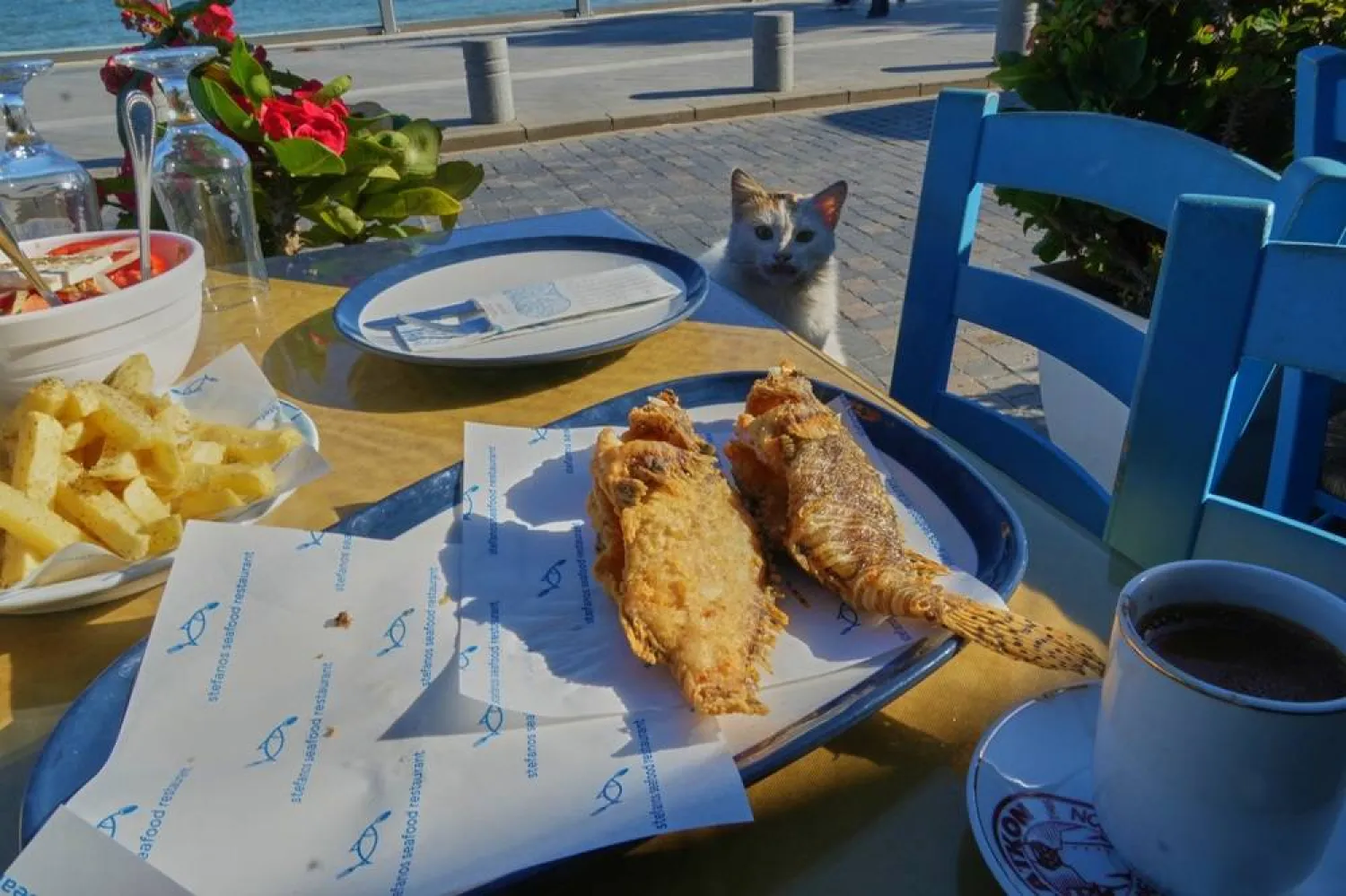
 A cat stands next to a table with fried lionfish at Stefanos restaurant in Larnaca, Cyprus, in the eastern Mediterranean, Thursday, Dec. 18, 2025. (AP)
A cat stands next to a table with fried lionfish at Stefanos restaurant in Larnaca, Cyprus, in the eastern Mediterranean, Thursday, Dec. 18, 2025. (AP)
TT

Cypriot Fishermen Battle Invasive Lionfish and Turn Them into a Delicacy

 A cat stands next to a table with fried lionfish at Stefanos restaurant in Larnaca, Cyprus, in the eastern Mediterranean, Thursday, Dec. 18, 2025. (AP)
A cat stands next to a table with fried lionfish at Stefanos restaurant in Larnaca, Cyprus, in the eastern Mediterranean, Thursday, Dec. 18, 2025. (AP)

Photis Gaitanos’ rough fingers adroitly untangle the venomous spikes of a lionfish from a net, throwing the exotic-looking creature into an ice-filled rubber bin along with other fish from the day’s catch.

Unlike a few years ago when he would have mostly caught local staples as sea bream, red mullet or bass, the veteran fisherman now hunts for the invasive species that made its way from the Red Sea to the warming waters of the Mediterranean,

Lionfish, with their red and orange-hued stripes and antennae-like barbs that menacingly ward off enemies, threaten to decimate indigenous fish stocks, wreaking havoc on the livelihoods of the roughly 150 professional fishermen in Cyprus.

The prickly fish has even made its way as far north as the Ionian Sea, where Italian authorities have asked the public to photograph and report sightings.

The East Mediterranean has also seen another invasive Red Sea fish in the last decade: the silver-cheeked toadfish. Known as an eating machine whose powerful jaws cut through fishing nets, decimating fishermen’s catch, it has no natural predators off Cyprus, allowing its population to explode.

That toadfish also produces a lethal toxin, making it inedible.

Warmer waters are the culprit

Gaitanos, the 60-year-old fisherman, has fished for years in an area a few kilometers off the coastal town of Larnaca, once famous for its fishing bounty. Now, he says, it’s been more than two years since he’s caught a red mullet, a consumer favorite.

"I have been practicing this profession for 40 years. Our income, especially since these two foreign species appeared, has become worse every year. It is now a major problem (affecting) the future of fishing," he said. "How can it be dealt with?"

Europe’s General Fisheries Commission for the Mediterranean says with the sea warming some 20% faster than the global average, the presence of invasive species "is progressively increasing in the western basin."

Models show that warmer seas as a result of climate change could see lionfish swarm the entire Mediterranean by the century’s end. Warmer waters and an expanded Suez Canal "have opened the floodgates" to Indo-Pacific species in general, according to Cyprus’ Fisheries Department.
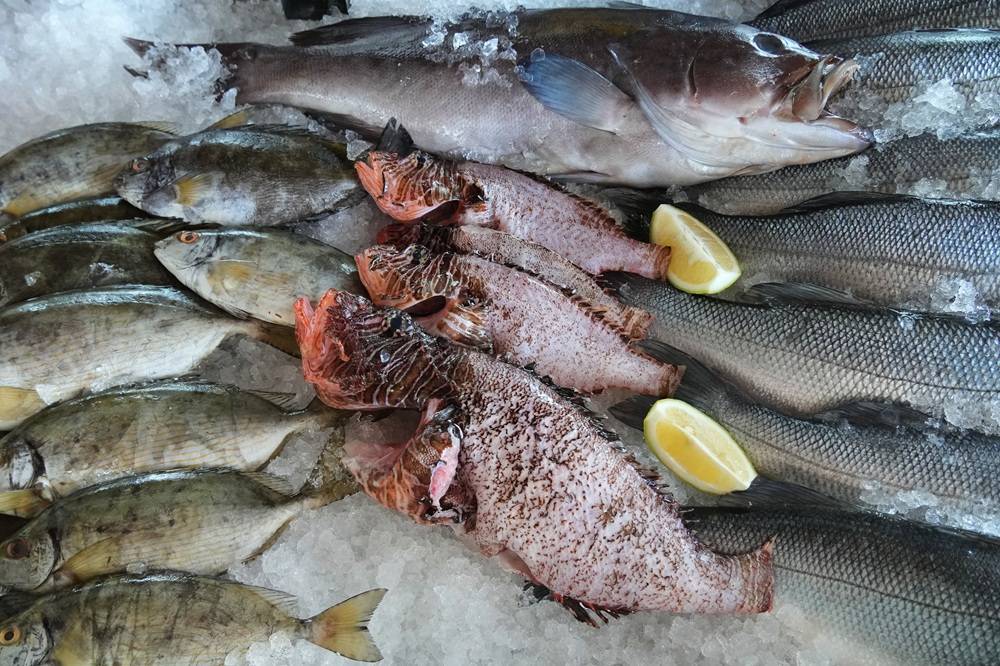
Lionfish, center, are seen at Stefanios restaurant in Larnaca, Cyprus, in the eastern Mediterranean, Thursday, Dec. 18, 2025. (AP)

The European Union’s Fisheries Commissioner Costas Kadis, a Cypriot himself, told The Associated Press that more frequent and intense extreme weather, often linked to climate change, could make the Mediterranean more hospitable to invasive species.

And that’s taking a heavy toll on Europe’s fishing industry as fishermen’s catches diminish while their costs shoot up as a result of repairs to fishing gear damaged by the powerful intruders.

"The native marine biodiversity of a specific region, as in the case of Cyprus, faces heightened competition and pressure, with implications for local ecosystems and industries dependent on them," said Kadis.

Fishermen cry for help

Gaitanos, who inherited his father’s boat in 1986, is not sure the fishermen’s grievances are being handled in a way that can stave off the profession’s decline.

"We want to show the European Union that there’s a big problem with the quantity of the catch as well as the kind of fish caught, affected by the arrival of these invasive species and by climate change," he said.

Some EU-funded compensation programs have been enacted to help fishermen. The latest, enforced last year, pays fishermen about 4.73 euros ($5.5) per kilogram (2.2 pounds) to catch toadfish to control their number. The toadfish are then sent to incinerators.

Another project, RELIONMED, which began in 2017, recruits some 100 scuba divers to cull lionfish around wrecks, reefs and marine protected areas. The Cyprus Fisheries Department says surveys show that frequent culls could buy time for native species to recover, but it’s not a permanent fix.

Some try eating the problem

What local fishermen are hoping will catch on with the fish-loving public is a new campaign to serve lionfish as a delicacy after its poisonous spines are carefully removed.

Kadis, the EU Fisheries commissioner, said a social media campaign that began in 2021, #TasteTheOcean, had top European chefs and influencers plugging invasive species as a tasty alternative to the more commonly consumed fish. Renowned Cypriot chef Stavris Georgiou worked up a lionfish recipe of his own.

For most Cypriots, local taverns with their rich meze menus that feature numerous plates different fish is the way to go. Although eating lionfish has been slow to catch on, many tavernas and fish restaurants have started to introduce it as part of their menu.

The bonus is that lionfish is now priced competitively compared to more popular fish like sea bass. At the Larnaca harbor fish market, lionfish cost less than half as much as more popular fish like sea bass.

"By incorporating invasive species such as lionfish into our diet, we can turn this challenge into an opportunity for the fisheries sector and at the same time help limit the environmental threat caused by these species," Kadis said

Stephanos Mentonis, who runs a popular fish tavern in Larnaca, has included lionfish on his meze menu as a way to introduce the fish to a wider number of patrons.

Mentonis, 54, says most of his customers aren’t familiar with lionfish. But its meat is fluffy and tender, and he says it can hold up against perennial tavern favorites like sea bream.

"When they try it, it’s not any less tasty than any other fish," he said.


Deep-sea Fish Break the Mold with Novel Visual System

A close-up showing the shiny silver-green photophores (light organs) on the lower head of the deep-sea fish Maurolicus muelleri from the Red Sea, seen in this photograph released on February 11, 2026. Dr. Wen-Sung Chung/Handout via REUTERS
TT

Deep-sea Fish Break the Mold with Novel Visual System

A close-up showing the shiny silver-green photophores (light organs) on the lower head of the deep-sea fish Maurolicus muelleri from the Red Sea, seen in this photograph released on February 11, 2026. Dr. Wen-Sung Chung/Handout via REUTERS

For more than a century, biology textbooks have stated that vision among vertebrates - people included - is built from two clearly defined cell types: rods for processing dim light and cones for bright light and color. New research involving deep-sea fish shows this tidy division is, in reality, not so tidy.

Scientists have identified a new type of visual cell in deep-sea fish that blends the shape and form of rods with the molecular machinery and genes of cones. This hybrid type of cell, adapted for sight in gloomy light conditions, was found in larvae of three deep-sea fish species in the Red Sea, Reuters reported.

The species studied were: a hatchetfish, with the scientific name Maurolicus mucronatus; a lightfish, named Vinciguerria mabahiss; and a lanternfish, named Benthosema pterotum. The hatchetfish retained the hybrid cells throughout its life. The other two shifted to the usual rod-cone dichotomy in adulthood.

All three are small, with adults measuring roughly 1-3 inches (3-7 cm) long and the larvae much littler. They inhabit a marine realm of twilight conditions, with sunlight struggling to penetrate into the watery depths.

The vertebrate retina, a sensory membrane at the back of the eye that detects light and converts it into signals to the brain, possesses two main types of light-sensitive visual cells, called photoreceptors. They are named for their shape: rods and cones.

"The rods and cones slowly change position inside the retina when moving between dim and bright conditions, which is why our eyes take time to adjust when we flick on the light switch on our way to the restroom at night," said Lily Fogg, a postdoctoral researcher in marine biology at the University of Helsinki in Finland and lead author of the research published in the journal Science Advances.

"We found that, as larvae, these deep-sea fish mostly use a mix-and-match type of hybrid photoreceptor. These cells look like rods - long, cylindrical and optimized to catch as many light particles - photons - as possible. But they use the molecular machinery of cones, switching on genes usually found only in cones," Fogg said.

The researchers examined the retinas of fish larvae caught at depths from 65 to 650 feet (20 to 200 meters). In the type of dim environment they inhabit, rod and cone cells both are usually engaged in the vertebrate retina, but neither works very well. These fish display an evolutionary remedy.

"Our results challenge the longstanding idea that rods and cones are two fixed, clearly separated cell types. Instead, we show that photoreceptors can blend structural and molecular features in unexpected ways. This suggests that vertebrate visual systems are more flexible and evolutionarily adaptable than previously thought," Fogg said.

"It is a very cool finding that shows that biology does not fit neatly into boxes," said study senior author Fabio Cortesi, a marine biologist and neuroscientist at the University of Queensland in Australia. "I wouldn't be surprised if we find these cells are much more common across all vertebrates, including terrestrial species."

All three species emit bioluminescence using small light-emitting organs on their bodies, mostly located on the belly. They produce blue-green light that blends with the faint background light from the sun above. This strategy, called counterillumination, is a common form of camouflage in the deep sea to avoid predators.

"Small fish like these fuel the open ocean. They are plentiful and serve as food for many larger predatory fishes, including tuna and marlin, marine mammals such as dolphins and whales, and marine birds," Cortesi said.

These kinds of fish also engage in one of the biggest daily migrations in the animal kingdom. They swim near the surface at night to feed in plankton-rich waters, then return to the depths - 650 to 3,280 feet (200 to 1,000 meters) - during daytime to avoid predation.

"The deep sea remains a frontier for human exploration, a mystery box with the potential for significant discoveries," Cortesi said. "We should look after this habitat with the utmost care to make sure future generations can continue to marvel at its wonders."


Japan City Gets $3.6 Mn Donation in Gold to Fix Water System

FILE PHOTO: Factories line the port of Osaka, western Japan October 23, 2017. REUTERS/Thomas White/File Photo
TT

Japan City Gets $3.6 Mn Donation in Gold to Fix Water System

FILE PHOTO: Factories line the port of Osaka, western Japan October 23, 2017. REUTERS/Thomas White/File Photo

Osaka has received an unusual donation -- 21 kilograms of gold -- to pay for the maintenance of its ageing water system, the Japanese commercial hub announced Thursday.

The donation worth $3.6 million was made in November by a person who a month earlier had already given $3,300 in cash for the municipal waterworks, Osaka Mayor Hideyuki Yokoyama told a press conference.

"It's an absolutely staggering amount," said Yokoyama, adding that he was lost for words to express his gratitude.

"I was shocked."

The donor wished to remain anonymous, AFP quoted the mayor as saying.

Work to replace water pipes in Osaka, a city of 2.8 million residents, has hit a snag as the actual cost exceeded the planned budget, according to local media.


Thai Cops Go Undercover as Lion Dancers to Nab Suspected Thief

People gather to watch performers outside Emsphere shopping mall on the first day of the Lunar New Year of the Horse, in Bangkok on February 17, 2026. (Photo by Lillian SUWANRUMPHA / AFP)
TT

Thai Cops Go Undercover as Lion Dancers to Nab Suspected Thief

People gather to watch performers outside Emsphere shopping mall on the first day of the Lunar New Year of the Horse, in Bangkok on February 17, 2026. (Photo by Lillian SUWANRUMPHA / AFP)

Thai police donned a lion dance costume during this week's Lunar New Year festivities to arrest a suspect accused of stealing about $64,000 worth of Buddhist artifacts, police said Thursday.

Officers dressed as a red-and-yellow lion made the arrest on Wednesday evening after receiving a report earlier this month of a home burglary in the suburbs of the capital, Bangkok, AFP reported.

Capital police said the reported break-in involved "numerous Buddhist objects and two 12-inch Buddha statues", along with evidence of repeated attempts to enter the house, according to a statement.

With few leads, police kept watch for weeks before hatching an unusual plan to join a lion dance procession at a nearby Buddhist temple.

"Officers gradually moved closer to the suspect before arresting him," police said.

A video released by police showed the festive lion dancers approaching the suspect before an officer suddenly emerged from the head of the costume and, with help from colleagues, pinned him to the ground.

Police estimated the value of the stolen items at around two million baht ($64,000).

The suspect, a 33-year-old man, has a criminal record involving drug offences and theft, police added.
