

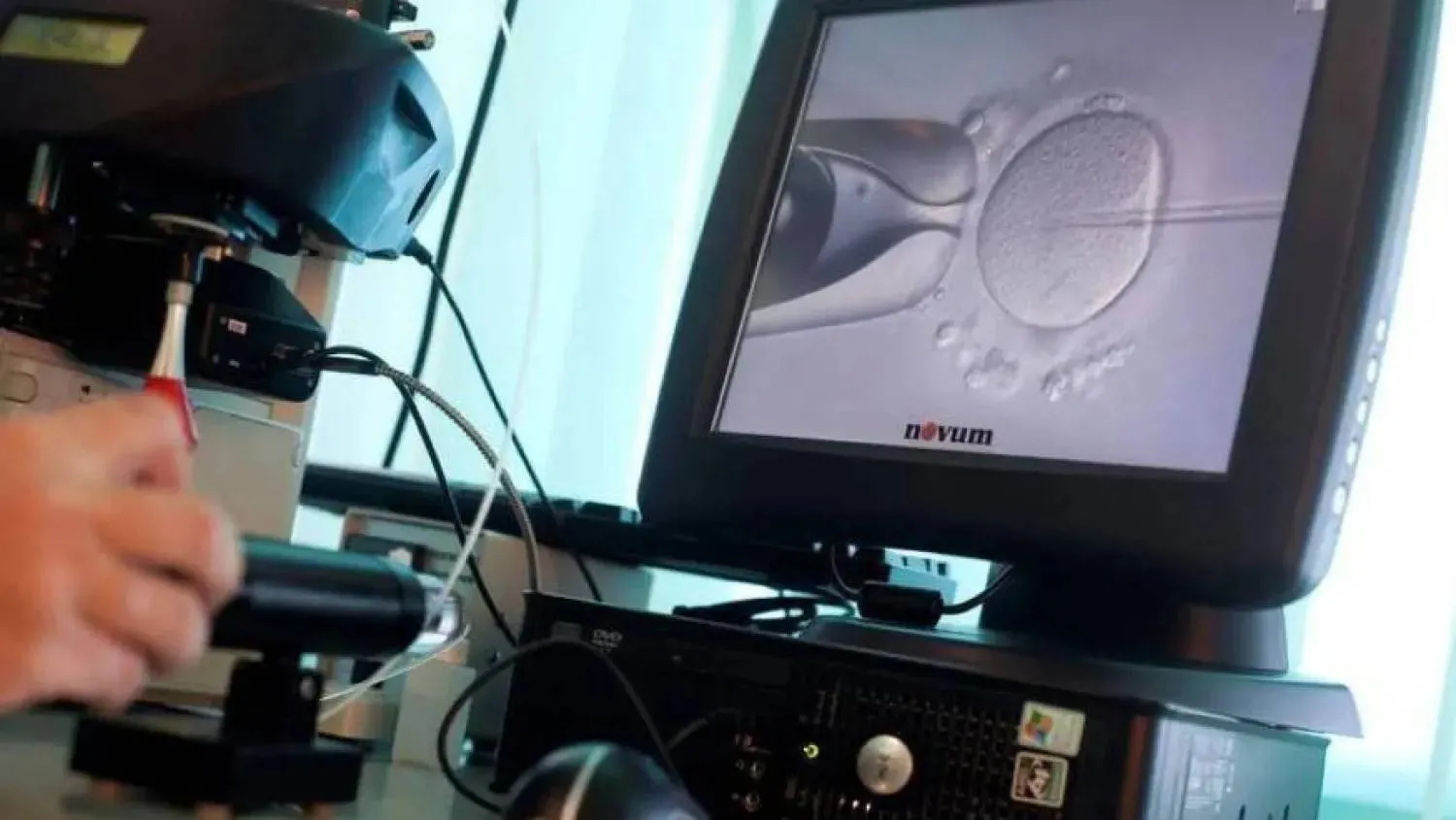

Rejuvenated Human Eggs… Scientists Revolutionize IVF Success

Egg quality is the primary cause of IVF failure and miscarriage in older women (Reuters) 
TT

Rejuvenated Human Eggs… Scientists Revolutionize IVF Success

Egg quality is the primary cause of IVF failure and miscarriage in older women (Reuters) 

German scientists claim to have “rejuvenated” human eggs for the first time in an advance that they predict could revolutionize IVF success rates for older women.

The groundbreaking research suggests that an age-related defect that causes genetic errors in embryos could be reversed by supplementing eggs with a crucial protein, according to The Guardian.

When eggs donated by fertility patients were given microinjections of the protein, they were almost half as likely to show the defect compared with untreated eggs.

If confirmed in more extensive trials, the approach has the potential to improve egg quality, which is the primary cause of IVF failure and miscarriage in older women.

The decline in egg quality is the main reason IVF success rates drop steeply with female age and is why the risk of chromosome disorders such as Down’s syndrome increases with maternal age.

“Overall we can nearly halve the number of eggs with [abnormal] chromosomes. That’s a very prominent improvement,” said Prof Melina Schuh, a director at the Max Planck Institute for Multidisciplinary Sciences in Göttingen and a co-founder of Ovo Labs, which is aiming to commercialize the technique.

“Most women in their early 40s do have eggs, but nearly all of the eggs have incorrect chromosome numbers,” added Schuh, whose lab has been investigating egg biology for the past two decades. “This was the motivation for wanting to address this problem.”

The latest approach targets a vulnerability in eggs linked to a process called meiosis, in which sex cells (eggs or sperm) jettison half their genetic material so they can join together to make an embryo.

In eggs, this requires 23 pairs of X-shaped chromosomes to align along a single axis in the cell. On fertilization, the cell divides causing the chromosome pairs to be – ideally – neatly snapped down their centers to create a cell with precisely 23 single chromosomes from the mother, the rest being delivered by the sperm.

However, in older eggs the chromosome pairs tend to loosen at their midpoint, becoming slightly unstuck or detaching entirely before fertilization.

In this scenario, the X-shaped structures fail to line up properly and move around chaotically in the cell, so when the cell divides they are not snapped symmetrically.

This results in an embryo with too many or too few chromosomes.

Schuh and colleagues previously found that a protein, Shugoshin 1, which appears to act as a glue for the chromosome pairs, declines with age. In the latest experiments in mouse and human eggs, they found that microinjections of Shugoshin 1 appeared to reverse the problem of chromosome pairs separating prematurely.

Using eggs donated by patients at the Bourn Hall fertility clinic in Cambridge, they found that the number showing the defect decreased from 53% in control eggs to 29% in treated eggs. When they looked only at eggs from women over 35 years of age, a similar trend was seen (65% compared with 44%), although this result was not statistically significant, which the scientists said was probably due to them only having treated nine eggs in this age range.

Dr Agata Zielinska, a co-founder and co-CEO of Ovo Labs, said: “Currently, when it comes to female factor infertility, the only solution that’s available to most patients is trying IVF multiple times so that, cumulatively, your likelihood of success increases. What we envision is that many more women would be able to conceive within a single IVF cycle.”

The findings will be presented at the British Fertility Conference in Edinburgh on Friday and have been published as a preprint paper on the Biorxiv website.



Some Supplements Can Make Your Medication Less Effective

Some vitamin and mineral supplements can interfere with absorption of medications (Oklahoma State University) 
TT

Some Supplements Can Make Your Medication Less Effective

Some vitamin and mineral supplements can interfere with absorption of medications (Oklahoma State University) 

Health experts warned that some supplements can interact with certain medications and reduce their effectiveness, according to Eating Well website.

While these supplements are usually sold over-the-counter, taking them without asking a health care provider can have dangerous impact on your health.

Naturopathic doctor Jacob Wolf said that for instance, some vitamin and mineral supplements can interfere with absorption of medications.

Other supplements can bind with medications, preventing the drug from being utilized in the body, or they may be metabolized by the same or similar pathways as medications, explains Wolf. That can have a dangerous impact on your health.

Top offenders include calcium, magnesium, iron, fiber, activated charcoal and vitamins C and K.

Minerals like calcium, magnesium and iron can bind with medications, especially levothyroxine, a drug used to treat hypothyroidism, said Wolf.

“This can impact how levothyroxine is utilized in the body, adversely affecting treatment,” he explained.

These minerals can also interact with antibiotics in the tetracycline and fluoroquinolone class, said pharmacist Amanda Corbett.

Taking these mineral supplements at the same time as antibiotics may reduce the bioavailability of the antibiotic, creating risks like bacterial resistance or ineffective treatment.

And while scientists affirm fiber is an important nutrient for digestive regularity, healthy cholesterol levels and blood sugar management, supplementing isn’t always a great idea, as large doses can impact the absorption of certain medications.

Fiber-rich foods are a cornerstone of blood sugar management, even for those taking blood sugar–lowering medications, like metformin.

Fiber may also impair the effectiveness of other drugs, including digoxin (which treats certain heart conditions) and levothyroxine for hypothyroidism, Wolf said.

Therefore, if you do choose to take a fiber supplement, Wolf recommended speaking with your health care provider about spacing out your fiber and medication doses.

As for activated charcoal, it is a form of carbon that is used in the emergency room to treat the ingestion of toxic drugs and poisons.

“Activated charcoal acts like a sponge and can bind to many medications. It is best to completely avoid activated charcoal if on any life-critical medication,” said Wolf.

For Vitamin C, it is an important antioxidant that protects cells from free radical damage and supports proper immune system function.

However, if you are undergoing chemotherapy treatment for cancer, experts strongly caution against taking vitamin C supplements.

“Vitamin C can lead to certain chemotherapies being less effective or ineffective in treating cancer,” said Corbett.

Vitamin E, another antioxidant, can also interfere with chemotherapy’s effectiveness.

If taking Vitamin K, which is a fat-soluble vitamin that helps blood clot and shores up bone health, you should know that it can reduce the effectiveness of a blood-thinning medication called warfarin (Coumadin).

That, in turn, can make blood more likely to clot, which can lead to a heart attack or stroke.

If you are taking warfarin, you don’t necessarily need to avoid vitamin K, but it is critical to keep the amount you consume—from both foods and supplements—consistent to avoid clotting problems.

Experts advise that to take supplements safely, consult with your health care provider.

Many supplements can interact with medications, and so it’s critical to connect with your prescribing health care provider to make sure that the supplements you’re taking play nice with your medications.

Also, look for those that have been independently tested in a laboratory, recommended Corbett.

Experts say you should also know how much to take. Supplement dosages are listed on the label, but they aren’t standardized.

That means they can vary from product to product, and may far exceed safe levels.


Swiss Author Erich von Daeniken Dies at 90

Erich von Daeniken, co-founder and co-owner of Mystery Park, poses in front of the Panorama Tower at Mystery Park in Interlaken, Wednesday, April 23, 2003. (Gaetan Ball)/Keystone via AP, File)
TT

Swiss Author Erich von Daeniken Dies at 90

Erich von Daeniken, co-founder and co-owner of Mystery Park, poses in front of the Panorama Tower at Mystery Park in Interlaken, Wednesday, April 23, 2003. (Gaetan Ball)/Keystone via AP, File)

Swiss author Erich von Daeniken, who helped popularize the idea that astronauts from outer space visited Earth ​to help lay the foundations for human civilization, has died aged 90.

Swiss media including national broadcaster SRF reported his death, and a note on his website said it occurred on Saturday, The AP news reported.

Von Daeniken rose to ‌prominence with ‌his 1968 book "Chariots of ‌the ⁠Gods?" ​which posited ‌that structures such as the pyramids of Ancient Egypt, Britain's Stonehenge and Peru's Nazca lines were too advanced for their time, and needed outside help.

"In my opinion, ancient structures were made ⁠by humans, not by the extraterrestrials, but it was ‌the extraterrestrials who guided them, ‍who them, ‍who gave them the knowledge how to ‍do it," von Daeniken says in a video on his YouTube channel.

His theories were controversial with historians, scientists and fellow ​writers. But they were popular, and his books, which included "The Gods were ⁠Astronauts", sold nearly 70 million copies worldwide, appearing in more than 30 languages, SRF said.

Von Daeniken argued that ancient religions, myths and art contained evidence that millennia ago, the ancestors of modern humans had made contact with advanced extraterrestrial beings who appeared godlike to them and enabled them to progress.

One ‌day, von Daeniken said, those beings would return.


Massive Iconic Iceberg 'on Verge of Complete Disintegration'

Iceberg A23a has turned blue and is “on the verge of complete disintegration,” NASA said. This photo was taken on December 26, 2025 (NASA)
TT

Massive Iconic Iceberg 'on Verge of Complete Disintegration'

Iceberg A23a has turned blue and is “on the verge of complete disintegration,” NASA said. This photo was taken on December 26, 2025 (NASA)

One of the largest and oldest icebergs ever tracked by scientists has turned blue and is “on the verge of complete disintegration,” NASA said on Thursday.

A23a, a massive wall of ice that was once twice the size of Rhode Island, is drenched in blue meltwater as it drifts in the South Atlantic off the eastern tip of South America, NASA said in a new release, according to CBS News.

A NASA satellite captured an image of the fading berg the day after Christmas, showing pools of blue meltwater on its surface. A day later, an astronaut aboard the International Space Station captured a photograph showing a closer view of the iceberg, with an even larger melt pool.

The satellite image suggests that the A23a has also “sprung a leak,” NASA said, as the weight of the water pooling at the top of the berg punched through the ice.

Scientists say all signs indicate the so-called “megaberg” could be just days or weeks from totally disintegrating as it rides currents that are pushing it toward even warmer waters.

Warmer air temperatures during this season could also speed up A23a's demise in an area that ice experts have dubbed a “graveyard” for icebergs.

“I certainly don't expect A-23A to last through the austral summer,” retired University of Maryland, Baltimore County scientist Chris Shuman said in a statement.

Blue and white linear patterns visible on A23a are likely related to striations, which are ridges that were scoured hundreds of years ago when the iceberg was part of the Antarctic bedrock, NASA said.

“The striations formed parallel to the direction of flow, which ultimately created subtle ridges and valleys on the top of the iceberg that now direct the flow of meltwater,” said Walt Meier, a senior research scientist at the National Snow & Ice Data Center.

The berg detached from Antarctica in 1986. It remained stuck for over 30 years before finally breaking free in 2020.

According to current estimates from the US National Ice Center, in early January 2026, the berg's area is 1,182 square kilometers -- still larger than New York City but a fraction of its initial size.