


Astronomers Spot White Dwarf Star Creating a Colorful Shockwave

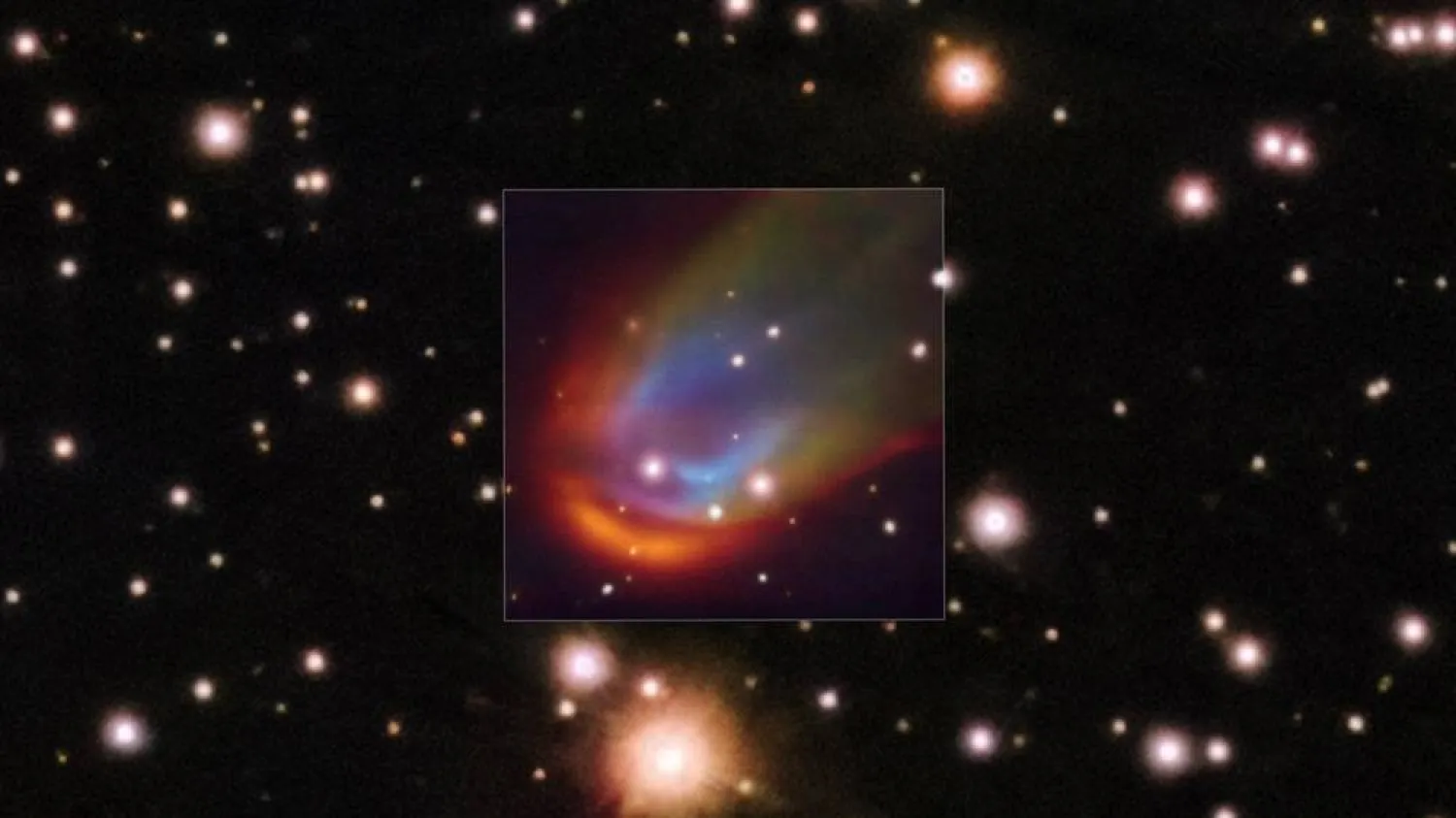
The central square image, taken with the MUSE instrument on ESO's Very Large Telescope, shows shock waves around the dead star RXJ0528+2838. (European Southern Observatory (ESO)/K. Ilkiewicz and S. Scaringi et al./Handout via Reuters)
TT

Astronomers Spot White Dwarf Star Creating a Colorful Shockwave

The central square image, taken with the MUSE instrument on ESO's Very Large Telescope, shows shock waves around the dead star RXJ0528+2838. (European Southern Observatory (ESO)/K. Ilkiewicz and S. Scaringi et al./Handout via Reuters)

Astronomers have observed a white dwarf - a highly compact Earth-sized stellar ember - that is creating a colorful shockwave as it moves through space, leaving them searching for an explanation.

The highly magnetized white dwarf is gravitationally bound to another star in what is called a binary system. The white dwarf is siphoning gas from its companion as the two orbit close to each other. The system is located in the Milky Way about 730 light-years from Earth - relatively nearby in cosmic terms - in the constellation Auriga.

A light-year is the distance light travels in a year, 5.9 trillion miles (9.5 trillion km).

The shockwave - more specifically a bow shock - caused by the white dwarf was observed using the European Southern Observatory's Chile-based Very Large Telescope. The shockwave was seen in an image released by the scientists glowing in various colors produced when material flowing outward from the white dwarf collided with interstellar gas.

"A shockwave ‌is created when ‌fast-moving material plows into surrounding gas, suddenly compressing and heating it. A ‌bow shock ⁠is the curved ‌shock front that forms when an object moves rapidly through space, similar to the wave in front of a boat moving through water," said astrophysicist Simone Scaringi of Durham University in England, co-lead author of the study published on Monday in the journal Nature Astronomy.

"The colors come from interstellar gas that is being heated and excited by the shock. Different chemical elements glow at specific colors when this happens," Scaringi added.

In this shockwave, a red hue represented hydrogen, green represented nitrogen and blue represented oxygen residing in interstellar space.

A handful of other white dwarfs have been observed creating shockwaves. But all of those were ⁠surrounded by disks of gas siphoned from a binary partner. Although this white dwarf is siphoning gas from its companion, it lacks any such disk and ‌is releasing gas into space for unknown reasons.

White dwarfs are among the ‍universe's most compact objects, though not as dense as ‍black holes.

Stars with up to eight times the mass of the sun appear destined to end up as ‍a white dwarf. They eventually burn up all the hydrogen they use as fuel. Gravity then causes them to collapse and blow off their outer layers in a "red giant" stage, eventually leaving behind a compact core - the white dwarf.

"There are plenty of white dwarfs out there, as these are the most common endpoints of stellar evolution," Scaringi said.

The sun appears fated to end its existence as a white dwarf, billions of years from now.

This white dwarf has a mass comparable to the sun contained in a body slightly larger than Earth. Its binary companion is ⁠a type of low-mass star called a red dwarf that is about a tenth the mass of the sun and thousands of times less luminous. It orbits the white dwarf every 80 minutes, with the two extremely close to each other - approximately the distance between the moon and Earth.

The gravitational strength of the white dwarf is pulling gas off the red dwarf. This siphoned material is being pulled into the white dwarf along its strong magnetic field, eventually landing at its magnetic poles. While this process releases energy and radiation, it cannot account for the outflow of material needed to produce the observed shockwave, Scaringi said.

"Every mechanism with outflowing gas we have considered does not explain our observation, and we still remain puzzled by this system, which is why this result is so interesting and exciting," Scaringi said.

"The shape and length of the (shockwave) structure show that this process has been ongoing for at least about 1,000 years, making it long-lived rather than a one-off event," Scaringi added.

The ‌researchers took note of the aesthetics of the colorful shockwave.

"Beyond the science, it's a striking reminder that space is not empty or static as we may naively imagine it: it's dynamic and sculpted by motion and energy," Scaringi said.



SpaceX Launches 12th Long-duration Crew to ISS

NASA’s Crew-12 members, Russian cosmonaut Andrey Fedyaev, NASA astronauts Jack Hathaway, Jessica Meir, and ESA astronaut Sophie Adenot walk out of the Operations & Checkout Building at the Kennedy Space Center before transport to Launch Complex 40, ahead of their launch to the International Space Station, in Cape Canaveral, Florida, US, February 13, 2026. REUTERS/Steve Nesius
TT

SpaceX Launches 12th Long-duration Crew to ISS

NASA’s Crew-12 members, Russian cosmonaut Andrey Fedyaev, NASA astronauts Jack Hathaway, Jessica Meir, and ESA astronaut Sophie Adenot walk out of the Operations & Checkout Building at the Kennedy Space Center before transport to Launch Complex 40, ahead of their launch to the International Space Station, in Cape Canaveral, Florida, US, February 13, 2026. REUTERS/Steve Nesius

A SpaceX rocket lifted off from Florida early on Friday with a crew of two US NASA astronauts, a French astronaut and a Russian cosmonaut headed to the International Space Station for an eight-month science mission in Earth orbit.

The two-stage Falcon 9 rocket, topped with an autonomously operated Crew Dragon capsule dubbed Freedom, was launched from the Cape Canaveral Space Force Station, along Florida's Atlantic Coast, at about 5:15 a.m. EST (1015 GMT).

A live NASA-SpaceX webcast showed the 25-story-tall vehicle rising from the launch tower as its nine Merlin engines roared to life, gulping 700,000 gallons of fuel per second, emitting clouds of vapor and a reddish fireball that lit up the predawn sky, Reuters reported.

The four crew were set to ‌reach the space ‌station on Saturday afternoon after a 34-hour flight, docking with ‌the orbiting ⁠laboratory platform some ⁠250 miles (420 km) above Earth.

The mission, designated Crew-12, marks the 12th long-duration ISS team that NASA has flown aboard a SpaceX launch vehicle since the private rocket venture founded in 2002 by billionaire Elon Musk began sending US astronauts to orbit in May 2020.

Crew-12 was led by Jessica Meir, 48, a veteran astronaut and marine biologist on her second trip to the space station, nearly seven years after making history with NASA colleague Christina Koch by ⁠completing history's first all-female spacewalk.

Joining her was Jack Hathaway, 43, ‌a former US Navy fighter pilot and rookie ‌astronaut; European Space Agency astronaut Sophie Adenot, 43, a master helicopter pilot from France; and Russian cosmonaut ‌Andrey Fedyaev, a former military pilot on his second mission to the ISS.

Upon ‌arrival, the team will get busy with a host of scientific, medical and technical research tasks in microgravity, according to NASA.

Those include studies of pneumonia-causing bacteria to improve treatments on Earth, and experiments with plant and nitrogen-fixing microbe interactions to boost food production in space.

Crew-12 will be welcomed aboard ‌the space station by three current ISS occupants - NASA astronaut Chris Williams and Roscosmos cosmonauts Sergey Kud-Sverchkov and Sergei Mikaev.

Four Crew-11 ⁠members who were ⁠supposed to have stayed aboard until the arrival of Crew-12 departed a few weeks early, when an undisclosed serious health condition affecting one forced an unprecedented medical evacuation flight home in mid-January.

The ISS, which spans the length of a football field and ranks as the largest human-made object in space, has been continuously operated by a US-Russian-led consortium that includes Canada, Japan and 11 European countries.

The first hardware for the outpost was launched more than a quarter century ago. It was conceived as part of a multinational venture to improve ties between Washington and Moscow following the Soviet Union's collapse and the end of Cold War rivalries that spurred the original US-Soviet space race in the 1950s and 1960s.

NASA has said it is committed to keeping the space station operating until the end of 2030.


Saudi Arabia: King Abdulaziz Royal Reserve Plants 10,000 Native Trees to Combat Desertification

The project engaged 300 volunteers from government agencies and educational institutions to rehabilitate local ecosystems. SPA
TT

Saudi Arabia: King Abdulaziz Royal Reserve Plants 10,000 Native Trees to Combat Desertification

The project engaged 300 volunteers from government agencies and educational institutions to rehabilitate local ecosystems. SPA

The King Abdulaziz Royal Reserve Development Authority, in partnership with the Green Dahna Association, has launched an initiative to plant 10,000 Arta trees in the Al-Dahna sands.

The project engaged 300 volunteers from government agencies and educational institutions to rehabilitate local ecosystems and promote a culture of environmental stewardship.

Chosen for its high adaptability to harsh desert climates and its effectiveness in soil stabilization, the Arta tree serves as a strategic investment in biodiversity and desertification control.

Authority CEO Maher AlGothmi‏ highlighted that this collaboration exemplifies the institutional integration required to meet Saudi Green Initiative and Vision 2030 goals, ensuring the sustainability of natural resources for future generations through research and community engagement.


Hello Kitty Designer Bows Out After 40 Years in Charge 

A participant dressed as Hello Kitty throws beans during the annual Setsubun ceremony to celebrate the upcoming arrival of spring. (Reuters)
TT

Hello Kitty Designer Bows Out After 40 Years in Charge 

A participant dressed as Hello Kitty throws beans during the annual Setsubun ceremony to celebrate the upcoming arrival of spring. (Reuters)

The flamboyant designer behind Hello Kitty -- the cute Japanese character that became a global mega brand -- is stepping down after more than four decades in charge of her look.

Yuko Yamaguchi has been responsible since 1980 for the design of Kitty, who is officially not a cat but a little girl from London, overseeing her rise to the epitome of Japan's "kawaii" -- cute -- soft power.

But now Yamaguchi, who often wore Kitty-style dresses in public and piled her hair in buns -- has "passed the baton to the next generation", Sanrio, the company behind the character, said on its website Tuesday.

The company said new designer "Aya" -- a pseudonym -- was due to start by the end of 2026.

Yamaguchi "listened to the voices of fans, actively collaborated with artists and designers from Japan and abroad and has grown Hello Kitty into a character loved by everyone", Sanrio said, as it thanked her for her work.

Hello Kitty started life as an illustration on a vinyl coin purse.

It has since appeared on tens of thousands of products -- everything from handbags to rice cookers -- and has secured lucrative tie-ups with Adidas, Balenciaga and other top brands.

The phenomenon shows no sign of slowing, with a Warner Bros movie in the pipeline and a new Hello Kitty theme park due to open next year on China's tropical Hainan island.

Unlike other Japanese cultural exports such as Pokemon or Dragon Ball, there is minimal narrative around the character, whose full name is Kitty White.

She has a twin sister Mimmy, a boyfriend called Dear Daniel, and a pet cat of her own, Sanrio says. She loves her mother's apple pie and dreams of becoming a pianist or poet.