


Astronomers Unveil Map of Dark Matter's Distribution in Universe

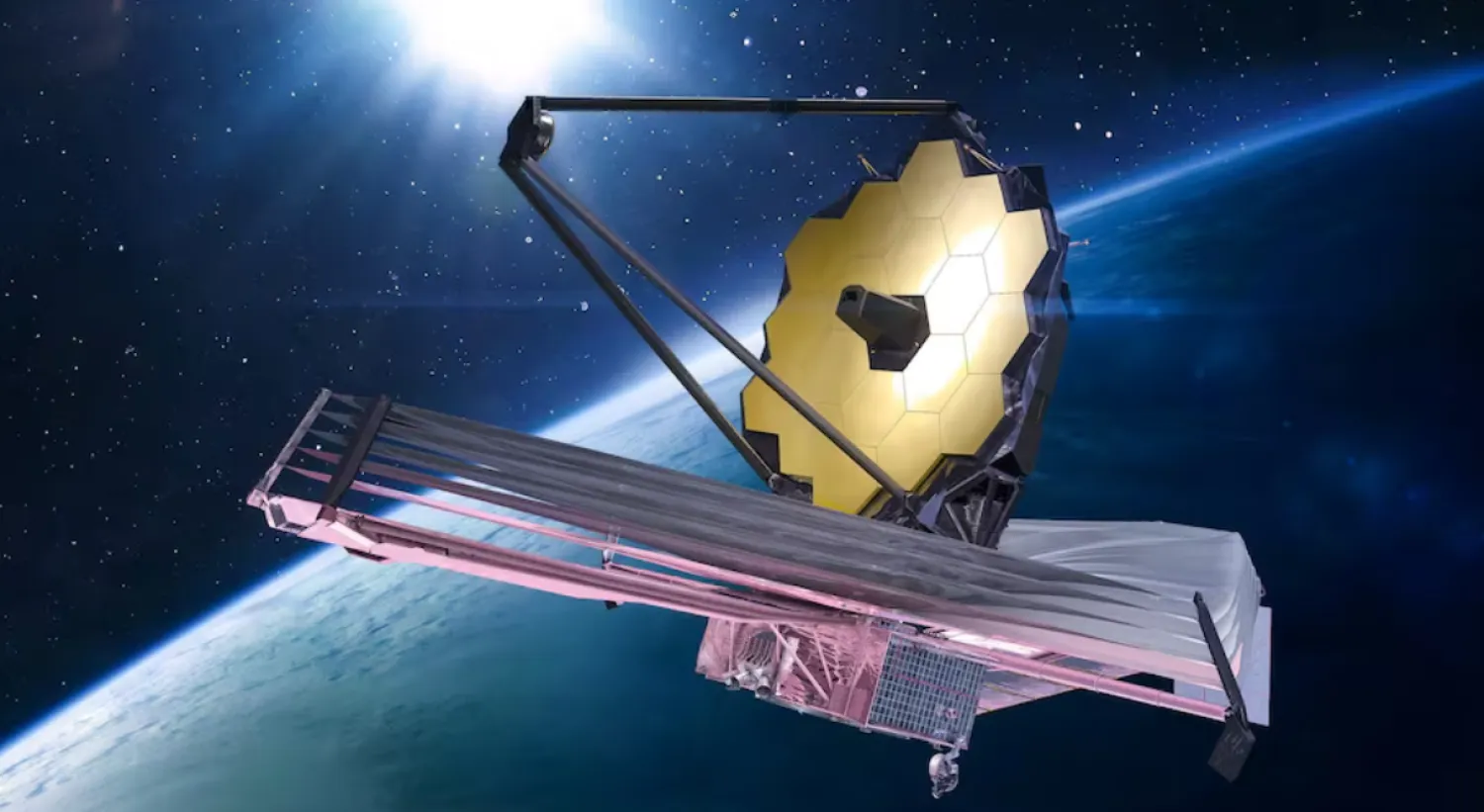
Artist's rendering of James Webb Space Telescope in space near Earth, in this image released on September 19, 2023. NASA/dima_zel/Handout via REUTERS
TT

Astronomers Unveil Map of Dark Matter's Distribution in Universe

Artist's rendering of James Webb Space Telescope in space near Earth, in this image released on September 19, 2023. NASA/dima_zel/Handout via REUTERS

Using observations from the James Webb Space Telescope in a patch of the sky covering almost three times the area of the full moon, scientists have created the most detailed cosmic map to date of the mysterious substance called dark matter that accounts for most of the stuff that populates the universe.

Ordinary matter makes up stars, planets, people and everything else we can see. But it represents only about 15% of all the matter in the cosmos. The rest is dark matter, which does not emit or reflect light, making it invisible to the human eye and to telescopes, Reuters reported.

Scientists infer its existence based on the gravitational effects it exerts on a large scale such as how quickly galaxies rotate, how galaxy clusters are held together and how light from distant objects bends as it passes through massive cosmic structures.

The new map of the distribution of dark matter was based on this phenomenon of light bending - causing subtle distortions in the shape of roughly 250,000 distant galaxies as observed by Webb - thanks to the gravitational effects of matter along the line of sight.

A previous map of dark matter was based on observations by the Hubble Space Telescope. The new map, powered by Webb's greater capabilities, offers double the resolution of the previous map, spans more parts of the cosmos and peers further back in time - effectively looking to roughly 8 to 10 billion years ago, a key period for galaxy formation.

"This allows us to resolve finer dark matter structures, detect mass concentrations that were previously unseen, and extend dark-matter mapping into earlier epochs of the universe," said observational cosmologist Diana Scognamiglio of NASA's Jet Propulsion Laboratory in California, lead author of the research published on Monday in the journal Nature Astronomy, opens new tab.

The map reveals with unprecedented clarity new details of the macrostructure of the universe called the cosmic web - galaxy clusters, immense filaments built of dark matter along which galaxies and gas are distributed, as well as regions with less density of mass.

Webb, an infrared telescope possessing about six times the light-gathering power of Hubble, was launched in 2021 and became operational in 2022.

"The James Webb Space Telescope is like putting on a new pair of glasses for the universe," Scognamiglio said. "It sees fainter and more distant galaxies with much sharper detail than ever before. That effectively gives us a much denser grid of background galaxies to work with, which is exactly what you want for this kind of study. More galaxies and sharper images translate directly into a sharper map of dark matter."

The map covers a part of the sky called the Cosmic Evolution Survey, or COSMOS, located in the direction of the constellation Sextans. The map will facilitate future investigations of the universe in numerous ways, the researchers said.

"For example, a major question in astrophysics is how galaxies grow and evolve with time - how the universe went from an almost perfectly homogenous soup to the spectacular variety of galaxies we see today," said observational cosmologist and study co-author Jacqueline McCleary of Northeastern University in Boston.

"Dark matter halos - self-gravitating 'clouds' of dark matter - are the site of galaxy formation, the nurseries of galaxies, if you will. So knowing where the dark matter is, how much of it there is and connecting it to the population of galaxies inside the dark matter distribution places an important boundary condition on models of galaxy formation and evolution," McCleary said.

The method used by the researchers involving the bending of light revealed the distribution of dark and ordinary matter.

The researchers said their observations are in harmony with the leading cosmological model - called Lambda-CDM, or cold dark matter - that explains the universe's beginning with the Big Bang and its subsequent evolution and structure. The model sees a universe dominated by dark matter and the invisible cosmic force called dark energy that is responsible for its accelerating expansion.

"In this framework, dark matter provides the gravitational backbone on which galaxies, groups and clusters form, creating the large-scale cosmic web. Our map provides a much sharper observational view of this dark-matter scaffolding," Scognamiglio said.



Japan’s Beloved Last Pandas Leave for China as Ties Fray

Giant panda Lei Lei eats bamboo at Ueno Zoological Gardens in Tokyo, Japan, 25 January 2026. (EPA)
TT

Japan’s Beloved Last Pandas Leave for China as Ties Fray

Giant panda Lei Lei eats bamboo at Ueno Zoological Gardens in Tokyo, Japan, 25 January 2026. (EPA)

Hundreds gathered to say farewell to two popular pandas departing Tokyo for China on Tuesday, leaving Japan without any of the beloved bears for the first time in 50 years as ties between the Asian neighbors fray.

Panda twins Lei Lei and Xiao Xiao were transported by truck out of Ueno Zoological Gardens, their birthplace, disappointing many Japanese fans who have grown attached to the furry four-year-olds.

"I've been coming to watch them since they were born," Nene Hashino, a woman in her 40s wearing a panda-themed jacket and clutching a bear stuffed toy, told AFP.

"It feels like my own children are going somewhere far away. It's sad."

The pandas' abrupt return was announced last month during a diplomatic spat that began when Japanese Prime Minister Sanae Takaichi hinted that Tokyo could intervene militarily in the event of an attack on Taiwan.

Her comment provoked the ire of Beijing, which regards the island as its own territory.

The distinctive black-and-white animals, loaned out as part of China's "panda diplomacy" program, have symbolized friendship between Beijing and Tokyo since they normalized ties in 1972.

Their repatriation comes a month before their loan period expires in February, according to the Tokyo Metropolitan Government, which operates Ueno Zoo.

"According to the relevant agreement between China and Japan, the giant pandas who were living in Japan, Xiao Xiao and Lei Lei, today began their return trip to China," said Guo Jiakun, China's foreign ministry spokesman.

"As always, we welcome the Japanese public to come see giant pandas in China."

Japan has reportedly been seeking the loan of a new pair of pandas.

However, a weekend poll by the liberal Asahi Shimbun newspaper showed that 70 percent of those surveyed do not think the government should negotiate with China on the lease of new pandas, while 26 percent would like them to.

On Sunday, Ueno Zoo invited some 4,400 lucky winners of an online lottery to see the pandas for the last time.

- 'Part of my heart' -

Well-wishers wearing panda-themed clothes, hats and badges waited for hours on the streets lining the zoo two days later to say their final goodbyes.

They called out to the animals as the windowless truck left the gates.

"It's so sad," said Daisaku Hirota, a 37-year-old shop worker who said he tried to visit the pandas as often as he could on his days off.

"I lost one part of my heart," he said.

Lei Lei and Xiao Xiao were delivered in 2021 by their mother Shin Shin, who arrived in 2011 and was returned to China in 2024 because of declining health.

Since late last year, China has discouraged its nationals from travelling to Japan, citing deteriorating public security and criminal acts against Chinese nationals in the country.

Beijing is reportedly also choking off exports to Japan of rare-earth products crucial for making everything from electric cars to missiles.

However, China routinely removes pandas from foreign countries and the latest move may not be politically motivated, said Masaki Ienaga, a professor at Tokyo Woman's Christian University and an expert in East Asian international relations.

"If you talk about (Chinese) politics, the timing of sending pandas is what counts," and pandas could return to Japan if bilateral ties warm, Ienaga said.

Other countries use animals as tools of diplomacy, including Thailand with its elephants and Australia with its koalas, he added.

"But pandas are special," Ienaga said.

"They have strong customer-drawing power, and... they can earn money."


Accidental 'Crying Horse' Toy Wins Hearts in China

Lou Zhenxian, owner of Vision Plush Toys, works at her desk near crying horse plush toys, ahead of the Chinese Lunar New Year, which will welcome the Year of the Horse, at Yiwu International Trade City in Yiwu, Zhejiang province, China January 21, 2026. REUTERS/Nicoco Chan
TT

Accidental 'Crying Horse' Toy Wins Hearts in China

Lou Zhenxian, owner of Vision Plush Toys, works at her desk near crying horse plush toys, ahead of the Chinese Lunar New Year, which will welcome the Year of the Horse, at Yiwu International Trade City in Yiwu, Zhejiang province, China January 21, 2026. REUTERS/Nicoco Chan

At Yiwu International Trade City, China’s largest wholesale market, customers crowd into a small shop searching for an unlikely bestseller ahead of the Lunar New Year.

They are looking for a red plush horse with a downturned mouth, a gold bell around its neck, and eyes that appear to shy away from a viewer’s gaze. The toy has gone viral on Chinese social media ahead of the Spring Festival holiday, which this year marks ‌the Year ‌of the Horse in the ‌Chinese ⁠zodiac, Reuters said.

Called the “crying ‌horse” by online users, the toy was designed as a happy-faced Lunar New Year decoration, but a manufacturing mistake turned its smile into a frown.

“A worker sewed the mouth on upside down by accident,” said Zhang Huoqing, owner of the Yiwu-based shop Happy Sister.

Zhang said she offered ⁠a refund after discovering the flaw, but the customer never returned the ‌toy. Not long after, she discovered photos ‍of it circulating online.

“People ‍joked that the crying horse is how you ‍look at work, while the smiling one is how you look after work,” Zhang said. As demand surged, Zhang decided to keep making the sad-faced version.

Some young white-collar workers in China say the horse's dour expression mirrors their long hours and workplace stress.

It also taps into a ⁠broader trend for so-called “ugly-cute” toys, popularized in recent years by characters such as Pop Mart’s toothy monster Labubu.

“These days, almost everyone who walks through the door asks for the crying horse,” said Lou Zhenxian, a Yiwu vendor who has sold festive toys for more than 25 years.

By early afternoon, racks of crying horses outside Happy Sister had sold out and employees were rushing to restock the shelves.

“We will keep selling it,” Zhang said. “This crying horse really ‌fits the reality of modern working people.”


Firefighters Order Evacuation as Heatwave Bakes Australia

A man shades himself from the heat with a fan in Melbourne, Australia, 27 January 2026. (EPA)
TT

Firefighters Order Evacuation as Heatwave Bakes Australia

A man shades himself from the heat with a fan in Melbourne, Australia, 27 January 2026. (EPA)

Firefighters told people to flee an out-of-control bushfire in southeast Australia on Tuesday as a heatwave baked much of the country.

Temperatures hit a record high in the eastern state of Victoria, preliminary data showed.

"Conditions are heating up across the state, and we're seeing those 40 degree temperatures roll in," said Country Fire Authority chief officer Jason Heffernan.

"Firefighters on the ground will now start to really notice how hot it is getting, and they'll really start to notice the picking up of the winds," he told public broadcaster ABC.

Authorities issued an immediate emergency evacuation warning for hundreds of people in four country towns at risk from the fire in the Otways region southwest of Melbourne.

Residents in another three rural areas nearby were urged to leave as well, with the warning: "Due to extreme weather today, the fire is predicted to rapidly expand and pose a threat to communities."

A total fire ban was imposed on the state, where a total of six major bushfires were burning. The temperature in the towns of Walpeup and Hopetoun, northwestern Victoria, peaked at 48.9C, according to the Bureau of Meteorology's website.

The temperature nudged past the state's record of 48.8C, but officials said it would need to be verified later to become official.

The heatwave forced the Australian Open to close the roof over its center court to protect players and fans, with the temperature in Melbourne forecast to hit 45C.

Hot air has settled across swathes of Victoria, South Australia, and New South Wales.

"Prolonged heat can affect anyone and when high heat continues for a number of days it can affect your health," said Victoria chief health officer Caroline McElnay.

The elderly, children and people with underlying health conditions were most at risk, she warned.

"It can cause potentially fatal health problems such as heat exhaustion and heat stroke but it can also trigger events like heart attacks or stroke," McElnay told reporters.

She urged people to stay cool and hydrated, and watch out for symptoms ranging from dizziness to cramps, rapid pulse, a high body temperature and eventually loss of consciousness.