


Snowstorm Disrupts Travel in Southern US as Blast of Icy Weather Widens

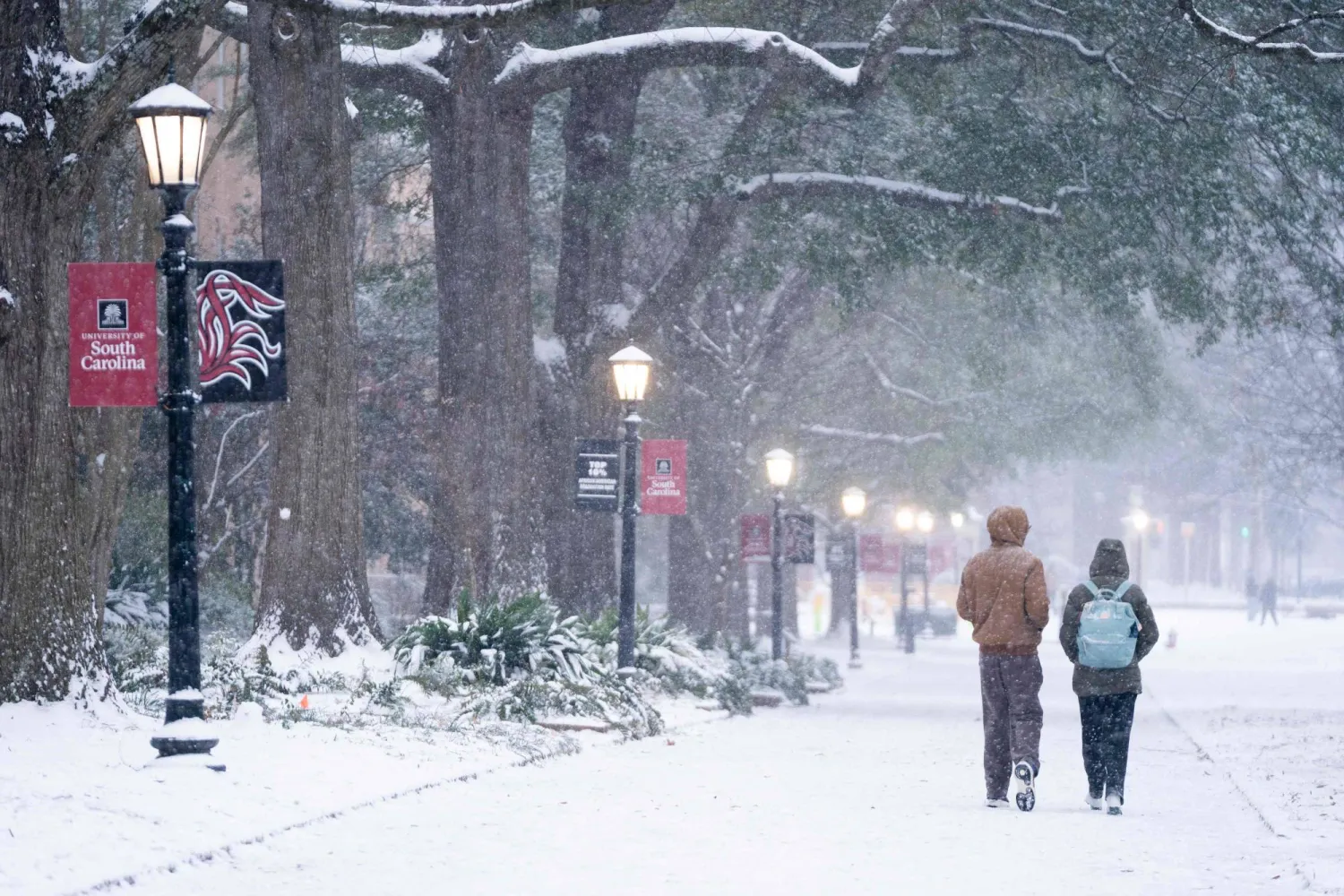
Students walk across the historic Horseshoe as snow falls at the University of South Carolina on January 31, 2026 in Columbia, South Carolina. (Getty Images/AFP)
TT

Snowstorm Disrupts Travel in Southern US as Blast of Icy Weather Widens

Students walk across the historic Horseshoe as snow falls at the University of South Carolina on January 31, 2026 in Columbia, South Carolina. (Getty Images/AFP)

Travel misery was set to continue Sunday as a powerful snowstorm blasted southern US states, bringing subzero temperatures to regions not accustomed to the deadly winter conditions.

The latest bout of extreme weather came about a week after a monster storm pummeled a wide swath of the United States, killing more than 100 people and leaving many communities struggling to dig out from snow and ice.

Heavy snow fell in North Carolina and neighboring states Saturday, as authorities urged residents to stay off the roads and warned oceanfront structures were threatened by the storm.

All of North and South Carolina, and portions of Georgia, eastern Tennessee and Kentucky, as well as southern Virginia were under a winter storm warning.

North Carolina saw 750 car crashes on Saturday, the highway patrol said.

Faust, North Carolina recorded 14.5 inches (37 cm) of snow, while West Critz, Virginia got 12.5 inches. Harrisburg, Tennessee received more than nine inches of accumulation.

In the North Carolina town of Cape Carteret, high winds sent thick snow blowing sideways, prompting the National Weather Service to warn that travel was "Treacherous and Potentially Life-Threatening especially if you become stranded."

In dramatic footage released by police in Gastonia, North Carolina, a train plowed at high speed into a semi-truck that had gotten stuck on the tracks, crushing the vehicle. No one was hurt.

The weekend storm forced more than 1,800 flight cancellations Saturday and Sunday at Charlotte Douglas International Airport in North Carolina, a major hub for American Airlines, data from the tracker FlightAware showed.

A 300-strong "snow team" was working to clear runways, taxiways, roads and sidewalks, the airport said Saturday.

More than 600 flights were cancelled Saturday at Atlanta's international airport, the world's busiest. About 50 flights in and out of Atlanta were cancelled in the early hours of Sunday.

"An explosively deepening coastal cyclone will continue to bring moderate to heavy snow, high winds, and possibly blizzard conditions for the Carolinas," the National Weather Service said Saturday.

"An intense surge of arctic air behind the coastal storm will send below freezing temperatures down toward South Florida by Sunday morning."

Davis, West Virginia recorded the lowest temperature in the lower 48 states on Saturday -- a frigid minus 28F (minus 33C).

About 156,000 customers remained without power early Sunday, mostly in the south, according to poweroutage.us, with Mississippi, Tennessee and Louisiana hardest hit.

In North Carolina, the National Park Service announced the closure of campgrounds and some beaches at the Outer Banks, a series of barrier islands off the coast of the southern state that are vulnerable to storms.

It said oceanfront structures were threatened, and a section of highway that threads through its dunes was closed.

In Mississippi, Governor Tate Reeves said the US Army Corps of Engineers helped to install generators at critical sites, and authorities were opening 79 shelters and warming centers across the state.

The freezing weather forced NASA to postpone a key fueling test over the weekend of the 322-foot (98-meter) rocket that is on the Cape Canaveral launch pad in Florida.

That in turn is likely to push back by at least a couple of days a planned manned Moon flyby slated for this month.



Does Fasting Stress You? Here’s the Role of Cortisol and How to Manage It

Deep breathing exercises, remembrance, and brief meditation before sleep may reduce stress markers (Pexels).
TT

Does Fasting Stress You? Here’s the Role of Cortisol and How to Manage It

Deep breathing exercises, remembrance, and brief meditation before sleep may reduce stress markers (Pexels).

Fasting during Ramadan is both a spiritual and a health practice that benefits the body and mind. Medical studies, however, show that fasting can sometimes raise levels of cortisol, the hormone commonly known as the stress hormone. Elevated cortisol may have noticeable effects on mood, including irritability, anxiety, and tension, making emotional regulation more challenging during long fasting hours.

Cortisol is released by the adrenal glands according to a natural daily rhythm, higher in the morning and lower in the evening. This rhythm, however, can be disrupted by poor sleep, dehydration, or physical and mental stress.

So how can cortisol levels be kept in balance during fasting? Here are key practical guidelines:

1. Prioritize sleep. It is central to hormonal balance. Sleep disruption increases stress and interferes with cortisol regulation. To minimize this effect:

Aim for a total of 7 to 8 hours of sleep, including nighttime rest and a short daytime nap if needed.

Keep sleep and wake times as consistent as possible.

Limit screen exposure for at least one hour before bedtime.

2. Break your fast in a balanced way to avoid blood sugar spikes. Research links blood sugar fluctuations to heightened stress responses. For that reason:

Start with fluids and a moderate amount of dates, followed by a meal that includes protein and fiber.

Avoid excessive simple sugars, which can cause a rapid rise and fall in blood glucose, triggering cortisol release.

3. Carbohydrates matter; do not eliminate them. While reducing refined sugars is beneficial, including moderate amounts of healthy carbohydrates - such as oats, whole-grain bread, potatoes, or fruit - at iftar and suhoor helps stabilize blood sugar gradually after fasting.

This balance helps prevent excessive cortisol release and reduces irritability, tension, and anxiety during fasting hours.

4. Maintain hydration between sunset and dawn. Dehydration places additional stress on the body. Health authorities recommend spreading fluid intake after iftar:

Drink water gradually between iftar and suhoor.

Limit caffeinated beverages, as they may interfere with sleep and increase stress.

5. Engage in moderate physical activity. Moderate movement supports healthy stress regulation:

Opt for light walking or stretching about two hours after iftar.

Avoid intense exercise during prolonged fasting hours.

6. Use relaxation techniques. Deep breathing, remembrance, and brief meditation before sleep may help lower stress markers.

US medical sources recommend daily relaxation practices lasting 5 to 10 minutes to support hormonal balance related to stress.

7. Be mindful of caffeine and sugar at night. Heavy coffee intake or frequent sweets during late Ramadan gatherings can disrupt sleep, affecting cortisol levels the following day. Keep your last cup of coffee before midnight and limit desserts to small portions.

8. Consult your doctor if you have a medical condition. If you have hormonal disorders, elevated blood sugar, or high blood pressure, medical guidance is important to adjust medications and dosing schedules during fasting.

Cortisol plays an essential role in energy regulation and the body’s stress response, but maintaining healthy levels depends on consistent sleep, balanced nutrition, adequate hydration, and moderate activity. With thoughtful planning during Ramadan, it is possible to support energy and focus throughout the month, rather than struggling with irritability, anger, and stress.


Jazan Marks Founding Day with 1,500 Banners and Regional Festivities

The region is set to host a diverse lineup of events, including national performances - SPA
TT

Jazan Marks Founding Day with 1,500 Banners and Regional Festivities

The region is set to host a diverse lineup of events, including national performances - SPA

The Jazan Municipality has finalized its preparations for Founding Day, decorating the region with over 1,500 banners and a comprehensive visual identity, SPA reported.

Streets, parks, and public squares across the city and its governorates have been transformed to reflect national pride and the joy of the local community.

In collaboration with various government departments, the region is set to host a diverse lineup of events, including national performances, folk arts, and heritage displays unique to Jazan.


Scottish Antiques Auction Selling Neck Shackles Accused of ‘Profiting from Slavery’

“I think it’s important not to upset and offend, but shock people into learning the whole truth,” the auctioneer, Marcus Salter, said. (Cheeky Auctions Tain)
TT

Scottish Antiques Auction Selling Neck Shackles Accused of ‘Profiting from Slavery’

“I think it’s important not to upset and offend, but shock people into learning the whole truth,” the auctioneer, Marcus Salter, said. (Cheeky Auctions Tain)

An antiques auction selling chains linked to the enslavement of African people in Zanzibar has been accused of “profiting from slavery,” according to The Guardian.

The shackles, dated to 1780 and valued at about £1,000, are among objects listed in the auction, called “Challenging History.”

The auctioneer Marcus Salter, of Cheeky Auctions in Tain, Ross, said he wanted to ensure history was confronted with the sale of the “sensitive artifact” and did not wish to offend.

“I think it’s important not to upset and offend, but shock people into learning the whole truth,” Salter said. “There are certain things we’re not allowed to sell at auction. We had to check with the platform we’re selling with that we could do this. They consider the slave chains to be a historical artefact, therefore we can.

But Labour MP Bell Ribeiro-Addy, who chairs the all-party parliamentary group for Afrikan reparations, said trading in such items meant people were “continuing to profit from the slave trade.”

She said, “If they were to be put in a museum I would understand, but buying and selling them like oddities is the same thing that people do when it comes to human remains– treating them as collector’s items, something to be fetishized rather than items that should be looked at in horror.”

Salter said he was selling the chains for a dealer whose father had owned them for 50 years, adding: “No matter what happens there’s going to be money made out of it from somewhere.”

He claimed if the item was donated to a museum, it could be “put into storage and never seen again”, and that slavery-linked mahogany was sold and used without controversy.

In 2024, the Antiques Roadshow expert Ronnie Archer-Morgan refused to value an ivory bangle linked to enslavement.

Caecilia Dance, an associate at London law firm Wedlake Bell, has advised on the restitution of Nazi-looted art. Dance said she could not comment on the auction, but that there was “no specific law against” trading objects linked to slavery.

She added that “public interest stewardship” – donation, sale, or long-term loan to a museum with relationships with affected communities – would be the “ideal management pathway” for an item linked to slavery.