


Chinese Cash in Jewellery at Automated Gold Recyclers as Prices Soar

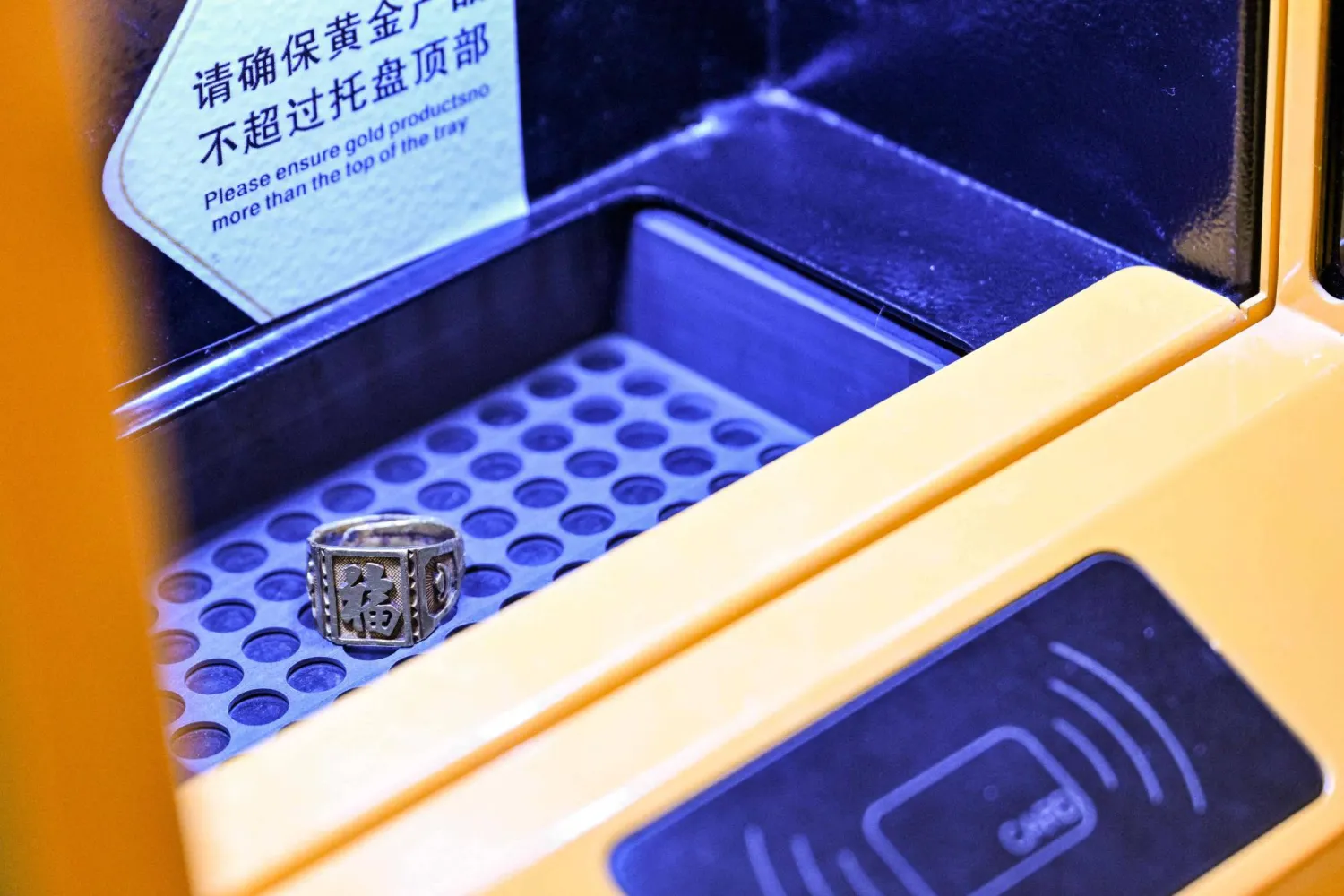
A gold ring is placed in a Smart Gold Store Machine where a customer has brought it to sell in Shanghai on January 29, 2026. (AFP)
TT

Chinese Cash in Jewellery at Automated Gold Recyclers as Prices Soar

A gold ring is placed in a Smart Gold Store Machine where a customer has brought it to sell in Shanghai on January 29, 2026. (AFP)

Dozens of people crowded around an automated gold recycling machine at a Shanghai mall, hoping to melt down family heirlooms for cash as prices of the precious metal hit record highs.

China is the world's largest consumer of gold, which is traditionally purchased by families to mark special occasions like births and weddings.

But as prices soared to a fresh high near $5,600 on Thursday, customers surrounding the bright yellow machine installed by gold trading firm Kinghood Group were looking to sell.

"I never thought prices would rise so dramatically," said 54-year-old Wu, who told AFP she wanted to sell panda-themed gold coins she had purchased after the birth of her daughter in 2002.

She said she had previously sold the machine a ring inherited from her late father, which fetched around 10,000 yuan ($1,400) -- a huge increase from the original 1,000 yuan her mother had paid for the ring decades ago.

"Gold prices hold steady at a historic high, it's the right time to sell gold," an ad on the machine advised customers.

An embedded screen displayed the Shanghai Gold Exchange's fluctuating prices, while a live video feed showed a robotic arm moving gold scraps onto a scale and under a device that used light waves to measure its purity.

Some people told AFP they had waited over an hour for their turn.

An attendant kept track of each seller's position in the queue, and helped to deposit ornate pendants, hammered rings and commemorative coins into an opening in the device.

Wu said her elderly mother was especially excited about soaring gold prices, and saw the recycling machine as a chance to supplement her modest pension.

"Everyone is suddenly talking about (gold), and it has sparked this emotion in her," Wu told AFP.

Customers wait to sell their gold jewelry in a Smart Gold Store Machine placed in a shopping in Shanghai on January 29, 2026. (AFP)

- Old gold -

Zhao, a woman sporting an intricately carved gold medallion on a necklace of jade beads and shimmering bangles on her wrist, brought her late grandfather's ring to the recycling machine.

The ring's surface was adorned with the Chinese character for "luck" and tiny images of traditional gold ingots.

She said she believed her grandfather had purchased the ring sometime between the 1950s and the 1980s, and that her mother had handed it down to her this year.

"If the price is good, I will sell it," she told AFP as she waited for her turn.

Minutes after Zhao deposited the ring into the machine, a message popped up on its screen that said Kinghood would buy the chunk of high-karat gold for over 12,000 yuan.

Satisfied, Zhao clicked "agree" on the terms displayed onscreen and keyed in her full name, ID number and bank account details, while her grandfather's ring was melted down into a smooth puddle on the live video feed.

The attendant promised she would receive the full amount via bank transfer by the end of the day.

"Other places test the gold by burning it slightly, but here they test it directly and it's open and transparent," Zhao said, explaining that she trusted the automated recycler over a traditional human buyer.

In addition to a steady stream of sellers, the machine also drew the attention of bystanders who gawked at the large sums of money changing hands at the unassuming corner of the mall.

"Damn!" said a passerby when she saw that one person was selling their old jewellery for more than 75,000 yuan.

And onlookers crowded around an elderly couple as the machine calculated that their finger-sized gold bar could fetch over 122,000 yuan.



Greece Is Paying Fishermen to Catch Toxic Toadfish Invading the Warming Mediterranean

A silver-cheeked toadfish placed on the ground after being caught by fishermen on the southern island of Crete, Greece, Monday, June 22, 2015. (InTime News via AP)
TT

Greece Is Paying Fishermen to Catch Toxic Toadfish Invading the Warming Mediterranean

A silver-cheeked toadfish placed on the ground after being caught by fishermen on the southern island of Crete, Greece, Monday, June 22, 2015. (InTime News via AP)

Fishermen in Greece are getting cash payouts to catch toxic fish migrating north into the Mediterranean Sea due to climate change.

The silver-cheeked toadfish is a torpedo-shaped species with prominent, humanlike teeth. Its skin and organs contain a powerful neurotoxin that can cause heart failure in humans if consumed.

Authorities say the fish have not been sighted in bathing areas at Greek island resorts. But in recent weeks, the fish have wreaked havoc for fishermen off the coast of Crete and several other Greek islands, chomping through nets.

“It’s got to the point where we might go out fishing one day and then spend the next three days fixing our nets,” Giorgos Kyriakakis, of a Cretan fishermen’s association, told Greek public broadcaster ERT on Friday.

“They eat our catch and damage our nets — that’s very costly,” he said.

The fish are believed to have traveled up the Suez Canal and into the Mediterranean, attracted by warming waters. The invasion prompted Cyprus to launch a similar catch program earlier this year.

Starting Friday, Greece's government is offering 5.33 euros per kilogram (about $2.75 per pound) for catches of the fish, which is normally found in tropical waters.

“It’s the first time that such a measure has been taken in Greece,” Agriculture Minister Margaritis Schinas, a former European Commission vice president, said ahead of the program’s launch.

The fish – a member of the puffer fish family – will be frozen and incinerated at local government facilities, Schinas said. He added that the measure would likely be expanded from the currently affected islands to all Greek waters.

Public concern has been stoked in Greece by online videos posted by Greek fishing crews, showing the fish sinking their teeth into soda cans or pieces of wood.

The Greek Red Cross has issued a public health warning about the fish, outlining first-aid protocols for bleeding caused by potential bites and warning of the deadly neurotoxin in the fish’s organs.

But authorities and businesses on the island of Crete cautioned against overreacting to the fish’s offshore presence.

“The presence of these fish in the Mediterranean has been known for years,” a statement issued Friday by 16 medical and tourism associations on Crete said.

“There is, however, no ‘invisible’ or imminent danger to bathers. Marine predators do not threaten the safety of visitors and residents,” it said. “Exaggeration is often a feature of public debate.”


St. Bernard Dogs Still Roam the Swiss Alps as Part of 'Living Museum'

St. Bernard dogs from the Barry foundation run in the hills at the St. Bernard Pass, Switzerland, Monday, June 22, 2026. (AP Photo/Jez Fielder)
TT

St. Bernard Dogs Still Roam the Swiss Alps as Part of 'Living Museum'

St. Bernard dogs from the Barry foundation run in the hills at the St. Bernard Pass, Switzerland, Monday, June 22, 2026. (AP Photo/Jez Fielder)

At the Great St. Bernard Pass high in the Swiss Alps, the eponymous dogs still walk the same mountain paths their ancestors patrolled for hundreds of years to find travelers buried beneath the snow.

Down in the valley, a living museum honoring the Swiss national dog's history — and its future — is marking its first year.

More than 130,000 people have visited Barryland, the world's only space dedicated to St. Bernards, since it opened last summer in Martigny, Switzerland, after outgrowing a much smaller space. Tourists can watch live grooming and physiotherapy sessions, explore the mountain pass with augmented reality technology and learn more about the dogs.

“We have a lot of demand and interest for this breed and this whole history and patrimony,” The Associated Press quoted Barryland director Mélanie Glassey-Roth as saying. “So we decided to create a new park, a big one.”

At 2,469 meters (8,100 feet) above sea level on the Swiss-Italian border, the Great St. Bernard Pass is one of the country’s highest and most treacherous.

Since the mid-17th century, large mountain dogs have been kept on the pass. They arrived as guard dogs, became companions, and gradually evolved into something the Alpine world had never seen before: Animals with an extraordinary instinct for locating hikers lost in snow and fog.

The breed's name stems from the Great St. Bernard Hospice, which was founded in 1050 by Bernard de Montjoux, the archdeacon of Aosta and future saint, to provide refuge for pilgrims and merchants crossing the dangerous pass. The dogs became central to that mission, and by the early 19th century they had a reputation that was carried across Europe by soldiers of Napoleon Bonaparte following his army's own crossing of the route.

Barry the First, the most celebrated dog, is traditionally credited with saving more than 40 lives when he was at the hospice between 1800 and 1812. At the Barry Foundation, the steward for the breeding program, there is always a male dog called Barry.

Currently, the foundation's 21 keepers care for 32 dogs. Roughly 20 pedigree puppies are born annually. These dogs, as well as other St. Bernards, no longer do mountain rescues because they’re too big to be transported by helicopter. Smaller breeds like Australian shepherds are used instead, though a number of St. Bernards are kept on the pass to keep the tradition alive.

The foundation's dogs typically eat about 10 metric tons (22,046 pounds) of dry food each year and spend their summers gamboling in the remnants of snow in the mountains before heading 40 kilometers (25 miles) down winding roads back to the kennel in Barryland.

“We get to see them born, and we get to see them grow up, and then become mothers, and we get to accompany them through all those different challenges in life,” keeper Alexandra Piatti said. “We are their guide, so we can help them with socialization and educate them, and really be by their side for their whole lives.”

In 2025 alone, the foundation says its dogs completed 609 jobs by visiting hospitals, care homes, schools and prisons across Switzerland.

Keeper Déborah Dini balances the weight of the breed's history with affection for the dogs in her charge.

“We perpetuate the tradition,” she said. “We take care of them. We love them.”


Analysis: At Least 150 Mn People in Europe Forecast to Face Temperatures Above 35C Friday

Youths cool down in the waters of the Canal Saint-Martin as France experiences a heatwave, in Paris on June 25, 2026. (Photo by Ludovic MARIN / AFP)
TT

Analysis: At Least 150 Mn People in Europe Forecast to Face Temperatures Above 35C Friday

Youths cool down in the waters of the Canal Saint-Martin as France experiences a heatwave, in Paris on June 25, 2026. (Photo by Ludovic MARIN / AFP)

At least 150 million people in Europe are expected to experience temperatures above 35C on Friday, according to an AFP analysis.

Germany is now expected to bear the brunt of the heatwave, with some 82 million people forecast to experience temperatures above 30C on Friday, including 52 million facing temperatures exceeding 35C.

Some 420 million people across Europe (excluding Türkiye) -- around 70 percent of the population -- will swelter in temperatures of more than 30C, according to the analysis.

Pedestrians cool off at “The area with Ljubljana’s own weather” in Preseren Square in Ljubljana on June 24, 2026. (Photo by Jure MAKOVEC / AFP)

Britain, France, Spain and Switzerland have all broken temperature records during the heatwave, with the high temperatures now expected to affect large parts of Hungary, Belgium and Luxembourg, among others.

The analysis is based on forecasts from the German Meteorological Service and 2025 population projections from the Joint Research Center and is in line with figures from Austrian NGO Klimadashboard.