

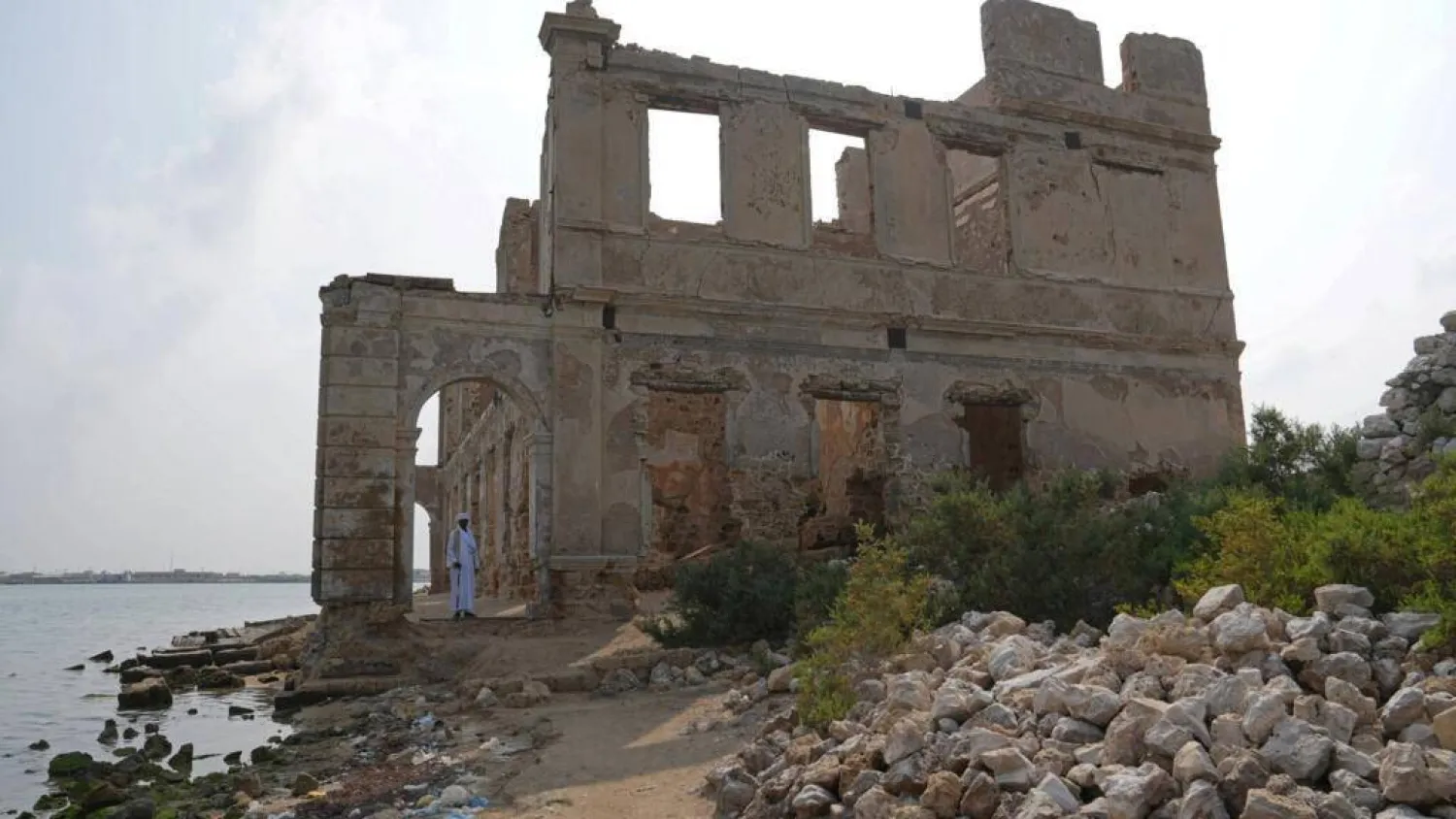

In Sudan's Old Port of Suakin, Dreams of a Tourism Revival

Local officials in the historic Sudanese city of Suakin hope the once-booming transit port turned tourist draw can be revived. Mutawakil ISSA / AFP
TT

In Sudan's Old Port of Suakin, Dreams of a Tourism Revival

Local officials in the historic Sudanese city of Suakin hope the once-booming transit port turned tourist draw can be revived. Mutawakil ISSA / AFP

The mayor of Suakin dreams of a rebirth for his town, an ancient Red Sea port spared by the wars that have marked Sudan's history but reduced to ruins by the ravages of time.

"It was called the 'White City'," for its unique buildings made of coral stone taken from the seabed, said mayor Abu Mohamed El-Amin Artega, who is also the leader of the Artega tribe, part of eastern Sudan's Beja ethnic group.

Now the once-booming port and tourist draw languishes on the water, effectively forgotten for years as Sudan remains mired in a devastating war between the army and paramilitary forces.

But inside the ruins of a mosque, a restoration crew is hard at work rebuilding this piece of Suakin, over a century after the city was abandoned.

"Before the war, a lot of people came, a lot of tourists," said Ahmed Bushra, an engineer with the association Safeguarding Sudan's Living Heritage from Conflict and Climate Change (SSLH).

"We hope in the future, when peace comes to Sudan, they will come and enjoy our beautiful historic buildings here," he told AFP.

Architecture student Doha Abdelaziz Mohamed is part of the crew bringing the mosque back to life with funding from the British Council and support from UNESCO.

"When I came here, I was stunned by the architecture," the 23-year-old said.

The builders "used techniques that are no longer employed today", she told AFP. "We are here to keep our people's heritage."

- Abandoned -

The ancient port -- set on an oval island nestled within a lagoon -- served for centuries as a transit point for merchant caravans, Muslim and Christian pilgrims travelling to Makkah and Jerusalem, according to the Rome-based heritage institute ICCROM.

It became a vibrant crossroads under the Ottoman Empire, said Artega, 55, and its population grew to around 25,000 as a construction boom took off.

"The streets were so crowded that, as our forefathers said, you could hardly move."

Everything changed in 1905, when the British built a deeper commercial port 60 kilometers (37 miles) north, to accommodate increased maritime traffic with the opening of the Suez Canal.

"Merchants and residents moved to Port Sudan," the mayor said, lamenting the decline of what he calls "Sudan's great treasure".

But his Artega tribe, which has administered the city since the sixth century with powers "passed from father to son", refused to leave.

His ancestor, he said, scolded the British: "You found a port as prosperous as a fine hen -- you took its eggs, plucked its feathers and now you spit its bones back at us."

As proof of the Artega's influence, he keeps at home what he says are swords and uniforms gifted to his ancestors by Queen Victoria during the British colonial period.

The rise of Port Sudan spelled disaster for Suakin, whose grand public buildings and elegant coral townhouses were left to decay, slowly eaten away by the humid winds and summer heat.

But the 1990s brought new hope, with the opening of a new passenger port linking Suakin to Jeddah in Saudi Arabia.

Today, the Sudanese transport company Tarco operates daily crossings, carrying around 200 passengers per trip from the modern port of Suakin, within sight of the ancient city and its impoverished environs.

- Lease to Türkiye-

The city's optimism grew in 2017 when then-president Omar al-Bashir granted the old port to his Turkish counterpart, Recep Tayyip Erdogan, under a 99-year lease for touristic development.

A Turkish company restored the old governor's palace, customs house and two mosques, but the project stalled in 2019 after Bashir fell from power in the face of mass protests.

Then, in April 2023, the cruise passengers and scuba divers who once stopped in Suakin completely vanished when fighting erupted between the army and the paramilitary Rapid Support Forces (RSF).

A rusting cargo ship now lies stranded on a sandbank in the blue lagoon, where only a handful of fishing boats float around.

But Bushra, from SSLH, remains optimistic. He hopes to see the mosque, which houses the tomb of a Sufi sheikh, host a traditional music festival when the renovation is complete, "in five months".

"When we finish the restoration, the tourists can come here," he said.


Does Fasting Stress You? Here’s the Role of Cortisol and How to Manage It

Deep breathing exercises, remembrance, and brief meditation before sleep may reduce stress markers (Pexels).
TT

Does Fasting Stress You? Here’s the Role of Cortisol and How to Manage It

Deep breathing exercises, remembrance, and brief meditation before sleep may reduce stress markers (Pexels).

Fasting during Ramadan is both a spiritual and a health practice that benefits the body and mind. Medical studies, however, show that fasting can sometimes raise levels of cortisol, the hormone commonly known as the stress hormone. Elevated cortisol may have noticeable effects on mood, including irritability, anxiety, and tension, making emotional regulation more challenging during long fasting hours.

Cortisol is released by the adrenal glands according to a natural daily rhythm, higher in the morning and lower in the evening. This rhythm, however, can be disrupted by poor sleep, dehydration, or physical and mental stress.

So how can cortisol levels be kept in balance during fasting? Here are key practical guidelines:

1. Prioritize sleep. It is central to hormonal balance. Sleep disruption increases stress and interferes with cortisol regulation. To minimize this effect:

Aim for a total of 7 to 8 hours of sleep, including nighttime rest and a short daytime nap if needed.

Keep sleep and wake times as consistent as possible.

Limit screen exposure for at least one hour before bedtime.

2. Break your fast in a balanced way to avoid blood sugar spikes. Research links blood sugar fluctuations to heightened stress responses. For that reason:

Start with fluids and a moderate amount of dates, followed by a meal that includes protein and fiber.

Avoid excessive simple sugars, which can cause a rapid rise and fall in blood glucose, triggering cortisol release.

3. Carbohydrates matter; do not eliminate them. While reducing refined sugars is beneficial, including moderate amounts of healthy carbohydrates - such as oats, whole-grain bread, potatoes, or fruit - at iftar and suhoor helps stabilize blood sugar gradually after fasting.

This balance helps prevent excessive cortisol release and reduces irritability, tension, and anxiety during fasting hours.

4. Maintain hydration between sunset and dawn. Dehydration places additional stress on the body. Health authorities recommend spreading fluid intake after iftar:

Drink water gradually between iftar and suhoor.

Limit caffeinated beverages, as they may interfere with sleep and increase stress.

5. Engage in moderate physical activity. Moderate movement supports healthy stress regulation:

Opt for light walking or stretching about two hours after iftar.

Avoid intense exercise during prolonged fasting hours.

6. Use relaxation techniques. Deep breathing, remembrance, and brief meditation before sleep may help lower stress markers.

US medical sources recommend daily relaxation practices lasting 5 to 10 minutes to support hormonal balance related to stress.

7. Be mindful of caffeine and sugar at night. Heavy coffee intake or frequent sweets during late Ramadan gatherings can disrupt sleep, affecting cortisol levels the following day. Keep your last cup of coffee before midnight and limit desserts to small portions.

8. Consult your doctor if you have a medical condition. If you have hormonal disorders, elevated blood sugar, or high blood pressure, medical guidance is important to adjust medications and dosing schedules during fasting.

Cortisol plays an essential role in energy regulation and the body’s stress response, but maintaining healthy levels depends on consistent sleep, balanced nutrition, adequate hydration, and moderate activity. With thoughtful planning during Ramadan, it is possible to support energy and focus throughout the month, rather than struggling with irritability, anger, and stress.


Jazan Marks Founding Day with 1,500 Banners and Regional Festivities

The region is set to host a diverse lineup of events, including national performances - SPA
TT

Jazan Marks Founding Day with 1,500 Banners and Regional Festivities

The region is set to host a diverse lineup of events, including national performances - SPA

The Jazan Municipality has finalized its preparations for Founding Day, decorating the region with over 1,500 banners and a comprehensive visual identity, SPA reported.

Streets, parks, and public squares across the city and its governorates have been transformed to reflect national pride and the joy of the local community.

In collaboration with various government departments, the region is set to host a diverse lineup of events, including national performances, folk arts, and heritage displays unique to Jazan.


Scottish Antiques Auction Selling Neck Shackles Accused of ‘Profiting from Slavery’

“I think it’s important not to upset and offend, but shock people into learning the whole truth,” the auctioneer, Marcus Salter, said. (Cheeky Auctions Tain)
TT

Scottish Antiques Auction Selling Neck Shackles Accused of ‘Profiting from Slavery’

“I think it’s important not to upset and offend, but shock people into learning the whole truth,” the auctioneer, Marcus Salter, said. (Cheeky Auctions Tain)

An antiques auction selling chains linked to the enslavement of African people in Zanzibar has been accused of “profiting from slavery,” according to The Guardian.

The shackles, dated to 1780 and valued at about £1,000, are among objects listed in the auction, called “Challenging History.”

The auctioneer Marcus Salter, of Cheeky Auctions in Tain, Ross, said he wanted to ensure history was confronted with the sale of the “sensitive artifact” and did not wish to offend.

“I think it’s important not to upset and offend, but shock people into learning the whole truth,” Salter said. “There are certain things we’re not allowed to sell at auction. We had to check with the platform we’re selling with that we could do this. They consider the slave chains to be a historical artefact, therefore we can.

But Labour MP Bell Ribeiro-Addy, who chairs the all-party parliamentary group for Afrikan reparations, said trading in such items meant people were “continuing to profit from the slave trade.”

She said, “If they were to be put in a museum I would understand, but buying and selling them like oddities is the same thing that people do when it comes to human remains– treating them as collector’s items, something to be fetishized rather than items that should be looked at in horror.”

Salter said he was selling the chains for a dealer whose father had owned them for 50 years, adding: “No matter what happens there’s going to be money made out of it from somewhere.”

He claimed if the item was donated to a museum, it could be “put into storage and never seen again”, and that slavery-linked mahogany was sold and used without controversy.

In 2024, the Antiques Roadshow expert Ronnie Archer-Morgan refused to value an ivory bangle linked to enslavement.

Caecilia Dance, an associate at London law firm Wedlake Bell, has advised on the restitution of Nazi-looted art. Dance said she could not comment on the auction, but that there was “no specific law against” trading objects linked to slavery.

She added that “public interest stewardship” – donation, sale, or long-term loan to a museum with relationships with affected communities – would be the “ideal management pathway” for an item linked to slavery.
