


Japan Retrieves Rare Earth-rich Mud from Seabed to Lower Reliance on China

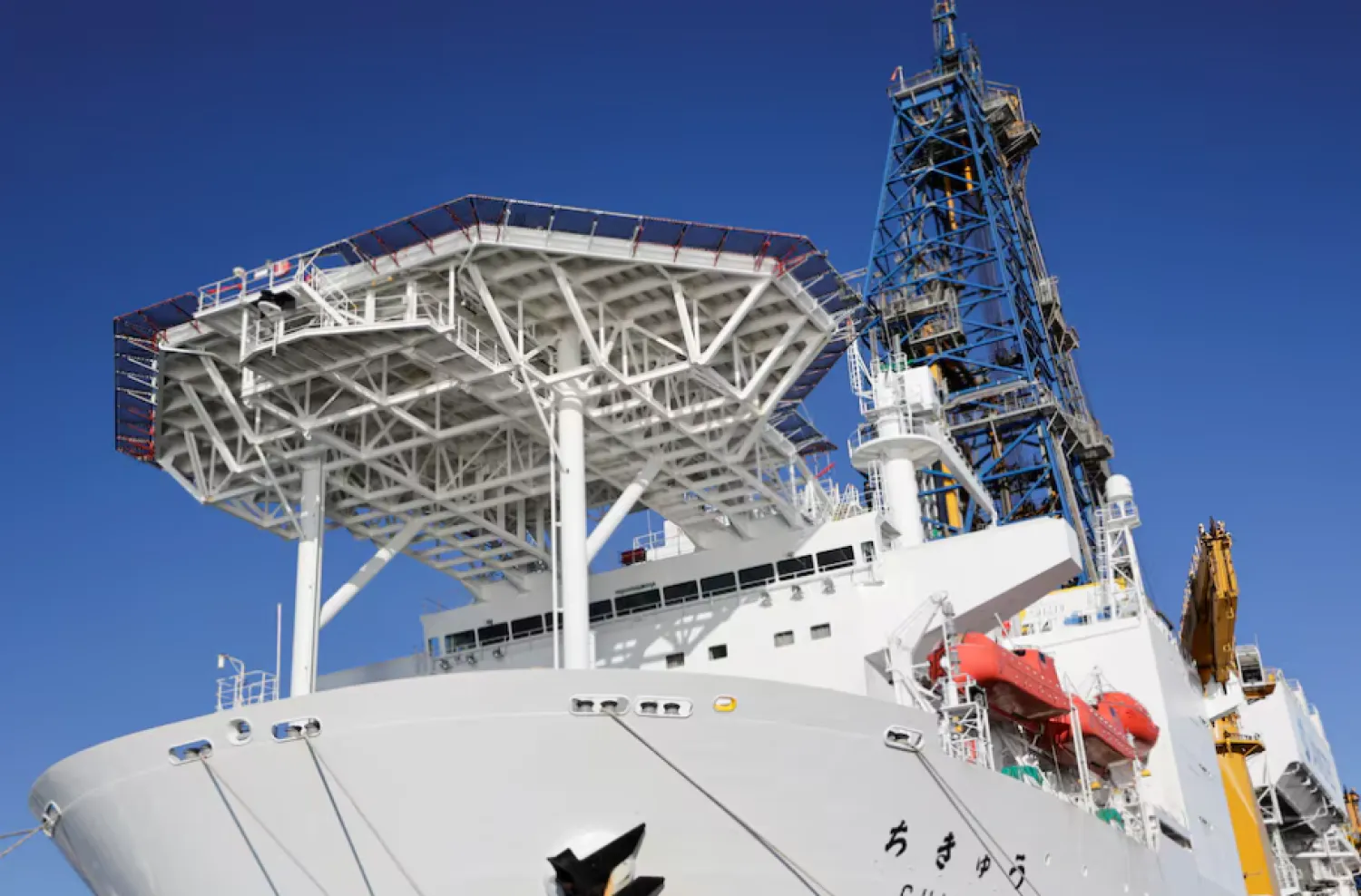
Japan's drilling-equipped research vessel Chikyu before its departure from Shimizu port to conduct a test recovery of rare-earth–rich mud near Minamitori Island, marking the world's first attempt to continuously lift rare-earth seabed sludge from a depth of about 6 km onto a ship, in Shimizu, Shizuoka prefecture, Japan - Reuters
TT

Japan Retrieves Rare Earth-rich Mud from Seabed to Lower Reliance on China

Japan's drilling-equipped research vessel Chikyu before its departure from Shimizu port to conduct a test recovery of rare-earth–rich mud near Minamitori Island, marking the world's first attempt to continuously lift rare-earth seabed sludge from a depth of about 6 km onto a ship, in Shimizu, Shizuoka prefecture, Japan - Reuters

Japan said Monday it has successfully drilled and retrieved deep-sea sediment containing rare earth minerals from the seabed near a remote island, as the country seeks to reduce its reliance on China.

The deep-sea drilling vessel Chikyu's successful gathered the sediment at a depth of nearly 6,000 kilometers near the island of Minamitorishima, Prime Minister Sanae Takaichi said in a statement on X.

The test retrieval of the rare earths from that depth is a world first, she added.

“It is a first step toward industrialization of domestically produced rare earth in Japan,” Takaichi said. “We will make effort toward achieving resilient supply chains for rare earths and other critical minerals to avoid overdependence on a particular country."

China controls most of the global production of heavy rare earths, which are used for making powerful, heat-resistant magnets in industries such as defense and electric vehicles, Reuters reported.

Japan has faced growing tensions with China since Takaichi's comment in November about a possible Japanese involvement in the case of Chinese military action against Taiwan, the self-governing island that Beijing claims as its own.

China recently suspended exports to Japan of dual-use goods with potential military use, raising concern in Japan that rare earths may be included.

While 17 elements are classified as rare earth, the U.S. government has identified 50 minerals overall that are labeled critical minerals, which also include a number of other minerals that are seen as essential to the economic and military strength of the nation.

Japanese researchers discovered deposits rich with critical minerals around Minamitorishima in the 2010s, including those containing high-concentration rare earths that could last hundreds of years.

Under the Strategic Innovation Promotion Program, Japan has been working on research, development and feasibility studies of rare earths deposits around the island.

“The successful retrieval of the sediment containing rare earth elements is a meaningful achievement from the perspectives of economic security and comprehensive ocean development,” Japan’s Deputy Chief Cabinet Secretary Masanao Ozaki said Monday.

He said that moving toward industrialization of rare earths mud mining will require demonstrating the full process from mining through separation and refining, as well as verifying its economic viability, based on the results of the ongoing tests.

Details, including the amount of rare earth contained, still need to be analyzed, officials said.

The Chikyu, which means Earth, departed last month for Minamitorishima, about 1,950 kilometers (1,210 miles) southeast of Tokyo, and arrived at the mining site on Jan. 17. The first batch of rare earth sediment was retrieved on Feb. 1, according to Japan's Agency for Marine-Earth Science and Technology, which is conducting the survey.

Japan’s Self Defense Forces last year said Chinese naval vessels had been spotted near Minamitorishima.



Venezuela Says Oil Spill from Trinidad and Tobago Could Hurt Fishing, Environment

An Indian fisherman washes his hands in the waters of Ennore Creek covered with an oil spill after Cyclone Michaung, in Chennai, India, 11 December 2023. (EPA)
TT

Venezuela Says Oil Spill from Trinidad and Tobago Could Hurt Fishing, Environment

An Indian fisherman washes his hands in the waters of Ennore Creek covered with an oil spill after Cyclone Michaung, in Chennai, India, 11 December 2023. (EPA)

Venezuela's government said on Friday that an oil spill originating from Trinidad and Tobago is putting at risk fishing in the region, ‌as well ‌as the environment.

"This event ‌exceeds in ⁠magnitude the one ⁠that occurred in May and confirms the drift of pollutants toward Venezuelan waters," the government said in a statement, without providing further details ⁠on the extent of ‌the spill, ‌which it said was confirmed by ‌satellite imagery.

Trinidad and Tobago's government ‌did not immediately respond to a Reuters request for comment.

In the statement, Venezuela's foreign ministry asked Trinidad ‌and Tobago to take measures to “prevent further incidents”, adding ⁠that ⁠it "reserves the right to take appropriate action before the competent international bodies to determine liability."

In May, Foreign Minister Yvan Gil asked Trinidad and Tobago for compensation for another oil spill that had affected areas in the far east of the country.


Timmy, Germany's Humpback Whale, Likely Lived for Only 5 Days after Rescue Effort

FILED - 30 May 2026, Denmark, Anholt: Two people sit in the sand near the carcass of "Timmy," a famous humpback whale washed ashore on the Danish island of Anholt. Photo: Marcus Golejewski/dpa
TT

Timmy, Germany's Humpback Whale, Likely Lived for Only 5 Days after Rescue Effort

FILED - 30 May 2026, Denmark, Anholt: Two people sit in the sand near the carcass of "Timmy," a famous humpback whale washed ashore on the Danish island of Anholt. Photo: Marcus Golejewski/dpa

The humpback whale that kept Germany spellbound for months likely lived for roughly five days after the final controversial rescue attempt failed to guide it back to its natural habitat in the Atlantic Ocean, officials said Friday.

The whale, nicknamed “Timmy” and “Hope” by German media, was found dead on May 14, stranded just off the small island of Anholt in the Kattegat, the broad strait between Denmark and Sweden that connects the Baltic Sea to the North Sea.

The discovery of the body ended months of a spectacular and contentious rescue effort that culminated May 2, when the mammal was transported toward the North Sea in a barge in the final rescue attempt.

Scientists, government officials, the public and a private initiative sparred over whether it was more humane to let the weakened and sick animal die on its own or continue the rescue efforts.

Data from a tracking transmitter attached to its dorsal fin shows that the whale’s death likely occurred on May 6 or 7, according to Till Backhaus, the environment minister for the state of Mecklenburg-Western Pomerania.

It had swum roughly 215 kilometers (134 miles) over the five days and was heading back toward the Baltic Sea, which is the wrong direction for it to reach the Atlantic Ocean.

The data shows that the whale likely drifted aimlessly after that — or the transmitter's signal was lost, Backhaus said Friday during a news conference.

Timmy was first spotted off the German coast on March 3, prompting a media frenzy that included push alerts and updated live blogs with the status of its health.

It’s not clear why it swam into the Baltic Sea, which it wasn’t suited to, although some experts said it may have lost its way while swimming after a shoal of herring or during migration, The Associated Press reported.

An autopsy of the carcass has not yet determined the cause of death, Backhaus said, though officials were able to figure out that “Timmy” was a female whale, after months of assumptions that it was male.

The minister said no serious injuries were discovered during the autopsy, as well as no indication of violence or any items that would have caused its death.

“Did it have any nets or other foreign objects on its body, in its mouth or on its body?” Backhaus said. "Nothing was found.”

Some of the remains will be turned into biodiesel in Denmark, according to German news agency dpa. Some of the bones will go to a Danish museum.


Hong Kong Seizes Haul of World Cup Fakes Worth $20 Million

 Hong Kong customs authorities showcase various types of fake goods they seized during a news conference at its headquarters in North Point, Hong Kong Thursday, June 11, 2026. (AP)
Hong Kong customs authorities showcase various types of fake goods they seized during a news conference at its headquarters in North Point, Hong Kong Thursday, June 11, 2026. (AP)
TT

Hong Kong Seizes Haul of World Cup Fakes Worth $20 Million

 Hong Kong customs authorities showcase various types of fake goods they seized during a news conference at its headquarters in North Point, Hong Kong Thursday, June 11, 2026. (AP)
Hong Kong customs authorities showcase various types of fake goods they seized during a news conference at its headquarters in North Point, Hong Kong Thursday, June 11, 2026. (AP)

Authorities in Hong Kong have seized suspected counterfeit World Cup items including football jerseys and balls with an estimated value of HK$156 million ($19.91 million), officials said.

The 2026 FIFA World Cup is running from ‌June 11 to ‌July 19, and ‌is ⁠being hosted jointly ⁠by the US, Canada and Mexico.

Wayne Chung, senior investigator at the city's Intellectual Property Investigation Bureau, told reporters on Thursday ⁠that 230,000 items had ‌been ‌seized.

Chung said the jerseys seized had ‌a close resemblance to ‌genuine football shirts.

"Many of the jerseys are uniforms of the participating countries. We noticed all ‌of these clothes are set to be exported ⁠to ⁠other countries, not for local market. At least 80% of them head to America," he said.

He said that this was due to high demand for jerseys during the World Cup, which got underway on Thursday.