

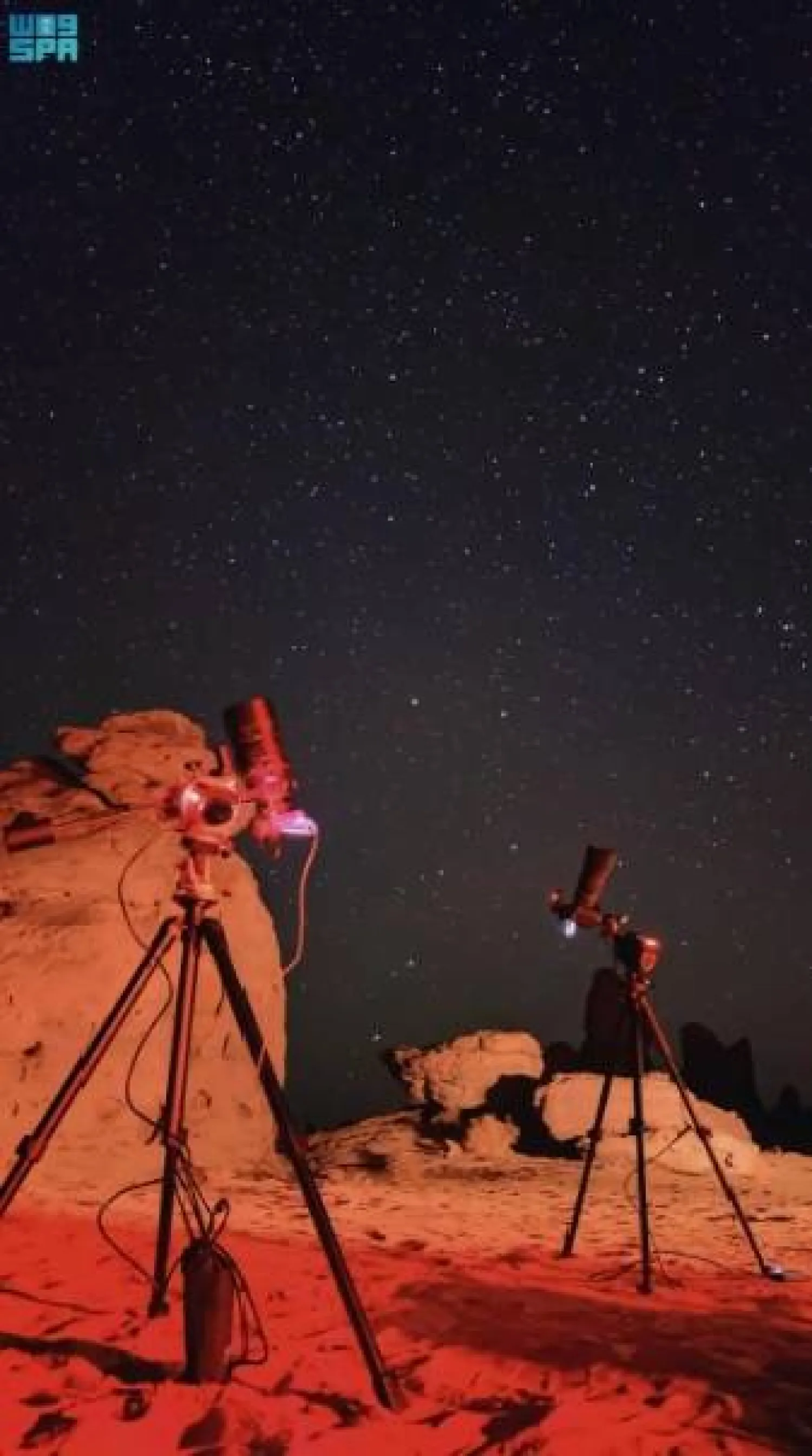

Saudi Arabia’s AlUla, Astrophotographers Launch Initiative to Strengthen Global Astrotourism Profile

Implemented under the “AlUla Manara” umbrella, the initiative supports RCU's objectives to protect the night sky. SPA
TT

Saudi Arabia’s AlUla, Astrophotographers Launch Initiative to Strengthen Global Astrotourism Profile

Implemented under the “AlUla Manara” umbrella, the initiative supports RCU's objectives to protect the night sky. SPA

Saudi Arabia’s AlUla Governorate launched a new initiative in collaboration with leading astrophotographers to highlight its position as a global destination for sustainable astrotourism, as part of the Royal Commission for AlUla's (RCU) efforts to showcase the governorate’s natural and environmental assets.

Implemented under the “AlUla Manara” umbrella, the initiative supports RCU's objectives to protect the night sky, document its exceptional clarity and low light pollution levels, and develop distinctive astrotourism experiences for astronomy and stargazing enthusiasts from within the Kingdom and abroad.

The initiative brought together national and Arab specialists in astrophotography, contributing to enhanced documentation quality, the exchange of technical and scientific expertise, and the development of professional practices in the field.

It focuses on producing scientific and documentary content that highlights AlUla's astronomical features, strengthening its presence on the global map of dark-sky destinations while building a local knowledge base and raising awareness of the importance of preserving the night sky as a natural and cultural resource.

Among the participants was Saudi astrophotographer Abobaker Abdullah Basudan, who documented a range of celestial scenes, taking advantage of AlUla’s clear skies and minimal light pollution.

Using advanced astronomical cameras, telescopes, and star trackers, he captured scenes including the Orion constellation and its famous nebulae, as well as meteors and faint celestial objects.

His work earned him first place nationwide in the “Abaad” competition launched by the Saudi Space Agency, reflecting the growth of national talent in space sciences and astrophotography.

The RCU's efforts have led to several sites in the governorate receiving Dark Sky designations, including AlUla Manara and AlGharameel Reserve, the first accredited Dark Sky sites in the Kingdom and the Gulf region.

Sharaan Nature and Wadi Nakhlah Nature reserves also received the designation under international standards aimed at reducing light pollution and protecting the night sky.

These achievements position AlUla as one of the world’s leading astrotourism destinations, in line with Saudi Vision 2030 objectives to diversify income sources and enhance the Kingdom’s cultural and scientific standing globally.



Northern Japan Hit by Deadly Snowfall, as Warnings Issued on More Heavy Snow

 People clear snow near a building in Aomori, northern Japan, Monday, Feb. 2, 2026. (Kyodo News via AP)
People clear snow near a building in Aomori, northern Japan, Monday, Feb. 2, 2026. (Kyodo News via AP)
TT

Northern Japan Hit by Deadly Snowfall, as Warnings Issued on More Heavy Snow

 People clear snow near a building in Aomori, northern Japan, Monday, Feb. 2, 2026. (Kyodo News via AP)
People clear snow near a building in Aomori, northern Japan, Monday, Feb. 2, 2026. (Kyodo News via AP)

Heavy snow battering northern Japan in the last two weeks has been blamed in 35 deaths nationwide so far, including people suffering sudden heart attacks or slipping while shoveling snow, government officials said Wednesday.

As of Wednesday, 15 prefectures have been affected, with the amount of snow piled up in the worst hit areas estimated to have reached 2 meters (6.5 feet).

The biggest number of snow-related fatalities, at 12 people, was reported in Niigata Prefecture, a rice-growing region in northern Japan, including a man in his 50s who was found collapsed on the roof of his home in Uonuma city on Jan. 21.

In Nagaoka city, a man in his 70s was spotted collapsed in front of his home and rushed to the hospital where he was pronounced dead. He is believed to have fallen from the roof while raking snow, according to the Niigata government.

Japan’s chief government spokesperson warned that, although the weather was getting warmer, more danger could lie ahead because snow would start melting, resulting in landslides and slippery surfaces.

“Please do pay close attention to your safety, wearing a helmet or using a lifeline rope, especially when working on clearing snow,” Chief Cabinet Secretary Minoru Kihara told reporters.

Various task forces were set up to respond to the heavy snow in Niigata and nearby regions, which began Jan. 20. Seven snow-related deaths have been reported in Akita Prefecture and five in Yamagata Prefecture.

Injuries nationwide numbered 393, including 126 serious injuries, 42 of them in Niigata. Fourteen homes were damaged, three in Niigata and eight in Aomori Prefecture.

The reason behind the heavy snowfall is unclear. But deaths and accidents related to heavy snow are not uncommon in Japan, with 68 deaths reported over the six winter months the previous year, according to the Fire and Disaster Management Agency.

More heavy snow is forecast for the coming weekend.


Penny the Doberman Pinscher Wins the 150th Westminster Dog Show

A Doberman named Penny sits next to the awards after winning the "Best in Show" competition at the 150th Westminster Kennel Club dog show in New York City, US, February 3, 2026. (Reuters)
TT

Penny the Doberman Pinscher Wins the 150th Westminster Dog Show

A Doberman named Penny sits next to the awards after winning the "Best in Show" competition at the 150th Westminster Kennel Club dog show in New York City, US, February 3, 2026. (Reuters)

The dog was Penny. The win was priceless.

A Doberman pinscher named Penny won best in show Tuesday night at the Westminster Kennel Club Dog Show, netting US show dogs’ most coveted prize — and giving veteran handler Andy Linton another win after nearly four decades. Linton got best in show in 1989 with another Doberman, named Indy.

Penny “is as great a Doberman as I have ever seen,” Linton told a supportive crowd. Despite health problems, he guided the 4-year-old dog through an impeccably crisp performance.

“I had some goals, and this was one of them,” Linton said, adding later in a conversation with reporters that as he's winding down his career, winning at the milestone 150th annual Westminster show is “extra-special.”

Runner-up — and cheers just as loud — went to a Chesapeake Bay retriever named Cota. While Dobermans have won five times including Tuesday, no retriever has ever won, and their fans applaud every encouraging sign.

Cota also seemed to enjoy the moment, particularly when his handler, Devon Kipp Levy, let him play with the ribbon.

Other finalists included an Afghan hound named Zaida, a Lhasa apso called JJ, a Maltese named Cookie, an old English sheepdog dubbed Graham and a smooth fox terrier called Wager. The judge, two-time Westminster-winning handler David Fitzpatrick, called the lineup one “that will go down in history.”

Each dog is assessed according to how closely it matches the ideal for its breed. The winner gets a trophy, ribbons and bragging rights.

A crowd favorite at the 2025 Westminster show, Penny has rocked show rings since. A throng of handlers and other dog folk cheered for the seemingly undistractable dog and for Linton in early-round action Tuesday afternoon.

Ringside afterward, Penny politely but pointedly nudged her nose into a visitor’s leg, looking for something — pets, as it turned out. She's generally “very chill,” Linton said later, “but she can get pretty pumped up for a bad guy. Or a squirrel.”

Co-owner Greg Chan of Toronto said Penny is “very demanding and very smart,” but she’s also “a pleaser — she’ll do anything for food.” (Her favorite snack? “Everything.”)

Penny came out on top after 2,500 dogs, spanning more than 200 breeds, strutted their stuff at the show.

Even if they didn't make the finals, there were plenty that scored meme-able moments or lightened up the crowd.

Over two nights of semifinals, spectators cheered extra-loud for a Xoloitzcuintli named Calaco, a hairless dog who went around the ring like he had nothing to prove. A vizsla named Beamer charmed the audience by hopping into a box set out for his handler's tools, and Storm the Newfoundland got laughs when he jumped up on his handler, standing as tall as she.

Spectators cheered so loud for a golden retriever named Oliver that they drowned out the arena's announcer, and chants of “Lumpy! Lumpy!” resounded as Lumpy the Pekingese strolled before a judge.

One dog that made history in the semifinals was Millie, a Danish-Swedish farmdog. The small, spry breed just became eligible for the Westminster show this year, and Millie bested about 10 other farmdogs Tuesday afternoon to get to the evening round.


Four Out of Every 10 Cancer Cases Are Preventable, Says WHO

Visitors walk past a sculpture of a pink ribbon installed to promote the "Pink Ribbon" breast cancer awareness campaign in this illustration, October 5, 2011. (Reuters)
TT

Four Out of Every 10 Cancer Cases Are Preventable, Says WHO

Visitors walk past a sculpture of a pink ribbon installed to promote the "Pink Ribbon" breast cancer awareness campaign in this illustration, October 5, 2011. (Reuters)

Nearly four out of every 10 cancer cases could be prevented if people avoided a range of risk factors including smoking, drinking, air pollution and certain infections, the World Health Organization said Tuesday.

New research published on the eve of World Cancer Day estimated that 38 percent of all new cancer cases globally in 2022 -- 7.1 million -- were linked to preventable causes.

The large team of researchers, which included the WHO's International Agency for Research on Cancer, looked at 30 factors that increase the risk of getting cancer.

Tobacco was the leading offender, responsible for 15 percent of all new cancer cases, followed by cancer-causing infections with 10 percent and drinking alcohol with three percent, according to the study published in the journal Nature Medicine.

Other risk factors included being overweight, a lack of exercise, UV radiation and being exposed to threats such as asbestos while working.

"This is the first global analysis to show how much cancer risk comes from causes we can prevent," senior study author Andre Ilbawi, the WHO's team lead for cancer control, said in a statement.

Almost half of all the preventable cases were lung, stomach or cervical cancer.

Lung cancer was linked to smoking and air pollution, while stomach cancer was largely linked to a bacteria called Helicobacter pylori.

Cervical cancer cases were overwhelmingly caused by human papillomavirus (HPV), which vaccines are effective against.

Men were far more likely to get preventable cancer, with 45 percent of new cases compared to 30 percent for women.

And nearly a quarter of all preventable cancer cases among men were from smoking, compared to 11 percent for women.

To address the problem, the researchers called for countries to adopt strong tobacco control measures and alcohol regulation, and to vaccinate against common infections such as HPV, improve air quality and ensure safer workplaces, healthy diets and exercise.

"If we want to reduce the cancer burden we also need to reduce the noncommunicable disease (NCD) burden -- it is indisputable that tobacco, alcohol, ultra-processed food and air quality are major drivers of multiple kinds of cancer," said Katie Dain, CEO of the NCD Alliance.