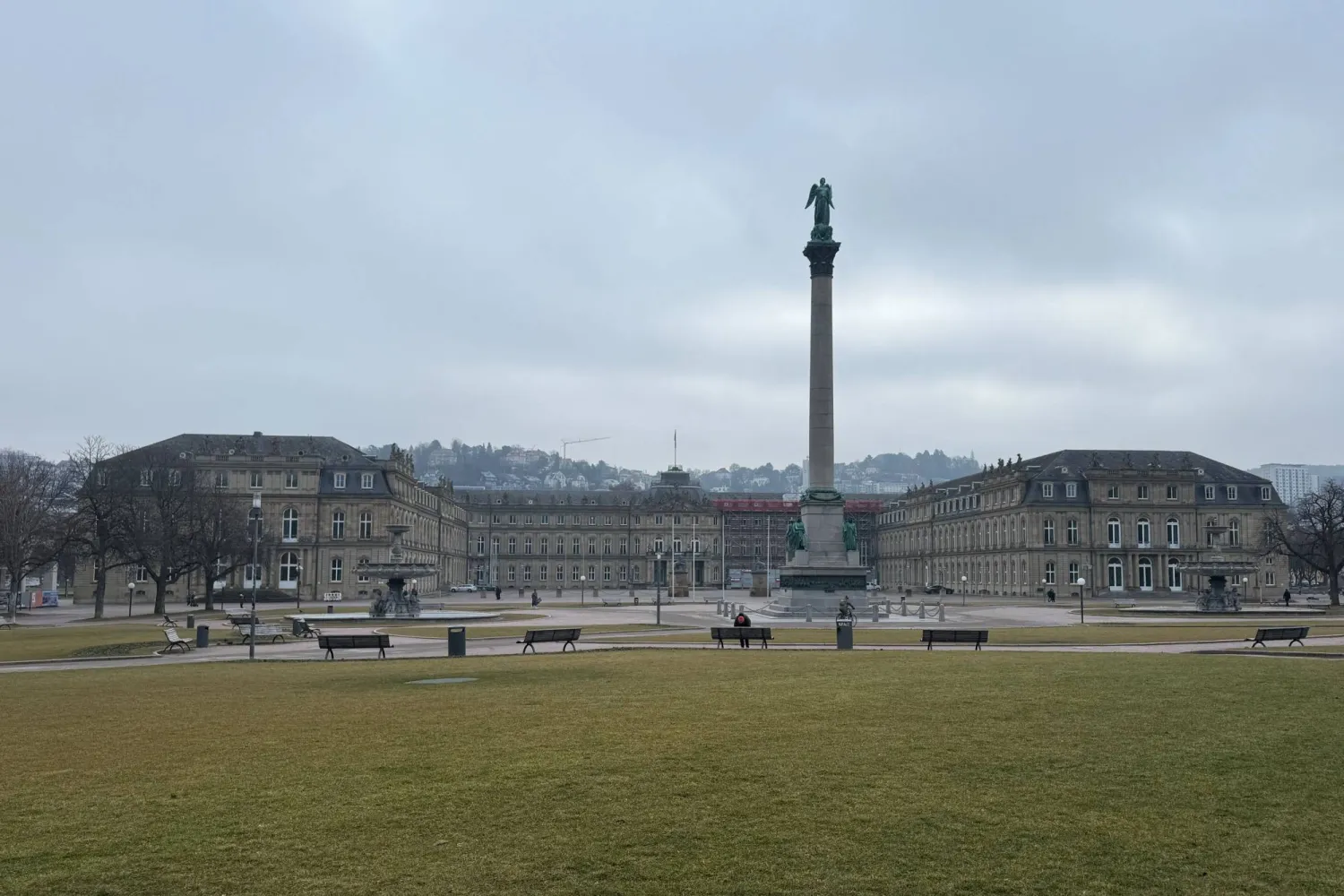
German City of Stuttgart Suffers Major Power Outage

05 February 2026, Baden-Württemberg, Stuttgart: View of the New Palace in Stuttgart. There is a major power outage in the city of Stuttgart. Photo: Stefanie Järkel/dpa
TT

German City of Stuttgart Suffers Major Power Outage

05 February 2026, Baden-Württemberg, Stuttgart: View of the New Palace in Stuttgart. There is a major power outage in the city of Stuttgart. Photo: Stefanie Järkel/dpa

The south-western German city of Stuttgart is suffering a major ‌power ‌outage ‌on ⁠Thursday, police said ‌on social media platform X, warning residents to ⁠be particularly ‌careful while ‍driving.

Some ‍traffic lights ‍are affected, said police in the city with a population ⁠of about 620,000.

They did not say what caused the outage, Reuters said.


Fifth Saudi Media Forum Concludes with Awards Ceremony and Global Participation

The closing ceremony of the fifth edition of the Saudi Media Forum, held under the theme “Media in an Evolving World". (SPA)
TT

Fifth Saudi Media Forum Concludes with Awards Ceremony and Global Participation

The closing ceremony of the fifth edition of the Saudi Media Forum, held under the theme “Media in an Evolving World". (SPA)

Saudi Minister of Media Salman Al-Dossary attended on Wednesday the closing ceremony of the fifth edition of the Saudi Media Forum, held under the theme “Media in an Evolving World,” alongside the accompanying Future of Media Exhibition (FOMEX).

The ceremony also included the announcement of the winners across the Forum’s award tracks, in the presence of several distinguished officials and media professionals from within the Kingdom and abroad.

President of the Saudi Media Forum Mohammed Al-Harthi expressed appreciation to all supporters, partners, and participants, affirming that a culture of gratitude and appreciation reinforces the values of recognition and acknowledgment of efforts.

He noted that the forum attracted around 300 speakers from countries around the world, and that the strong turnout enriched discussions and helped transform the event into a global media platform.

Al-Harthi said FOMEX achieved broad global participation, with more than 250 companies taking part and showcasing the latest content-creation technologies.

He emphasized that media today is a key partner in development, a contributor to awareness-building, and a driver of change.

The Saudi Media Forum announced that it had set a new global record, with 65,603 visitors in attendance, earning a Guinness World Records certificate and underscoring its rising profile among international media events.

During the closing ceremony, the winners of the Forum’s awards for its fifth edition were announced. Khalid Al-Badr won the news report award, Abdulhadi Habtoor received the journalistic interview award, while Lama Al-Suhali won the academic research award.

In the visual and audio media category, the winner of the AI-generated content award was announced. The “Rachid Show” from Morocco won the social talk shows track award, while the Ministry of Culture received the podcast and radio talk shows track award for its podcast "1949".

The Tourism Development Fund won the best media work for National Day award, while the Ministry of Defense won the best media work for Founding Day award for the film “Al-Awja.”

Supervisor General of the King Salman Humanitarian Aid and Relief Center Dr. Abdullah Al-Rabeeah received the global competitor award, while Dr. Mohammed Al-Rumaihi won the column writing award. The Saudi Vision 2030 account was awarded the best media work for Flag Day award.

During the ceremony, the media personality of the year award was presented to Dr. Hussein Najjar in recognition of his distinguished media career.

At the conclusion of the ceremony, commemorative photos were taken of the winners with the minister of media, who honored the forum’s partners and sponsors.


CIA Ends Publication of Its Popular World Factbook Reference Tool

CIA Ends Publication of Its Popular World Factbook Reference Tool
TT

CIA Ends Publication of Its Popular World Factbook Reference Tool

CIA Ends Publication of Its Popular World Factbook Reference Tool

Close the cover on the CIA World Factbook: The spy agency announced Wednesday that after more than 60 years, it is shuttering the popular reference manual.

The announcement posted to the CIA’s website offered no reason for the decision to end the Factbook, but it follows a vow from Director John Ratcliffe to end programs that don’t advance the agency’s core missions, The Associated Press said.

First launched in 1962 as a printed, classified reference manual for intelligence officers, the Factbook offered a detailed, by-the-numbers picture of foreign nations, their economies, militaries, resources and societies. The Factbook proved so useful that other federal agencies began using it, and within a decade, an unclassified version was released to the public.

After going online in 1997, the Factbook quickly became a popular reference site for journalists, trivia aficionados and the writers of college essays, racking up millions of visits per year.

The White House has moved to cut staffing at the CIA and the National Security Agency early in Trump's second term, forcing the agency to do more with less.

The CIA did not return a message seeking comment Wednesday about the decision to cease publication of the Factbook.


The Coming End of ISS, Symbol of An Era of Global Cooperation

The International Space Station will be guided back to Earth in 2030, marking the end of its three-decade mission. NASA / GETTY IMAGES NORTH AMERICA/AFP/File
TT

The Coming End of ISS, Symbol of An Era of Global Cooperation

The International Space Station will be guided back to Earth in 2030, marking the end of its three-decade mission. NASA / GETTY IMAGES NORTH AMERICA/AFP/File

When the International Space Station comes back to Earth in 2030, it will mark the end of three decades of peaceful international cooperation -- and an era when space became central to our daily lives.

Since November 2000, there have always been several humans on board the football field-sized scientific laboratory, whipping around the planet at eight kilometers per second.

With a new crew of astronauts set to blast off for the station as soon as next week, some of those who have helped the station from the ground are nostalgic about its looming demise.

"The ISS is a cathedral to human cooperation and collaboration across borders, languages and cultures," John Horack, the former manager of NASA's Science and Mission Systems Office, told AFP.

"For more than 25 years, we have had people in space, 24/7/365," added Horack, who now holds the Neil Armstrong Chair in aerospace policy at Ohio State University.

"It is a testament to how we can 'figure it out' rather than 'fight it out' when we wish to interact with each other."

The ISS was first proposed in the aftermath of the Cold War, illustrating a newfound spirit of cooperation between space race rivals Russia and the United States.

While many ties between Russia and the West have been severed over Moscow's war in Ukraine, cooperation has continued on board the space station.

"The history of human spaceflight is first and foremost the space race," Lionel Suchet of France's space agency CNES told AFP.

"This is a very interesting moment in the evolution of space exploration," said Suchet, who coordinated several early ISS projects after witnessing its predecessor, the Mir space station, de-orbiting in 2001.

Back to Earth

However, the ISS is getting old and its equipment is outdated.

NASA announced last year it had selected Elon Musk's SpaceX to build a vehicle that can push the station back into Earth's atmosphere in 2030, where it will break up.

"This large rocket engine will slow down the ISS, and enable it to have a precise re-entry over the Pacific Ocean, far from land, people or any other potential hazards," Horack explained.

Several spacecraft and telescopes -- including Mir -- have met a similar fate, splashing down at an isolated spot in the ocean called Point Nemo.

After 2030, the only space station orbiting Earth will be China's Tiangong.

For the future, the US is focusing more on space stations built and operated by private companies.

"We are moving into an era where space stations have a much more commercial dimension," similar to what has already happened with rockets and satellites, Horack said.

National space agencies would then need to pay these companies to stay on board.

Several companies, including Jeff Bezos's Blue Origin and Axiom Space, are already working on plans to build the first commercial space station.

Suchet emphasized that "the business model will still be largely institutional because countries are always interested in sending astronauts into low-Earth orbit".

Scientific research and exploration also remain an "objective of all humanity", he added, pointing to treaties that govern how nations are supposed to act in space.

Whether these treaties will hold once humans make it to the Moon -- the US and China both have plans to build lunar bases -- remains to be seen.

'Quite sad'

For Horack, the end of the ISS could be seen as "quite sad".

His children "had a lifetime of going out into the backyard to watch the ISS fly over".

But the end of this era will mark the opening of another, he added.

"We must grow as humans in our space-faring capacity, in our exploration of space, and in the use of space to generate social, economic, educational and quality of life outcomes for all people everywhere."

He finished by quoting the former head of the European Space Agency, Jean-Jacques Dordain: "If you want to go fast, go alone. If you want to go far, go together."