

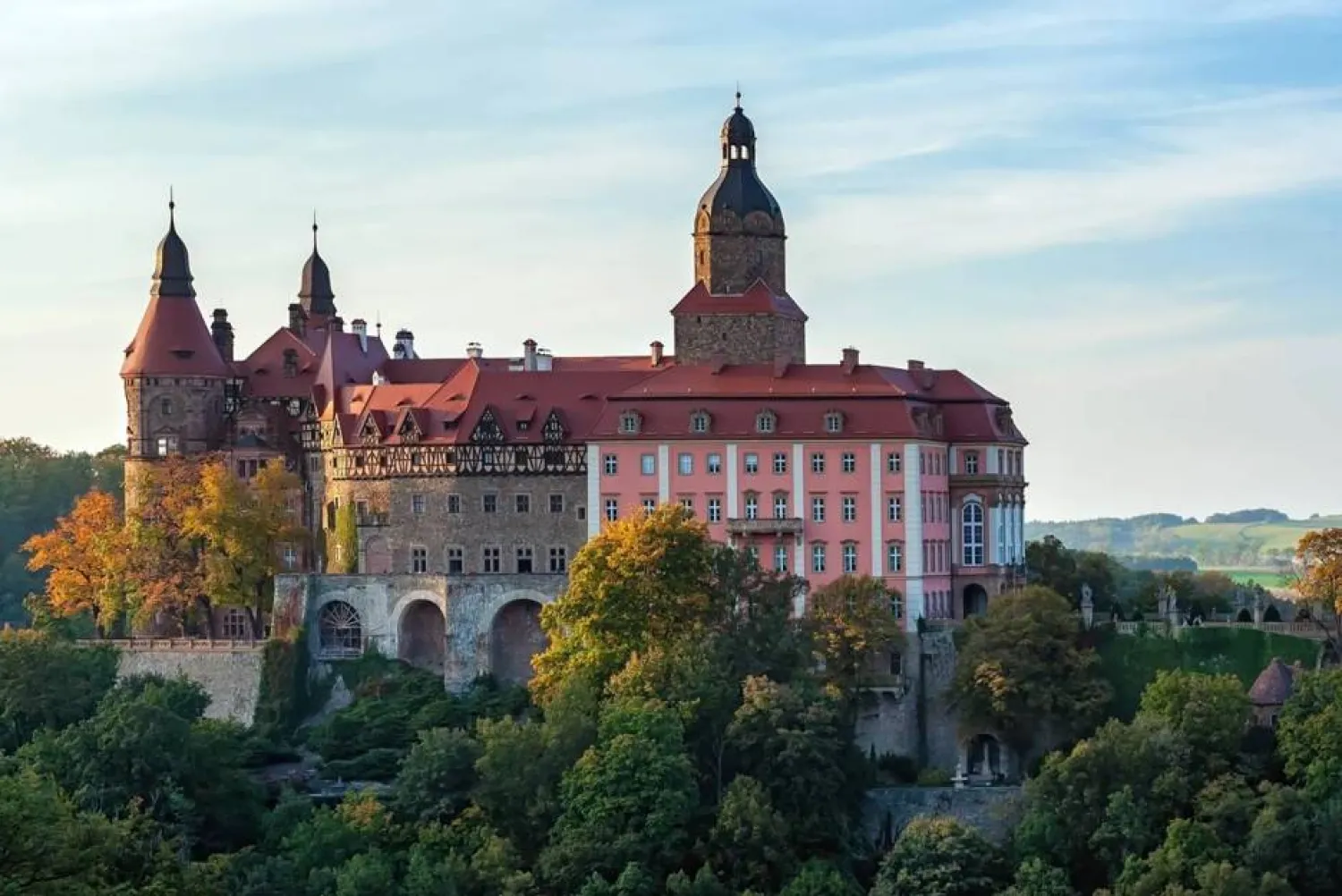

Ksiaz Castle: A Dark Nazi Secret and Buried Gold Mystery

Ksiaz Castle is one of Poland’s most popular attractions (Shutterstock)
TT

Ksiaz Castle: A Dark Nazi Secret and Buried Gold Mystery

Ksiaz Castle is one of Poland’s most popular attractions (Shutterstock)

The road to Ksiaz Castle feels almost too peaceful. Forested hills roll off into the distance, yew trees as far as the eye can see. And then a colossal building rears up over the landscape of Lower Silesia — dramatic and impossible to ignore.

Part Baroque palace, part Renaissance fortress, Poland’s third largest castle looks like something lifted from a fairytale, according to CNN.

But beneath the lavish architecture lies a darker story.

Here, deep in Poland’s Owl Mountains, lies a vast underground Nazi complex tied to one of the Third Reich’s most mysterious construction projects and, legend has it, a lost train filled with stolen gold.

Ksiaz’s history stretches back to the Middle Ages, when Silesian duke Bolko I the Strict built a fortress on this hilltop. Over time it expanded into a grander residence.

In 1466, Hans von Schellendorf acquired the castle and named it Schloss Fürstenstein — a title it would keep until the end of World War II.

As Lower Silesia was a part of Prussia until the 20th century, the castle became one of Germany’s most significant aristocratic residences.

In 1944, with World War II raging, the Nazis seized control of the castle from Count Hans Heinrich XVII, who had already relocated to England. Ksiaz and the Owl Mountains then became a hub for Project Riese — German for “Giant.”

The project aimed to create a network of massive underground facilities across Lower Silesia. Seven major subterranean complexes have been discovered so far, but the true purpose of the tunnels remains uncertain. Many documents were destroyed or hidden by the Nazis as the war ended.

Brutal conditions

The tunnels at Ksiaz lie away from the heart of most of the Project Riese structures, deepening the mystery here.

According to Mateusz Mykytyszyn, Ksiaz's head of public relations, it’s widely assumed this is because the castle was intended to become Adolf Hitler’s Headquarters — though definitive proof has never emerged.

What is known is the human cost.

More than 13,000 prisoners were brought to the region to excavate tunnels and construct underground infrastructure.

The tunnels beneath Ksiaz stretch nearly a mile. Some passages are constructed from reinforced concrete, made smooth and precise. Measuring five meters high, or roughly 16.5 feet, they’re wide enough to drive a car down.

Some sections are just bare rock. In one tunnel, the remains of a narrow-gauge railway used during excavation can be seen.

There are modern exhibitions here that use projections and audio to tell the story of Project Riese. Screens illuminate dark chambers with archival images and historical context. The effect is immersive and — particularly because of the human cost of creating the space they’re in — often unsettling.

Many visitors say it’s the scale that leaves the deepest impression.

Buried gold?

Despite the documented history, myths continue to swirl around Lower Silesia — especially the story of a hidden train loaded with stolen Nazi gold.

“Even today, many people are looking for the treasures and hidden tunnels here,” said Michał Miszczuk, a local guide at Underground City Osówka, another major Project Riese complex nearby.

The legend suggests that during their retreat from Wrocław — then Breslau — in 1945, Nazi forces concealed a train filled with valuables somewhere in the Owl Mountains. In 2015, treasure hunters received permission to excavate a suspected site near Wałbrzych known as Zone 65, but found nothing.

But the mystery persists, fueled by missing documents and the many undiscovered tunnels believed to remain sealed.

“Lower Silesia has been German for centuries,” explained Miszczuk. “Even if they knew the war was lost, they were sure that they would get this land back.”

Believing in a buried treasure is easier when standing in the dark tunnels of Osowka, which are rough and rocky, in contrast to the mostly smooth concrete of Ksiaz.

The complex spans roughly two kilometers, or just over a mile, with towering chambers and a 48-meter vertical shaft. Some researchers speculate that it may have been intended as a central hub connected to other Riese sites.

Today, Ksiaz Castle is one of Poland’s most popular attractions. Spring brings crowds for the Festival of Flowers and Art, while nearby hotels housed in former outbuildings accommodate visitors year-round. The castle also hosts conferences, weddings and cultural events.

The global fascination with the supposed Nazi gold train has boosted international attention.


Jewellery Worth Millions Stolen in French Museum Burglary

 This photograph shows the logo of French luxury crystal manufacturer Lalique displayed on the facade of the group's factory in Wingen-sur-Moder, eastern France on December 5, 2007. (AFP)
This photograph shows the logo of French luxury crystal manufacturer Lalique displayed on the facade of the group's factory in Wingen-sur-Moder, eastern France on December 5, 2007. (AFP)
TT

Jewellery Worth Millions Stolen in French Museum Burglary

 This photograph shows the logo of French luxury crystal manufacturer Lalique displayed on the facade of the group's factory in Wingen-sur-Moder, eastern France on December 5, 2007. (AFP)
This photograph shows the logo of French luxury crystal manufacturer Lalique displayed on the facade of the group's factory in Wingen-sur-Moder, eastern France on December 5, 2007. (AFP)

Jewellery worth millions of euros was stolen in a burglary at the museum of French luxury glassmaker Lalique on Sunday, the company and an investigation source said.

The thief or thieves broke in to the museum in Wingen-sur-Moder in northeastern France around 5:30 am (0330 GMT) and headed straight for the jewellery room, the source close to the investigation told AFP.

"Around twenty pieces of jewellery were stolen. The loss is currently being assessed but could amount to several million euros, likely close to four million," the source said.

The museum said on its website that it will be closed for several days because of the burglary.

"An alarm went off, but by the time the security company had completed its checks, it was a cleaning lady who arrived first on the scene and called the police," the investigation source added.

The CCTV footage is currently being examined.

The museum, dedicated to the Art Nouveau and Art Deco jeweller and glassmaker Rene Lalique, was opened in 2011 near the company's factory.

A dramatic daytime jewel heist at the Louvre museum in Paris in October last year put security at French museums and galleries under the spotlight.

Thieves made off with $102 million worth of jewellery from the Louvre in a raid lasting less than eight minutes.


Security Forces Hospital in Riyadh Treats Premature Infant's Rare Brain Condition

The newborn was discharged after approximately six weeks in stable condition, showing encouraging signs of neurological growth and development. (SPA)
TT

Security Forces Hospital in Riyadh Treats Premature Infant's Rare Brain Condition

The newborn was discharged after approximately six weeks in stable condition, showing encouraging signs of neurological growth and development. (SPA)

The Security Forces Hospital in Riyadh successfully diagnosed and treated a premature infant with a large occipital encephalocele measuring more than 10 centimeters in diameter, a rare and complex congenital malformation of the nervous system, reported the Saudi Press Agency on Sunday.

The condition was diagnosed prenatally in the hospital's high-risk pregnancy clinic using advanced ultrasound imaging and fetal MRI.

The examinations revealed brain tissue and major blood vessels within the encephalocele, prompting the development of a comprehensive treatment plan involving specialists from the departments of obstetrics and gynecology, neurosurgery, the Neonatal Intensive Care Unit (NICU), and social services.

The mother underwent a safe cesarean section, after which the premature infant was admitted to the NICU. Following a comprehensive medical evaluation and consultation with the family regarding the treatment plan, the infant successfully underwent surgical repair of the occipital encephalocele.

The infant subsequently had a procedure to drain cerebrospinal fluid to treat hydrocephalus, without notable complications.

The newborn was discharged after approximately six weeks in stable condition, showing encouraging signs of neurological growth and development.

This achievement highlights the effective integration of multidisciplinary medical teams and the advanced capabilities of the Ministry of Interior's medical services, reinforcing the quality of healthcare and patient safety.


Unbearable Heat Suspected in 19 New Jersey Deaths as High Temperatures Give Way to Thunderstorms

 People walk through the Empty Sky Memorial, with the One World Trade Center in the background, as the United States celebrates its 250th anniversary on Independence Day, in Jersey City, New Jersey, US, July 4, 2026. (Reuters)
People walk through the Empty Sky Memorial, with the One World Trade Center in the background, as the United States celebrates its 250th anniversary on Independence Day, in Jersey City, New Jersey, US, July 4, 2026. (Reuters)
TT

Unbearable Heat Suspected in 19 New Jersey Deaths as High Temperatures Give Way to Thunderstorms

 People walk through the Empty Sky Memorial, with the One World Trade Center in the background, as the United States celebrates its 250th anniversary on Independence Day, in Jersey City, New Jersey, US, July 4, 2026. (Reuters)
People walk through the Empty Sky Memorial, with the One World Trade Center in the background, as the United States celebrates its 250th anniversary on Independence Day, in Jersey City, New Jersey, US, July 4, 2026. (Reuters)

Several days of scorching temperatures are suspected to have caused at least 19 deaths in New Jersey as a heat dome that had settled above parts of the central and eastern United States gives way to severe storms that have knocked out power to close to 1 million homes and businesses.

New Jersey officials said Saturday that they began seeing what they believe are heat-related deaths as early as Thursday with most occurring in the central and northern parts of the state.

“Unfortunately, many of these individuals were found in homes without air conditioning,” state Health Commissioner Dr. Raynard Washington told reporters Saturday. "A few were outside their residences, some on the street and some even in parked cars.”

New Jersey Gov. Mikie Sherrill called the current weather “the hottest stretch we’ve seen in over 14 years.”

“The heat's hitting all of us, not just seniors, not just with underlying health conditions, people of all ages,” Sherrill said.

On Thursday, LaGuardia Airport in New York set a new record high of 104 degrees Fahrenheit (40 degrees Celsius), topping the previous record of 101 F (38.3 C) set in 1966, according to Bryan Jackson, a meteorologist with the National Oceanic and Atmospheric Administration’s Weather Prediction Center.

Trenton, New Jersey, reached 101 F, which broke the record of 100 F (37.7 C) set in 1901. Newark’s high Thursday was 105 F (40.5 C).

Atlantic City, New Jersey, hit 103 F (39.4 C) on Thursday, breaking the city’s record of 100 F set in 1966, Jackson said. Atlantic City reached 105 F on Friday and 106 F (41.1 C) on Saturday.

Heat domes can be dangerous and combine very high temperatures with high moisture, Jackson said.

“In a lot of cases they also had direct sunshine,” he said. “It was relentless. It was multiple days. It was not as cool overnight, as well. The low Friday morning in Atlantic City was 80. The body can't recover as well. You just have that multiple day buildup and too much added stress on the body.”

But even as the heat moved to the east, lowering temperatures a bit, severe storms blew in with heavy winds that toppled utility poles and split trees, causing their boles and branches to fall onto power lines.

About 900,000 utility customers in parts of the central, eastern and southern United States were without electricity early Sunday afternoon, according to PowerOutage.com.

More than 223,000 customers in Michigan and close to 170,000 in Pennsylvania had lost power.

PPL Electric reported 121,417 without power Sunday morning, including about 47,000 in the Harrisburg, Pennsylvania, area.

Central Hudson in New York State reported that it had more than 430 reported downed wires on Sunday. The utility said about 50,000 customers were affected by the storm and that about 650 still were without power Sunday.

Amanda Vesper was putting her children to bed Friday evening when the first storm rolled through the Detroit area, knocking out her power.

“It didn't seem that awful. It got quite windy,” said Vesper, 40, of Commerce Township.

As of late Sunday morning, the electricity still was out.

“We've been going back and forth between a hotel and our home because we have dogs there,” she said. “We really can't stay there. I have a small child with autism. Our well runs on an electric pump.”

The outage also ruined the family's July 4 celebration.

“We had planned on having company over at the house, but had to cancel,” Vesper said. “I went grocery shopping. I'm hoping my freezer holds.”

Jackson, with the Weather Prediction Center, said Sunday will see heavy thunderstorms in and around the Cleveland area. Those storms then will shift eastward and move into Pennsylvania, New Jersey and New York — where chances exist for flash flooding, he added.
