

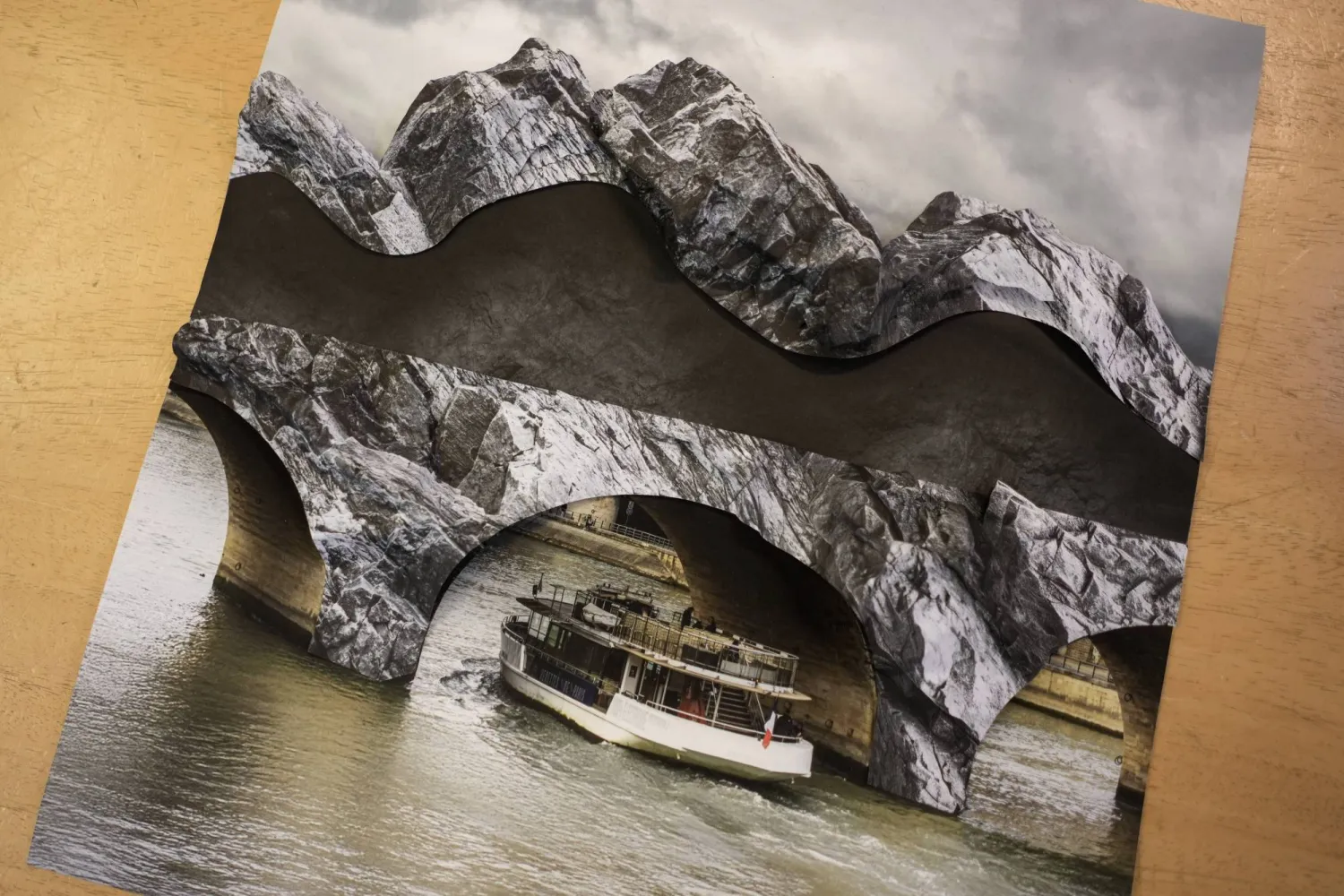

French Artist's Installation Will Transform Paris' Oldest Bridge Into Giant Cave

A photomontage shows the project by French artist JR called Pont Neuf Cavern in his studio, in Paris, France, Tuesday, Feb. 17, 2026. (AP Photo/Thibault Camus)
TT

French Artist's Installation Will Transform Paris' Oldest Bridge Into Giant Cave

A photomontage shows the project by French artist JR called Pont Neuf Cavern in his studio, in Paris, France, Tuesday, Feb. 17, 2026. (AP Photo/Thibault Camus)

He is known as the French Banksy — or simply JR. Now the artist popular across France for large-scale projects, from photographs to graffiti and street art, wants Parisians to do something unusual on the city's arguably most famous bridge: stop.

In June, he plans to transform the bustling bridge that dates back to the 17th century into a walk-through “cave” — a temporary, monumental public artwork that will cover the stone arches with a rocky illusion and invite visitors to cross the River Seine through a tunnel complete with sound and digitally augmented reality.

He says it's possibly the “largest immersive installation ever made” and — one that will be accessible around the clock and offer a “totally different approach” to the bridge.

“We’re about to leave something pretty incredible in the middle of Paris,” JR told The Associated Press at his studio in eastern Paris, wearing his trademark hat and shades.

His project, the Pont Neuf Cavern is to run June 6-28, spanning 120 meters (yards) in length and over 17 meters in height.
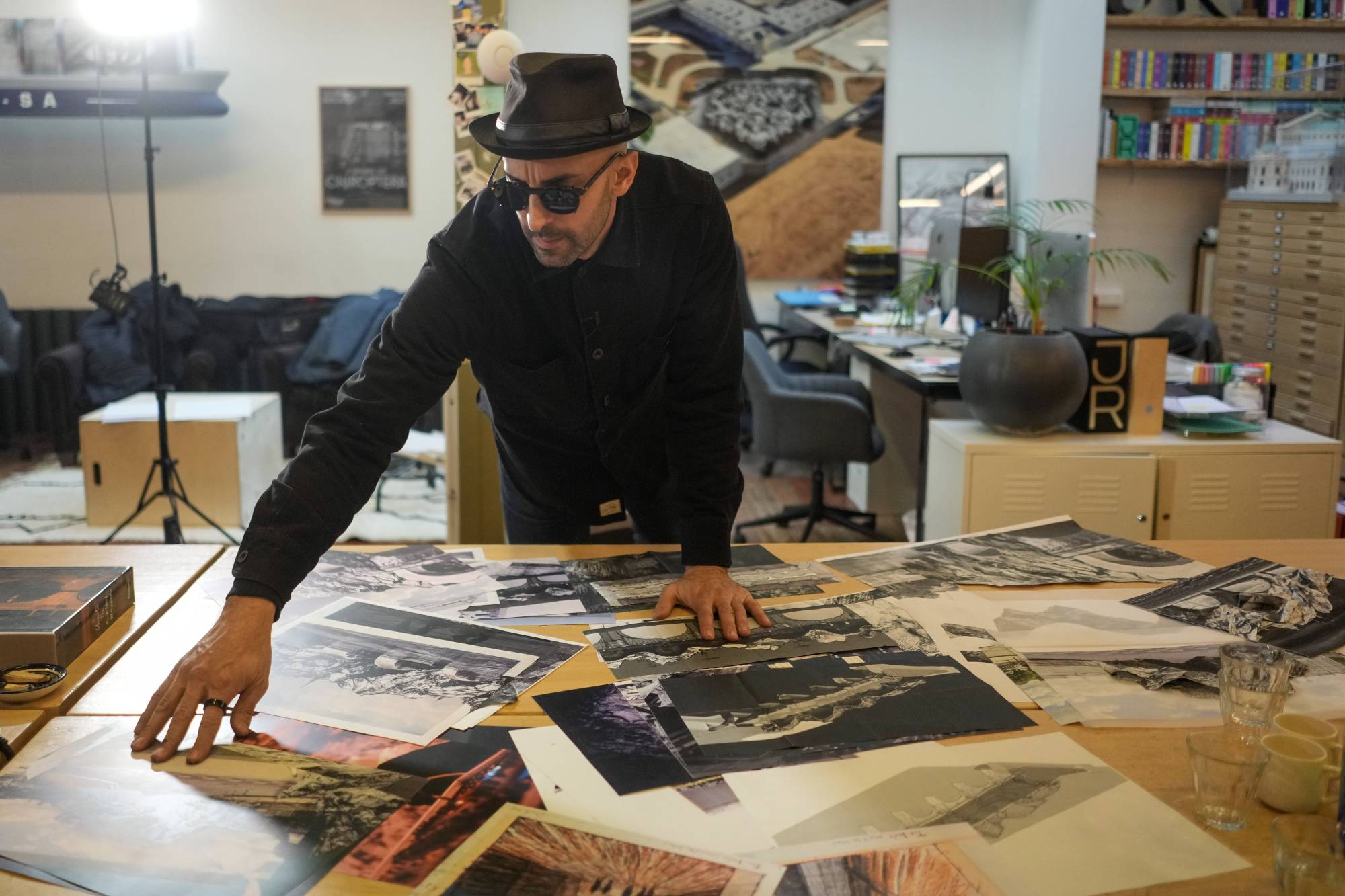
French artist JR shows his project Pont Neuf Cavern during an interview with The Associated Press in his studio, in Paris, France, on Feb. 17, 2026. (AP Photo/Thibault Camus)

The installation is a nod to a Paris legend: the late artistic duo Christo and Jeanne-Claude who in 1985 wrapped Pont Neuf — and its streetlamps — in a pale golden fabric.

The project, which took years of negotiations with the authorities, helped define the genre of monumental public art in modern cities across the world.

To JR, the homage is both aesthetic and personal.

“I had the chance to meet Christo along the years," he said. "We had big respect for each other’s work.”

While walking recently on the street with an AP crew, an older woman stopped JR — now, a household name in his country — to share her memories of the Christo and Jeanne-Claude wrapping. She told him she was excited to see the bridge transformed again.

Still, JR — a pseudonym stemming from first name, Jean-René — acknowledges the weight of following in the iconic pair's footsteps.

“It’s pretty hard to go after them,” he said, “but I’m doing it in a very different style, in my own way.”

His idea is about “bringing back mineral and nature" to the heart of Paris.

From the outside, his installation will make Pont Neuf look “as if it has been overtaken by a prehistoric outcrop,” a structure visible along the banks of the Seine — a rocky mass that is “literally going to break the landscape,” he said.

JR said there will be two main ways for people to experience his installation. From the outside, those heading to Pont Neuf will see the giant installation hundreds of meters away.

And from the inside, once visitors enter the “cave” on Pont Neuf, they will be able to walk through a long tunnel-like structure, having a feeling of "total immersion,” he said.

The cave will allow no daylight in and once inside, visitors “will lose track of time,” JR said.

A key collaborator on the project is Thomas Bangalter, a former member of French rock band Daft Punk who is creating the sound to accompany the installation — “something you’ll only hear from the inside,” JR said.

Snap’s AR studio in Paris is developing the augmented reality technology. Visitors will be able to use their smartphones to “experience and see things that you can’t see with your eyes,” JR said.

He is intentionally mysterious about what that is — keeping it a surprise until closer to the opening.

JR's team conducted extensive engineering studies, including tests in a hangar at Paris' Orly airport, to understand how the structure behaves, especially in an emergency when the electricity that fuels the cave's air supply cuts off. Tests show the structure stays the same. There is also the security question — the bridge is a busy zone, especially during Paris’ tourist-packed early summer.

JR said visitor numbers will be limited at any given time, and that his team is consulting with authorities on that. During the three weeks of the exhibition, the installation will be continuously monitored.

JR is best known for his large-scale art — enormous portraits pasted on buildings, border walls and rooftops. Because of his origins in graffiti and street art he has inevitably drawn comparison with Banksy, the elusive UK-based artist famous for his huge murals and activism.

JR's installation will not have any massive faces, but the theme is still human, he says: gathering, connection, and what people project onto a shared space.

He says his installation is also an allusion to Plato’s allegory of the cave in which chained men interpret shadows on the cave wall as reality, ignorant of the real world outside — and compares that to the fake reality created by the visual world of our social media platforms.

“What are our caves today is our phone,” JR said, “because we ... believe that ... our algorithm on social media ... is the reality.”

During the installation, which will coincide with June's Paris Fashion Week and World Music Day, the bridge will close to traffic.



Two Holy Mosques Exhibition Welcomes Visitors for Founding Day Celebrations

The exhibition is open daily from 10:00 a.m. to 1:30 a.m - SPA
TT

Two Holy Mosques Exhibition Welcomes Visitors for Founding Day Celebrations

The exhibition is open daily from 10:00 a.m. to 1:30 a.m - SPA

In celebration of the Kingdom’s Founding Day, the Exhibition of the Two Holy Mosques Architecture in Makkah is welcoming visitors to explore a comprehensive historical journey.

The exhibition presents the evolution of the Two Holy Mosques through rare artifacts, historical photographs, and documentation of successive Saudi expansions, according to SPA.

The halls highlight the Kingdom’s long-standing dedication to serving the Two Holy Mosques. They combine heritage and modern technology to present the architectural development of Islam’s holiest sites.

The exhibition is open daily from 10:00 a.m. to 1:30 a.m.


Photos Show Filming of Ramadan TV Drama Series on the War-scarred Streets of Syria's Aleppo

Extras stand by as a television crew films an episode of the TV series “Al-Souriyoun al-Aada” (“The Syrian Enemies”), based on a novel of the same name that was banned under Bashar Assad, along a transformed street in central Aleppo, Syria, Friday, Feb. 13, 2026. (AP Photo/Ghaith Alsayed)
TT

Photos Show Filming of Ramadan TV Drama Series on the War-scarred Streets of Syria's Aleppo

Extras stand by as a television crew films an episode of the TV series “Al-Souriyoun al-Aada” (“The Syrian Enemies”), based on a novel of the same name that was banned under Bashar Assad, along a transformed street in central Aleppo, Syria, Friday, Feb. 13, 2026. (AP Photo/Ghaith Alsayed)

Ramadan in the Arab world is a month of fasting and prayer by day — and television by night. For decades, families have gathered after the iftar, the evening meal that breaks the daytime fast, to follow the season’s highly anticipated drama series, produced specially to air during the Islamic holy month.

In the week before Ramadan, a television crew in central Aleppo was busy preparing one of those productions, with a battered street in the historic city transformed into a scene from decades past.

Lamees Al-Ali, an extra in the series, poses for a photograph during the filming of an episode of the TV series “Al-Souriyoun al-Aada” (“The Syrian Enemies”), based on a novel of the same name that was banned under Bashar Assad, along a transformed street in central Aleppo, Syria, Friday, Feb. 13, 2026. (AP Photo/Ghaith Alsayed)

Classic 1970s cars lined the curb. A horse-drawn cart rolled through the frame. A vendor in a red tarboush, a brimless cone-shaped hat, stood beside steaming pots of sahlep — a sweet, thickened milk drink flavored with spices and associated with winter evenings.

Just outside the camera’s view stood a stark reminder of Syria's more recent history. Collapsed buildings and damaged facades testified to Aleppo’s role as a major battleground during the country's civil war. However, with costumes, props and careful framing, the production temporarily carried the street back to what it portrays as a more innocent era, according to The AP news.

A television crew films an episode of the TV series “Al-Souriyoun al-Aada” (“The Syrian Enemies”), based on a novel of the same name that was banned under Bashar Assad, along a transformed street in central Aleppo, Syria, Friday, Feb. 13, 2026.(AP Photo/Ghaith Alsayed)

The series being filmed — “Al-Souriyoun al-Aada,” or “The Syrian Enemies” — is based on a novel that was banned during the rule of former President Bashar Assad. The story examines painful chapters of Syria’s past, including the 1982 events in Hama, when government forces crushed an uprising led by the Muslim Brotherhood, killing or disappearing an estimated 10,000 to 40,000 people and leaving the city in ruins.

As filming continues into Ramadan, the production reflects both a cherished seasonal tradition and Syria’s complex, layered history.


How Bomb Cyclones Form and Create Dangerous Conditions 

A man works in a snowstorm, Sunday, Feb. 22, 2026, in New York. (AP)
TT

How Bomb Cyclones Form and Create Dangerous Conditions 

A man works in a snowstorm, Sunday, Feb. 22, 2026, in New York. (AP)

When turbulent weather with whipping winds and heavy snow is in the forecast, meteorologists sometimes warn that a storm could “bomb out” or become a bomb cyclone. But what exactly does this mean?

According to the US National Oceanic and Atmospheric Administration, certain storms undergo bombogenesis, which happens when a storm’s central pressure drops at least 24 millibars in 24 hours. These storms are sometimes called bomb cyclones. Storm intensity is measured by central pressure, so the lower the pressure, the stronger the storm.

Such rapidly strengthening storms are capable of producing heavy rain, blizzard conditions and intense winds that can create dangerous conditions such as downed trees and power outages.

“If you’re watching TV at night and the weather report comes on and you’re hearing ‘bomb cyclone’ being used, that usually means there’s quite a bit of active weather going on,” said Andrew Orrison, a meteorologist with the National Weather Service in College Park, Maryland.

Bomb cyclones can happen in any season, but mainly occur during fall and winter when frigid air from the Arctic can creep south and clash with warmer air masses.

“It’s really the clash of those air masses that really kind of helps to generate the areas of low pressure in the first place,” said Orrison.

Regions in North America that are prone to seeing bomb cyclones include Alaska, the Pacific Northwest and the Great Lakes region.