

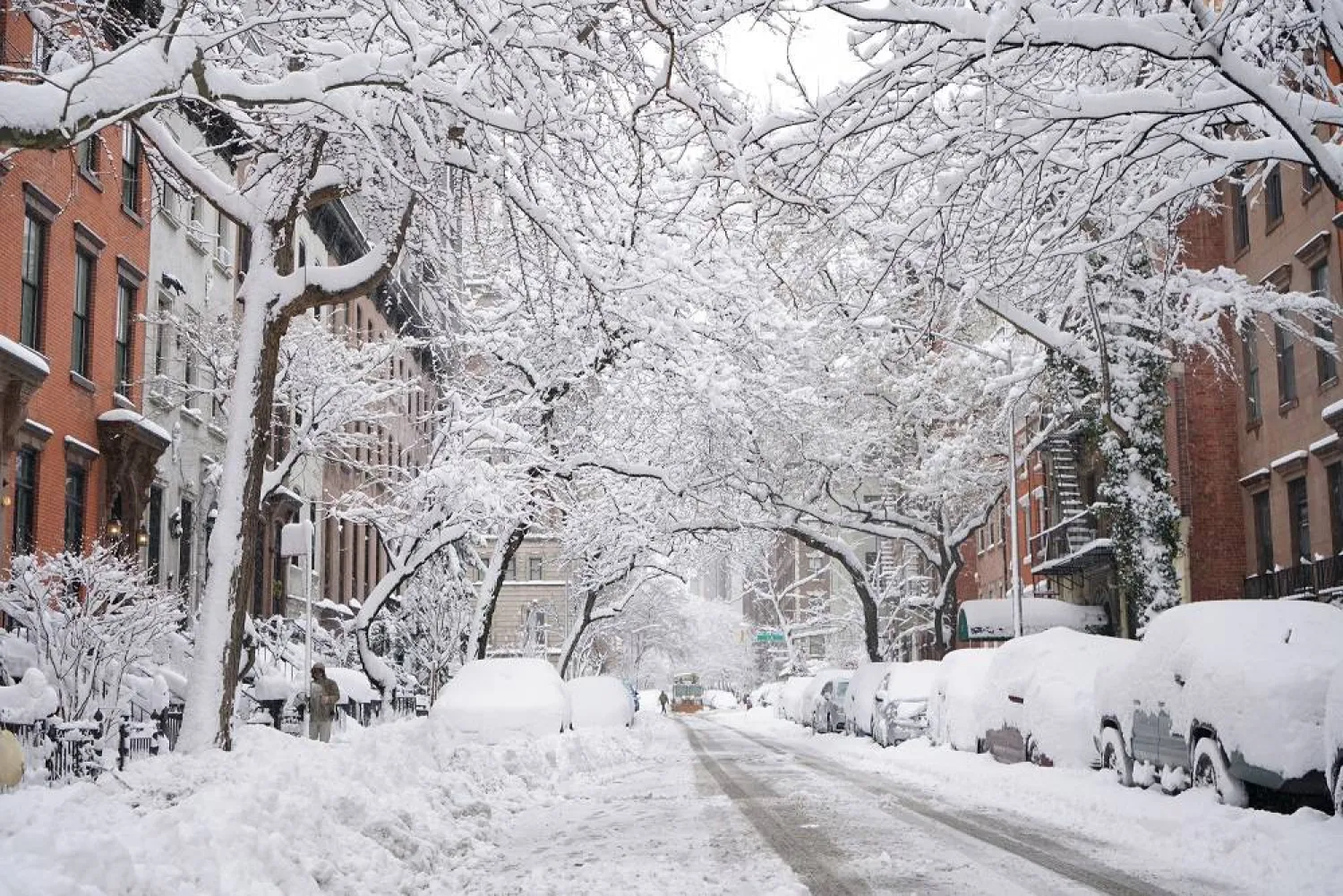

Northeast US Digs Out from Brutal Snowstorm That Disrupted Flights and Canceled School 

A snow plow crosses Second Avenue and heads down 19th Street to clear it after a snowstorm, Monday, Feb. 23, 2026, in New York. (AP)
TT

Northeast US Digs Out from Brutal Snowstorm That Disrupted Flights and Canceled School 

A snow plow crosses Second Avenue and heads down 19th Street to clear it after a snowstorm, Monday, Feb. 23, 2026, in New York. (AP)

Neighbors, government workers and a powerful railroad snow-clearing machine nicknamed “Darth Vader” scrambled to dig out much of the northeastern United States from a brutal and — in some areas — record-breaking storm that blanketed the region with snow and resulted in thousands of flight cancellations.

But as the snow moved northward and tapered off in other areas Tuesday, forecasters warned that another storm could be right around the corner.

Monday’s storm that meteorologists are calling the strongest in a decade dumped more than 2 feet (61 centimeters) of snow in parts of the Northeast. More than 3 feet (91 centimeters) fell in Rhode Island — surpassing snow totals from the historic Blizzard of 1978 that struck the Northeast, the National Weather Service said.

By Tuesday morning, roads were beginning to reopen, mass transportation was coming back online in some cities and power had returned for some of the hundreds of thousands who had lost electricity in Massachusetts, New Jersey, Delaware and Rhode Island.

Amtrak canceled some trains between Boston and New York and between New York and Philadelphia on Tuesday morning.

Some schools reopening while others stick with online learning In New York City, which canceled classed Monday, Mayor Zohran Mamdani announced that schools would reopen for in person learning on Tuesday, raising questions about how feasible that is with snow still piled along sidewalks.

Staten Island Borough President Vito Fossella said school should remain closed, while Michael Mulgrew, president of the United Federation of Teachers, described the situation as “a big mess.”

“There's going to be low attendance of students. You're going to have low attendance of staff because people don't know if they can travel, if they can get to schools,” he said.

Spokespersons for Mamdani didn’t respond to an email seeking comment but his schools chief, Chancellor Kamar Samuels, said in a post on X, that they were “confident in our decision to reopen.”

Philadelphia switched to online learning Monday and Tuesday. Districts on Long Island and elsewhere in the New York suburbs said they would cancel school again Tuesday.

Another storm is on the way

The weather service said it's tracking another storm that could bring more snow to the region later this week. A combination of rain and snow is expected Wednesday, with up to a couple of inches of possible snow.

While the new storm is not expected to be as strong, even a few extra inches of snow on top of hard-hit areas could make cleanup more difficult, said Frank Pereira, meteorologist for the weather service in College Park, Maryland.

“Any additional snow at this point is probably not going to be welcome,” he said.

Bomb cyclone cancels thousands of flights

The weather service referred to Monday’s storm as a “classic bomb cyclone/nor’easter off the Northeast coast.” A bomb cyclone happens when a storm’s pressure falls by a certain amount within a 24-hour period, occurring mainly in the fall and winter when frigid Arctic air can reach the south and clash with warmer temperatures.

More than 2,000 flights in and out of the United States were canceled Tuesday, according to the flight tracking website FlightAware. Most of the cancellations involved airports in New York, New Jersey and Boston.

Rhode Island’s T.F. Green International Airport paused its airport operations Monday as it dealt with nearly 38 inches (97 centimeters) of snow, according to the Weather Service, breaking a record of 28.6 inches (72.6 centimeters) set in 1978. The pause continued through Tuesday morning as the airport assessed conditions.

Central Park in New York City recorded 19 inches (48 centimeters) of snow. Warwick, Rhode Island, exceeded 3 feet (91 centimeters), topping the nation so far. The highest wind gust of 84 mph (135 kph) was recorded in Montauk Point, New York.

New York, Philadelphia and other cities, as well as several states, declared emergencies.

The Boston Globe management called off printing its daily newspaper for the first time in its more than 150-year history because snow and winds kept staff from safely getting to its printing plant, the newspaper said in an article on its website.

Christa Prince and two others were out in Brooklyn on Monday afternoon with shovels and an electric snowblower.

“We’re just making a path for this car,” Prince said. “It’s not our car but you know, we’re just doing our neighbor a kind deed.”



Research Reveals Decades-Long Silverpit Crater Triggered by Tsunami 40 Million Years Ago

A massive asteroid struck the North Sea millions of years ago (Getty)
TT

Research Reveals Decades-Long Silverpit Crater Triggered by Tsunami 40 Million Years Ago

A massive asteroid struck the North Sea millions of years ago (Getty)

A long-running dispute about the origin of a North Sea crater has finally been settled, as new research finds a massive asteroid hit the water and triggered a towering tsunami millions of years ago.

Scientists have found that the Silverpit Crater – which lies around 700 meters beneath the southern North Sea seabed, roughly 80 miles off the coast of Yorkshire – was formed when an asteroid or comet struck the region roughly 43 to 46 million years ago, sparking a 330 feet tsunami.

Since geologists first identified the formation in 2002, the 3km-wide crater and its surrounding ring of circular faults spanning about 20 km have sparked intense debate, according to The Independent.

But researchers say their new study marks the clearest evidence yet that the structure is one of Earth’s rare impact craters.

This confirmation places it in the same category as well-known structures such as the Chicxulub Crater in Mexico, which is linked to the dinosaur mass extinction.

The team used computer modelling and analyzed newly available seismic imaging and microscopic geological samples taken from beneath the seabed.

Dr. Uisdean Nicholson, a sedimentologist in Heriot-Watt University’s School of Energy, Geoscience, Infrastructure and Society, who led the investigation, said: “New seismic imaging has given us an unprecedented look at the crater.”

He said samples from an oil well in the area also revealed rare ‘shocked’ quartz and feldspar crystals at the same depth as the crater floor.

“We were exceptionally lucky to find these – a real ‘needle-in-a-haystack’ effort. These prove the impact crater hypothesis beyond doubt, because they have a fabric that can only be created by extreme shock pressures,” said Nicholson.

The scientists say these microscopic minerals form only under the extreme pressures generated during asteroid impacts, providing strong confirmation of the event.

Early research proposed that the feature was created by a high-speed asteroid impact. Supporters of that idea pointed to its round shape, central peak, and surrounding concentric faults, which are often seen in known impact craters.

But other scientists suggested different explanations. Some proposed that underground salt movement distorted the rock layers and created the structure.

Others argued that volcanic activity may have caused the seabed to collapse.

In 2009, geologists even voted on the issue. According to a report in the December 2009 issue of Geoscientist magazine, most participants rejected the asteroid impact explanation at the time.

The latest findings, published in the journal Nature Communications and funded by the Natural Environment Research Council (NERC), now appear to overturn that conclusion.

Dr. Nicholson said: “Our evidence shows that a 160-meter-wide asteroid hit the seabed at a low angle from the west.”

“Within minutes, it created a 1.5 km high curtain of rock and water that then collapsed into the sea, creating a tsunami over 100 meters high.”

The impact would have produced a violent explosion at the seafloor and sent enormous waves spreading across the region.

Professor Gareth Collins, of Imperial College London, who attended the 2009 debate about the crater’s origin and contributed to the new research, said the researchers have “finally found the silver bullet” to end the debate.

He said: “I always thought that the impact hypothesis was the simplest explanation and most consistent with the observations.”

“It is very rewarding to have finally found the silver bullet. We can now get on with the exciting job of using the amazing new data to learn more about how impacts shape planets below the surface, which is really hard to do on other planets,” Collins added.

Dr. Nicholson also expressed his excitement about using the new findings for further research into asteroids.

“Silverpit is a rare and exceptionally preserved hypervelocity impact crater,” he said.

“These are rare because the Earth is such a dynamic planet – plate tectonics and erosion destroy almost all traces of most of these events.”


Naples Museum to Allow Visually Impaired Visitors to Experience Art Through Touch

Giuseppe Sanmartino's sculpture of the Veiled Christ housed in the Sansevero Chapel in Naples, Italy, 10 March 2026. EPA/CIRO FUSCO
TT

Naples Museum to Allow Visually Impaired Visitors to Experience Art Through Touch

Giuseppe Sanmartino's sculpture of the Veiled Christ housed in the Sansevero Chapel in Naples, Italy, 10 March 2026. EPA/CIRO FUSCO

The Sansevero Chapel Museum in Naples will allow dozens of visually impaired visitors to take part in a rare tactile experience, letting them touch celebrated works of art including the Veiled Christ, which is widely regarded as one of the most striking masterpieces in the history of sculpture.

On March 17, the museum will host an initiative called La meraviglia a portata di mano – Wonder within reach – organized in partnership with the Italian Union of the Blind and Visually Impaired of Naples, offering about 80 blind and partially sighted visitors a chance to encounter the marble masterpieces.

According to The Guardian, visitors will be guided through the chapel by guides who are also visually impaired in a program designed to place accessibility at the center of the museum experience.

The protective barrier surrounding the sculptures will be removed, allowing participants, wearing latex gloves, to explore by touch the intricate marble surface of the sculptures including Giuseppe Sanmartino’s Veiled Christ, which depicts Jesus covered by a transparent shroud made from the same block as the statue. The tactile route will also extend to the reliefs at the feet of the sculptures La Pudicizia and Il Disinganno.

Chiara Locovardi, a guide, told the state agency Ansa: “The veil covering Christ is extraordinary. It’s impossible to understand how Sanmartino managed to create it. The veil defies explanation – for those who can see and for those who cannot. When you touch it, you can feel the veins pulsing beneath.”

“This initiative forms part of our wider program to create a cultural space that is inclusive and accessible through dedicated pathways and tools tailored to the different needs of museum visitors,” Maria Alessandra Masucci, the president of the Sansevero Chapel Museum, said.


All But 2 of Austria's 96 Glaciers Have Retreated Over Last 2 Years

FILE - The Sulzenauferner Glacier is visible near Innsbruck, Austria, on Sept. 25, 2023. (AP Photo/Matthias Schrader, File)
TT

All But 2 of Austria's 96 Glaciers Have Retreated Over Last 2 Years

FILE - The Sulzenauferner Glacier is visible near Innsbruck, Austria, on Sept. 25, 2023. (AP Photo/Matthias Schrader, File)

All but two of Austria’s 96 glaciers have retreated over the last two years, monitors in the Alpine country reported Friday, saying the “dramatic development” highlights the impact of climate change.

The latest report from the Austrian Alpine Club shows the Alpeiner Ferner in the western Tyrol region and Stubacher Sonnblickkees in Salzburg to the east are facing the greatest loss, each with a retreat of more than 100 meters (about 330 feet). The average retreat was more than 20 meters (65 feet).

“The disintegration of the glacier tongue is also progressing at the Pasterze, Austria’s largest glacier, making the consequences of climate change visible,” the club said in the report covering 2024 and 2025.

The report, it added, “confirms once again the long-term trend: Glaciers in Austria continue to shrink significantly in length, area, and volume.”

FILE - The Gaisskarferner Glacier is visible near Innsbruck, Austria, Monday, Sept. 25, 2023. (AP Photo/Matthias Schrader, file)

The retreat of glaciers in Europe has vast implications for drinking water, power generation, agriculture, infrastructure, recreational activities, the Alpine landscape and more.

Neighboring Switzerland, which is home to the most glaciers in Europe, has noted a similar retreat in its glaciers in recent years, a trend that has been reported around the world.

Poor weather conditions including low snowfall, warm temperatures including an exceptionally hot June last year — nearly 5 degrees Celsius (9 degrees Fahrenheit) above the average — have contributed to the retreat, The Associated Press quoted the club as saying.

“The glaciers are melting — and with every new report, the urgency grows,” club vice president Nicole Slupetzky said. “It’s no longer a question of whether we can still save the glaciers in their old form; it’s about mitigating the consequences for ourselves.”

Such changes in the Alps should serve as a “wake-up call” for policymakers and the public in its behavior, the club said.

It said the current figure was lower than during the previous two years, but still ranks as the eight-largest retreat in the 135 years of measurements.