

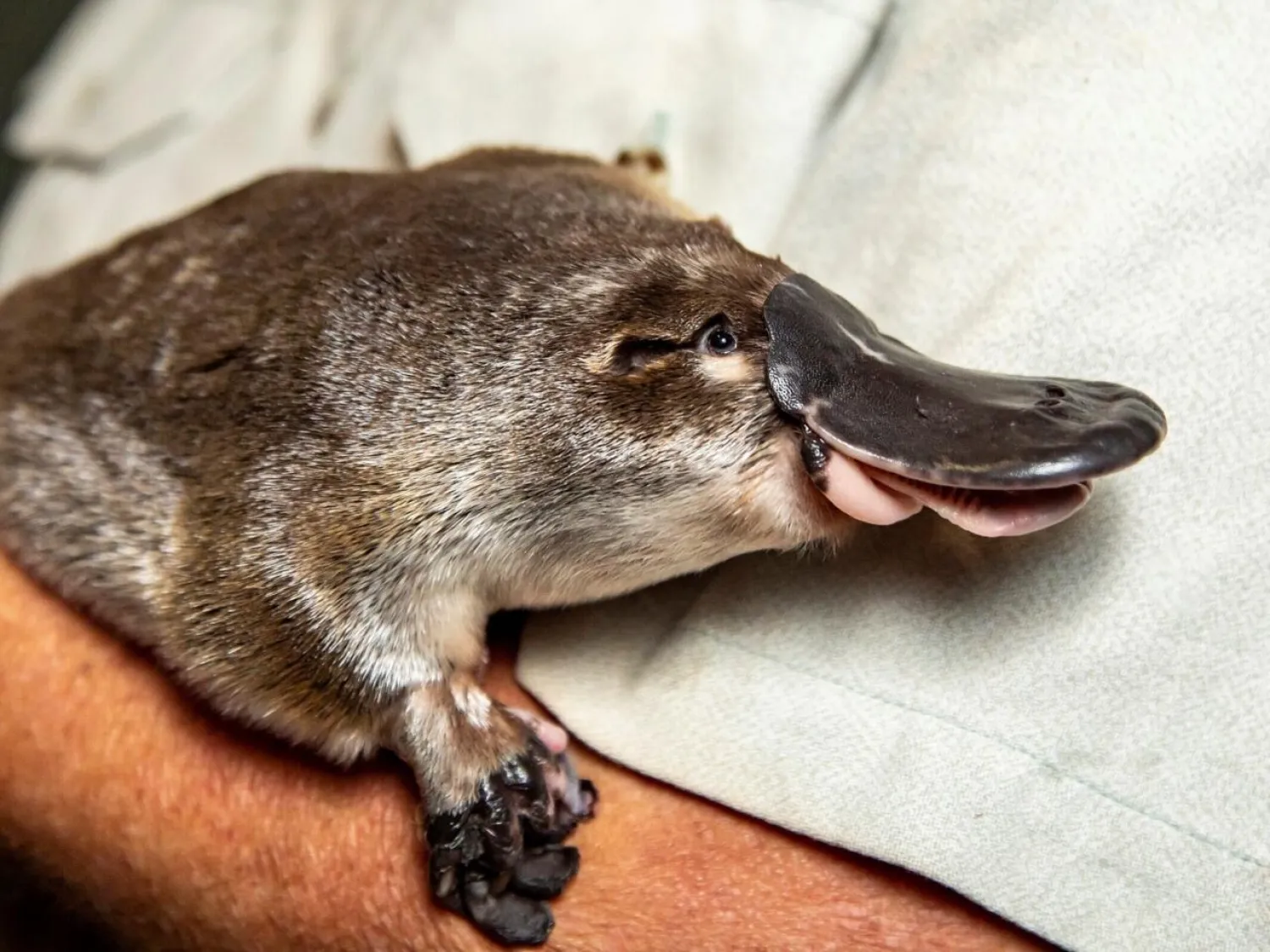

The Platypus is Even Weirder than Thought, Scientists Discover

Weird guys: The platypus has found yet another way to stand out in the animal kingdom. RICK STEVENS / TARONGA ZOO/AFP/File
TT

The Platypus is Even Weirder than Thought, Scientists Discover

Weird guys: The platypus has found yet another way to stand out in the animal kingdom. RICK STEVENS / TARONGA ZOO/AFP/File

They already have the bill of a duck, the tail of a beaver, lay eggs like reptiles and have venom like snakes.

Yet the humble platypus, a small creature which quietly swims in the rivers of eastern Australia, has found yet another way to amaze scientists, AFP said.

It is the only mammal that has hollow structures of the pigment melanin, a trait normally found in birds, biologists said in a new study on Wednesday.

When the first taxidermied specimen of a platypus was brought back from Australia in 1799, European naturalists began looking for the seams -- they assumed it was a hoax.

The animal has been surprising scientists ever since.

The platypus is one of only five mammal species that lay eggs, which are called monotremes. The other four are all types of echidna -- spiny creatures that waddle through the Australian bush.

It is also one of the few poisonous mammals -- males have a spur on their hind legs that releases venom at their enemies.

Now another oddity has been added to the unusual platypus characteristics, according to the study published in the Biology Letters journal of the UK's Royal Society.

In animals with spines, called vertebrates, the pigment called melanin protects against UV radiation, helps regulate body temperature and is responsible for the color of skin, fur or feathers.

Melanin is contained in tiny, specialized structures inside cells called melanosomes, the shape of which is linked to their color.

For example, eumelanin -- which produces black, grey and dark brown hues -- is usually found in elongated melanosomes.

Pheomelanin, which produces reds, reddish-browns and some shades of orange and yellow, is found in spherical melanosomes.

And in mammals, these melanosomes are always solid.

However in birds, sometimes the structures are hollow or flat, with only a thin layer of melanin. This helps birds have the dazzling and varied colors seen across the world.

Birds also have melanosomes that are organized into smaller "nanostructures" which create iridescent colors that interact with light, such as the feathers of a peacock.

'Surprising and exciting'

Jessica Leigh Dobson, a biologist at Ghent University in Belgium and the study's lead author, told AFP the team was compiling a database of mammal melanosomes when they made an "extremely surprising and exciting" discovery.

Platypus melanosomes were mostly spherical -- which should give it reddish-orange fur. But the animal is merely dark brown.

Then the scientists discovered that some of its melanosomes are hollow -- like those of birds.

They checked their database for other mammals, including marsupials, rodents and primates.

"To the best of our knowledge, this is the only example of hollow melanosomes in mammals," Dobson said.

The melanosomes were "scattered randomly throughout the hair cortex" and do not create iridescence, she said.

"Further work is definitely needed to find out why they have them," Dobson added.

Why these animals evolved these unusual features in the first place is also unclear.

The ancestors of the platypus and echidna are thought to have been aquatic burrowing animals, so their hollow melanosomes could have helped them adapt to life in the water, giving them warmer insulation.

But this theory raises more questions.

If this was the case, why is this trait "not more widespread among aquatic mammals?" the study asked.




Baby Monkey Punch Acclimatizing, Making New friends at Japan zoo

A seven month-old male Japanese macaque monkey named Punch, who was abandoned by his mother shortly after birth, sits with a stuffed orangutan toy at Ichikawa City Zoo and Botanical Gardens in Ichikawa, Chiba Prefecture on March 18, 2026. (Photo by Yuichi YAMAZAKI / AFP)
TT

Baby Monkey Punch Acclimatizing, Making New friends at Japan zoo

A seven month-old male Japanese macaque monkey named Punch, who was abandoned by his mother shortly after birth, sits with a stuffed orangutan toy at Ichikawa City Zoo and Botanical Gardens in Ichikawa, Chiba Prefecture on March 18, 2026. (Photo by Yuichi YAMAZAKI / AFP)

Clutching a monkey plushie, Eliete Ikeda screamed "Punch!" as she caught sight of the underdog baby macaque still drawing crowds of photo-hungry visitors to a Japanese zoo weeks after he shot to stardom.

Seven-month-old Punch was abandoned by his mother and became an internet sensation after clips of him clinging to a plush orangutan toy for comfort -- and seemingly being roughhoused by fellow monkeys -- proliferated online last month.

His plight at Ichikawa City Zoo outside Tokyo has since spawned a dedicated fanbase under the hashtag #HangInTherePunch, leading to the local facility being flooded with an unprecedented number of visitors, including foreign tourists.

"I think it's the relatability of it," 30-year-old Jon Frigillana of the United States told AFP when asked why the monkey is tugging at the heartstrings of so many.

Hand-raised in an artificial environment immediately after his birth in July, the small, dark-furred macaque is gradually acclimatizing, the zoo said, no longer clutching the plushie all the time. He's also making a few friends.

"He's going through a lot, but seeing him come through adversity... It's nice to see strength in that way," Frigillana said.

And with wars around the world dominating his newsfeed, "in this day and age, it's heartwarming to see" Punch, he added.

Ikeda, meanwhile, said seeing the "kawaii" -- or "cute" -- Punch was a "present" during a birthday trip to the zoo to celebrate turning 53.

"Happy birthday for me," she said excitedly.

Lately about 2,000 to 3,000 people a day have been flocking to the facility, roughly 10 times the usual number during the winter off-season, zoo official Takashi Yasunaga told AFP.

One local taxi driver said that "around a half" of pedestrians he drives past on the way to the zoo now appear to be non-Japanese -- an "unprecedented" sight in his typically quiet neighborhood.

"Some foreign tourists get in, and with big smiles on their faces, just tell me: 'Punch'" to convey their destination, said the driver, who declined to be named because he was not authorized to speak to media.

- Rules of monkey society -

But the attention showered on the zoo hasn't all been positive.

The People for the Ethical Treatment of Animals (PETA) called Punch's initial predicament a reminder of the cruelty faced by animals in captivity.

Widely circulated online clips focusing on a few pitiable interactions with other monkeys have exposed the zoo to criticisms, including from Europe over his state in enclosure.

In the strictly hierarchical society of Japanese macaques, it is not uncommon for higher-ranked individuals to "discipline and scold" newcomers in behaviors that are "fundamentally different from abuse in human society," Yasunaga, the zoo official, said.

"We're watching with patience and care as Punch gets trained in the troop and learns rules of monkey society," he said.

On AFP's recent visit, Punch was spotted playing alone with chains and branches on the floor of his enclosure, and occasionally approaching others -- only to be ignored -- before going back to his plushie.

"We hope he will eventually let go of his stuffed toy and become bigger in size and indistinguishable from others," Yasunaga said.

"Such a sight might bring a bit of sadness to many of our visitors, but his growth into a full-fledged member of the troop is our ultimate hope."


World Happiness Report Highlights Social Media's Negative Impact

FILE - Outdoor swimming pools are seen in a harbor of Helsinki, May 29, 2023. (AP Photo/Pavel Golovkin, File)
TT

World Happiness Report Highlights Social Media's Negative Impact

FILE - Outdoor swimming pools are seen in a harbor of Helsinki, May 29, 2023. (AP Photo/Pavel Golovkin, File)

Heavy social media use contributes to a stark decline in well-being among young people, with the effects particularly worrying in teenage girls in English-speaking countries and Western Europe, according to the World Happiness Report 2026 published Thursday.

The annual report, published by the Wellbeing Research Centre at the University of Oxford, also found that Finland is the happiest land in the world for the ninth year in a row, with other Nordic countries such as Iceland, Denmark, Sweden and Norway ranking among the top 10 countries.

It highlighted how life evaluations among under 25-year-olds in the United States, Canada, Australia and New Zealand have dropped significantly over the past decade, and suggested that long hours spent scrolling through social media is a key factor in that trend.

A new entry to the top five on the list is Costa Rica, which climbed to fourth place this year after rising through the ranks from 23rd place in 2023.

The report attributes that to well-being boosts from family bonds and other social connections.

“We think it’s because of the quality of their social lives and the stability that they currently enjoy,” said Jan-Emmanuel De Neve, an Oxford economics professor who directs the Wellbeing Research Centre and co-edits the World Happiness Report.

“Latin America more generally has strong family ties, strong social ties, a great level of social capital, as a sociologist would call it, more so than in other places,” he added.

The report said Finland and the other Northern European countries’ steady ranking on top is related to a combination of wealth, its equal distribution, having a welfare state that protects people from the risks of recessions, and a healthy life expectancy.

As in previous years, nations in or near zones of major conflict remain at the foot of the rankings. Afghanistan is ranked as the unhappiest country again, followed by Sierra Leone and Malawi in Africa.

Country rankings were based on answers given by around 100,000 people in 140 countries and territories who were asked to rate their own lives. The study was done in partnership with the analytics firm Gallup and the UN Sustainable Development Solutions Network.

In most countries, approximately 1,000 people are contacted by telephone or face-to-face each year.

Respondents were asked to evaluate their lives on a scale from 0 to 10. Among under-25s in English-speaking and Western European countries, that score dropped by almost one point over the past decade.

The report said the negative correlation between well-being and extensive social media use is particularly concerning among teenage girls. For example, it said that 15-year-old girls who use social media for five hours or more reported a drop in life satisfaction, compared to others who use it less.

Young people who use social media for less than one hour per day report the highest levels of well-being, researchers said, higher than those who do not use social media at all. But adolescents are spending an estimated average of 2.5 hours a day on social media.

“It is clear that we should look as much as possible to put the ‘social’ back into social media,” The Associated Press quoted De Neve as saying.

Algorithmic feeds and influencers seen as culprits Researchers noted that in some parts of the world, such as the Middle East and South America, the links between social media use and well-being are more positive — and youth well-being has not fallen despite heavy social media use.

The report said this is due to many factors that differ between continents, but concluded that heavy social media use in some countries is an important contributing factor to the decline in youth well-being.

It said the most problematic platforms are those with algorithmic feeds, feature influencers and where the main material is visual, because they encourage social comparisons. Those who use platforms that mainly facilitate communication do better.

The 2026 rankings mark the second year in a row that none of the English-speaking countries appear in the top 10. The United States is at 23rd place, Canada is at 25th and Britain at 29th.

The report, with its focus on social media, comes at a time when more and more countries have banned or are considering bans of social media for minors.


Real Possum Appears Among Plush Toy Animals in Australia Airport Shop

This handout frame grab from UGC video footage by Melissa Oddie taken on March 18, 2026 and received via AFPTV shows a wild possum on a shelf among toys at Hobart Airport in Tasmania. (Photo by Handout / various sources / AFP)
TT

Real Possum Appears Among Plush Toy Animals in Australia Airport Shop

This handout frame grab from UGC video footage by Melissa Oddie taken on March 18, 2026 and received via AFPTV shows a wild possum on a shelf among toys at Hobart Airport in Tasmania. (Photo by Handout / various sources / AFP)

On shelves crammed with cuddly toy native animals in an Australian airport gift shop, one fluffy possum stood out: Its big brown eyes were moving.

A browsing passenger first spotted a living Australian brushtail possum peering out from among the kangaroos on the display shelf at the departure terminal shop at Hobart Airport in Tasmania state on Wednesday, an airport retail manager Liam Bloomfield said on Thursday.

Above the possum were bilbies, marsupials with rabbit-like long ears, and dingoes, Australia’s native dog. Beside the possum in the kangaroo section were Tasmanian devils, a growling carnivore that inspired the feisty Warner Bros. cartoon character Taz.

“A passenger reported it to .... one of the staff members on shift who couldn’t quite believe what she was hearing,” Bloomfield said. “She then called the (airport) management and said we’ve got a possum in the store.”

A staff member took a video of the possum with her phone before the animal grew wary of the growing attention and left the shop.

Airport staff were able to remove the possum from the airport unharmed.

Bloomfield didn’t know what attracted the possum to the toy shelf, The Associated Press reported.

“I’m imaging it saw some of the plush animals that were for sale on the shelf and it decided to make its home with those. It wanted to blend in,” Bloomfield joked.

How the possum got into the store and how long it spent there are also unknown.

It was unlikely to have been placed there as a prank. Someone would have had to put the possum through X-ray screening to get it into the secure departure terminal area.
