


Spain Rethinks How to Turn Tide against Beach Erosion

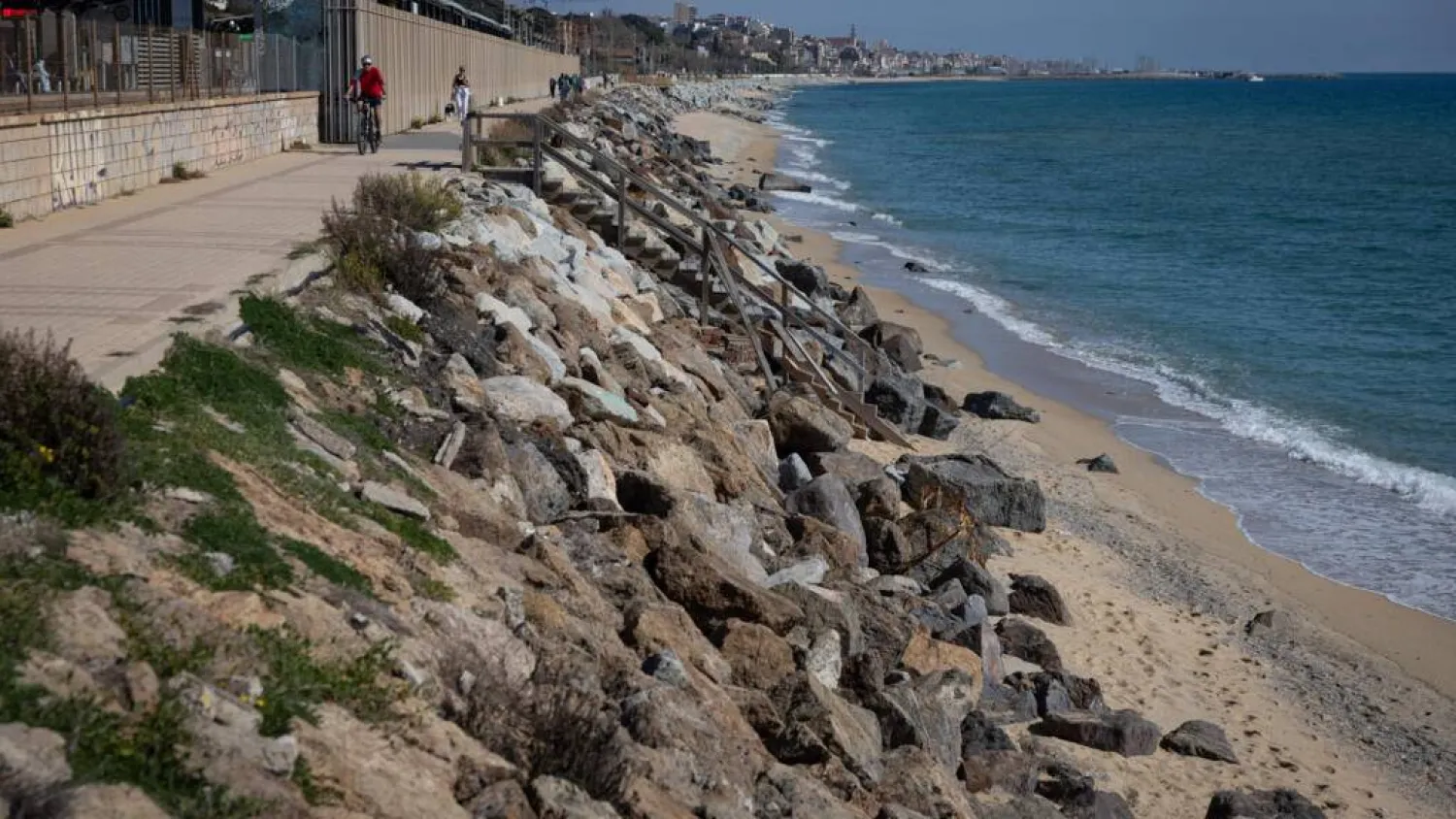
The seafront promenade at Montgat beach north of Barcelona on February 26, 2026. Josep LAGO / AFP
TT

Spain Rethinks How to Turn Tide against Beach Erosion

The seafront promenade at Montgat beach north of Barcelona on February 26, 2026. Josep LAGO / AFP

Every winter, storms wipe out swathes of the picturesque Spanish coast, undoing summer reconstruction work and threatening the foundations of the country's vital tourism industry.

Faced with a futile cycle of damage followed by reparations of artificial material, some beach holiday destinations are now turning to natural solutions in a bid to save their landscapes and livelihoods, said AFP.

In the northeastern region of Catalonia, Montgat beach has all but disappeared -- rocks that had long remained buried by extensive stretches of sand have been laid bare by the elements.

Bruno Cambre enjoys fishing with friends on the tiny patch of surviving sand, planting his rods, a table and a refrigerator next to small homes of former fishermen.

"Four or five years ago, you would go to these beaches and the sand would stretch far, for 500 or 700 meters. Now there are no more than 20 (meters) left," the 37-year-old told AFP.

As waves devour more of the coast, whipped up by storms made fiercer by climate change, he also fears the fishermen's houses "will eventually disappear".

The problem is serious in Catalonia, dotted with idyllic coastal villages and resorts that bathe in Mediterranean sunshine and draw droves of tourists.

A historic railway from Barcelona to the town of Mataro, which runs parallel to the coast, inches ever closer to the sea every winter.

South of Barcelona, part of the problem is the overdevelopment of beachfronts with promenades and apartments, which box in the sand against ferocious waves.

The severity of winter erosion has reached an intensity at which "we will start to lose beaches in the next 10 years," Greenpeace Spain warned in a 2024 report.

- 'Ineffective' -

An hour's drive south of Barcelona, the town of Calafell has tried to harness natural processes to halt its receding beaches.

For Carla Garcia Lozano, a professor of physical geography at the University of Girona, the usual technique of dumping tons of sand doomed to be washed away by the next succession of winter storms, or replacing paving stones on promenades, is not a long-term solution.

"Artificial regeneration is no longer possible, partly because it is very expensive economically, but its maintenance is also very expensive and very ineffective," she told AFP.

Garcia Lozano has supervised the regeneration of beaches for the past six years in Calafell, a town of 30,000 residents that depends mainly on tourism.

The beaches regenerate naturally in periods of more clement weather, "especially in summer", but that revival "only happens in spaces that are very natural", she explained.

Calafell has therefore removed 800 square meters (8,600 square feet) of its promenade and two dykes; placed barriers made of reeds along the beach to retain sand and create dunes; replenished eroded areas with nearby sand of the same type; and uses drones to observe the area.

"In an area of 4,500 square meters, 1,000 cubic meters of sand have been gained," she said, calling the result "a significant amount".

"On average it comes to 25 centimeters, but in some areas it reaches one and a half meters high."

Calafell's environment councilor Aron Marcos Fernandez explained that demolishing part of the promenade worked "because before the sea would batter the promenade, and now there is sand".

- 'Part of the history' -

Other Catalan municipalities have tried similar measures, removing car parks, breakwaters and beach stalls, but natural solutions only go so far.

Calafell is considering the demolition of the widest and most modern part of its promenade, but the historic section is untouchable due to the proximity of houses, said councilor Fernandez, arguing for a balance between renaturalization and tourism.

In Sitges, south of Barcelona, the restoration of dunes has been prioritized, but dismantling the bustling, century-old seafront walk is out of the question.

"It's a part of the history of Sitges and it's part of the citizens. So removing the promenades is a difficult action for us," mayor Aurora Carbonell told AFP.

The shimmering water and pristine sand of sunny Spain's renowned beaches play a fundamental role in the tourism sector.

Almost 100 million foreign visitors flocked to the country last year -- a record -- and tourism is a motor of a fast-growing Spanish economy, sustaining 2.7 million jobs and representing more than 12 percent of GDP.



Jurassic Art: Fossils Transformed Into Artwork at Amsterdam Museum

Typical Amsterdam houses sit next to a canal in Amsterdam, Netherlands, March 19, 2026. (Reuters)
TT

Jurassic Art: Fossils Transformed Into Artwork at Amsterdam Museum

Typical Amsterdam houses sit next to a canal in Amsterdam, Netherlands, March 19, 2026. (Reuters)

Hanging by a thin metal strap, a 67-million-year-old triceratops skull twirls above a coral sculpture, the centerpiece of a new exhibition aiming to make art out of prehistoric fossils.

The "Relics" show at Amsterdam's Art Zoo will display nine works by creative duo Jaap Sinke and Ferry van Tongeren that combine science and art.

The aim was to highlight the aesthetic side of the fossils, usually presented in an educational way in natural history museums, van Tongeren told AFP.

The artists tried to give the fossils "a more monumental form" with "more stature," the 59-year-old told AFP in an interview.

The exhibition also features the bones of a basilosaurus, which roamed the seas up to 40 million years ago, but arranged as a sculpture rather than a traditional skeleton reconstruction.

Natural history museums have a valuable scientific and educational value "but lack a captivating element," said van Tongeren. "And that was the starting point for everything we did."

The artists worked with Zoic, an Italian palaeontology company that processes fossils and reconstructs dinosaur skeletons.

Creating the exhibits required "an extraordinary combination of knowledge and different processes," Iacopo Briano, 42, curator of the exhibition and palaeontology expert at Zoic, told AFP.

First comes the "puzzle" of unearthing and reconstructing the bones from a fossil discovery.

Then the fragile bones need to be transported so the artists could start their own work -- a 10-year process in the case of this exhibit.

This prehistoric show, whose oldest exhibit is a dinosaur vertebra about 150 million years old, opens to the public on Friday and runs until November 2026.


Greenpeace Warns of Potential ‘Catastrophic’ Chernobyl Collapse

Representatives of Greenpeace and media stand in front of the sarcophagus covering the destroyed fourth reactor under the New Safe Confinement (NSC), at the Chernobyl Nuclear Power Plant on April 9, 2026. (AFP)
TT

Greenpeace Warns of Potential ‘Catastrophic’ Chernobyl Collapse

Representatives of Greenpeace and media stand in front of the sarcophagus covering the destroyed fourth reactor under the New Safe Confinement (NSC), at the Chernobyl Nuclear Power Plant on April 9, 2026. (AFP)

An uncontrolled collapse of the internal radiation shell at the defunct Chernobyl nuclear power station in Ukraine could increase the risk of radioactivity release in the environment, Greenpeace warned on Tuesday.

In 1986, while Ukraine was part of the Soviet Union, a reactor at Chernobyl exploded, sending clouds of radiation across much of Europe and forcing tens of thousands of people to evacuate.

The remnants of the plant are covered by an inner steel-and-concrete radiation shell -- known as the sarcophagus and built hastily after the disaster -- and a modern, high-tech outer shell, called the New Safe Confinement (NSC) structure.

Kyiv has accused Russia of repeatedly targeting the site since Moscow launched its full-scale invasion in 2022, including of a strike last year that pierced the outer shell.

In a report released Tuesday, days before the 40th anniversary of the Chernobyl disaster, Greenpeace warned that despite some repair works, the confinement function of the NSC "could not be fully restored".

"This increases the risk of radioactivity release in the environment, especially in the case of a collapse" of the internal shelter, Greenpeace said.

"That would be catastrophic because... there's four tons of dust, highly radioactive dust, fuel pellets, enormous amounts of radioactivity inside the sarcophagus," Shaun Burnie, a senior nuclear specialist for Greenpeace Ukraine, told AFP earlier this month.

"And because the New Safe Confinement cannot be repaired at the moment, it cannot function as it was designed, there's a possibility of radioactive releases," Burnie added.

Greenpeace said deconstruction of unstable elements of the internal shell was necessary to prevent their uncontrolled collapse.

But any works at the site were impeded by the war raging on as "there's missiles from the Russians still being fired across Chernobyl," Burnie said.

"Here we are 40 years on, and Russia is still conducting effectively a nuclear war against the people of Ukraine and Europe."

Plant director Sergiy Tarakanov said the situation around the site was "very dangerous".

"If a rocket will drop, not directly into the safe confinement, but just in 200 meters, it will create an external impact like an earthquake," increasing the risk of the inner shell collapsing.

"And what actually 1986 accident showed to us... that the radioactive particles, they do not recognize borders," Tarakanov added.

Last month, France said that the Chernobyl protective dome would require almost 500 million euros of repairs after the Russian strike in 2025.


Prince Harry and Meghan Arrive in Australia to a Muted Welcome

 Prince Harry and Meghan Markle, the Duke and Duchess of Sussex, arrive at the Australian National Veterans Arts Museum (Anvam) in Southbank, Melbourne, Australia, Tuesday, April 14, 2026. (Jonathan Brady/Pool Photo via AP)
Prince Harry and Meghan Markle, the Duke and Duchess of Sussex, arrive at the Australian National Veterans Arts Museum (Anvam) in Southbank, Melbourne, Australia, Tuesday, April 14, 2026. (Jonathan Brady/Pool Photo via AP)
TT

Prince Harry and Meghan Arrive in Australia to a Muted Welcome

 Prince Harry and Meghan Markle, the Duke and Duchess of Sussex, arrive at the Australian National Veterans Arts Museum (Anvam) in Southbank, Melbourne, Australia, Tuesday, April 14, 2026. (Jonathan Brady/Pool Photo via AP)
Prince Harry and Meghan Markle, the Duke and Duchess of Sussex, arrive at the Australian National Veterans Arts Museum (Anvam) in Southbank, Melbourne, Australia, Tuesday, April 14, 2026. (Jonathan Brady/Pool Photo via AP)

Britain's Prince Harry and wife Meghan landed in Australia on Tuesday for a four-day visit with engagements covering sport, mental health and veterans' affairs.

The Duke and Duchess of Sussex began their trip at the Royal Children’s Hospital in Melbourne, where they took part in an activity in the hospital's therapeutic garden spaces.

"It was a genuinely meaningful visit for our staff and for the young people receiving care," said Dr. Peter Steer, the hospital's CEO.

Harry, ‌wearing a navy ‌suit and white shirt, spoke to children and posed ‌for ⁠photographs with patients ⁠in the foyer of the hospital, calling one of the handmade signs welcoming the couple "beautiful".

Meghan, who wore a matching A$1,250 ($885) navy dress by Sydney-based designer Karen Gee, later helped serve food at a women's domestic violence shelter in the city.

The Sussexes stepped down as working members of the British royal family and moved to the US in 2020, citing a desire to be financially independent and ⁠to escape what they characterized as media intrusion into ‌their private lives.

They last visited Australia in ‌2018 while still working royals, announcing Meghan's first pregnancy hours after arriving in Sydney.

Their latest visit has captured public attention in Australia, where ‌Britain's King Charles is the head of state, though a sizeable minority supports becoming a republic. But there was little sign of the ecstatic reception that greeted them on the 2018 trip. Television networks aired footage that they said showed the couple arriving ‌in Melbourne on a commercial flight from Los Angeles, before being taken from the tarmac in a vehicle convoy.

The ⁠couple's travel is ⁠being privately funded, though local media reported some policing costs associated with the visit would be paid by Australian taxpayers, sparking a protest petition signed by more than 45,000 people.

The couple will travel to the capital, Canberra, on Wednesday to meet military veterans, attend a mental health summit in Melbourne on Thursday and round off the joint leg of their trip with sailing and rugby events in Sydney on Friday.

In contrast to their previous visit, the Sussexes will also undertake commercial activities while in Australia, with Meghan remaining in the country to host a wellness retreat at a luxury beachside hotel in Sydney over the weekend.

Tickets for the event, which includes yoga, manifestation and sound healing, start at A$2,699 ($1,912) per person.