


Thousands of Small Fish Defy Gravity to Climb Congo Waterfall

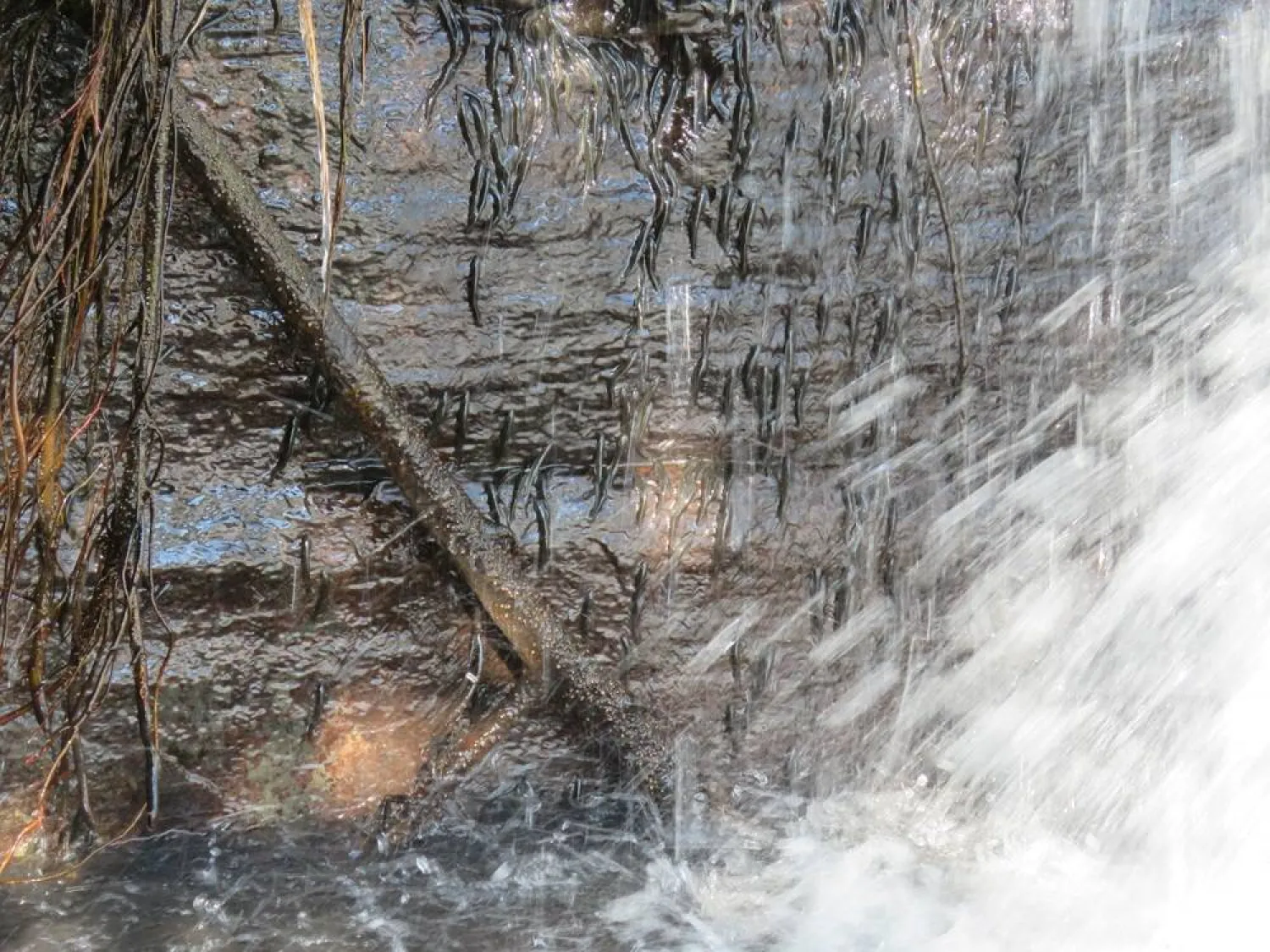
Members of a species of shellear fish, scientific name Parakneria thysi, crossing the second level of Luvilombo Falls, a waterfall in the Democratic Republic of Congo, in April 2020, in this photograph released on April 1, 2026. (Pacifique Kiwele/Handout via Reuters)
TT

Thousands of Small Fish Defy Gravity to Climb Congo Waterfall

Members of a species of shellear fish, scientific name Parakneria thysi, crossing the second level of Luvilombo Falls, a waterfall in the Democratic Republic of Congo, in April 2020, in this photograph released on April 1, 2026. (Pacifique Kiwele/Handout via Reuters)

A species of small fish has been observed by the thousands climbing a vertical waterfall 15 meters (50 feet) tall in the Democratic Republic of Congo in a behavior that illustrates the surprising and ingenious ways animals can adapt to extreme environments.

The researchers documented how this species of shellear fish, whose scientific name is Parakneria thysi, scales the Luvilombo Falls in the upper Congo Basin, a vast river system spanning Central Africa and home to the world's second-largest rainforest.

Researchers observed the fish ascending the vertical rock face during seasonal floods at the end of the rainy season, typically in April and May.

While this species can reach about 9.8 centimeters (3.9 inches) long, the researchers observed only small to medium-sized individuals - about 3.7 to 4.8 cm (1.5 to 1.9 inches) long - journeying up the falls.

Observations suggest a fish may take nearly 10 hours to complete ‌the slow and ‌demanding climb to the top, moving in short bursts and resting frequently. ‌Larger ⁠individuals of the species ⁠appeared to be too heavy for their fins to support the climb.

"This discovery highlights the importance of maintaining the continuity of watercourses, particularly in the context of the Congo Basin, where studies on fish behavior are virtually nonexistent," said Pacifique Kiwele, a researcher in ichthyology and a member of the scientific staff at the Université de Lubumbashi in the Democratic Republic of Congo who was the lead author of the study published in the journal Scientific Reports.

"It prompts scientists to be even more vigilant in their observations, as anything is possible. Who would have believed it without being ⁠close enough to check, and document it with photographic and film material, that ‌indeed some fish are able to climb waterfalls? It illustrates that ‌there are wonders out there that surpass our imagination," Kiwele said.

Some other fish species are capable of scaling waterfalls through ‌various means, but the researchers said this species is the first one documented in Africa.

The researchers recorded ‌the behavior of this shellear fish on four occasions in 2018 and 2020, observing them moving up the rock face through what is called the splash zone - areas kept wet by spray rather than direct water flow.

So how do they do it? The fish cling to wet rock surfaces using their pectoral fins, supported by pelvic fins and aided by tiny ‌hook-like projections known as unculi, which help them grip surfaces, the researchers said. Then they push themselves upward by wiggling their bodies from side to side.

Scaled ⁠to human size, it ⁠would be comparable to a person climbing hundreds of meters (yards) vertically.

The ascent is also risky. Some fish lose their grip when sudden jets of water hit them, knocking them off the rock face - particularly when they flip upside down to navigate overhanging sections.

Given the volume of water at the base of the falls, fish that fall are most likely able to start climbing again. However, those landing directly onto rocks may not survive, the researchers said.

So why do they do it? The researchers said the fish may climb upstream to find suitable living conditions and areas of the waterway with less competition and fewer predators.

The researchers identified two major human threats to the species: illegal fishing using fine-mesh mosquito nets that can easily catch the fish, and water extraction for irrigation, which has in some years depleted the Luvilombo River.

The discovery underscores how little is known about fish behavior in the Congo Basin, the researchers said.

"It is quite possible that other fish species living in rapid habitats ... are capable of overcoming similar vertical obstacles," Kiwele said, adding that researchers plan further fieldwork to confirm preliminary observations in another fish family.



Jurassic Art: Fossils Transformed Into Artwork at Amsterdam Museum

Typical Amsterdam houses sit next to a canal in Amsterdam, Netherlands, March 19, 2026. (Reuters)
TT

Jurassic Art: Fossils Transformed Into Artwork at Amsterdam Museum

Typical Amsterdam houses sit next to a canal in Amsterdam, Netherlands, March 19, 2026. (Reuters)

Hanging by a thin metal strap, a 67-million-year-old triceratops skull twirls above a coral sculpture, the centerpiece of a new exhibition aiming to make art out of prehistoric fossils.

The "Relics" show at Amsterdam's Art Zoo will display nine works by creative duo Jaap Sinke and Ferry van Tongeren that combine science and art.

The aim was to highlight the aesthetic side of the fossils, usually presented in an educational way in natural history museums, van Tongeren told AFP.

The artists tried to give the fossils "a more monumental form" with "more stature," the 59-year-old told AFP in an interview.

The exhibition also features the bones of a basilosaurus, which roamed the seas up to 40 million years ago, but arranged as a sculpture rather than a traditional skeleton reconstruction.

Natural history museums have a valuable scientific and educational value "but lack a captivating element," said van Tongeren. "And that was the starting point for everything we did."

The artists worked with Zoic, an Italian palaeontology company that processes fossils and reconstructs dinosaur skeletons.

Creating the exhibits required "an extraordinary combination of knowledge and different processes," Iacopo Briano, 42, curator of the exhibition and palaeontology expert at Zoic, told AFP.

First comes the "puzzle" of unearthing and reconstructing the bones from a fossil discovery.

Then the fragile bones need to be transported so the artists could start their own work -- a 10-year process in the case of this exhibit.

This prehistoric show, whose oldest exhibit is a dinosaur vertebra about 150 million years old, opens to the public on Friday and runs until November 2026.


Greenpeace Warns of Potential ‘Catastrophic’ Chernobyl Collapse

Representatives of Greenpeace and media stand in front of the sarcophagus covering the destroyed fourth reactor under the New Safe Confinement (NSC), at the Chernobyl Nuclear Power Plant on April 9, 2026. (AFP)
TT

Greenpeace Warns of Potential ‘Catastrophic’ Chernobyl Collapse

Representatives of Greenpeace and media stand in front of the sarcophagus covering the destroyed fourth reactor under the New Safe Confinement (NSC), at the Chernobyl Nuclear Power Plant on April 9, 2026. (AFP)

An uncontrolled collapse of the internal radiation shell at the defunct Chernobyl nuclear power station in Ukraine could increase the risk of radioactivity release in the environment, Greenpeace warned on Tuesday.

In 1986, while Ukraine was part of the Soviet Union, a reactor at Chernobyl exploded, sending clouds of radiation across much of Europe and forcing tens of thousands of people to evacuate.

The remnants of the plant are covered by an inner steel-and-concrete radiation shell -- known as the sarcophagus and built hastily after the disaster -- and a modern, high-tech outer shell, called the New Safe Confinement (NSC) structure.

Kyiv has accused Russia of repeatedly targeting the site since Moscow launched its full-scale invasion in 2022, including of a strike last year that pierced the outer shell.

In a report released Tuesday, days before the 40th anniversary of the Chernobyl disaster, Greenpeace warned that despite some repair works, the confinement function of the NSC "could not be fully restored".

"This increases the risk of radioactivity release in the environment, especially in the case of a collapse" of the internal shelter, Greenpeace said.

"That would be catastrophic because... there's four tons of dust, highly radioactive dust, fuel pellets, enormous amounts of radioactivity inside the sarcophagus," Shaun Burnie, a senior nuclear specialist for Greenpeace Ukraine, told AFP earlier this month.

"And because the New Safe Confinement cannot be repaired at the moment, it cannot function as it was designed, there's a possibility of radioactive releases," Burnie added.

Greenpeace said deconstruction of unstable elements of the internal shell was necessary to prevent their uncontrolled collapse.

But any works at the site were impeded by the war raging on as "there's missiles from the Russians still being fired across Chernobyl," Burnie said.

"Here we are 40 years on, and Russia is still conducting effectively a nuclear war against the people of Ukraine and Europe."

Plant director Sergiy Tarakanov said the situation around the site was "very dangerous".

"If a rocket will drop, not directly into the safe confinement, but just in 200 meters, it will create an external impact like an earthquake," increasing the risk of the inner shell collapsing.

"And what actually 1986 accident showed to us... that the radioactive particles, they do not recognize borders," Tarakanov added.

Last month, France said that the Chernobyl protective dome would require almost 500 million euros of repairs after the Russian strike in 2025.


Prince Harry and Meghan Arrive in Australia to a Muted Welcome

 Prince Harry and Meghan Markle, the Duke and Duchess of Sussex, arrive at the Australian National Veterans Arts Museum (Anvam) in Southbank, Melbourne, Australia, Tuesday, April 14, 2026. (Jonathan Brady/Pool Photo via AP)
Prince Harry and Meghan Markle, the Duke and Duchess of Sussex, arrive at the Australian National Veterans Arts Museum (Anvam) in Southbank, Melbourne, Australia, Tuesday, April 14, 2026. (Jonathan Brady/Pool Photo via AP)
TT

Prince Harry and Meghan Arrive in Australia to a Muted Welcome

 Prince Harry and Meghan Markle, the Duke and Duchess of Sussex, arrive at the Australian National Veterans Arts Museum (Anvam) in Southbank, Melbourne, Australia, Tuesday, April 14, 2026. (Jonathan Brady/Pool Photo via AP)
Prince Harry and Meghan Markle, the Duke and Duchess of Sussex, arrive at the Australian National Veterans Arts Museum (Anvam) in Southbank, Melbourne, Australia, Tuesday, April 14, 2026. (Jonathan Brady/Pool Photo via AP)

Britain's Prince Harry and wife Meghan landed in Australia on Tuesday for a four-day visit with engagements covering sport, mental health and veterans' affairs.

The Duke and Duchess of Sussex began their trip at the Royal Children’s Hospital in Melbourne, where they took part in an activity in the hospital's therapeutic garden spaces.

"It was a genuinely meaningful visit for our staff and for the young people receiving care," said Dr. Peter Steer, the hospital's CEO.

Harry, ‌wearing a navy ‌suit and white shirt, spoke to children and posed ‌for ⁠photographs with patients ⁠in the foyer of the hospital, calling one of the handmade signs welcoming the couple "beautiful".

Meghan, who wore a matching A$1,250 ($885) navy dress by Sydney-based designer Karen Gee, later helped serve food at a women's domestic violence shelter in the city.

The Sussexes stepped down as working members of the British royal family and moved to the US in 2020, citing a desire to be financially independent and ⁠to escape what they characterized as media intrusion into ‌their private lives.

They last visited Australia in ‌2018 while still working royals, announcing Meghan's first pregnancy hours after arriving in Sydney.

Their latest visit has captured public attention in Australia, where ‌Britain's King Charles is the head of state, though a sizeable minority supports becoming a republic. But there was little sign of the ecstatic reception that greeted them on the 2018 trip. Television networks aired footage that they said showed the couple arriving ‌in Melbourne on a commercial flight from Los Angeles, before being taken from the tarmac in a vehicle convoy.

The ⁠couple's travel is ⁠being privately funded, though local media reported some policing costs associated with the visit would be paid by Australian taxpayers, sparking a protest petition signed by more than 45,000 people.

The couple will travel to the capital, Canberra, on Wednesday to meet military veterans, attend a mental health summit in Melbourne on Thursday and round off the joint leg of their trip with sailing and rugby events in Sydney on Friday.

In contrast to their previous visit, the Sussexes will also undertake commercial activities while in Australia, with Meghan remaining in the country to host a wellness retreat at a luxury beachside hotel in Sydney over the weekend.

Tickets for the event, which includes yoga, manifestation and sound healing, start at A$2,699 ($1,912) per person.